
Karen Bertiger was holidaying in the Bahamas.
The Bahamas is a group of islands out in the Caribbean Sea.
Back in the 1980s, the network was poor practically everywhere. The Bahamas being a more remote location, had a much poorer network.
When Karen returned, she complained about it to her husband.
Her husband, Bary Bertiger, was a senior executive at Motorola. After listening to his wife’s complaint, he had an idea.

What if there was a cell network in every part of the world? No dead zones.
He pitched it to his company. Motorola’s then chairman was a daring person who loved the idea and pushed for it to be pursued.
The project kicked off in 1987.
It was called Iridium.
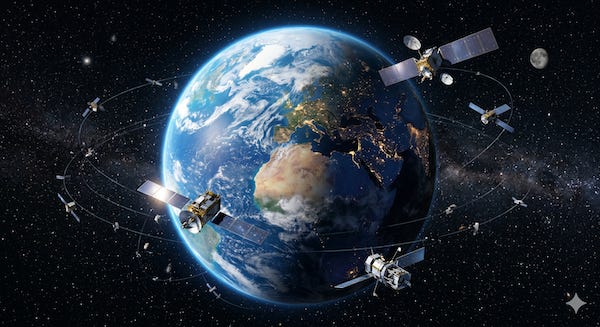
They had calculated that Iridium would need 77 low-Earth satellites across the earth to achieve its target. 77 is the atomic number of the element Iridium. So they chose Iridium as its name.
Oddly, technological improvements later enabled them to achieve the same results using only 66 satellites. But the name stayed.
It was not easy by any measure. It was one of the hardest technological challenges of that time.
So hard in fact, that Motorola decided to spin it off into a separate entity.
Iridium
In 1991, Iridium was created as a separate entity in which Motorola was a backer.
Motorola was a healthy publicly listed company. It could not be seen to be investing so much money into a new venture that was not ready yet.
This separate entity allowed Motorola to shield itself from Iridium. It also allowed Iridium to raise more money from other lenders and investors.
Motorola had signed on Iridium as the primary contractor. Motorola would make and maintain satellites for Iridium. This was a $3.37 billion contract along with a maintenance contract.
This was Motorola’s masterstroke.
The technology was incredibly complicated. It took many years of research and development.
But the promise of being able to talk on the phone from anywhere in the world was too tempting.
Their target audience was high-net-worth clients like CEOs, military personnel, oil barons, etc.

It was an 11-year effort. An extremely complicated and intricate technology was developed and rolled out.
Through the years, investors were enamored by the promise of the satellite-enabled communication. To many investors, it seemed like an obvious and easy bet to take.
It seemed like Iridium would have a monopoly over the global satellite communications network.
But to operate in various parts of the world, it would need local partners for permits and regulations.
Iridium decided to offer many other companies working across different countries a chance to invest in the company.
This would allow Iridium to operate in those countries. On the other hand, the companies would get a chance to invest in what was to be a monopoly company.
Companies from the USA, Europe, Japan, S Korea, Taiwan, and a few others lined up and bought stakes in Iridium.
The largest controlling shareholder was still Motorola. It owned around 20% of the company.
About $1.75 billion came from Motorola and a consortium of various companies. About $1.55 billion was from a consortium of banks in the form of loans. About $1.45 billion came from issuing bonds. The company also went for an IPO in 1997 and raised $240 million. There were a few other sources.
All in all, Iridium received around $5 billion.
The Moat
What made Iridium so irresistible?
The moat? There seemingly were many.
Motorola had practically invented the cellular industry. Their engineering was seen as the top of the chain. To bet against a company as good as Motorola was considered blasphemous.
And this tech sat on an investment that was unparalleled. Motorola and Iridium had been able to gather money to an astronomical level. Gathering this much investment interest was beyond most competitors.
There were some competitors, but none came close to Iridium’s satellite communications technology built on $5 billion cash.
The fact that the product was targeted towards wealthy clients who were usually willing to pay fat amounts for convenience made the project that much more tempting.
The absolute masterstroke was the use of strategic investments. Getting other companies to invest in Iridium would ensure all those companies (across different countries and continents) had an incentive to get all necessary legal and regulatory approvals.
To further sweeten the deals, Motorola and Iridium’s management had gathered investors who would also be suppliers (parts suppliers, maintenance companies, etc).
So if Iridium did well, their own businesses would get more orders from Iridium.
It was an extremely difficult to beat offer.
Launch & Post Launch
The product was launched on Nov 1, 1998.
It was a big handheld device that was roughly the size of a mineral water bottle. The Vice President of the USA, Al Gore, made the first call. It worked flawlessly.
Iridium kicked off its global advertising campaign. Orders started coming in. But not fast enough.
Further, they were not able to serve the orders. Motorola and other suppliers were not able to manufacture enough devices on time. They were busy fighting hardware and software glitches.
The device cost $3,000.
The big flaw in it started becoming loudly highlighted as more customers received their handsets. For the satellite phone to work, it needed to make direct contact with the sky.
So, the phone wouldn’t work inside buildings, inside moving cars, even under a tree.
In the meantime, telecom companies had invested billions in expanding their network. They set up towers and laid wires. The regular cellular network by now had started to offer very good network coverage.
It worked indoors and was much cheaper than Iridium’s satellite phone.
For the business model to work, Iridium needed 52,000 paying customers. They had only about 10,000. Some sources say they needed 5,00,000 subscribers and had only 20,000 or so.
Either way, the point still holds — they didn’t have enough paying customers to break even.
The only customers who needed the satellite phone were oil rig workers, military personnel, and sailors.
The market size of such customers was too tiny to pay back for their $5 billion investment.
Lenders soon realised that their hypothesis was wrong. The company was bleeding money to keep their satellites in orbit.
Less than a year after its launch, the company filed for bankruptcy.
It became one of the 20 biggest bankruptcies in the US.
The company’s assets eventually sold for $25 million (0.5% of what it received as investments and loans).
Today, it’s still alive. It was acquired and its technology was put to use. The company is doing quite well now.
But it is still nowhere near where investors thought it would be.
The case of Iridium is a pertinent example of how even the biggest and most prestigious investors and lenders can be very, very wrong.
Often, many such cases have an element of fraud and cheating in them.
Iridium was not that.
Nobody had bad intentions.
It was a case of very smart and ambitious people. They had the pedigree and required background. Their reputation was excellent.
They just got it wrong.
Quick Takes
+ India and Netherlands have elevated their bilateral ties to a Strategic Partnership and signed 17 MoUs in areas like semiconductors, renewable energy, critical minerals, defence, etc.
+ India and Norway signed 5 agreements to expand co-operation in science and innovation, clean energy, offshore wind, sustainability, geosciences, and academic collaboration.
+ The Indian Railways approved multiple infrastructure projects including the Rs 993 crore Arakkonam-Chengalpattu doubling project in Chennai, the Rs 962 crore Kiul-Jhajha 3rd line project on the Howrah-Delhi corridor, and safety and rehabilitation work on the Jammu-Shri Mata Vaishno Devi Katra section worth Rs 238 crore.
+ India’s petrol and diesel prices were raised by approximately Rs 0.90 per litre, to offset the losses due to the West Asia crisis. This is the second hike in five days, following a Rs 3 per litre increase.
+ The Indian Rupee hit a fresh all-time low, closing at Rs 96.84 per USD.
+ India’s infrastructure output of 8 core industries rose 1.7% year-on-year in April (vs 1.2% in March).
+ SEBI has clarified that clients of non-discretionary PMS (ND-PMS) can pledge their portfolio securities as collateral for loans as long as the client makes the choice themselves and for their own benefit.
+ India’s manufacturing PMI fell marginally to 54.3 in May (vs 54.7 in April) according to preliminary estimates. Services PMI rose marginally to 58.9 (vs 58.8 in April). Composite PMI (manufacturing + services) rose to 58.9 (vs 58.8 in April). This means overall economic activity grew marginally less in May than in April.
+ The RBI will conduct a $5 billion dollar-rupee swap auction on 26 May to inject liquidity into the financial system, stabilize the Rupee and boost forex reserves.
+ The National Commodity and Derivatives Exchange (NCDEX) announced the launch of India’s first exchange-traded weather derivatives contract based on Mumbai’s monsoon rains, starting 1 June.
The information contained in this Groww Digest is purely for knowledge. This Groww Digest does not contain any recommendations or advice.
Team Groww Digest
It's 2026 and I can see SpaceX walking the same path. THE EXACT SAME PATH!!
$5B couldn't fix a flawed demand assumption.