

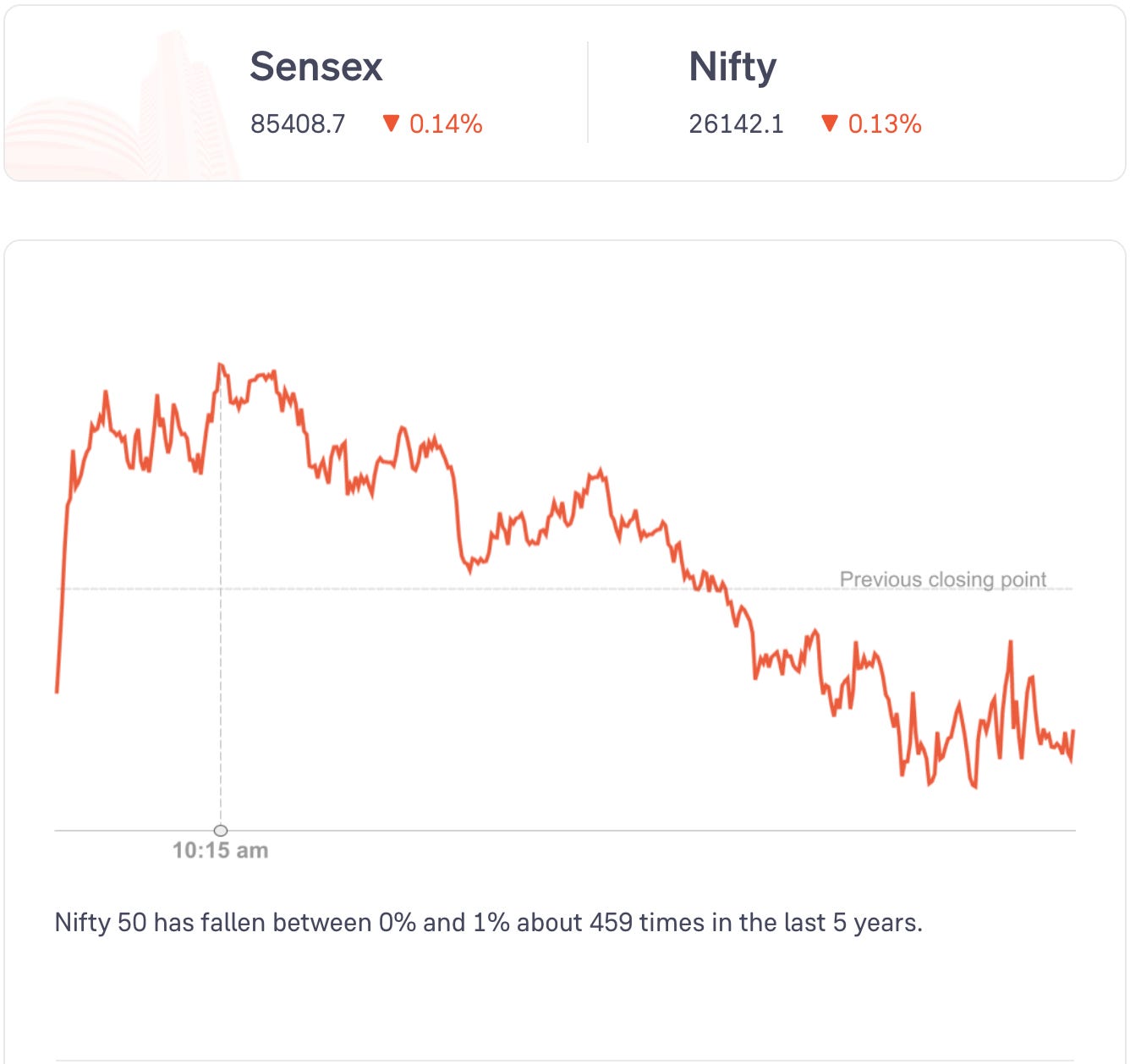
Markets opened below yesterday’s closing point.
Media stocks and realty stocks rose the most today. Oil and gas stocks and chemicals stocks fell the most.
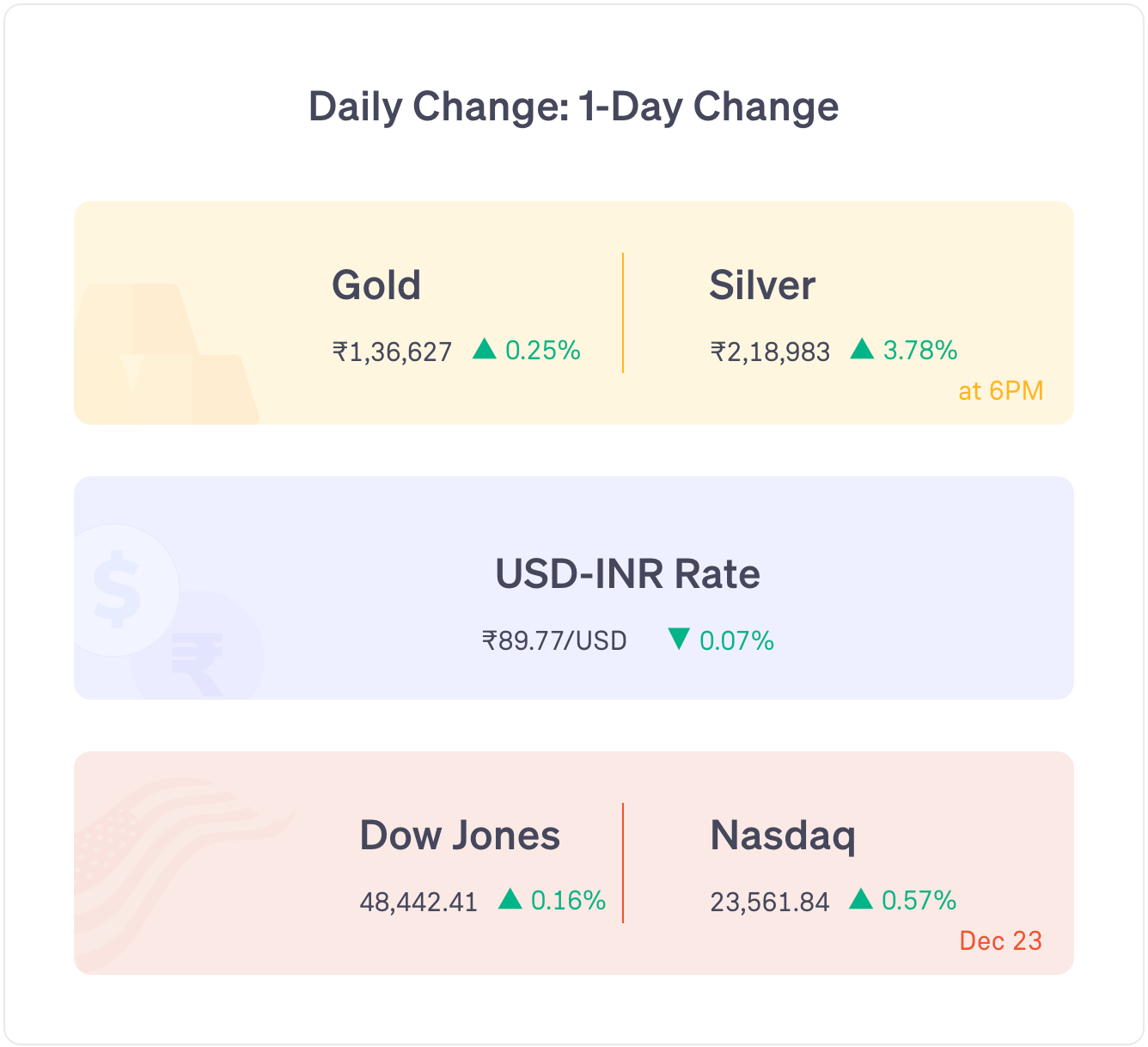
Global markets: US markets rose. Asian markets showed a mixed trend. Most European markets rose (as of 6 pm IST).
News
The US annual GDP grew 4.3% in the July-Sept quarter (vs 3.8% in the previous quarter).
The central government approved the Delhi Metro Phase 5(A) expansion project with 13 new stations for a cost of Rs 12,015 crore.
India’s Civil Aviation Ministry has granted No Objection Certificates (NOCs) to Al Hind Air and FlyExpress to enter the aviation industry. Another airline, Shankh Air, is expected to begin operations in 2026.
KSH International IPO listed on the stock exchanges at a discount of 3.65% over the issue price and closed 5.07% down at the end of the day.
Stocks Updates
JNTPC Green: declared commercial operation of 69.04 MW from the Khavda-I Solar Project in Gujarat.
ICICI Pru Life: received 2 GST orders for FY22 totaling about Rs 19.76 crore (tax, interest and penalty) from Delhi and Maharashtra authorities, which it will challenge.
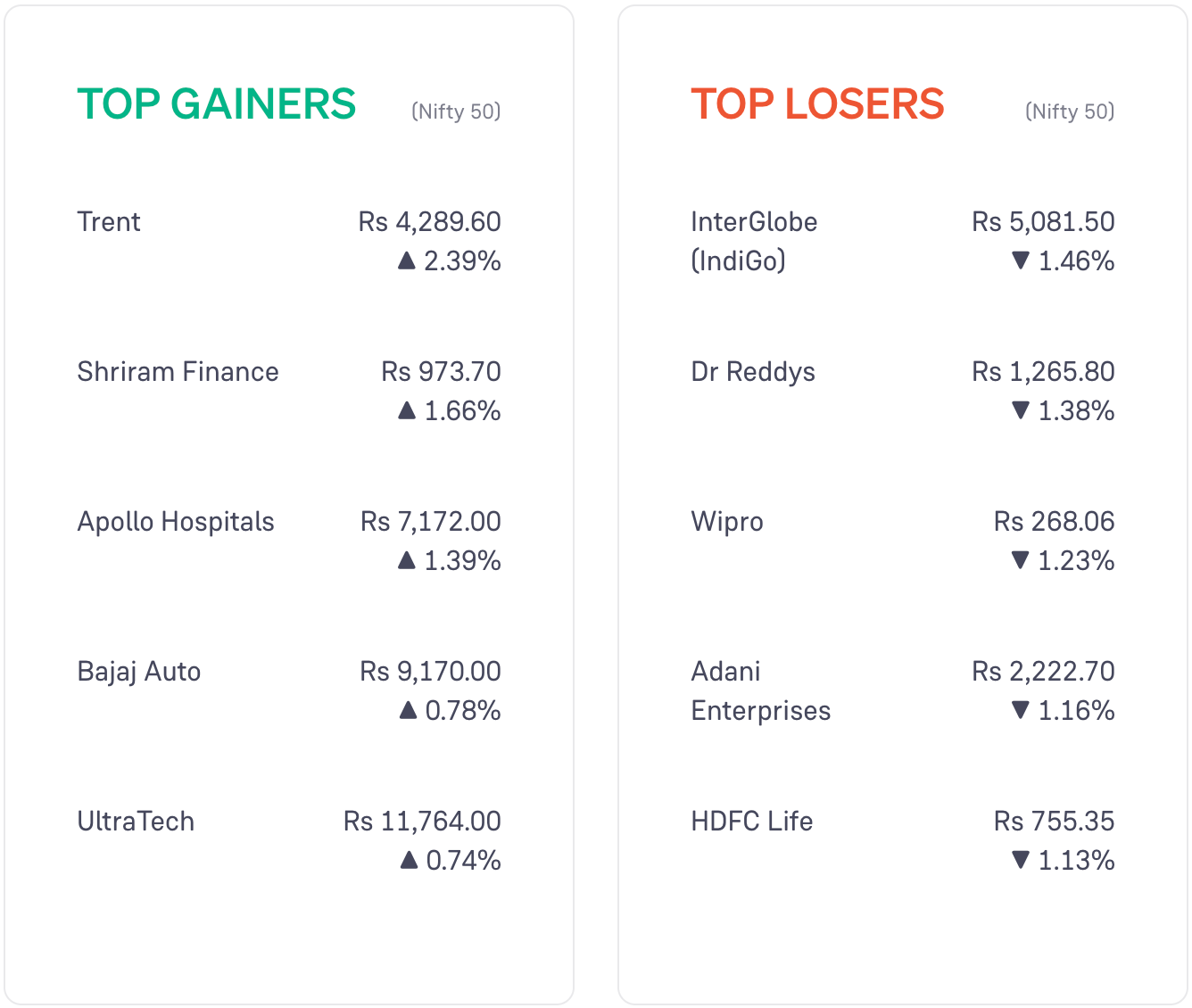
Adani Enterprises: approved raising up to Rs 1,000 crore through a public issue of non-convertible debentures.
Apollo Hospitals: got NSE and BSE approval letters for its proposed demerger and restructuring, subject to statutory and shareholder approvals.
L&T: won a significant order (Rs 1,000 crore to Rs 2,500 crore) from MMRDA for electrification and systems work on Mumbai Metro Line 4.
NTPC: approved forming an equal joint venture with ‘EDF Power Solutions India’ for pumped storage projects and a wholly-owned subsidiary in Mauritius for power projects.
Waaree Energies: received a GST order of Rs 5.83 crore for FY19, which it will challenge. It also incorporated 10 step-down subsidiaries for renewable power projects.
TCS: will consider a third interim dividend at its board meeting on 12 Jan. It fixed 17 Jan as the record date for the potential dividend.
Maruti Suzuki: received a GST order from West Bengal authorities for Rs 2.34 crore for FY19 to FY23, which it will challenge.
Solar Industries: issued Rs 100 crore of commercial paper on 23 Dec at a 6.28% interest rate, maturing on 23 March 2026.
Word of the Day
Minority Interest
It is the portion of a company’s ownership held by investors with less than 50% stake
So anything the parent company (or the majority shareholder) does not own is called minority interest.
These investors have a share in the company’s profits and assets.
But they don’t have control over how the company is run. It is also called non-controlling interest.
In financial reports, minority interest has to be accounted for separately.
6 Day Course
Theme: candlesticks
Day 3: Wednesday
Now, let’s look at the wick.
The tip of the top wick represents the highest price the stock touched during the day.
The tip of the bottom wick represents the lowest price the stock touched during the day.
So the candlestick is easily able to tell us the opening price, closing price, the highest price point of the day, and the lowest price point of the day, and of course, if the stock closed up (green) or down (red).
Sometimes, the top wick is missing. This means that the highest point in the day was the opening price (if candle was red) or the closing price (if candle was green).
Conversely, if the bottom wick is missing, it means that the lowest point in the day was the opening price (if candle was green) or the closing price (if candle was red).
You will often notice such candlesticks with missing wicks in case of stocks that hit upper or lower circuits.
Featured Question
Q. “Dear Team, I had doubt on Disclosure of Foreign Assets rule. I recently started investing in Mirae Asset NYSE+ index ETF which mostly invest in US market stocks through demat account held in India. Is it mandatory for me to disclose all my such ETF investment in foreign stock under Schedule of Foreign Assets while filing my ITR return. Pls let me know the actual rule and guide. Regards”
If based in India, it is considered Indian.
If not based in India, it is considered foreign.
There are many mutual funds and ETFs that invest in foreign markets.
These are India-based mutual fund companies that offer these mutual funds and ETFs.
These are stationed in India. From an investors’ perspective, these are Indian mutual funds and ETFs (even though they invest aboard).
So in those cases, you do not need to declare them as foreign assets.
Some investors use international investment platforms that allow them to invest in stocks and funds that are not Indian.
If you have stocks, ETFs, and mutual fund investments like that (not India based), you will have to declare them as foreign assets.
Most Indian investment platforms offer only India-based mutual funds, ETFs, and stocks.
If you want to be absolutely sure, you can check the mutual funds’ or ETF’s SID (Scheme Information Document).
All India-based stocks can be either found on NSE or BSE or both.
Did you like this edition?
Leave a feedback here!