

Petra is mostly deserted today.
It was once a bustling trading city — 2000 years ago.
Trade shifted, times changed, the city declined.
A horrible earthquake effectively wiped out the city. Most homes, administrative buildings, and such perished.
But nothing happened to the buildings carved in the red sandstone. Those structures still stand today, drawing tourists from all over the world.

Why?
Carved out of one rock.
A single piece of rock is stronger than anything built by joining together many rocks.
Similar examples of ultra strong buildings can be found across the world.
In India, the 1200-year old Kailasa Temple is one such. It still stands. Other structures around it came and crumbled.

Designers and engineers have been fascinated by this idea for a long time. Manufacturing techniques and costs have held them back.
Around 2008, Apple decided that its new laptop would have a unibody frame.
Until then, all laptops were a sandwich design. Multiple different parts were screwed together to make the frame.
Apple wanted their frame to be carved out of one block of aluminum alloy.
The challenge was that nobody had the capability to do this job at scale. This kind of a job requires specialised CNC machines.
And that was not it. It required skilled technicians who could operate them fast enough. Lots of such technicians.
Apple was working with many vendors. Apple did the design. The vendors did the actual manufacturing.
One relatively new vendor had grown to become a particular favourite of Apple’s. They had made a mark manufacturing the iPod.
Foxconn.
When the requirement arose, Apple and Foxconn went about acquiring CNC machines.
This effectively meant that the only companies that could make these CNC machines had their order books full for months. Apple’s competitors wouldn’t be able to get their hands on these CNC machines for some time.
Foxconn rapidly trained staff to work on these CNC machines and began churning out unibody Macbooks.
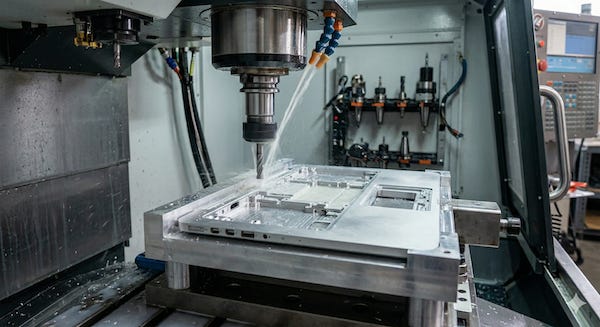
This made Macbooks incredibly light, yet strong, and better at heat management.
Seeing the unibody design work well, Apple introduced the unibody frame to the iPhone 5 and beyond.
Only Foxconn had the large-scale capability to manufacture unibody frames.
This was not the first time or last time Apple had relied on Foxconn to pump out pioneering technology by the hundreds of thousands.
Foxconn has been vital to Apple’s product strategy.
Foxconn was one of the biggest reasons why Steve Jobs had once said that making the iPhone in the US was not going to happen.
Foxconn Scale
Longhua Science and Technology Park is often called Foxconn city.
The Foxconn campus is so large, it has its own hospital, fire department, sports center, library, banks, etc.
At any given time, it can house 3-5 lakh workers.
Foxconn city is centered around manufacturing. Inside the campus are multiple factories dedicated to making different devices for different brands.
Yes, Apple is Foxconn’s biggest customer. But they are certainly not the only client Foxconn serves.
Sony Playstation and phones are made by Foxconn.
Microsoft Surface tablets, Pixel, Xiaomi, Huawei, Motorola, OnePlus are some of the other brands that get their devices made by Foxconn.
Foxconn is so vital to companies that many features become possible only after Foxconn is able to make and assemble them.
This campus can output lakhs of iPhones per day.
Not just entire devices, Foxconn also makes parts of devices that are sent to other factories to be assembled.
Foxconn isn’t just about manufacturing phones or tablets or laptops.
They are about manufacturing, period.
They make phones, tablets, laptops, gaming consoles, servers, networking devices, routers, etc.
Components like PCBs, display panels, battery cells and cases, cooling solutions, etc. are also done by them.
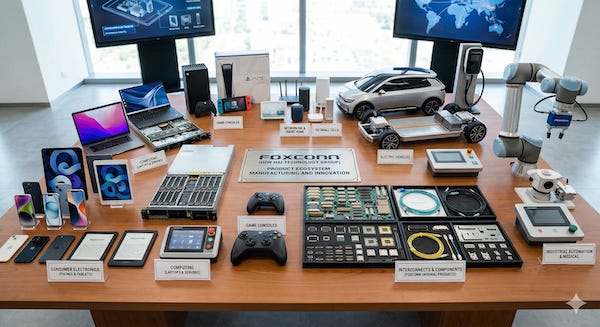
This ever-expanding list goes on — they’ve started manufacturing electric cars too.
In the early 2010s, it was said that 40% of all consumer electronics in the world were made by Foxconn — not just iPhones; not just phones.
Yet, most people have not heard of them. For the longest time, Foxconn was a manufacturer to other brands.
There was no ‘Foxconn’ branded consumer device.
In more recent years, Foxconn has bought other brands and has products that are effectively Foxconn products.
If you recently bought a TV by Sharp, you’re buying from a Foxconn-owned brand. If you bought a dongle or USB charger branded ‘Belkin’, you’re buying directly from Foxconn.
History and Beginnings
Foxconn has extremely basic origins.
Today it is categorized as an EMS or Electronics Manufacturing Services company. But that was not how it started.
Terry Gou founded Hon Hai Plastics Corporation in Taiwan in 1974. This later became Foxconn.
He had 10 elderly workers and they manufactured plastic knobs for black-and-white TVs. Not the entire TV, just the plastic knobs people turn to change the volume or channel.
A few years later, they landed a contract manufacturing joysticks for Atari.
Terry Gou spent year after year building capacity to manufacture rapidly and at scale.
Electronics companies back then were focussed on R&D of newer products. Manufacturing seemed like a blindspot in their planning.
Determined to keep scaling, Terry Gou spent months doing road trips around the US. He would simply turn up at companies’ offices asking for a meeting with the leadership.
He was often kicked out by security. Sometimes, he would land a meeting.
And some of those meetings would translate to manufacturing contracts.
From something as basic as plastic knobs in the 1970s. They moved into other plastic parts from that.
Then, they started making connectors in the 1980s and wire assemblies.
In the late 1980s, Foxconn started opening factories in China helping it scale rapidly by taking advantage of a large number of low-salaried skilled workers.
In the 1990s, they were making laptop frames. Towards the end of the 1990s, they started assembling components into the computer frames.
Their big break came when Apple asked them to manufacture the iMac G3 computer.
The partnership grew from there.
Speed, Scale, and Capability
Before the first iPhone was launched, Steve Jobs was testing the iPhone and noticed a major flaw.
The screen was easily getting scratched when kept with keys in the pocket.
He decided the screen could not be made of plastic. It had to be glass.
This was in May-June 2007. The launch was due in June 2007. They struck a deal with the glass-making company.
The glass arrived at Foxconn’s factory a few weeks before the phone’s launch.
Foxconn was able to retool the assembly lines in just 4 days. It started pushing out 10,000 iPhones per day — saving Apple the embarrassment of a delayed launch.
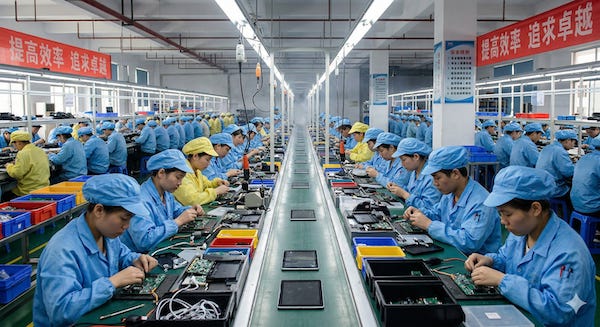
Foxconn is excellent at doing this.
They can make very sophisticated things, very fast, in high numbers.
The MegaCorp
At one point, nearly 90% of all of Foxconn’s earnings came from its plants located in China.
During the peak of pandemic lockdowns, Shenzhen was completely shut down. China was following a complete lockdown model.
Foxconn’s factory wasn’t able to ship out any products.
Terry Gou apparently wrote to the Chinese government to let the plants become active again. He claimed the company would lose market share irreversibly if the plants did not restart.
They were able to restart. This is probably a good demonstration of just how significant Foxconn is.
Foxconn has since started expanding in other parts of the world.
India is one of Foxconn’s biggest projects outside China.
As of writing this, about 25% of all iPhones in the world are made in India.
Besides India, Foxconn has also expanded into Vietnam, Malaysia, Thailand, Mexico, and on a smaller scale, even in Europe and the Americas.
The company today is worth about $72 billion.
Its revenue is greater than many countries’ GDP (over $200 billion), with earnings of around $6 billion.
Foxconn isn’t one of a kind. There are many like it — EMS companies.
Brands mostly rely on a handful of EMS companies to make their products.
Apple itself relies on Foxconn’s major competitors like Pegatron and Wistron.
Smaller competitors are also cropping up. We have a few such competitors right here in India — Dixon Tech and Keynes Technology are examples.
But when it comes to size and scale, the second biggest competitor, Pegatron, is a fraction of what Foxconn is.
Foxconn remains indispensable to the world’s electronics supply.
Quick Takes
+ India’s industrial production rose 5.2% year-on-year in Feb (vs 5.1% in Jan).
+ The Central Mine Planning and Design Institute Ltd IPO listed on the stock exchanges at a discount of 6.98% over the issue price and closed 10.43% down at the end of the day.
+ The Ministry of Defence signed a contract worth Rs 1,950 crore with Bharat Electronics to procure indigenous mountain radars for the Indian Air Force.
+ India’s net GST collections rose 8.2% year-on-year in March to Rs 1.78 lakh crore. Gross GST collections grew 8.8%, crossing 2 lakh crore rupees.
+ The government has introduced a temporary one-time relief allowing SEZ (Special Economic Zone) units to sell manufactured goods in the domestic market at concessional customs duty rates to ease global trade disruptions, with a minimum 20% value addition requirement and a cap of 30% of export value.
+ India’s manufacturing PMI fell to 53.9 in March (vs 56.9 in Feb). This means manufacturing activity grew less in March than in Feb.
+ State-run Oil Marketing Companies (OMCs) raised the prices of commercial cylinders in metro cities by around Rs 200 from 1 April as the Saudi Contract Price (the global benchmark for LPG) rose 44% due to the continued conflict in West Asia.
+ Powerica IPO listed on the stock exchanges at a discount of 7.34% to the issue price and closed 1.27% down at the end of the day.
+ India’s forex reserves fell by $10.29 billion to $688.06 billion in the week that ended on 27 March.
The information contained in this Groww Digest is purely for knowledge. This Groww Digest does not contain any recommendations or advice.
Team Groww Digest
Wonderful to know about foxconn's behind the scene work.
Fascinating read. Foxconn is such a perfect example of how scale, speed, and manufacturing depth quietly shape the entire tech world.