
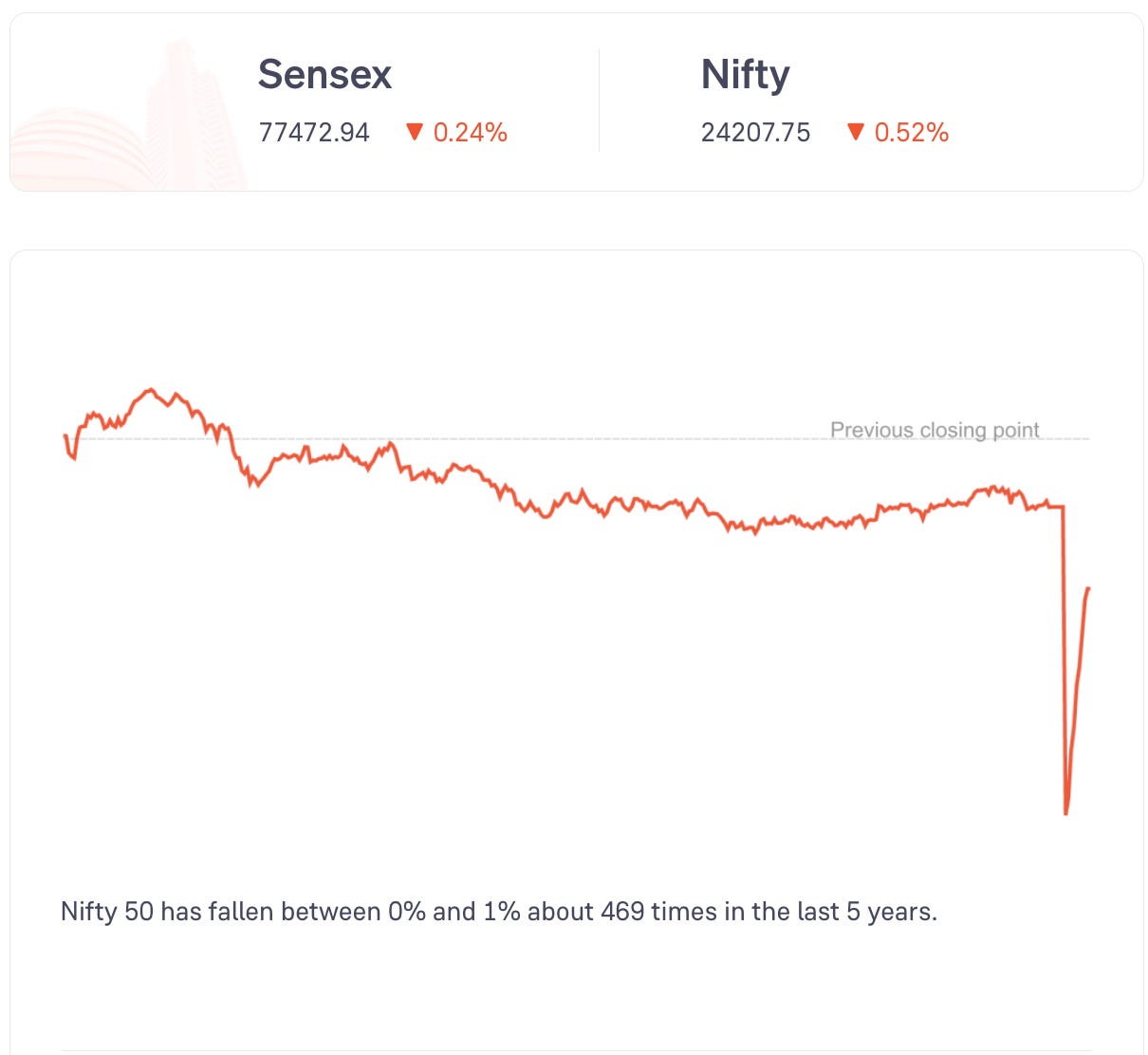
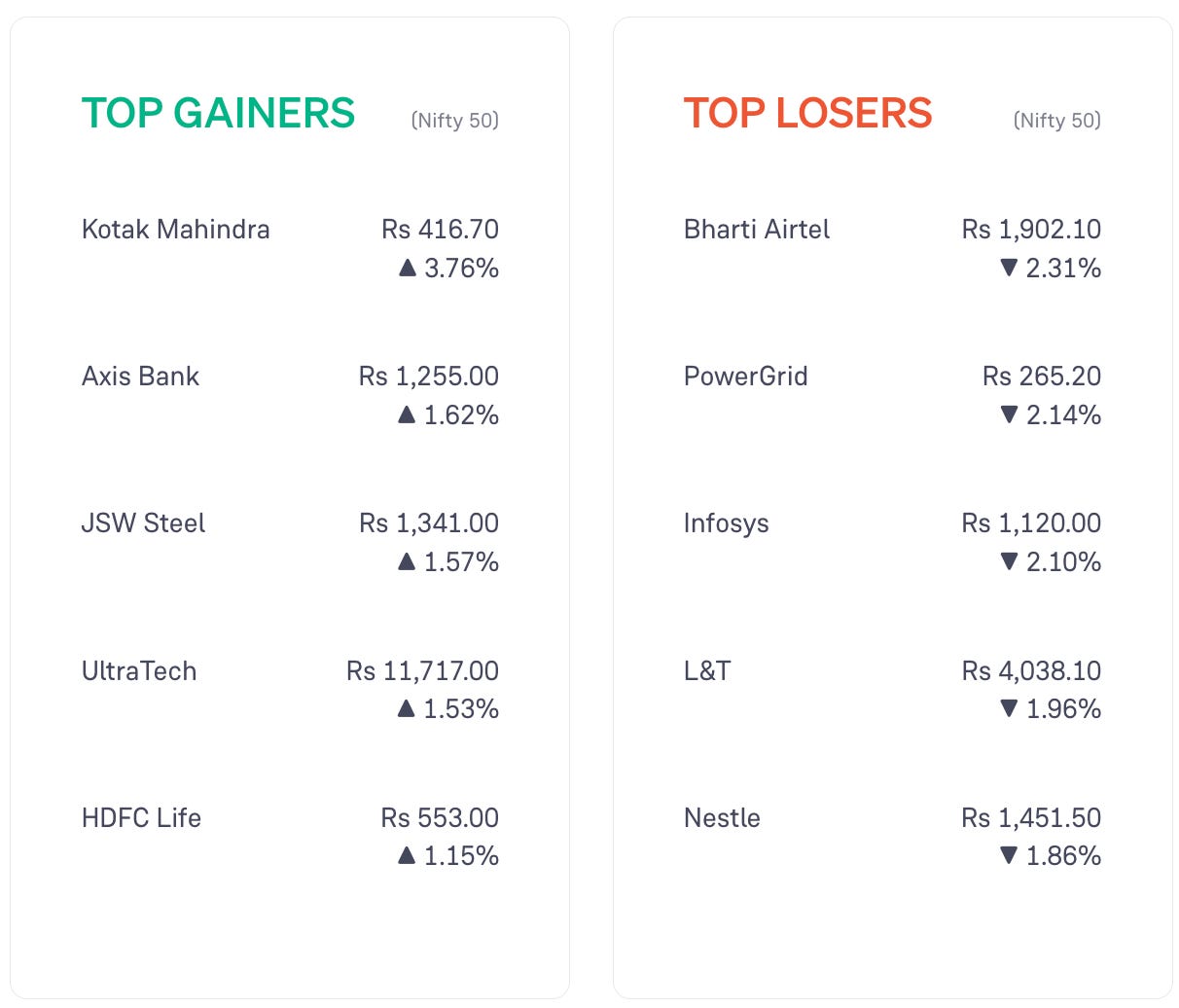
Markets closed lower compared to yesterday’s closing point.
IT stocks and consumer durable stocks fell the most today. Cement stocks and metal stocks rose the most.
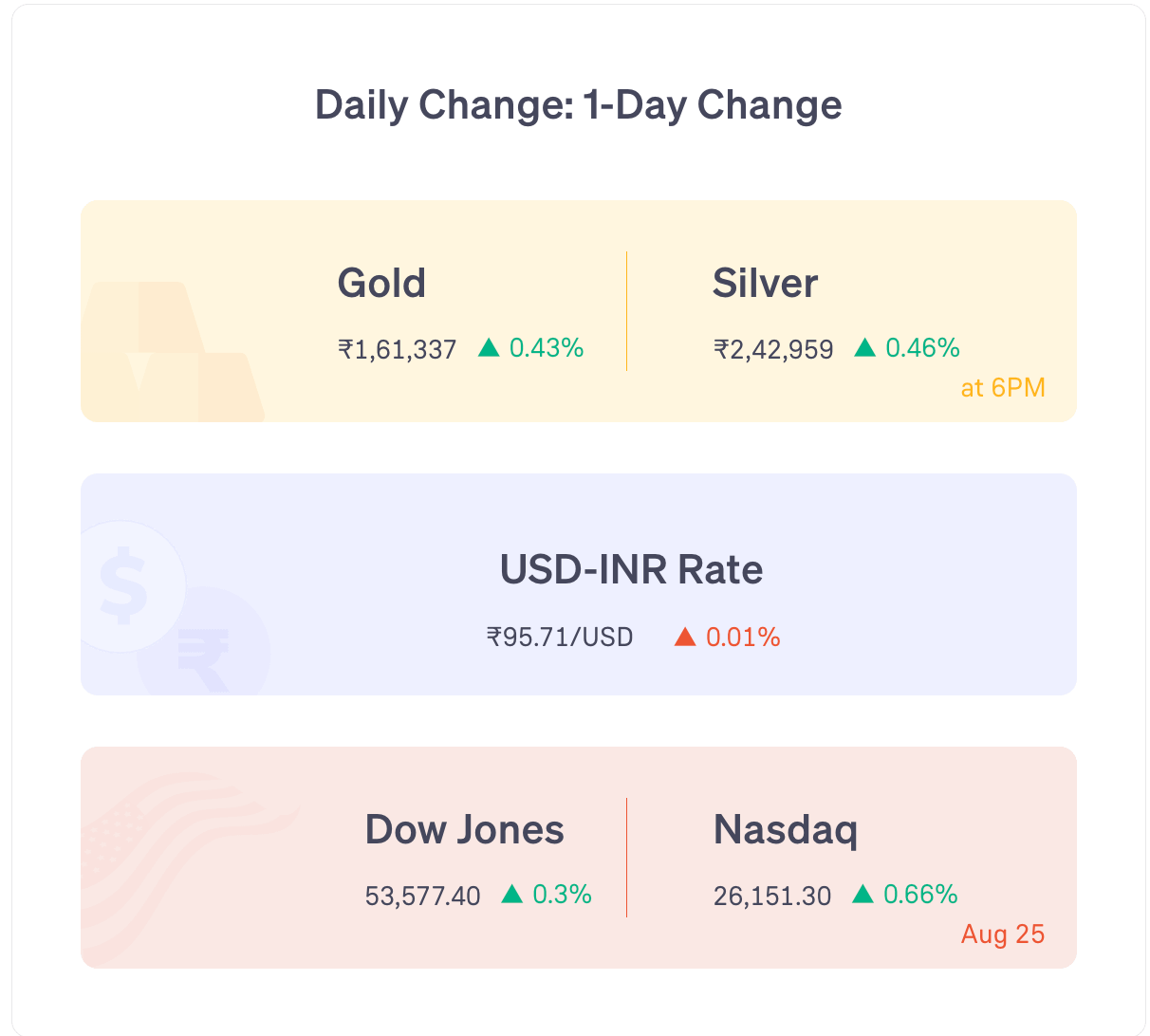
Global markets: US markets rose on Tuesday. Most Asian markets rose on Wednesday. Most European markets rose (as of 6 pm IST).
News
India and Seychelles held talks and discussed a possible dedicated MoU to strengthen cooperation in fisheries, aquaculture and the blue economy (including tuna fishing, marine farming and fisheries technology).
Symbiotec Pharmalab IPO was subscribed 5.31 times on day 3. Retail subscription: 5.05 times. The IPO will close for subscription on 27 August.
Skyways Air Services IPO was subscribed 5.08 times on day 3. Retail subscription: 6.92 times. The IPO will close for subscription on 27 August.
Hindustan Copper OFS was fully subscribed by retail investors on day 2. The government exercised the green shoe option and is selling up to 6% stake at a floor price of Rs 514.
Gaja Alternative Asset Management listed at Rs 185, a premium of 15.62% over its issue price and closed 6.38% highe
Stocks Updates
HAL: signed the final contract with Safran Helicopter Engines and their joint venture, SAFHAL, to design, develop, and manufacture the Aravalli helicopter engine.
Bharat Electronics: received additional orders worth Rs 730 crore since 10 August for communication equipment, radar, avionics, tank systems, etc.
Nestle India: received two customs orders demanding approximately Rs 13.58 crore in duty, along with penalties, interest and a redemption fine. It plans to explore legal options to challenge the orders.
Tata Steel: the Supreme Court sought Tata Steel’s response to Odisha appeals involving demands of about Rs 1,903 crore and Rs 2,411 crore over alleged shortfalls in chromite dispatches from the Sukinda Chromite Block. In a separate ruling, the court cancelled a GST notice and order involving Rs 890.52 crore in tax.
Adani Energy: won a power transmission project in Maharashtra worth about Rs 4,700 crore to carry up to 4,500 MW of renewable and pumped-storage power, adding 562 circuit km of lines and 9,000 MVA of transformation capacity.
ICICI Prudential AMC: promoter Prudential Corporation Holdings plans to sell up to a 2% stake in the open market on 27 August to meet minimum public shareholding requirements.
Hero MotoCorp: Ather Energy allotted Hero MotoCorp 76.19 lakh convertible warrants worth around Rs 960 crore at Rs 1,260 each. Hero paid about Rs 240 crore upfront, with the remaining 75% payable when the warrants are converted.
Zydus Lifesciences: incorporated wholly owned subsidiary Zydus Global Treasury Centre IFSC Ltd in GIFT City with paid-up capital of Rs 5 crore to undertake treasury activities and services.
GMR Airports: the airport regulator, AERA, revised aeronautical tariffs for Hyderabad’s Rajiv Gandhi International Airport for April 2026 to March 2031. The new charges will take effect from 1 Sept, 2026.
Vedanta: restrictions placed on the company under certain promoter-group financing agreements have been removed after the related loans and liabilities were fully repaid.
Mankind Pharma: plans to close material subsidiary Bharat Serums and Vaccines Ltd as a separate company and transfer its business directly to Mankind Pharma while continuing operations.
Godrej Consumer: inaugurated its fourth manufacturing unit at Malanpur, Madhya Pradesh, after investing around Rs 480 crore in expansion. The expanded facility is expected to generate turnover of around Rs 3,800 crore once fully operational.
Word of the Day
Value Trap
It is an investment that grows poorly or grows negatively (makes losses).
An obvious bad investment is not called a value trap.
The key characteristic of value traps is that they often look attractive and might seem like good investments — while being bad investments.
Example: a stock’s PE ratio is low making it appear like a good purchase. But the PE ratio might be low simply because the company’s revenues are declining quarter after quarter because of a competitor eating its market share.
6 Day Course
Theme: quarterly reports
Day 3: Wednesday
The mandatory parts of a quarterly report are:
Income Statement: this section includes revenues, profit/losses (before and after tax), operating expenses, etc.
Segment Reporting: companies must also give a break up of the different revenue and earnings’ sources.
This includes a break up of the same from a business perspective (for companies operating various different products and services), geographic perspective (for companies operating internationally), etc.
The EPS or Earnings Per Share must be revealed too.
It’s not that they must disclose these numbers from the current quarter only. They must also compare the numbers with the previous quarters so investors can see how the company is progressing.
There are more we’ll cover tomorrow.
————
Featured Question
Q. “In the IPO corner, during the subscription period, XYZ Company was subscribed 105 times on day n. Retail subscription: 30 times. ABC company was subscribed 2.5 times on day n. Retail subscription: 3 times. Once listed, XYZ company stock trades at a 20% premium over its issue price, while ABC company stock trades at a 2% premium over its issue price. How is the subscripted x times calculated? What happens during listing? Is there any correlation between a higher subscription rate and a listing at a premium to its issue price?”
In short, you are saying there are 2 different IPOs.
Company XYZ:
Oversubscribed: 105 times
Retail subscription: 30 times
Trades at 20% premium after listing
Company ABC:
Oversubscribed: 2.5 times
Retail subscription: 3 times
Trades at 2% premium after listing
Every IPO offers a certain number of shares for sale.
In that also, fixed numbers are reserved for different types of investors.
So, a company offering 1 lakh shares in an IPO might offer 35% shares in retail investor section, 20% in HNI category, 40% for anchor investors, and the remaining 5% for other categories.
When you hear “oversubscribed by x times”, it means the total applications received during the IPO was that much higher than the shares on offer.
So, let’s say all investors combined applied for 3 lakh shares when there were only 1 lakh shares available.
In this case, we can say the IPO was oversubscribed by 3 times or 3x.
The same can be done within each category of investors also.
So, say the retail investors section had 35,000 shares in total and it received applications for 3.5 lakh shares.
In this case, we will say the retail subscription was oversubscribed by 10 times or 10x.
Whenever there’s an oversubscription, shares are allocated randomly (lottery system).
What is the link between oversubscription and premium?
Oversubscription tells us that more investors were trying to get the shares in the IPO.
This could mean the demand for the shares is very high and therefore, when the share lists on the share markets, more investors will try to buy it — causing the share prices to go up (high premiums).
But we have seen that not all investors think like that.
Many IPO investors do not plan on holding their shares. They are buying simply to sell after listing.
If the number of such investors is high, a share’s price may even fall after listing, despite having been heavily oversubscribed.
In short, oversubscription does show investor interest in the IPO.
It does not tell us with certainty how that investor interest will affect the share price after listing.
The information presented in this post has been compiled and prepared by Groww Invest Tech Pvt Ltd and is intended solely for informational purposes. It is not tailored to any specific investment objectives, financial situations, or needs of any individual investor. The content should not be construed as investment, financial, legal, or tax advice and should not be relied upon as a substitute for professional consultation.
Investing in securities markets involves inherent risks. Investors are advised to carefully review all relevant documents and consider their own risk tolerance before making any investment decisions.
Mutual fund investments are subject to market risks; please read all scheme-related documents carefully. Past performance of financial instruments, schemes, or markets is not indicative of future results.
Groww Invest Tech Pvt Ltd is registered with the Securities and Exchange Board of India (SEBI) under Registration No: INZ000301838, as a Research Analyst under No: INH200008662, as a Depository Participant under No: IN-DP-417-2019, and with the Association of Mutual Funds in India (AMFI) under ARN-111686.
SEBI registration details: View registered name and registration numbers
Research Analyst Disclaimer: View Research Analyst disclaimer
Did you like this edition?
Leave a feedback here!
Good insight on the subject