

Amazon was in a little bit of a dilemma.
December 2014, Christmas time.
It is one of the biggest festivals of the year in the west.
Much like Diwali, people spend a lot of money during festive seasons even in the West.
It is also the season of gifting.

While most folks are busy preparing to spend quality time with their families, those working in the retail space are usually tense and stressed.
There’s just too much in transit that must reach the right place at the right time.
Amazon (USA) is right at the epicenter of this storm every year. Their learnings from each year are directly used in the years that follow.
Since its founding in 1994, it has expanded its capacity and increased control over its delivery network.
They had their own warehouses. They started partnering with courier companies to get better control over the delivery network.
When that didn’t prove to be enough, they bought their own delivery vans and set up their own delivery network.
In 2014, Amazon was promoting their Kindle device. The Kindle is a versatile reading device, an excellent gift item for Christmas.
On 21st December 2014, Amazon’s Seattle warehouse ran out of Kindle devices.
“Out of stock” was not a message Amazon wanted to show to its customers. So, it decided to arrange for the devices to be shipped to Seattle from other cities where they were available.
Since Christmas was literally around the corner, they couldn’t afford to wait for the devices to arrive on trucks.
They needed the Kindles fast.
Hence, air parcels.
They turned to courier companies they regularly worked with. Companies like FedEx and UPS.
These companies owned a fleet of cargo planes that ferried all kinds of goods across the country.
Amazon requested them to divert their planes from other locations to the routes they needed them on.
Christmas is a busy week for everyone, and the courier companies had prior commitments. Their planes were already full and booked. They refused to divert planes for Amazon.
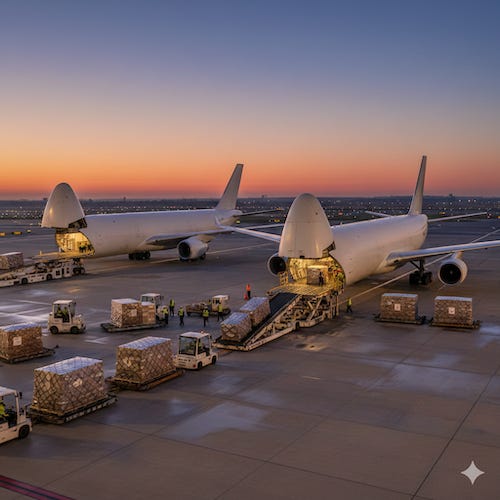
In a desperate attempt to avert an apparent disaster, Amazon turned to chartered planes, paying handsome sums of money to ship Kindle devices to Seattle.
The gravity must be understood. Seattle was their home base. It was where Amazon was founded and headquartered.
They succeeded.
Enough Kindles reached on time to fulfil demands.
Long Term Solution
Of course, Amazon had pre-booked planes and routes with the courier companies well in advance.
But last-minute demand surges cannot be predicted well in advance. And the folks at Amazon would obviously not want to go through the stress of arranging expensive chartered flights in 2015.
They started working on a solution.
They did what they had done earlier.
They decided they needed to control this part of the delivery supply chain. How do you do that?
Project Aerosmith.
They signed deals with two leasing companies: ATSG and Atlas Air for 40 cargo planes.
These were leased planes. This meant that Amazon would get operational control of the planes, but the repair, maintenance, staffing, etc would be handled by the leasing company.
Two plane types were leased, the Boeing 737 (narrow-body planes commonly seen flying national level routes) and the Boeing 767 (wide-body planes flying international routes).
40 planes were painted in Amazon colors and had “Amazon Air” written on the side.
With these 40 planes, Amazon had intended to reduce their reliance on courier companies’ planes.
And thus, Amazon’s internal experiment with operating planes began.
Only 2 years later, Amazon Air felt the need to spend $1.5 billion to set up a worldwide hub in Cincinnati. It had space for 100 planes and over 200 takeoffs and landings every day.
Project Aerosmith was a success.
Expansion
Amazon Air kept starting operations out of newer hubs in different cities. More planes were leased.
Then, Covid hit in 2020.
Airlines the world over were facing massive passenger shortages. Running planes was becoming expensive.
Empty planes became a money pit for airlines, and many airlines decided to sell or shelf their planes.
Various planes were being parked for long storage.
On the other end, Amazon customers were stuck at home because of the lockdowns. They were ordering more items and spending more money.
While airlines suffered, Amazon’s business was booming.
It needed more planes. And there was a desert yard full of unwanted planes.
In January 2021, Amazon announced it was buying 11 Boeing 767 planes because they were available for so cheap.
And with that, Amazon Air became a plane owner and operator too.
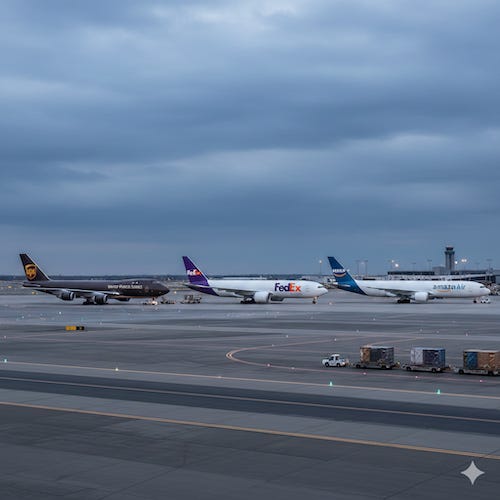
Two months later, Amazon acquired a stake in ATSG, the same company Amazon used to lease planes from. This move reaffirmed Amazon’s cargo ambitions yet again.
Every year, it continued expanding its fleet with more leased planes.
In 2023, Amazon Air reached India. Since then, it has expanded more in India.
Internal Tools
More than a decade before Amazon Air was born, the senior management was wondering about a scale related issue that they were unable to solve.
Every time they built something new, a huge chunk of the team’s time was spent in assembling the servers and the infrastructure needed for that feature.
Back in those days, companies had to set up servers by themselves in their own offices.
They decided that a team would build a plug and play solution. One team would set up servers and scale them. The others would simply use the servers for their teams’ features.
Amazon used to handle massive volumes during holiday seasons and discount seasons. At other times, the volumes were much lower.
During these lower volume periods, the servers were sitting idle.
Internal reports suggested that Amazon should rent out its servers to those who need it outside Amazon. It was something they had planned to do early on.
That’s what they did. Thus was born Amazon Web Services (AWS).
Those who are aware about software engineering would know just how massive an impact AWS has had on the internet. It changes how software engineers build online websites and apps.
Very few companies have their own servers now. They all rent servers from companies like AWS, Google, and Microsoft.
These rented servers are called cloud services.
What’s interesting is that as a business, AWS became even more profitable than its main business, e-commerce.
It took a good 7 years before Google and Microsoft launched their competing cloud services.
By that time, AWS had cemented its market share. It is still the biggest player in the industry.
Amazon is famous for doing this — spinning off internal tools as full fledged businesses to be used outside Amazon.
In keeping with that spirit, Amazon Air started offering to transport goods for others as well.
Since 2024, it has become an official competitor to the likes of UPS and FedEx.
Quick Takes
+ India’s gross non‑performing assets (NPAs) of scheduled commercial banks have fallen to a historic low of 2.15% as of September 2025.
+ Gujarat signed a letter of intent with Elon Musk’s Starlink to bring high‑speed satellite internet to remote and underserved areas.
+ India and Seychelles signed a $175 million special economic package to support development projects in Seychelles in areas like housing, mobility, health, defence and maritime security.
+ India’s unemployment rate stood at 4.8% in the Oct-Dec quarter (vs 5.2% in the previous quarter).
+ Equity mutual fund inflows stood at Rs 24,029 crore in Jan (vs Rs 28,054 crore in Dec). Debt funds saw an inflow of Rs 74,827 crore, reversing the outflow trend of the previous 2 months: AMFI
+ The US and Bangladesh have signed a Reciprocal Trade Agreement, cutting US tariffs on Bangladeshi goods to 19% and granting 0% duty on certain textiles made from US raw materials.
+ The US revised the trade factsheet of the India-US deal by removing the mention of pulses from the tariff discussions and changed a $500 billion purchase ‘commitment’ by India to an ‘intent’.
+ China’s annual inflation stood at 0.2% in Jan (vs 0.8% in Dec).
+ India’s forex reserves fell by $6.71 billion to $717.06 billion in the week that ended on 6 Feb.
+ India’s passenger vehicle sales grew 12.6% year-on-year in Jan to 4.50 lakh units: SIAM
+ The US annual inflation fell to 2.4% in Jan (vs 2.7% in Dec).
The information contained in this Groww Digest is purely for knowledge. This Groww Digest does not contain any recommendations or advice.
Team Groww Digest