
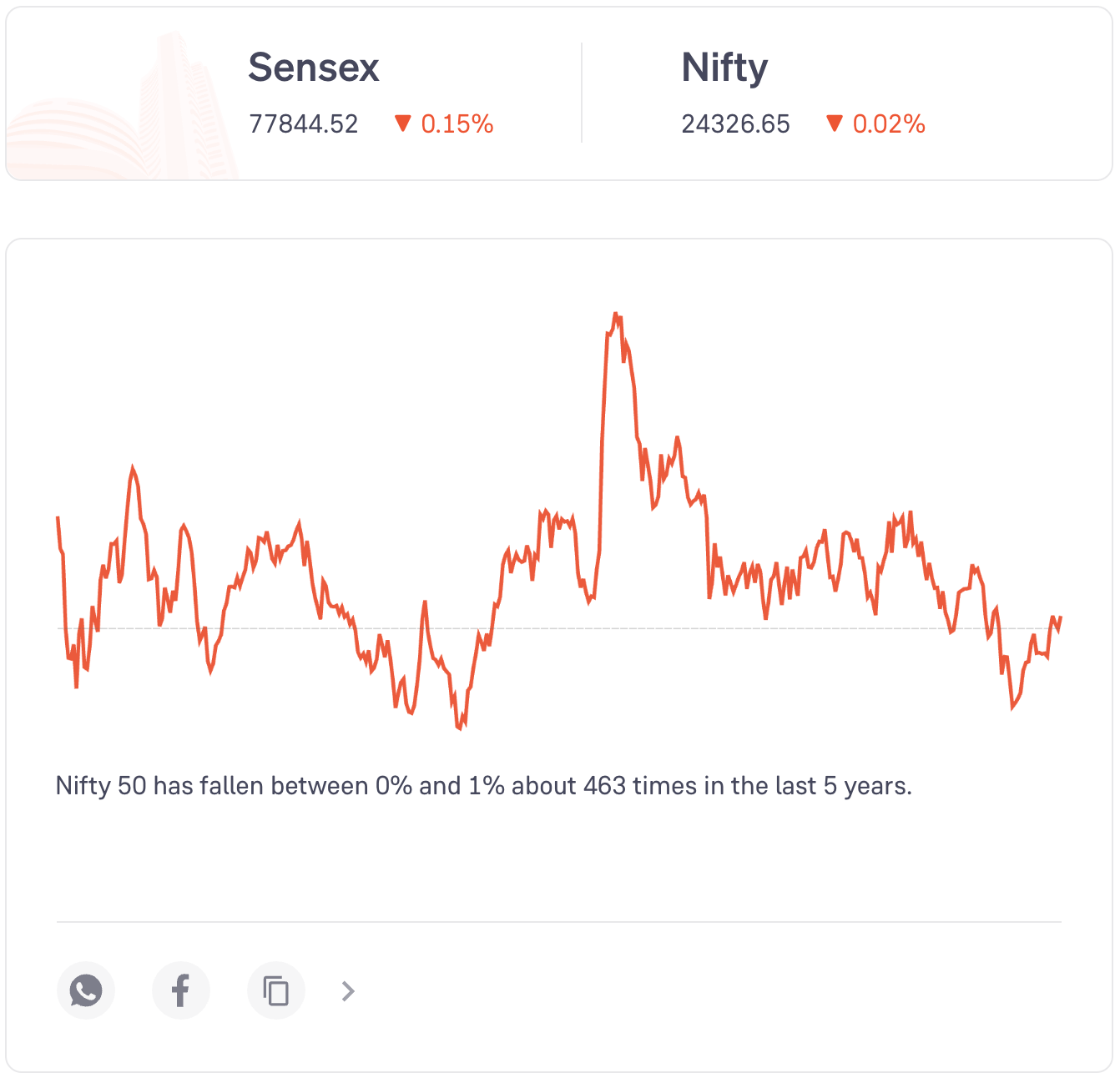
Markets opened above yesterday’s closing point.
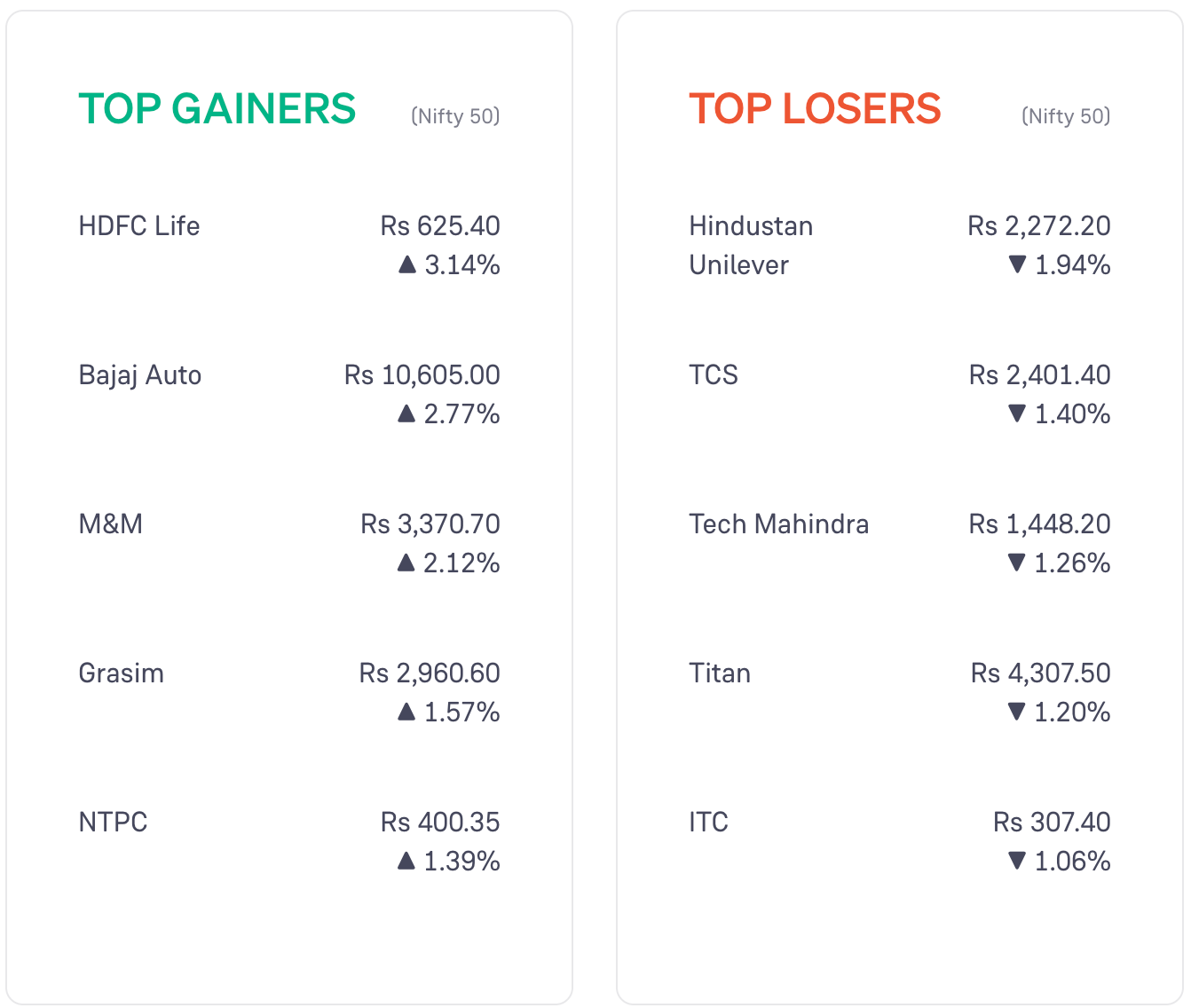
Auto stocks and realty stocks rose the most. Consumer durables stocks and IT stocks fell the most.
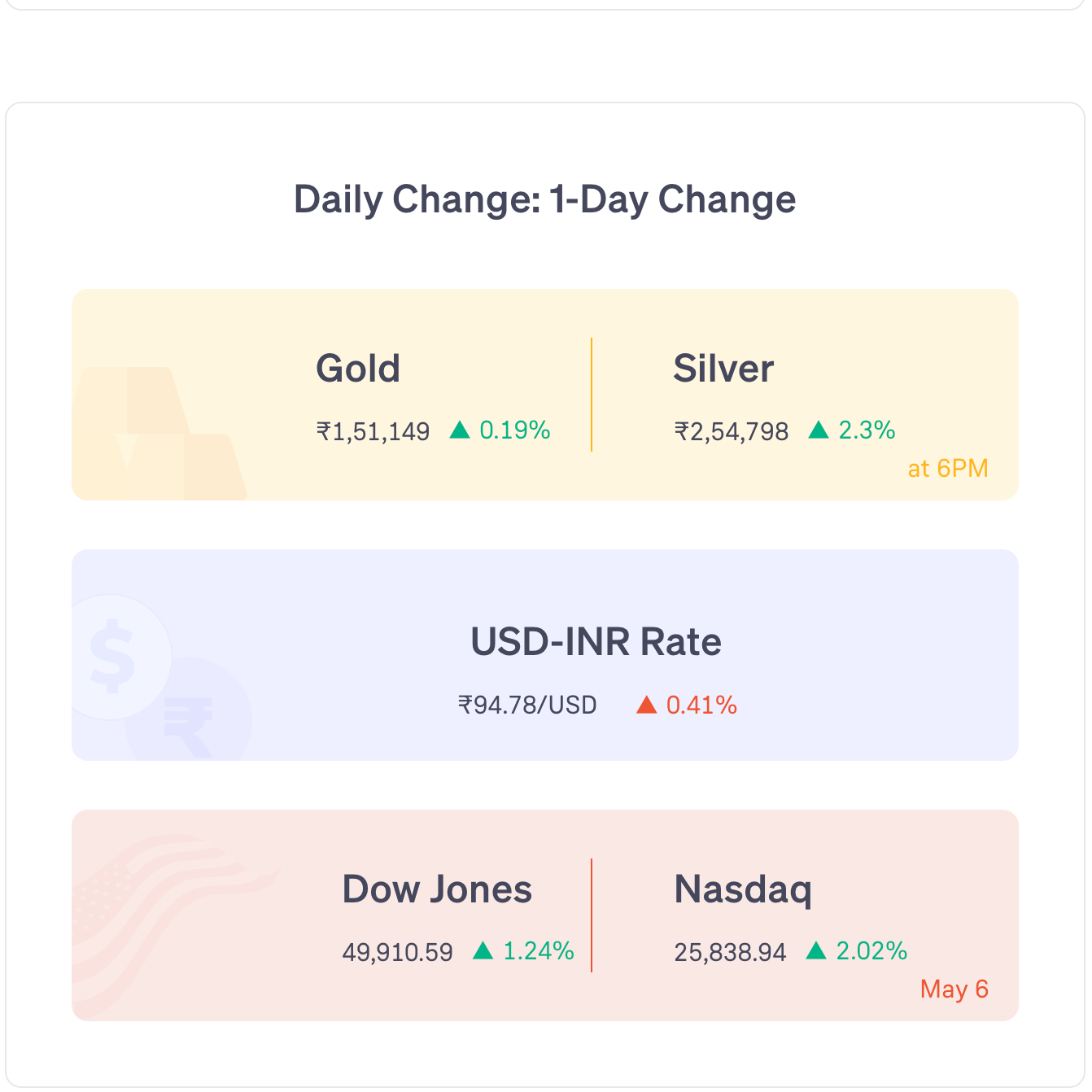
Global markets: US markets and Asian markets rose. Most European markets fell (as of 6 pm IST).
News
The RBI has revised the foreign exchange regulations for authorised dealers and money changers, effective 30 April, 2026. The rules mandate RBI approval for authorised forex dealers and introduce revised eligibility, net worth, and operational requirements across categories.
Royal Enfield will set up its first manufacturing plant outside Tamil Nadu, in Andhra Pradesh with an investment of Rs 2,200 crore.
Stocks Updates
Reliance: will not proceed with acquisition of 100% equity stake in Kandla GHA Transmission from PFC Consulting after the bidding process was annulled.
HDFC: received RBI approval to acquire up to 9.95% stake in ICICI Bank and Kotak Mahindra Bank via group entities, valid till 5 May 2027.
L&T: buildings & factories business won multiple large orders (Rs 2,500 crore to 5,000 crore each) across multiple states. Projects include 10 high-rise towers in Hyderabad, a luxury tower in Mumbai, and villa & hotel projects in Karnataka.
ITC: NCLT has approved the merger of Sresta Natural Bioproducts and Wimco into ITC, effective 1 June 2026. After this, both companies will be dissolved and stop existing separately.
NTPC: has signed an agreement with MCD to acquire the remaining 26% stake in NTPC EDMC Waste Solutions (NEWS) for Rs 5.20 lakh, making NEWS a wholly owned subsidiary.
UltraTech: received income tax demand of Rs 808.78 crore (including interest) for AY24, which it will challenge.
Bajaj Auto: net profit rose 102.7% year-on-year to Rs 3,661.92 crore in the Jan-March quarter. Dividend declared: Rs 150 per share, with 29 May as the record date. The board also approved a buyback of Rs 5,633 crore.
Bajaj Holdings: net profit rose 49.2% year-on-year to Rs 2,575 crore in the Jan-March quarter. Dividend declared: Rs 130 per share, with 30 June as the record date.
Jio Financial: invested Rs 300 crore in subsidiary Jio Finance Platform and Service, taking total investment to Rs 335 crore.
Adani Green: subsidiary, Adani Renewable Energy Sixty Four Ltd, incorporated two wholly owned step-down subsidiaries to expand the renewable energy business.
Power Finance: subsidiary, PFC Consulting Ltd, incorporated SPV, Fatehgarh II Transmission, to develop a power transmission project.
BSE: net profit rose 61.13% year-on-year to Rs 795.47 crore in the Jan-March quarter. Dividend announced: Rs 10 per share, with 10 July as the record date.
Waaree Energies: step-down subsidiary, Waaree Forever Energies Four Pvt Ltd, signed a Power Purchase Agreement with Solar Energy Corporation of India for a 300 MW wind power project in Dwarka, Gujarat.
Word of the Day
Anchor Investors
They are institutional investors who buy a large portion of shares before an IPO opens to the public.
They invest one day before the regular investors and buy shares at a fixed price within the IPO’s price range.
Anchor investors cannot sell these shares immediately. They must hold them for a certain period of time.
Anchor investors can include mutual funds, foreign portfolio investors, insurance companies, pension funds, etc.
Their early investment aims to build trust and encourage more people to invest in the IPO.
6 Day Course
Theme: India’s relation with USD
Day 4: Thursday
- Case 1: Exchange rate is Rs 95/USD
- Case 2: Exchange rate is Rs 90/USD
Case 2 means it is cheaper to import crude oil and other items we regularly import.
Case 1 means our import bills increase (including that of crude oil).
But, case 1 also means exports increase because everything seems cheaper in India (to foreign buyers).
This is why neither case 1 nor case 2 is perfect.
In fact, many developing countries have deliberately devalued their currency in the past in order to increase their economic activity.
This is good when the economy is heavily export dependent. India is not export dependent but wants to export more.
RBI generally feels it is better to let market forces (natural demand and supply for USD and INR) determine the exchange rate.
They do not try to influence the exchange rate much. They do work towards ensuring that there are no sudden surprises.
Featured Question
Q. “what is Free float market cap?”
Market cap or ‘market capitalisation’ or ‘m cap’ is the total value of the company.
Formula:
M Cap = total number of shares x price of one share
This is the size of the company.
It includes every single share of the company in its calculation.
Free float market cap does not include shares that are locked in or are not readily available to trade on the stock markets.
This means, it does not include shares owned by the promoters, govt stake, insiders, etc.
Shares owned by individual investors, institutional investors, mutual funds, pension funds, etc are included in it.
So, formula:
Free float m cap = total non-locked shares x price of one share
Did you like this edition?
Leave a feedback here!