
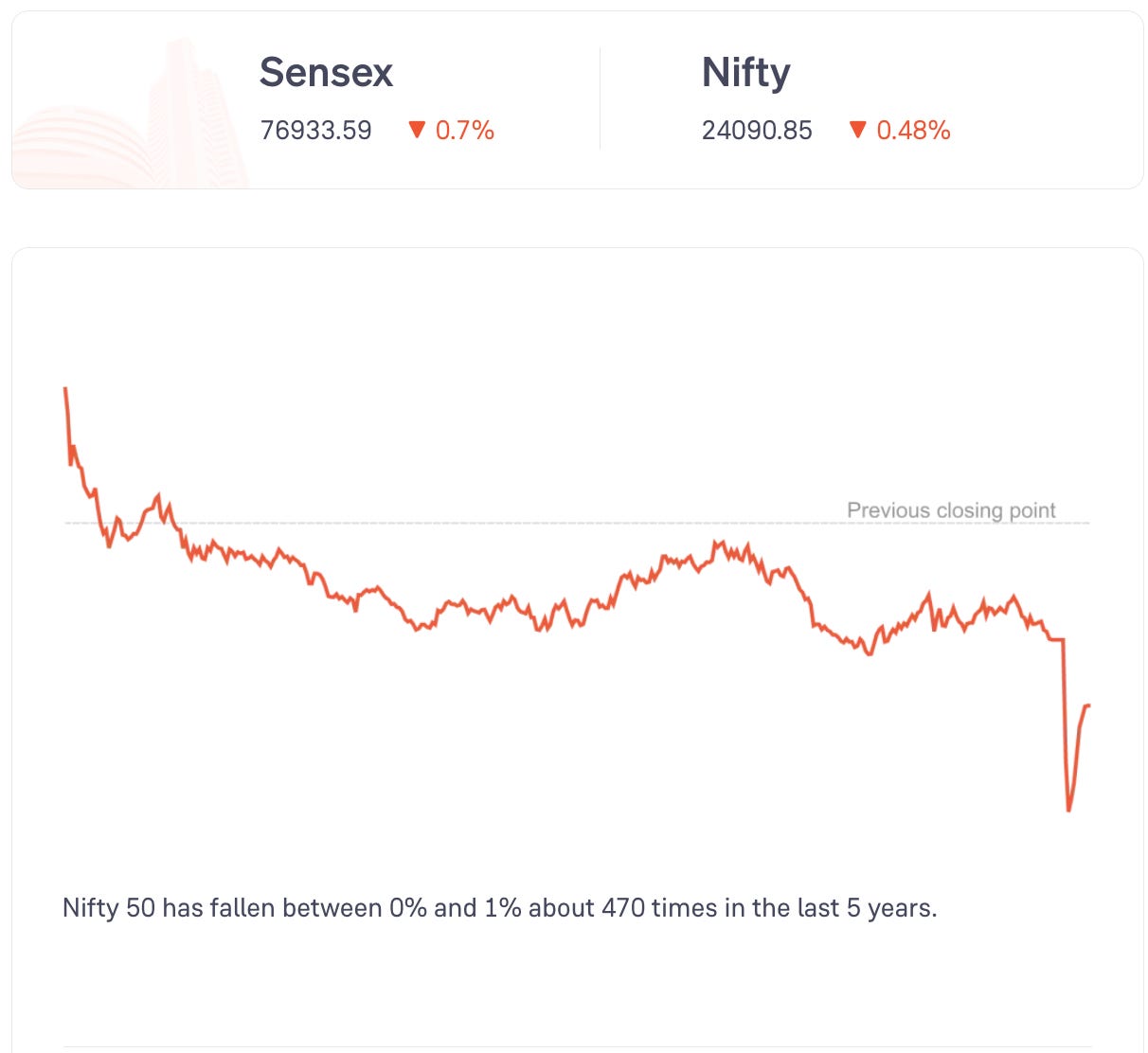
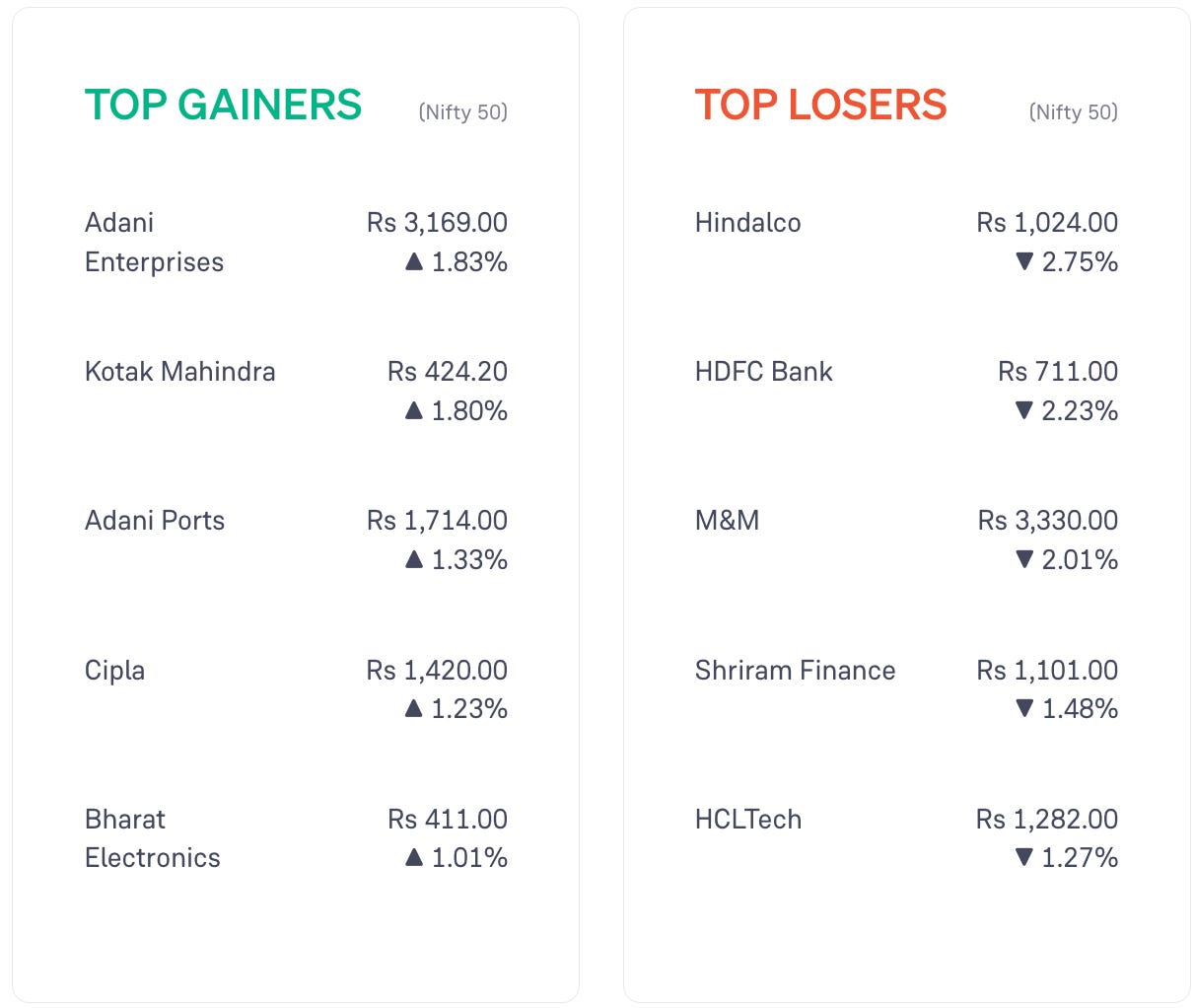
Markets closed lower compared to yesterday’s closing point.
Cement stocks and PSU Bank stocks fell the most today. Pharma stocks and healthcare stocks rose the most.
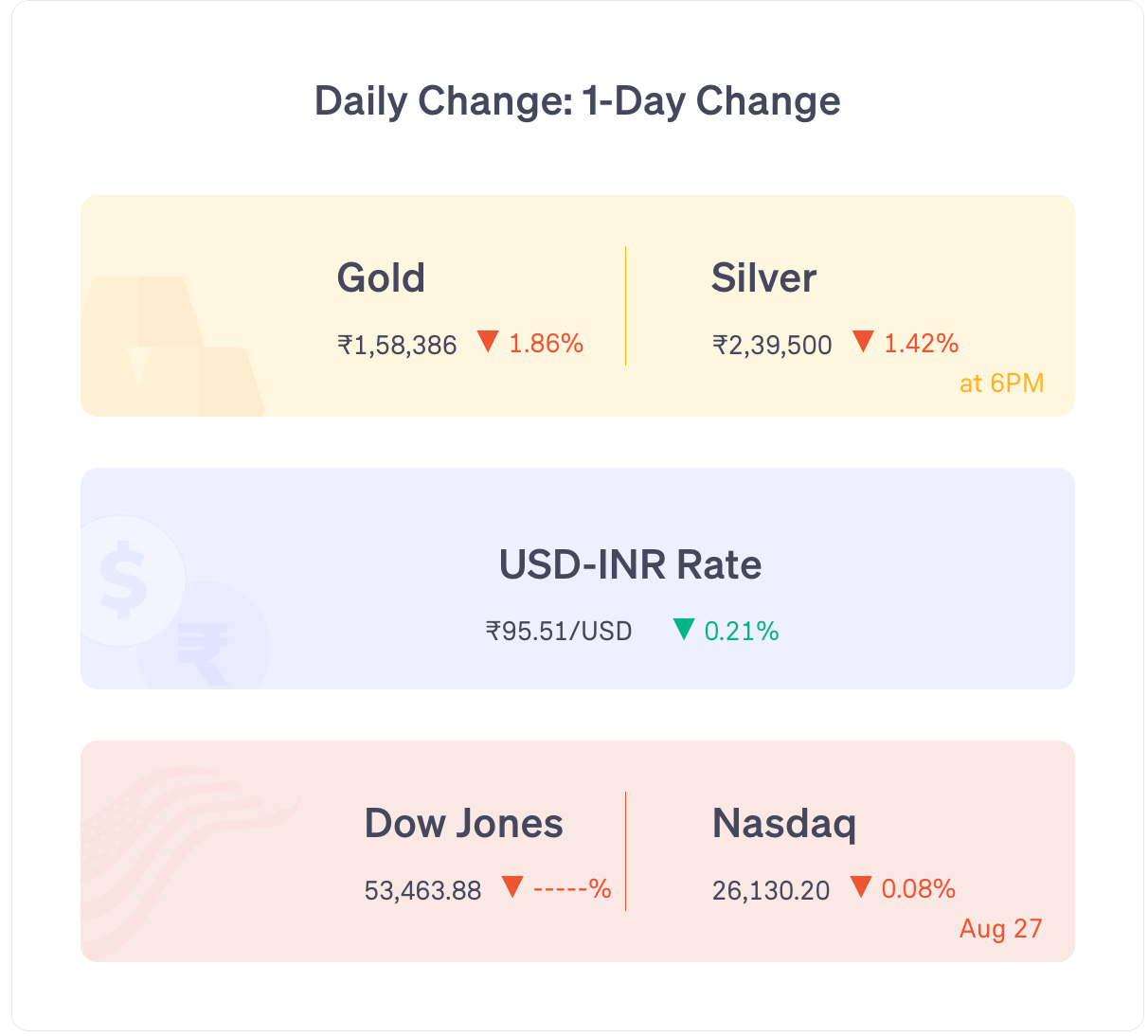
Global markets: US markets fell on Wednesday. Most Asian markets traded mixed on Thursday. Most European markets fell (as of 6 pm IST).
News
India’s merchandise and services exports rose 13.16% to $316.42 billion between April and July compared to $279.63 billion in the same period last year.
Symbiotec Pharmalab IPO was subscribed 71.26 times on day 4. Retail subscription: 12.96 times. The IPO closed for subscription.
Skyways Air Services IPO was subscribed 71.25 times on day 4. Retail subscription: 25.40 times. The IPO closed for subscription.
Lumino Industries IPO was subscribed 1.42 times on day 1. Retail subscription: 1.96 times. The IPO will close for subscription on 31 August.
Aragen Life Sciences filed for an IPO with Sebi. The IPO will comprise a fresh issue of Rs 800 crore and an Offer for Sale (OFS) of 2.7 crore shares.
Stocks Updates
Bajaj Finance: issued Rs 5,000 crore of secured NCDs at an 8.15% coupon rate, maturing in August 2036. LIC subscribed to the entire issue.
Adani Enterprises: joint venture AdaniConneX acquired 100% of Chandenvalle Infra Park Ltd from Adani Power for Rs 535.69 crore. The company owns sizeable land and key approvals, and AdaniConneX plans to use it to develop data-centre infrastructure.
Hindalco: commissioned India’s first superfine precipitated aluminium trihydrate (special form of aluminium) plant in Belagavi with an annual capacity of 30,000 tonnes, expandable to 60,000 tonnes. The specialty material is used in fire-retardant cables and other applications.
Tata Power: subsidiary Tata Power Renewable Energy commissioned a 72.5 MW captive solar project in Rajasthan for Tata Steel. The project is expected to generate 166 million units of power annually.
Info Edge: subsidiary Redstart Labs agreed to completely exit its 5.55% stake in SkyServe through a share repurchase.
Word of the Day
Greenshoe Option
It allows the underwriter in an IPO to sell up to 15% more shares than available.
A greenshoe option is also called an over-allotment option.
The underwriter is the investment bank that does the IPO filing of companies. They earn a commission based on the number of shares that are present in the IPO.
If a company signs a greenshoe option, the underwriter can sell more shares in the IPO than are available.
If the share price rises after the IPO, they can ask the company to give them the additional shares at the pre-IPO-listing price.
This move allows the share price to be more stabilised after the listing.
6 Day Course
Theme: quarterly reports
Day 4: Thursday
Continuing from yesterday, quarterly reports must also include:
Balance Sheet: companies’ assets, liabilities (debt, tax, unpaid bills, etc), equity.
Cash flow statement: this shows the movement of all kinds of money through the company, including all earnings, investments, debt repayments, earnings, etc.
Shareholder’s equity changes: the company must highlight changes in the shareholders’ funds.
The report must include an external auditor’s attestation stating that all the numbers in the quarterly report have been disclosed in adherence to the norms.
A similar statement of approval is also required from the CEO/MD.
Significant corporate events (like mergers, acquisitions, etc) must also be revealed.
The quarterly report must also include the management’s outlook on the company’s reported numbers.
Other governance and compliance-related disclosures must also be made.
————
Featured Question
Q. “What is the average return of investment through PMS? 2 How does it compare with investment through MFs?”
There are some online articles that state that many Portfolio Management Services (PMS) have not beaten Mutual Funds (MFs).
The reality is that PMS performance is not as publicly available.
Some PMS’ data is available, and others’ is not.
Some PMS have indeed performed extremely well. Many others have not been able to do any better than MFs.
PMS by nature are higher risk and high volatility.
This means that their returns can vary a lot more when compared to MFs.
Many PMS say timing is important in the case of investing in PMS.
Also, many PMS offer strategies catering to highly specialised and customised needs of investors.
We can’t make a comment on the average PMS returns since they all employ such highly specialised strategies that are vastly different from each other — so much so that comparing them would not be an apples to apples comparison.
The short answer is, it is difficult to say which is better.
It depends a lot on how individual investors handle their investments.
Many PMS are not handled personally by investors but are handled by certified investment advisors who are able to guide investors.
The information presented in this post has been compiled and prepared by Groww Invest Tech Pvt Ltd and is intended solely for informational purposes. It is not tailored to any specific investment objectives, financial situations, or needs of any individual investor. The content should not be construed as investment, financial, legal, or tax advice and should not be relied upon as a substitute for professional consultation.
Investing in securities markets involves inherent risks. Investors are advised to carefully review all relevant documents and consider their own risk tolerance before making any investment decisions.
Mutual fund investments are subject to market risks; please read all scheme-related documents carefully. Past performance of financial instruments, schemes, or markets is not indicative of future results.
Groww Invest Tech Pvt Ltd is registered with the Securities and Exchange Board of India (SEBI) under Registration No: INZ000301838, as a Research Analyst under No: INH200008662, as a Depository Participant under No: IN-DP-417-2019, and with the Association of Mutual Funds in India (AMFI) under ARN-111686.
SEBI registration details: View registered name and registration numbers
Research Analyst Disclaimer: View Research Analyst disclaimer
Did you like this edition?
Leave a feedback here!
very useful information