
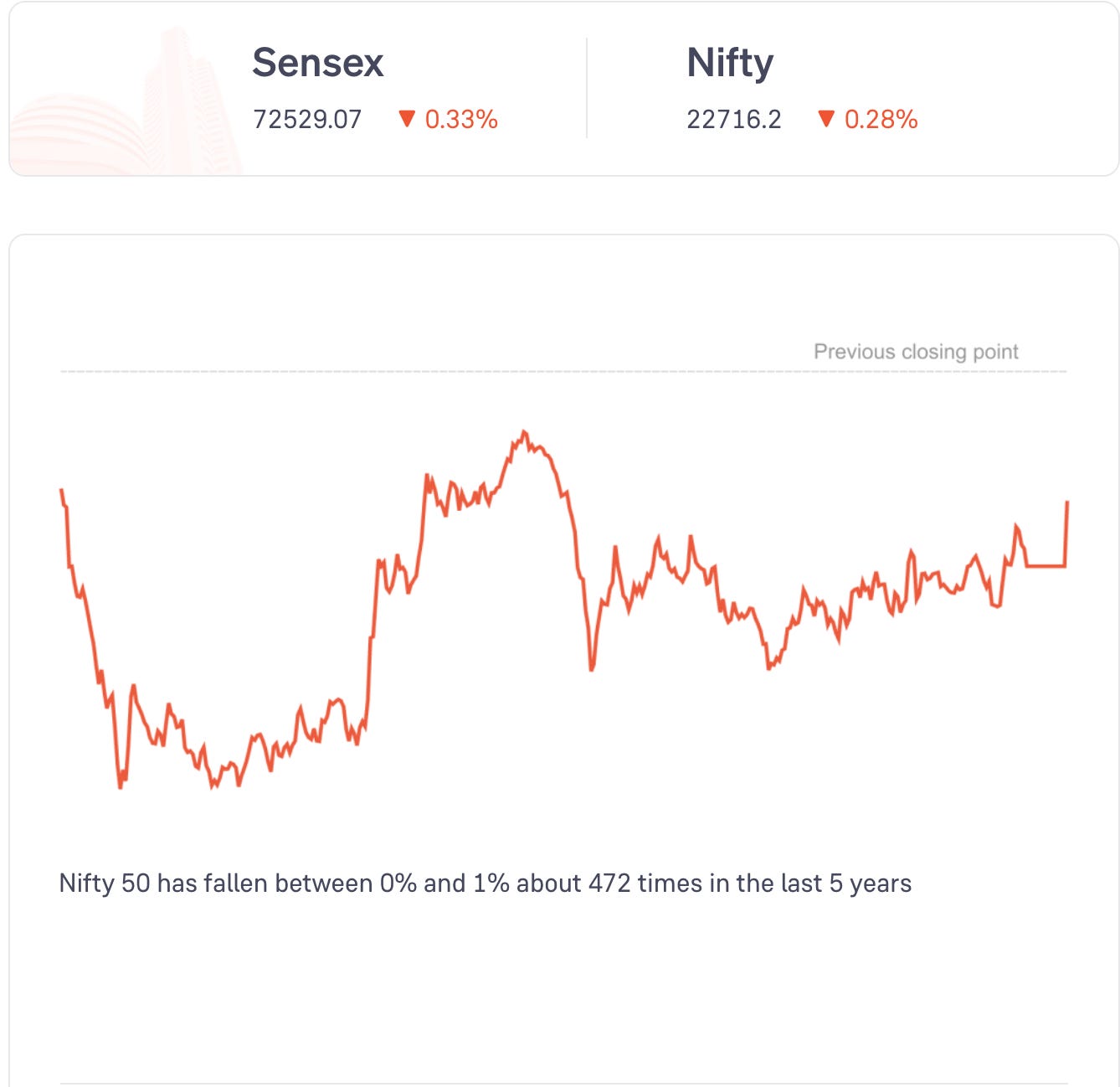
Markets ended lower compared to yesterday’s closing point. Nifty and Sensex opened lower, rose around 11 am but ended in red.
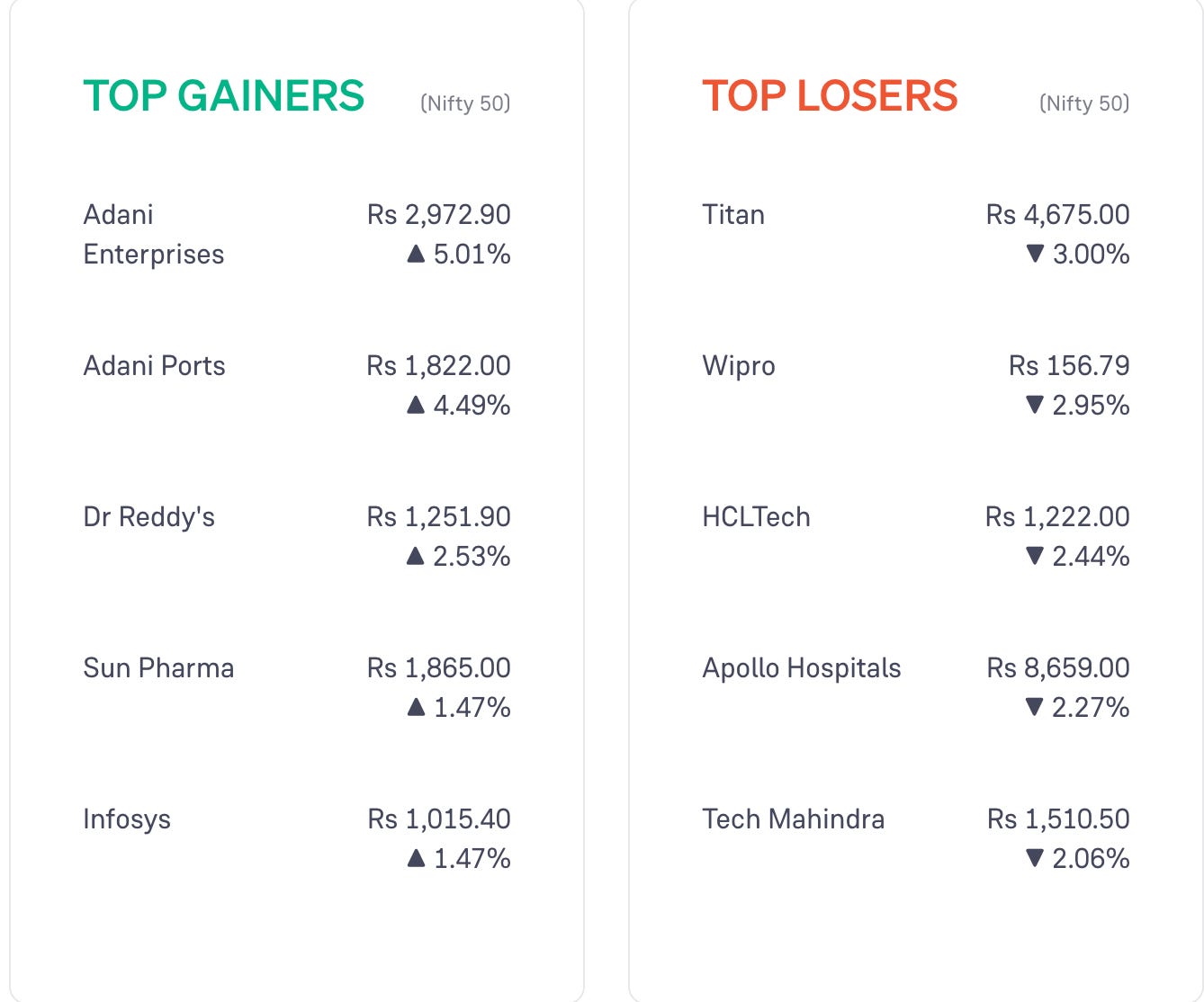
Consumer durable stocks and chemical stocks fell the most today. Metal stocks and pharma stocks rose the most.
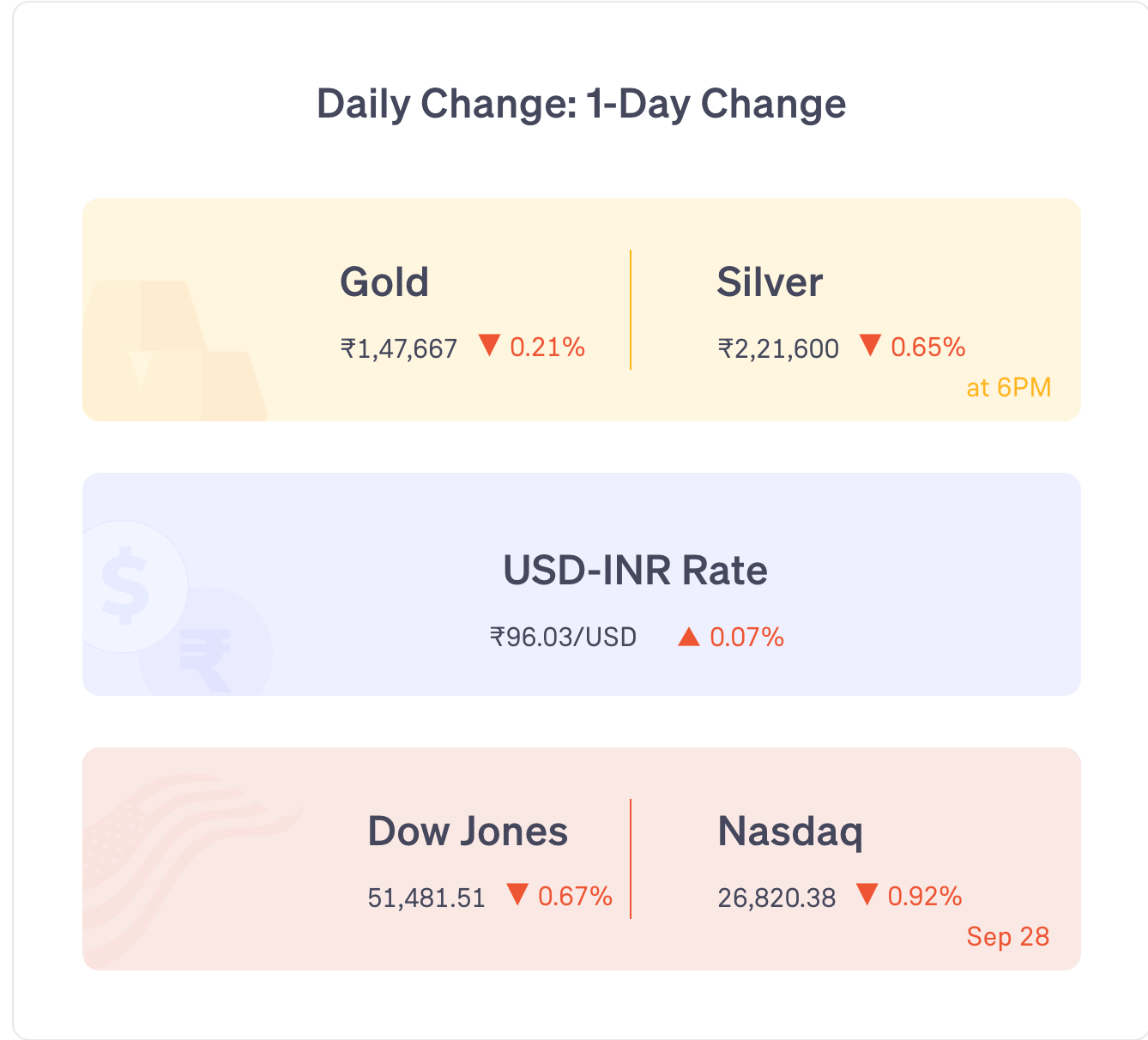
Global markets: US markets fell on Monday. Most Asian markets closed lower on Tuesday. European markets showed a mixed trend (as of 6 pm IST).
News
BSE Ltd stock will enter Nifty 50 from tomorrow and Wipro will exit in accordance with the NSE release in August.
17 out of 19 sub-sectors rose as per Index of Services Production (ISP) data for July 2026. Only repair services and air transport fell.
SEBI settled non-compliance with minimum public shareholding proceedings against Adani Group Chairman Gautam Adani and 4 other group companies for a settlement amount of Rs 1.48 crore.
EverBrands India which operates restaurant brands like Subway, Lavazza and Dilmah, filed DRHP for an IPO. The issue will comprise a fresh issue of Rs 600 crore with no offer for sale component.
IPO Corner
Orient Cables’ Rs 552 crore IPO was subscribed 92.27 times on day 3. Retail subscription: 30.55 times. The IPO is closed for subscription.
Runwal Enterprises’ Rs 500 crore IPO was subscribed 2.50 times on day 3. Retail subscription: 1.12 times. The IPO is closed for subscription.
Varmora Granito listed at Rs 155 on NSE, a premium of 4.73% over its issue price and closed 0.95% higher.
Stock Updates
ITC: acquired the remaining stake in Sproutlife Foods (Yoga Bar owner) for about Rs 645 crore, increasing its holding from around 47.5% to 100%.
HCLTech: will acquire Croatia-based automation software company Robotiq.ai for 9 million Euros.
Coal India: signed a non-binding MoU with Hindustan Urvarak & Rasayan Ltd to explore a coal-to-urea project at Sindri, Jharkhand.
Shriram Finance: will buy back about $460 million of its overseas bonds and pay about $479 million in total, including interest. The bought-back bonds will be cancelled.
Tata Steel: invested another $340 million (around Rs 3,260 crore) in its overseas subsidiary T Steel Holdings. This is part of its earlier approved plan to invest up to $2 billion.
Tata Motors: subsidiary TSCMSL and Mateshwari Urban Transport Solutions won a tender to operate and maintain electric buses for Telangana’s state transport corporation.
Bank of Baroda: one of its auditors will not review the Sept-quarter results because it reached the regulatory limit on audit assignments. The bank said this is not a resignation or disagreement.
GMR Airports: prepaid Rs 1,500 crore of bonds ahead of their 2028 maturities, along with accrued interest and redemption premium.
Ambuja Cements: shareholders approved the merger of Orient Cement into Ambuja Cements. The merger still needs final NCLT approval.
JSW Energy: raised Rs 500 crore through unsecured NCDs at 7.90% interest rate, maturing in Sept 2033.
Word of the Day
Due Diligence
It is a detailed analysis performed on a company, investment asset, deal, etc
Due diligence is usually done before an investment, transaction, or deal takes place.
It includes auditing, systems investigation, and analysis of other factors.
Due diligence can include aspects like financial health, accounting accuracy, identifying risks, checking legal and regulatory compliance, etc.
Example: investors often perform due diligence on companies in which they wish to invest money.
6 Day Course
Theme: US Fed rate changes
Day 2: Tuesday
Continuing from yesterday, we spoke about investors not keeping allocation percentages constant.
It greatly depends on the money returns they are able to make risk-free.
What does this mean?
If the US Fed reduces its interest rates, the government bond returns also become lower.
This means investors need to invest more money elsewhere if they want to earn higher returns (riskier bonds, share markets, emerging markets, etc).
Example:
Allocation before US Fed lowered interests rates:
20% in US govt bonds, 60% in US stocks, 20% in emerging markets stocks.
Say the US Fed decreased interest rates by 0.5%.
Allocation after US Fed lowered interests rates:
16% in US govt bonds, 62% in US stocks, 22% in emerging markets stocks.
The opposite also happens when the US Fed increases rates: more money gets shifted to US government bonds.
Featured Question
Q. “difference between buying share on nse & bse both show same script then why on both exchange not in one which is good between them to buy ?”
They are the same shares being available on two different exchanges.
Think about it like this: you can buy a Sony brand TV from Reliance Digital, Tata Croma, Sony World, etc.
It’s the same TV model available at different outlets.
Similarly, in India, we have two main active stock exchanges: BSE and NSE.
Most major shares are listed on both the exchanges.
Some stocks are available only on one exchange. That means those stocks can be bought and sold only on that one exchange.
For all other major stocks, they are available on both exchanges.
Companies tend to list on both exchanges in order to be able to reach more investors.
The price of stocks are almost the same on both exchanges.
This is because when the share price falls on one exchange, investors start quickly buying the stocks on the exchange where it is cheaper.
And then they sell the shares on the other exchange where it is more expensive.
This happens in milliseconds and it is performed by institutional investors who are able to trade very fast.
The price difference makes for a quick profit.
Because of this quick buying and selling, the price starts rising on the first exchange and falling on the other exchange.
This is why the gap in price on both exchanges is very small.
They are almost the same price. Sometimes it will be slightly more on one exchange and sometimes the other.
Practically speaking, it does not matter which exchange you buy the shares from.
The only time it matters is if you are trying to profit from the price difference — which is mostly not possible for individual investors. It is done by HFTs and other institutional investors.
————
Did you like this edition?
Leave a feedback here!