

Everest gets 600 to 1,000 climbers per year.
Most of these climbs happen in the March to May window.
The weather is too extreme during other months.
Climbing the world’s tallest mountain is no easy task. It is a daring task. One that many want to be able to boast about.
Climbing works in an organised manner.
Aspiring climbers have to team up with local tour companies that specialize in this endeavour. Those companies have experienced mountaineers leading the expeditions.
These mountaineers team up with locals called Sherpas who are extremely adept at climbing the mountains.
On the way, there are 5 camps. The first is base camp. This has all support like food, shelter, medical aid, etc.
Then, there are camps 1, 2, 3, and 4.
Camp 4 is the last camp before climbers depart for the peak. The journey between these camps is roughly 4-12 hours long.
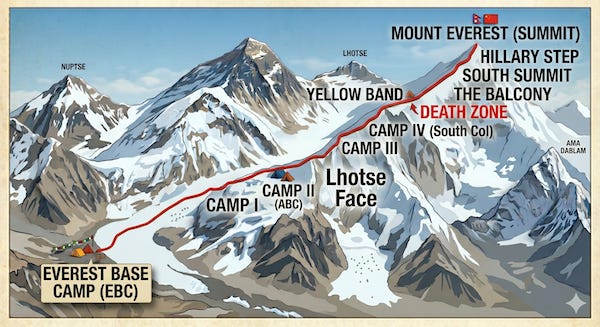
At each camp, climbers rest for a few days to acclimate to the height and lack of oxygen. At the top, there is only 1/3rd the oxygen there is at sea level.
The final camp is Camp 4.
After Camp 4, most climbers use oxygen cylinders to climb further, as the air is too thin. Some daring climbers do climb without cylinders, though.
From Camp 4, climbers start at night. The aim is to reach the peak by late morning. After touching the peak, they start to descend.
They maintain a cutoff time of 2 PM. They must turn around by 2 PM.
If they have not reached the peak, they must abandon the idea of reaching it and turn around.
The data are not crystal clear but 60-70% of climbers make it to the top. The rest return to Camp 4 without touching the summit.
All in, a little over 99% of the successful climbers return. The remaining small number is the percentage of people who die on the expedition — between 0.5% and 1%.
As far as expeditions go, the odds of survival seem pretty good.
May 1996
On the 10th of May 1996, a group set off from Camp 4.
This group was an eclectic mix.
Two of the most reputed mountaineers led the groups. Along with them were other experienced mountaineers, a journalist, a socialite, adventure junkies, and Sherpas.
There was another group that was on this expedition on the same day. It was a group of ITBP jawans.
In total, there were over 30 people headed for the summit.
Like every other group, they started at night.
The weather was stable. Many climbers were using oxygen cylinders.
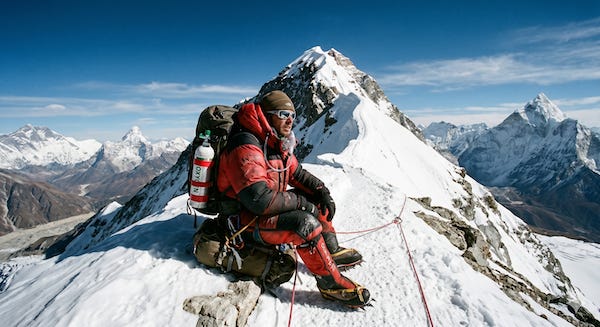
By the morning around 6 AM, they had reached the first major milestone.
By 9 AM, they had reached the next milestone.
Beyond this, the trek leads and Sherpas noticed that the ropes that climbers held on to while climbing the steep climb were missing.
This was a setback, but not rare. In these regions, this happens.
The Sherpas set off, putting new ropes for the climbers to use.
It took 1-2 hours for the ropes to be set, which is when the climbers started climbing again.
The climbers were not all together. They were spread out with gaps of around 1-2 hours. So while the first few climbers touched the summit and turned around, many others were behind and still climbing.
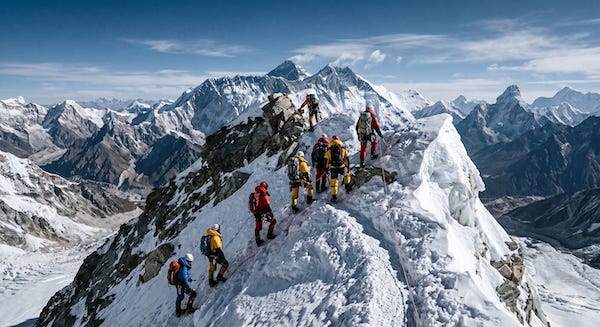
Several climbers reach the summit by 2 PM and turn around.
Among the climbers were two expedition leads with their own respective clients.
A client named Doug had attempted and failed the year before. His lead, Rob, was eager to help him.
They had not reached the summit by 2 PM, but were quite close to it.
Probably backed by his experience of climbing Everest several times, Rob decided that going past 2 PM for a few minutes would not be a big deal.
A few other climbers also decided the same.
1% Chances
To make a long story short, they became a part of the 1% of climbers who do not make it back alive.
When they started descending, they had consumed more of their oxygen cylinders. There was not enough oxygen to last them too long.
Tired from the arduous climb, they struggled to move fast.
Sometime between 2 and 4 PM, the weather started to worsen unexpectedly. A severe snowstorm hit between 4 and 6 PM, leaving many climbers to run for cover.
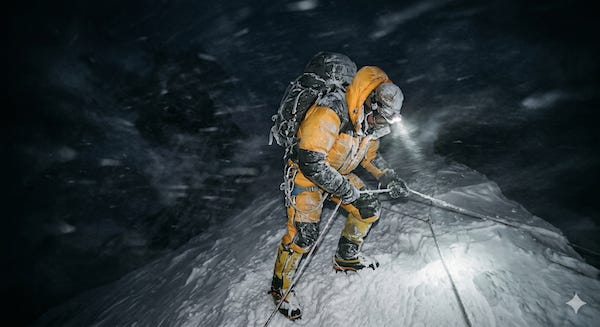
Many climbers got lost in the chaos.
The low oxygen and fatigue made critical thinking that much more difficult.
They remain stuck and stranded for the night in extreme conditions.
By the time the storm cleared, various climbers remained stuck at different points in the path.
Some made a desperate attempt to reach Camp 4 and succeeded. Others tragically died.
A total of 8 lives were lost. It was one of the worst accidents in the history of the Everest expedition.
Low Probability of Ruin
This is one of the most classic cases of probabilities being misunderstood.
Let’s say you are flipping a coin. Heads vs tails.
If you start counting the heads and tails, eventually, the distribution will be 50:50.
In the start, when the number of flips is low, this number could be varied. But as you increase the number of flips, the distribution will be closer to 50:50.
But flipping a coin does not harm you.
If you keep betting on heads and keep getting tails in the start, there’s no harm. Eventually, you will be right about the 50:50 ratio.
So you can continue playing this game since you know the probability in the long run.
But what if heads means you will get Rs 1 lakh and tails means you will be shot dead? Will you then consider playing this game?
Will probabilities still apply when you are unable to play the game in the long run?
In the second case it seems like a dumb idea to play (no matter what the probability).
So a game like that must never be played.
What if you were allowed to play multiple rounds but would be shot dead if you had accumulated 5 tails but a lower number of heads?
Then maybe you could try your luck, and if you accumulated 4 tails and a lower number of heads, you could quit before risking your life.
This way, you are taking advantage of the risk but ensuring there’s enough safety margin to continue to live.
In short, you are taking a risk, but not ruining yourself.
Or, if there is a probability of ruin, you shouldn’t play the game.
On Everest, the 2 PM rule was a generally accepted cutoff time after which the probability of a disaster was too high.
It didn’t mean if you stayed past 2 PM, you would see a snowstorm. But you could.
Before 2 PM? That chance was much much lower.
The climbers who have turned around before 2 PM from the summit have mostly made it back just fine.
In the world of finance, what this means is that you never make an investment such that you could be ruined.
Once your investment value is Rs 0, it gets incredibly hard to climb back up.
In short, have a “2 PM” amount from which you can recover even if your high-risk investments don’t perform as planned.
This is why we don’t always invest all our money in the ‘highest returns’ option.
Some money must be kept in low-risk options (which often means low returns).
Quick Takes
+ India’s infrastructure output of core industries fell by 0.4% year-on-year in March. Coal, crude oil, fertilisers and electricity output fell while natural gas, steel, cement and petroleum refinery products output rose.
+ India and South Korea signed 15 agreements to boost cooperation in areas like trade, AI, and shipbuilding, and aim to double bilateral trade to $50 billion by 2030.
+ The Ministry of Defence signed contracts worth Rs 975 crore with Bharat Earth Movers Limited (BEML) and Electro Pneumatics and Hydraulics (India) Private Limited for the procurement of TRAWL Assembly for T-72 and T-90 tanks.
+ SEBI has reduced the minimum investment in social impact funds from Rs 2 lakh to Rs 1,000 to widen retail participation on the Social Stock Exchange.
+ The RBI has issued new rules for recurring digital payments (e-mandates) allowing auto-debits up to Rs 15,000 without extra authentication after one-time approval. It also included pre and post payment alerts, security checks, and better control over subscriptions and auto-debits.
+ A SEBI panel has recommended that the National Stock Exchange (NSE) pay about Rs 1,800 crore to settle its long-pending regulatory cases: as per media reports.
+ India’s manufacturing PMI rose to 55.9 in April vs (53.9 in March) as per preliminary estimates. Services PMI rose to 57.9 (vs 57.5 in March). Composite PMI (manufacturing + services) rose to 58.30 (vs 57.0 in March). This means economic activity rose more in April than in March.
+ India’s forex reserves rose by $2.36 billion to $703.31 billion in the week that ended on 17 April.
+ India’s net FDI turned positive to $4.6 billion in Feb after six months of outflows.
The information contained in this Groww Digest is purely for knowledge. This Groww Digest does not contain any recommendations or advice.
Team Groww Digest
Brilliant way to explain risk. Markets, like Everest, don’t punish you for being wrong; they punish you for staying too long. The real edge isn’t chasing the summit, it is knowing when to turn back