

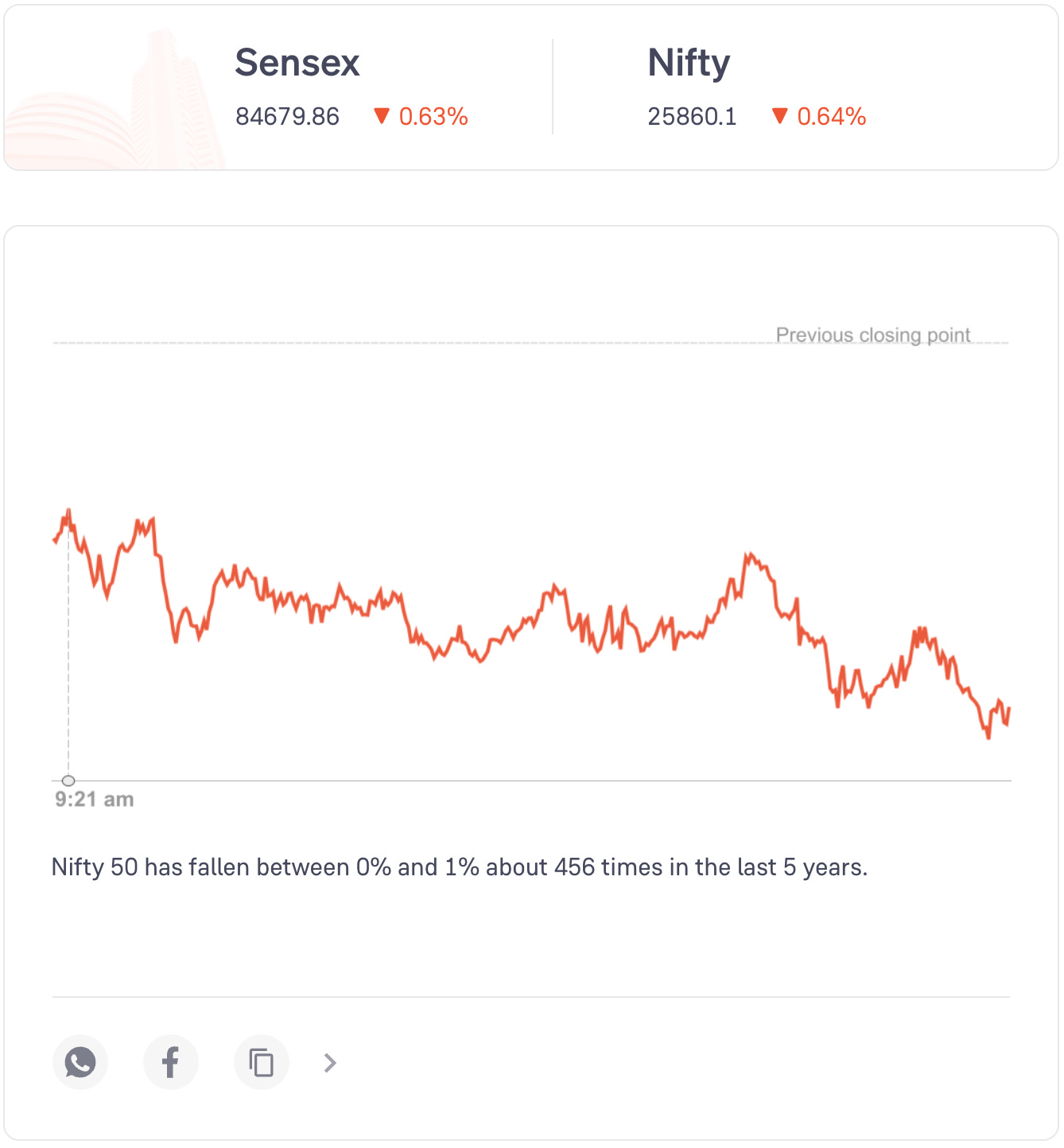
Markets opened below yesterday’s closing point.
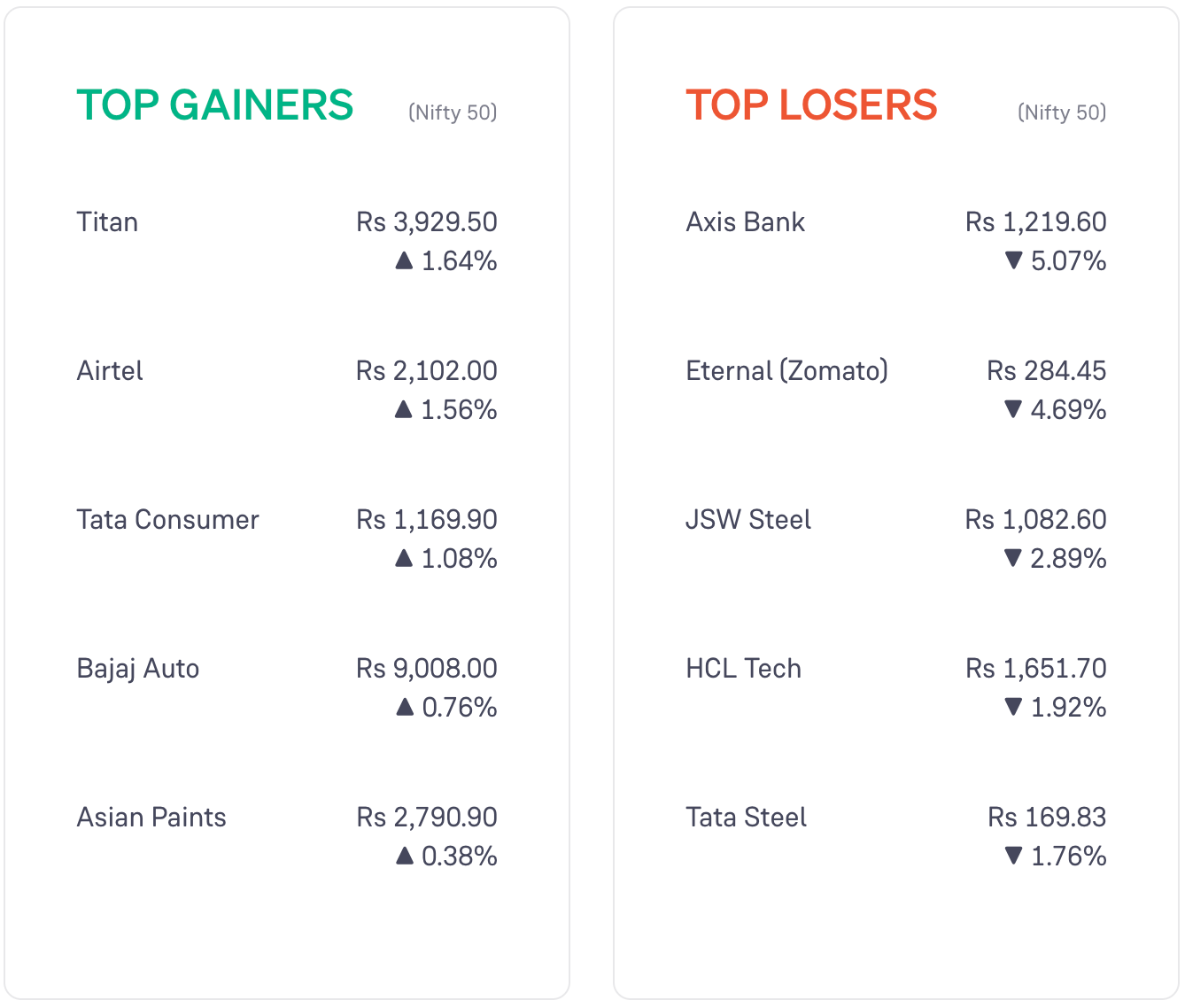
All sectors’ stocks fell today except for the consumer durables stocks and media stocks. Realty stocks and private bank stocks fell the most.
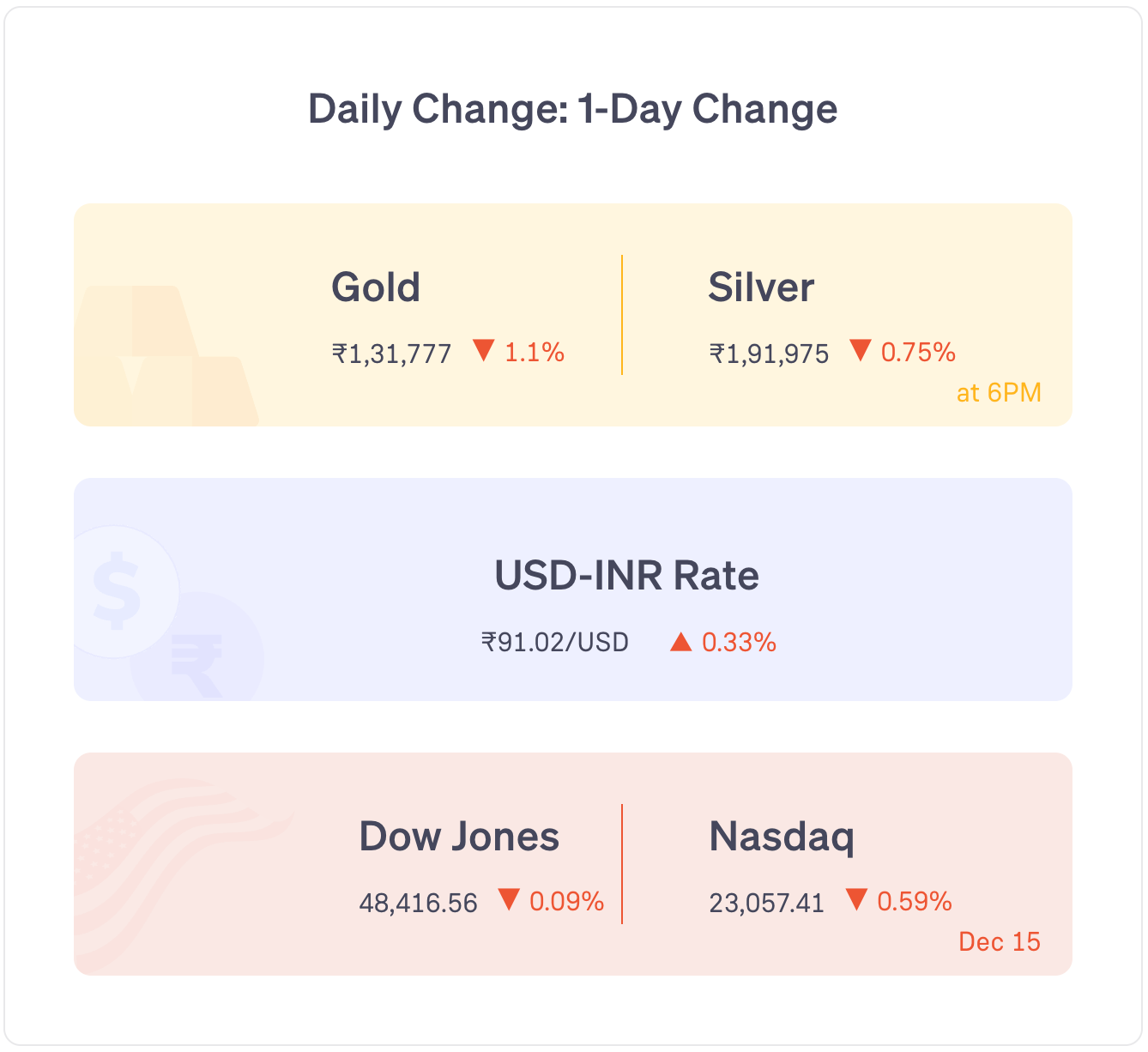
Global markets: Most US markets closed almost flat. Asian markets and most European markets fell (as of 6 pm IST).
News
India’s manufacturing PMI fell to 55.7 in Dec (vs 56.6 in Nov) as per preliminary estimates. Services PMI fell to 59.1 (vs 59.8 in Nov). Composite PMI (manufacturing + services) fell to 58.9 (vs 59.7 in Nov).
KSH International IPO has been subscribed 0.15 times. Retail subscription: 0.27 times. IPO closes on 18 Dec.
ICICI Prudential AMC IPO was subscribed 39.17 times. Retail subscription: 2.53 times. IPO is closed for subscription.
Stocks Updates
Coal India: announced ‘Mr B. Sairam’ as its new Chairman-cum-Managing Director, effective from 15 Dec.
SRF: received an ITAT update showing a potential Rs 99 crore reduction in its tax liability over carbon credit treatment. The tax dispute is about whether these carbon credits should be taxed or treated as tax-free capital receipts.
HDFC Bank: the RBI allowed HDFC Bank and its group entities to hold up to 9.5% of IndusInd Bank’s share capital or voting rights for 1 year.
Power Grid: was declared the winning bidder for a major inter-state transmission project connecting the Southern and Eastern grids. It comprises 765 kV transmission lines in Odisha and Andhra Pradesh.
Tata Power: the company’s CEO said that they will finalize a Rs 6,500 crore, 10 GW wafer-ingot solar manufacturing project by Jan (in Odisha, Tamil Nadu, and Andhra Pradesh).
Vedanta: clarified that NCLT has approved its demerger scheme, and a detailed disclosure will be published once the official order is uploaded.
Vodafone Idea: received a GST order with a Rs 40.09 lakh penalty over input tax credit, which it plans to challenge.
Hitachi Energy: received a customs order for over Rs 9 crore (duty + penalty + fines), which it plans to challenge.
Word of the Day
Contingent Liability
It is the possible cost that a company might have to pay in the future
It depends on whether a certain event happens or not.
If the event seems likely and the cost can be estimated, the company shows it in its financial statements by recording it as a liability.
Example: say a company is being sued. The outcome of the case is uncertain.
If the company loses, it may have to pay a settlement. The company would account for that money as contingent liability until the case is resolved.
6 Day Course
Theme: rebalancing
Day 2: Tuesday
How often?
This question often comes up while the topic of rebalancing is discussed.
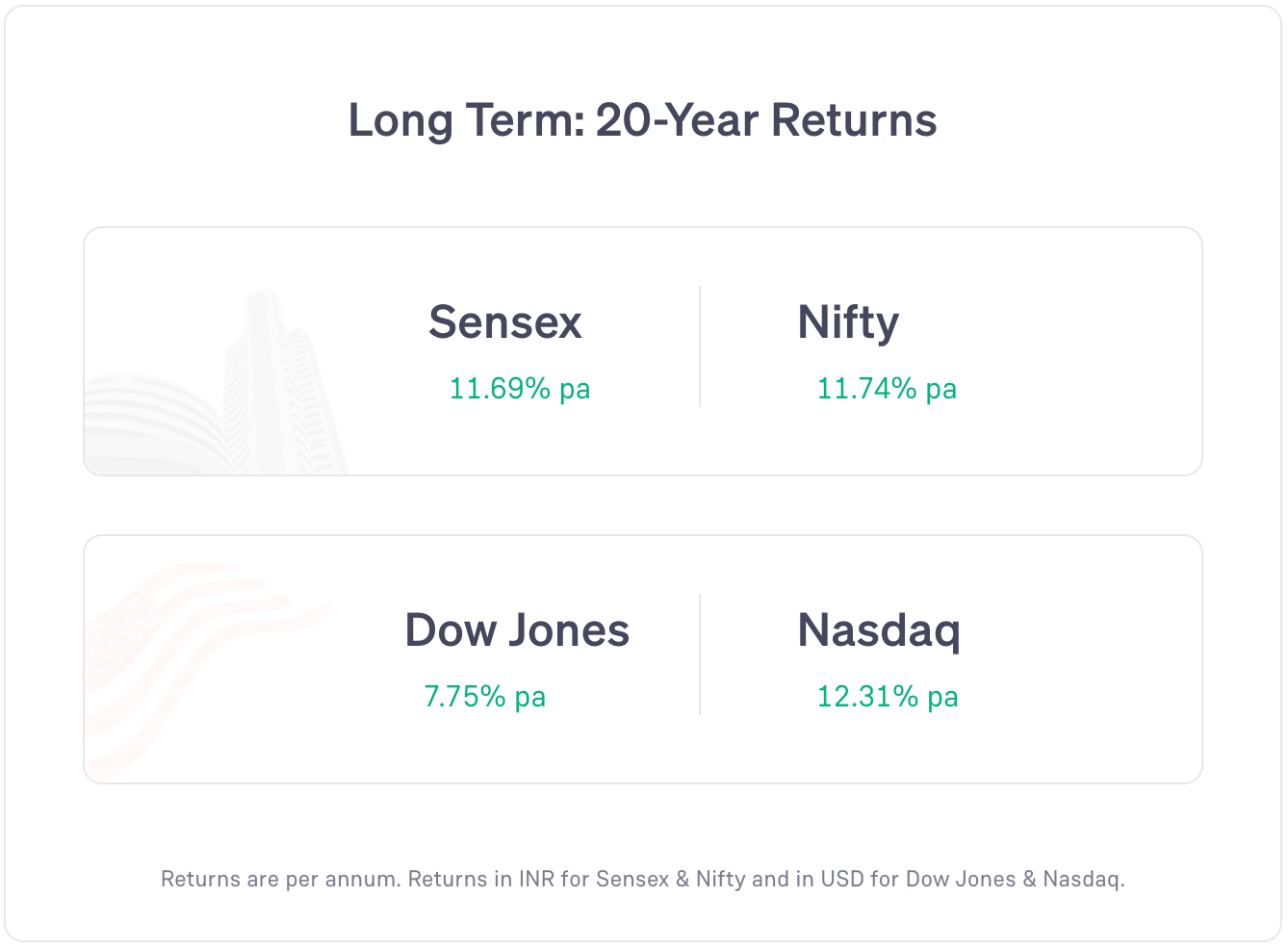
The fact is, assets like equities and gold never have smooth journeys.
They are always moving up or down — they are volatile.
If an investor sits and calculates his total investments’ value across different assets, the percentages will appear to change all the time.
Additionally, withdrawing money from one asset and investing in another asset too frequently will result in too much tax being paid — which ends up reducing the total gains.
Keeping both these factors in mind, investors generally do not rebalance their investments in a period of less than one year.
Some investors rebalance around the 1 year mark though many believe that it is too soon.
Some investors believe rebalancing every 3-5 years is the right frequency.
Further, many other investors opt for durations even longer than that — 7 or 10 years.
Featured Question
Q. “It is often said that investing in equity mutual funds should be a long term investment. But is it okay if one withdraws an equity mutual fund to invest in real estate etc. as these also appreciate in the long run?”
Investing in equity mutual funds must be done for the long term, yes.
But what should a person do when they find a better option to invest in?
In such cases, investors must calculate how much more returns they are making, and how much tax they will have to pay simply to take out money from one asset and invest in another asset.
If the difference in returns is small, then it does not make sense, as too much money is lost in paying taxes.
On the other hand, if the difference is large, it makes sense to pay taxes and still invest in the new asset.
So please calculate the taxes you will have to pay when you withdraw from your equity mutual funds.
Also calculate how much you expect the new asset (real estate in your case) is likely to grow.
Based on these, you can make an informed decision.
Also do note, real estate returns can be very different for different areas and factors.
Some areas’ real estate prices go up fast while others don’t.
They are also not linear or predictable.
Just because a particular area’s real estate price has done well does not mean it will continue to perform in that manner in the future also.
In short: do your research carefully, then compare the taxes and possible future returns.
Did you like this edition?
Leave a feedback here!