
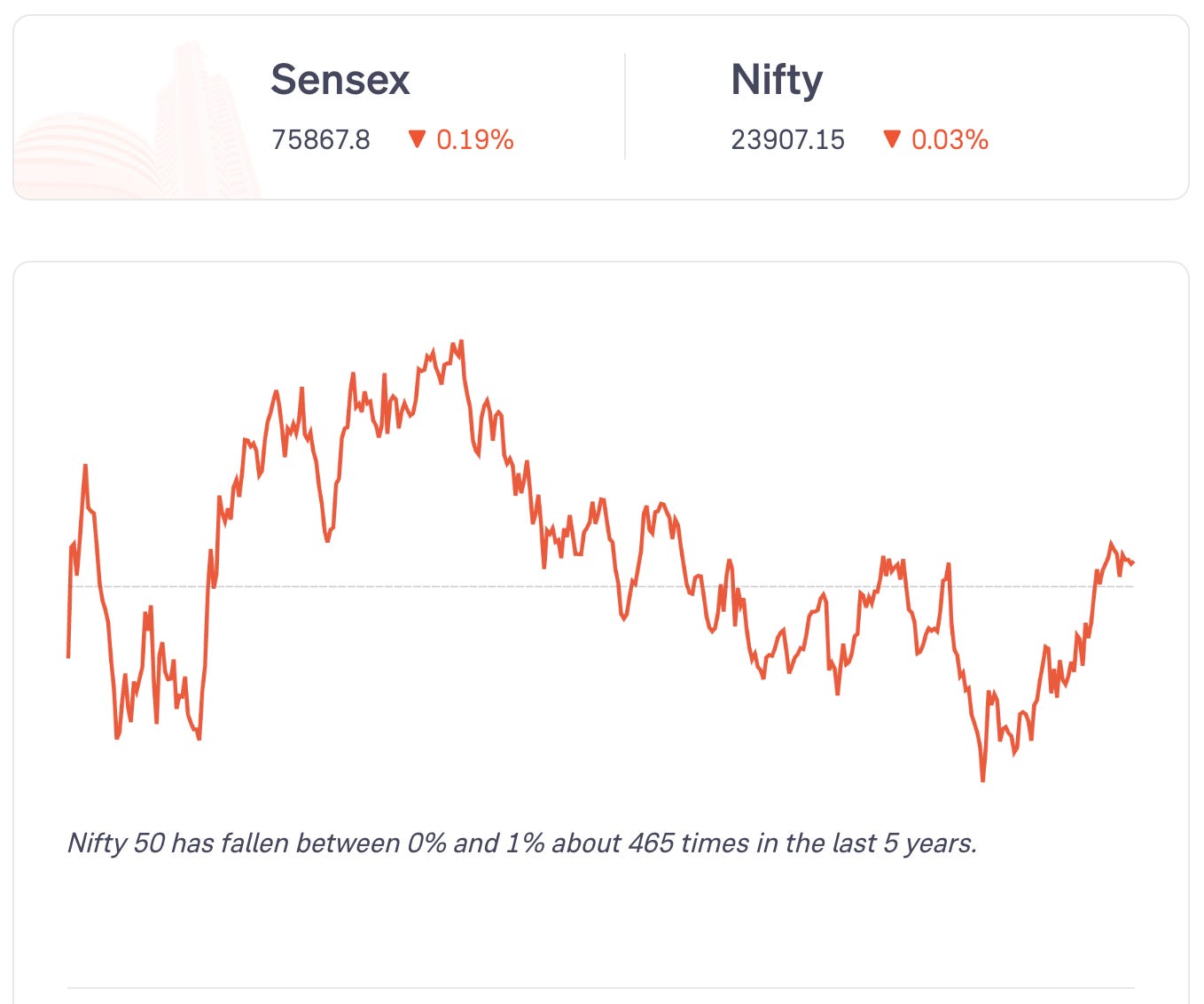
Markets opened below yesterday’s closing point.
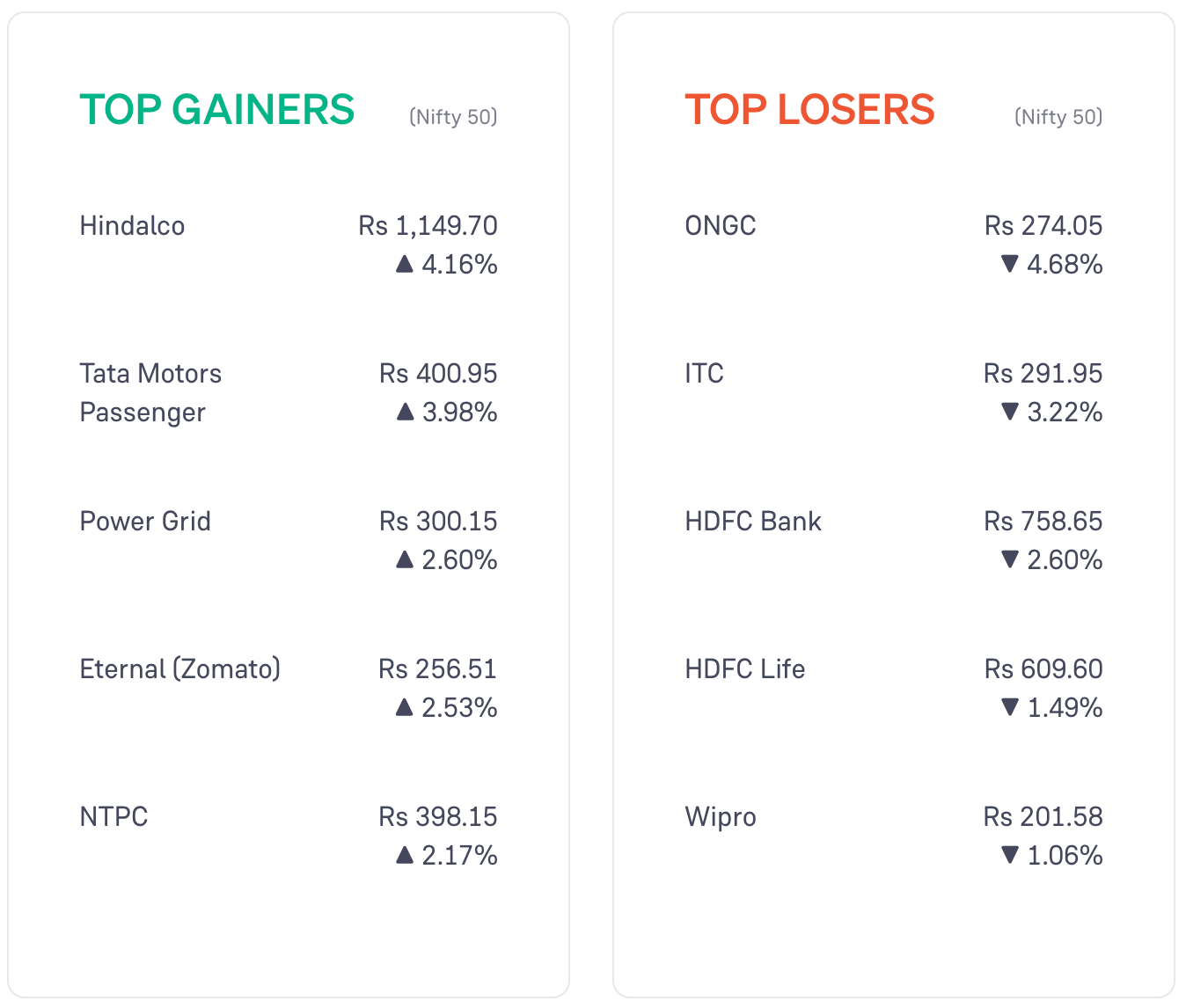
Media stocks and metal stocks rose the most today. Private bank stocks and oil & gas stocks fell the most.
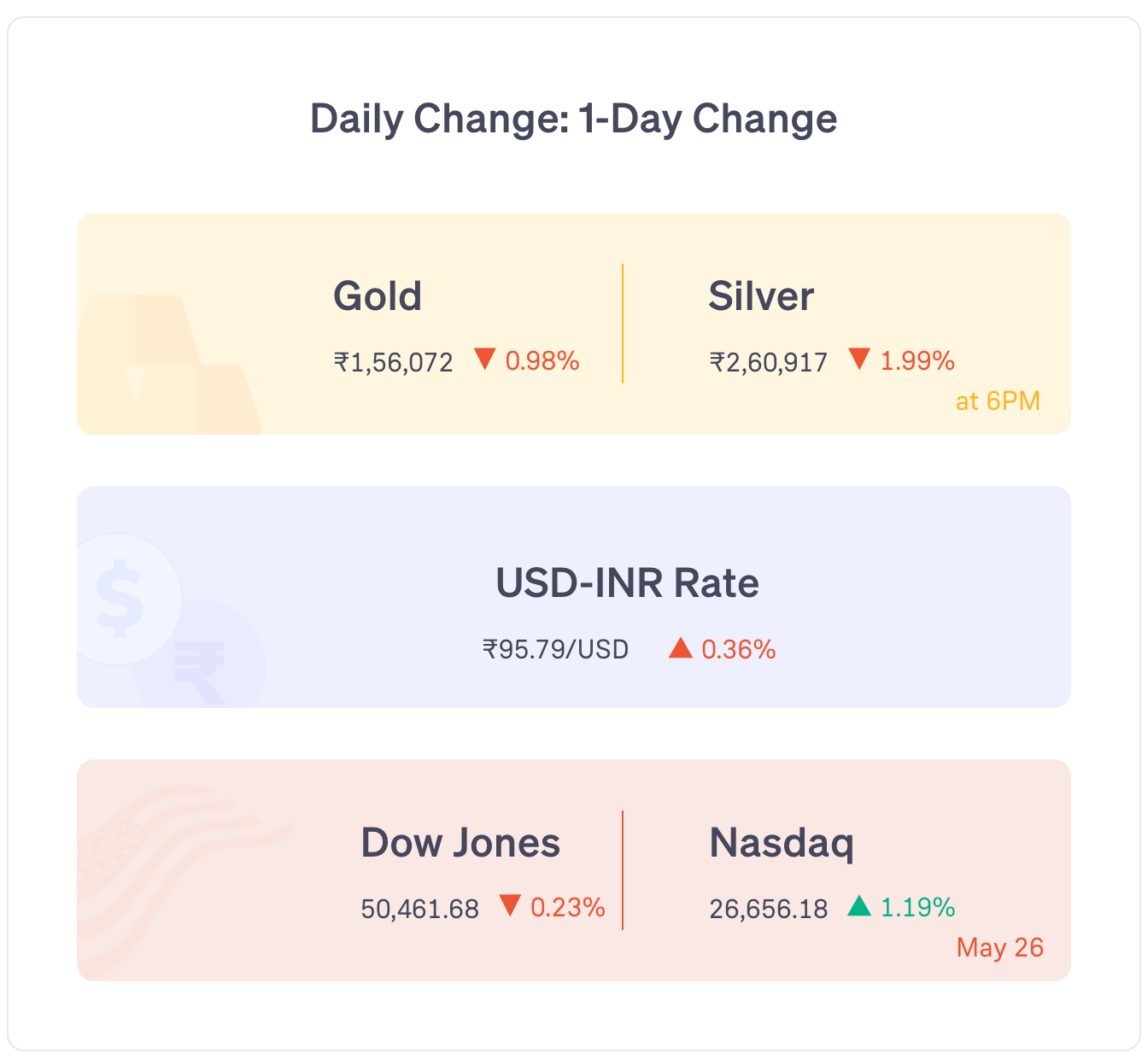
Global markets: Most US markets rose. Asian markets showed a mixed trend. European markets rose (as of 6 pm IST).
News
The government approved Rs 1,427.61 crore for a 4-lane Thiruvarur Bypass on NH-83 in Tamil Nadu.
The government has launched a 2 day offer-for-sale (OFS) for Coal India to divest up to a 2% stake in the company.
Stocks Updates
Hitachi Energy India: net profit rose 79.7% year-on-year to Rs 330.46 crore in the Jan-March quarter. Dividend announced: Rs 8 per share, with record date 21 Aug.
Siemens: net profit fell 36.4% year-on-year to Rs 370.4 crore in the Jan-March quarter. Dividend announced: Rs 18 per share.
Coal India: company has clarified over reports of coal shortage for power generation, stating it has adequate coal stocks for energy requirements.
Union Bank: company aims to raise Rs 8,000 crore via equity & debt modes to strengthen its base capital.
L&T: company’s wholly owned subsidiary L&T GeoStructure has received signifcant orders (Rs 1,000 cr - Rs 2,500 cr) from multiple clients including JSW Steel, and Inland Waterways of India.
Adani Green: has commissioned world’s largest single-location battery energy storage system outside China, with 3.37 GWh capacity.
Word of the Day
SPV (Special Purpose Vehicle)
It is a separate legal entity created for a specific business purpose, project, or transaction.
Companies often create SPVs to isolate financial risk, raise funds, hold assets, or execute large infrastructure and investment projects.
The SPV operates independently from the parent company. This means if the SPV fails, the parent company is protected, and if the parent company fails, the SPV’s assets usually remain safe.
SPVs are often temporary and are dissolved once the specific project is completed.
SPVs can be seen in sectors like infrastructure, real estate, renewable energy, etc.
6 Day Course
Theme: understanding alpha
Day 3: Wednesday
Every investor tries to make alpha from whatever they are investing.
A fund manager in charge of running a mid-cap mutual fund wants to generate alpha compared to the mid-cap benchmark index.
Even debt fund managers have a benchmark they are trying to beat.
Individual stocks investors also aim to generate alpha. If they do not generate an alpha over a long term, there is little point to investing. They can simply invest in an index fund instead.
The real challenge is generating alpha consistently.
In the US, many fund managers are struggling to generate alpha.
This means that their funds gives less returns than their benchmark index returns.
Why is that?
It’s mostly attributed to the markets being more “efficient”.
Alpha returns come from investing mis-priced assets.
Example: there’s a good company but its share price is still low because investors haven’t discovered it yet. In a more “efficient” market, news spreads fast and good companies’ stocks don’t remain cheap for a long time..
Featured Question
Q. “Does one need to have deep domain expertise of the industry when picking stocks? Like knowing IT very well if investing in Infy/TCS etc stocks?”
Yes — absolutely.
Investors should be able to understand the business. In the case of many businesses, this is easier.
Example: many people might find it easier to understand a company operating in the cement space or infrastructure space because of their existing knowledge.
So if something happens to the company, they will be in a better position to understand the positive/negative news and the extent of its seriousness.
Some sectors are more complex to understand and therefore require more knowledge of the field itself.
Example: not everybody understands how the semi-conductor and chip-manufacturing industry works.
So, investors should understand their industry “well”. How well should they know it?
As well as possible for an investor to know.
Warren Buffett is famous for popularising the idea of “circle of competence”. He suggests investors should stick to sectors they are competent in.
Despite being such a successful investor, he has stayed away or some sectors that have done very well — simply because he himself did not understand that specific industry.
The information presented in this post has been compiled and prepared by Groww Invest Tech Pvt Ltd and is intended solely for informational purposes. It is not tailored to any specific investment objectives, financial situations, or needs of any individual investor. The content should not be construed as investment, financial, legal, or tax advice and should not be relied upon as a substitute for professional consultation.
Investing in securities markets involves inherent risks. Investors are advised to carefully review all relevant documents and consider their own risk tolerance before making any investment decisions.
Mutual fund investments are subject to market risks; please read all scheme-related documents carefully. Past performance of financial instruments, schemes, or markets is not indicative of future results.
Groww Invest Tech Pvt Ltd is registered with the Securities and Exchange Board of India (SEBI) under Registration No: INZ000301838, as a Research Analyst under No: INH200008662, as a Depository Participant under No: IN-DP-417-2019, and with the Association of Mutual Funds in India (AMFI) under ARN-111686.
SEBI registration details: View registered name and registration numbers
Research Analyst Disclaimer: View Research Analyst disclaimer
Did you like this edition?
Leave a feedback here!