

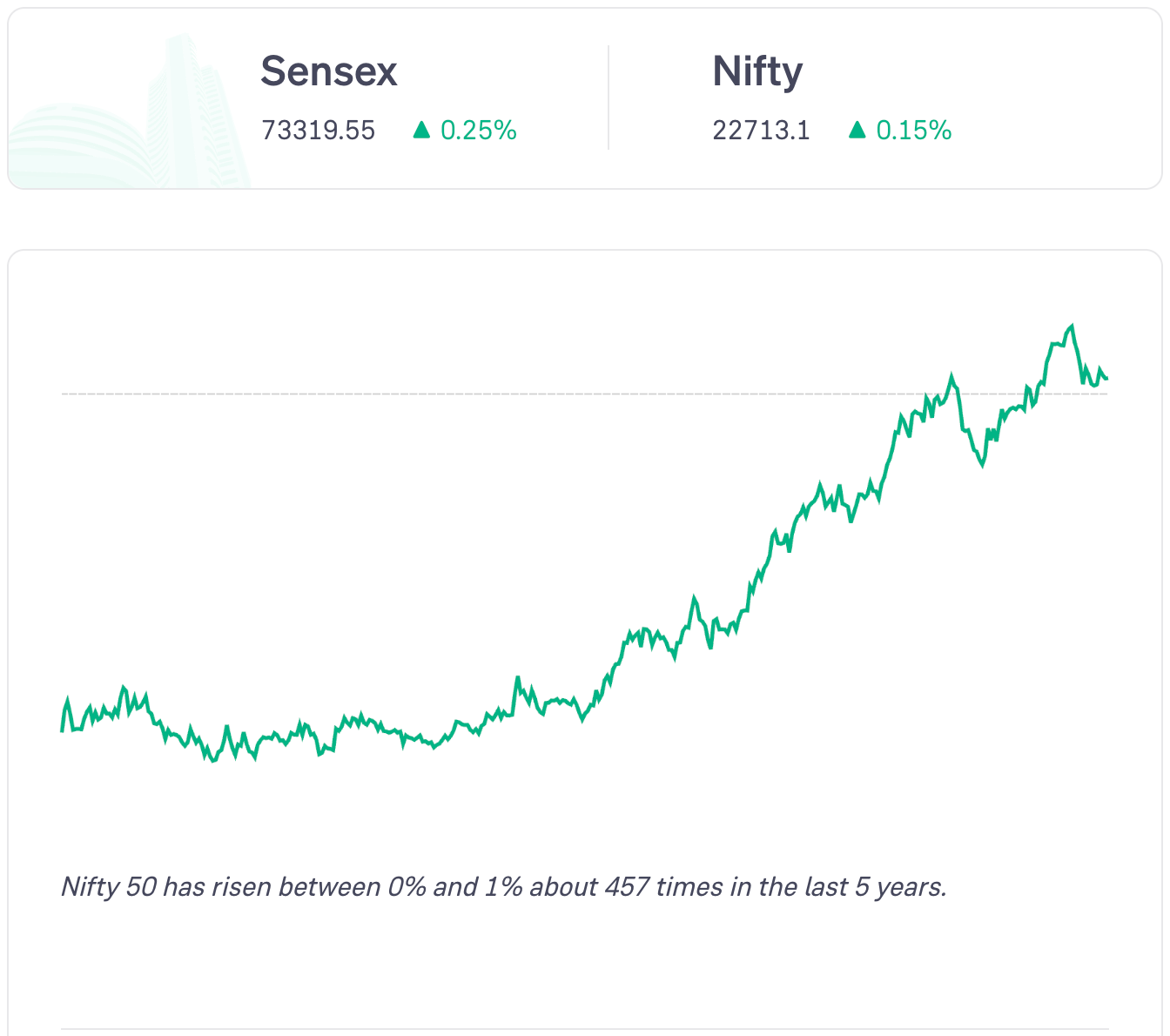
Markets opened significantly below yesterday’s closing point.
The Nifty 50 opened lower today and rose in the second half of the day and closed in the green.
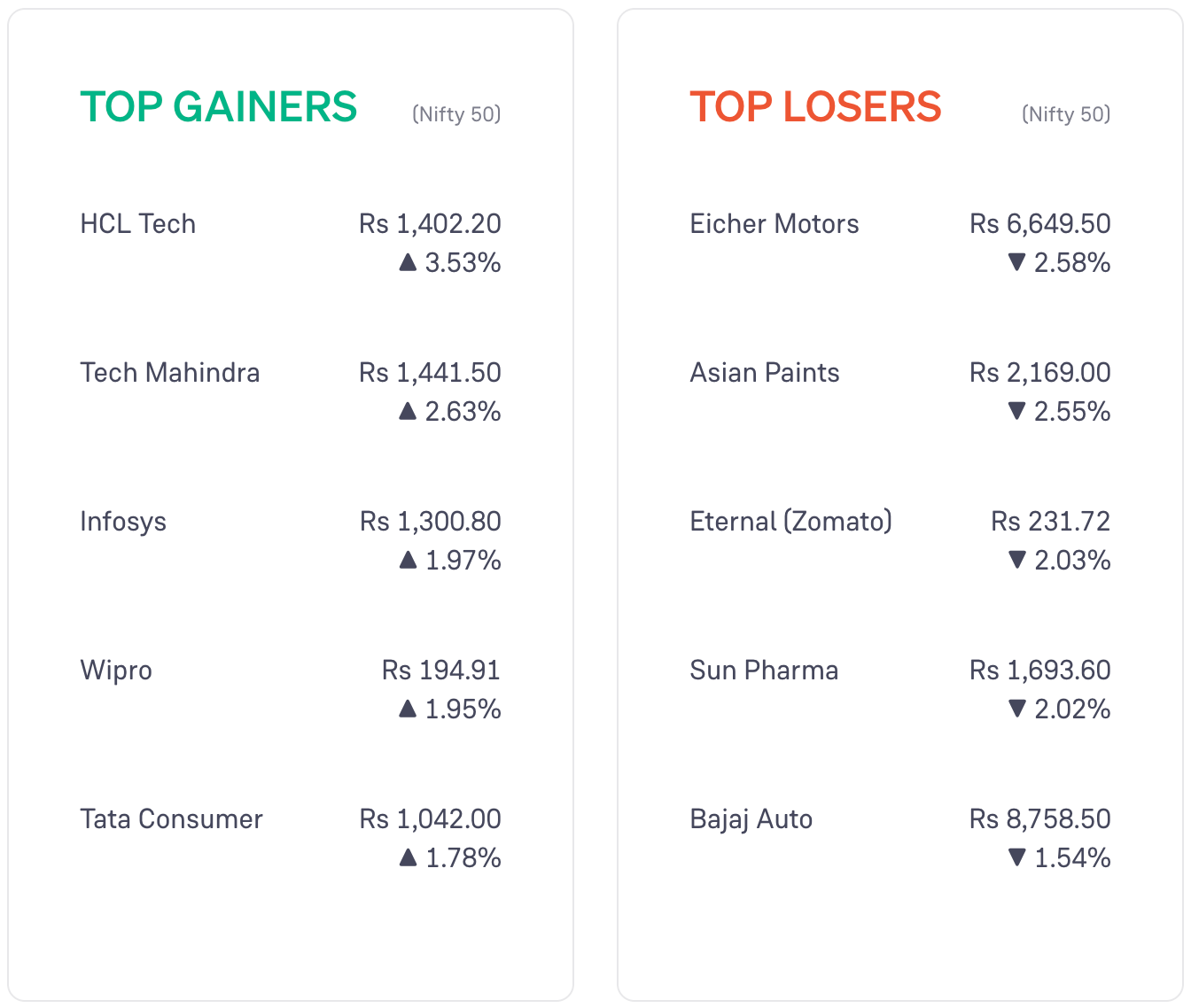
IT stocks and realty stocks rose today. Consumer durables stocks and pharma stocks fell the most.
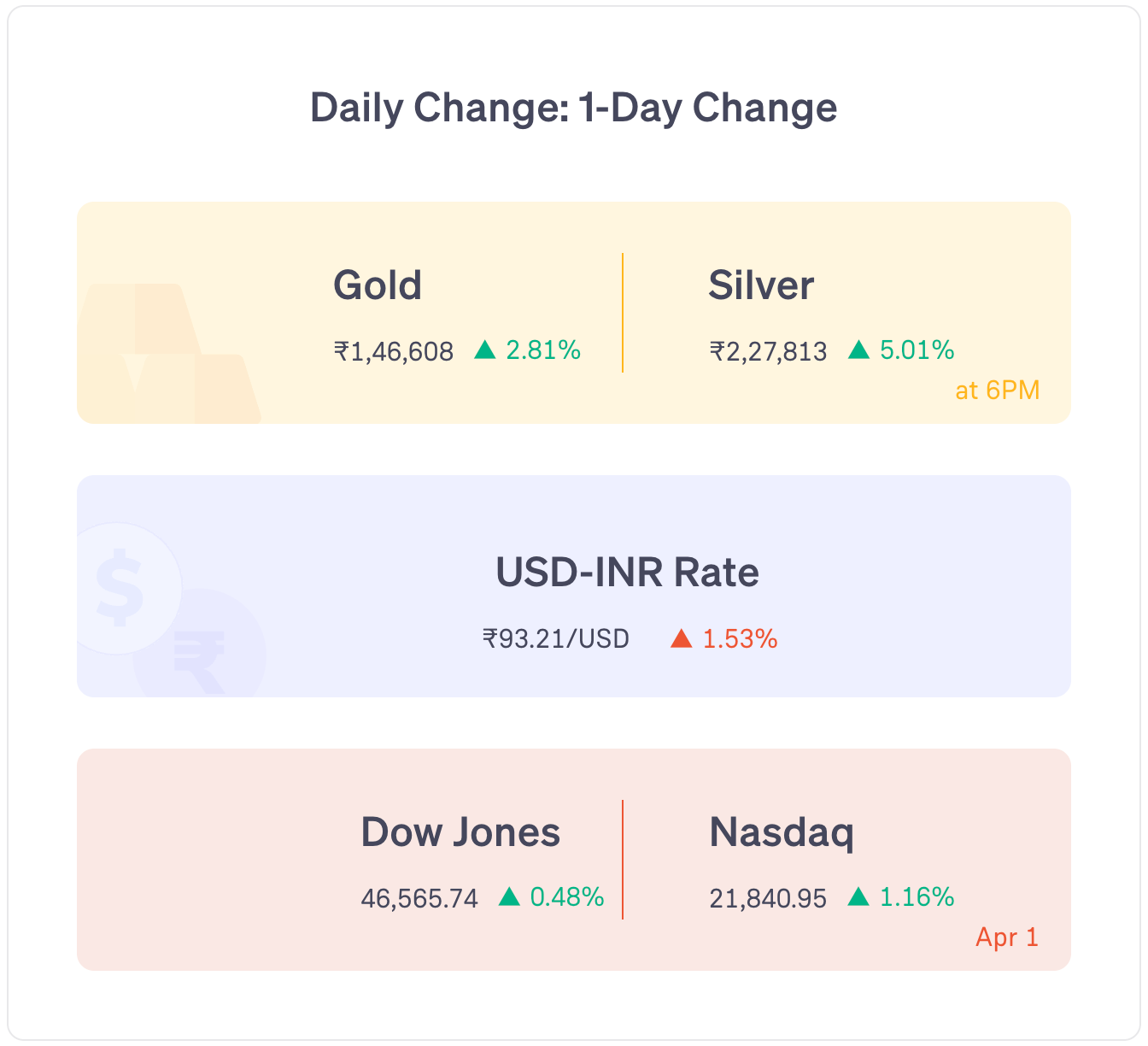
Global markets: US markets rose. Asian markets and European markets fell (as of 6 pm IST).
News
India’s manufacturing PMI fell to 53.9 in March (vs 56.9 in Feb). This means manufacturing activity grew less in March than in Feb.
State-run Oil Marketing Companies (OMCs) raised the prices of commercial cylinders in metro cities by around Rs 200 from 1 April as the Saudi Contract Price (the global benchmark for LPG) rose 44% due to the continued conflict in West Asia.
India’s defence exports rose to Rs 38,424 crore in FY 2025-26, a 62.66% increase over FY 24-25.
USA’s exports rose 11.3% year-on-year in Feb while imports decreased 9.2%.The trade deficit stood at $57.3 billion.
Powerica IPO listed on the stock exchanges at a discount of 7.34% to the issue price and closed 1.27% down at the end of the day.
Stocks Updates
IndiGo: will increase fuel charges on domestic and international flights from 2 April due to rise in ATF prices. The airline said this is due to a 130% increase in fuel prices in one month.
Nestle India: will invest about Rs 90 crore to add a new Maggi Noodles production line at its Sanand factory in Gujarat with a capacity of around 20,500 tons per annum.
Lupin: subsidiary, Nanomi, will acquire a 43.38% stake in Multicare Pharma Philippines for up to $39.6 million, with the intent to make it a wholly owned subsidiary. It also completed the acquisition of VISUfarma B.V., a European speciality pharma company focused on ophthalmology, to expand its speciality portfolio.
NTPC: completed the transfer of its Pakri Barwadih coal mine in Jharkhand to its subsidiary NTPC Mining. With this transfer, all coal mining units are now fully under NTPC Mining Ltd.
Varun Beverages: declared a final dividend of Rs 0.50 per share for FY25, with 8 April 2026 as the record date.
Wipro: completed the merger of two sets of US-based step-down subsidiaries to simplify group structure.
Airtel: crossed 650 million customers globally, becoming the world’s second-largest telecom operator by mobile customer base.
Adani Ports: received NCLT approval for the merger of subsidiary Adani Harbour Services with itself.
Power Grid: won the transmission project for integrating 2.7 GW renewable energy in Karnataka. The project includes a 400 kV transmission line and infrastructure upgrades at Tumkur-II station.
Auto Updates (March)
Maruti Suzuki: sales grew by 16.7% year-on-year to 2.25 lakh units. Domestic sales stood at 1.78 lakh units and exports stood at 47,040 units.
M&M: sales grew 21% year-on-year to 99,969 units. Domestic passenger vehicle sales grew 25% to 60,272 units while commercial vehicle sales grew 11% to 24,928 units.
Tata Motors Passenger: sales grew 29% year-on-year to 66,971 units.
Hyundai Motor: sales grew 2.5% year-on-year to 69,004 units including export sales of 13,940 units.
Eicher Motors: sales grew 11% year-on-year to 1.12 lakh units. Exports fell 8% to 11,928 units.
TVS Motor: sales grew 25% year-on-year to 5.19 lakh units. EV sales grew 44% to 38,877 units.
Ashok Leyland: sales grew 5% year-on-year to 25,381 units.
Escorts Kubota: sales grew 6.6% year-on-year to 12,119 units. Exports fell by 10.4% to 537 units.
Word of the Day
Special Economic Zone (SEZ)
It is a designated area within a country where businesses operate under special economic rules.
Businesses situated in SEZs get tax benefits, easier regulations, simplified customs procedures along with access to better infrastructure.
SEZs are created to boost exports, attract investment, and generate employment.
They are treated differently (as a foreign territory) from the rest of the country for trade and business purposes.
6 Day Course
Theme: biggest crude oil price spikes
Day 4: Thursday
Long-term debt: if a company is using its long-term debt for funding long-term projects (new factory, warehouse, office, etc.), it is usually a good sign.
Diverting money from long-term debt towards short-term spends (salary, bills, etc) is usually a warning sign.
Interest payment compared to EBITDA: if a company’s interest payments are relatively small compared to its earnings, it is a good sign.
If too much money is going towards paying back interests, it may not be a good sign.
Borrowing money to pay older debt: companies that constantly use debt to pay back their older debt often show spiralling tendencies where things keep getting worse.
Floating interest rates: if the company’s debt has a floating interest rate, it could become a risk if the interest rate rises too much.
A fixed interest rate loan is a more steady and comfortable position to be in.
Featured Question
Q. “Do gold and silver ETFs buy real gold & silver behind the screen when we buy etf units? and if etf units are pegged to gold prices why different etfs have different prices.”
Yes, technically that is what is happening.
Each unit of the ETF is pegged to a certain amount of gold or silver.
The gold or silver is stored in vaults by companies that specialise in storing such precious metals.
The ETF company hires the services of these companies to store their gold or silver.
When the demand for the ETF units goes up, new ETF units are created. Whenever new units are created, new gold/silver is bought and stored.
When demand for the ETF units falls the price of the ETF units starts falling.
At that point, ETF units are destroyed. When ETF units are destroyed, the gold or silver backing that unit is sold.
Different ETFs’ units are pegged to different quantities of gold and silver, which is why different ETFs have different unit prices.
The information presented in this post has been compiled and prepared by Groww Invest Tech Pvt Ltd and is intended solely for informational purposes. It is not tailored to any specific investment objectives, financial situations, or needs of any individual investor. The content should not be construed as investment, financial, legal, or tax advice and should not be relied upon as a substitute for professional consultation.
Investing in securities markets involves inherent risks. Investors are advised to carefully review all relevant documents and consider their own risk tolerance before making any investment decisions.
Mutual fund investments are subject to market risks; please read all scheme-related documents carefully. Past performance of financial instruments, schemes, or markets is not indicative of future results.
Groww Invest Tech Pvt Ltd is registered with the Securities and Exchange Board of India (SEBI) under Registration No: INZ000301838, as a Research Analyst under No: INH200008662, as a Depository Participant under No: IN-DP-417-2019, and with the Association of Mutual Funds in India (AMFI) under ARN-111686.
SEBI registration details: View registered name and registration numbers
Research Analyst Disclaimer: View Research Analyst disclaimer
Did you like this edition?
Leave a feedback here!