

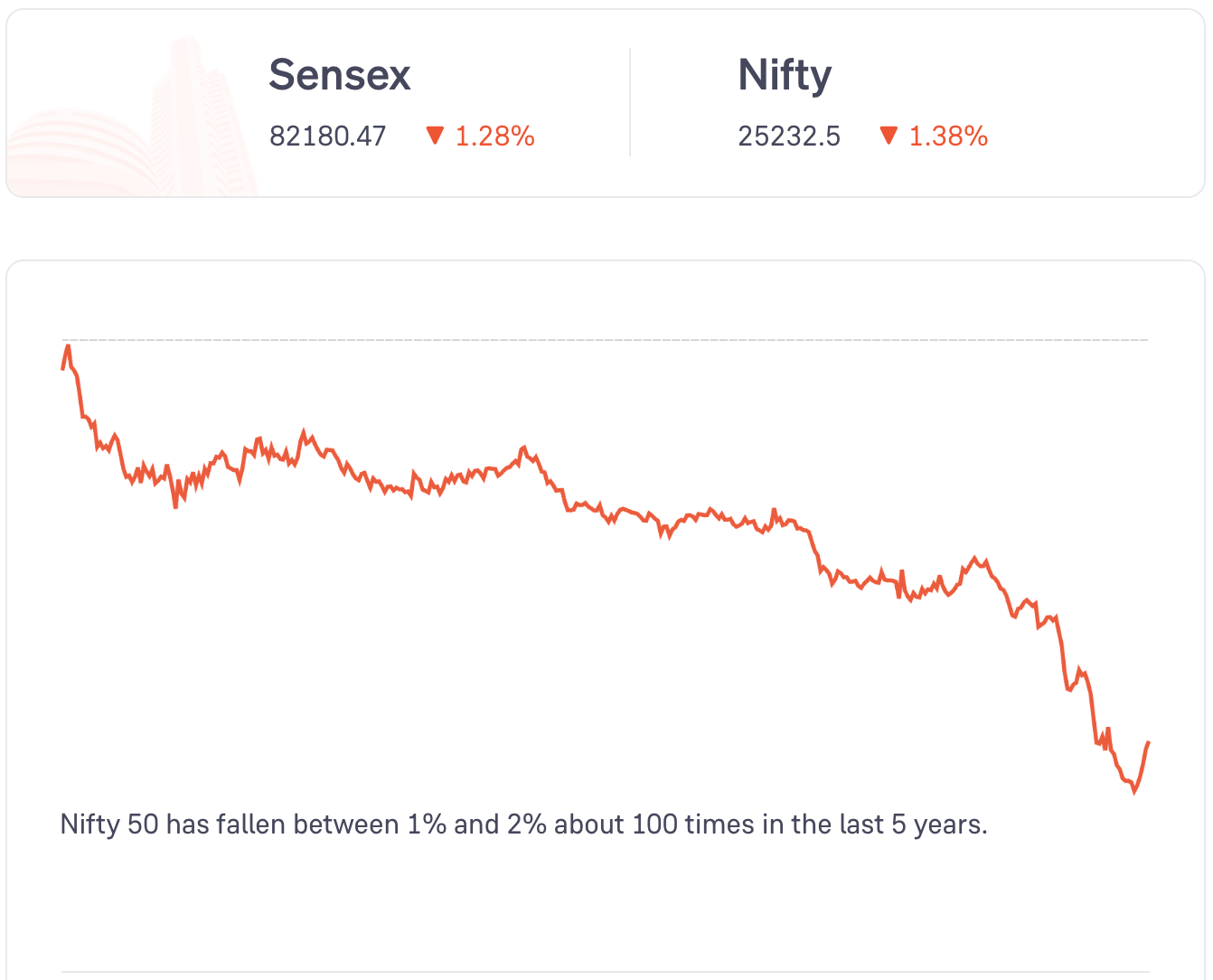
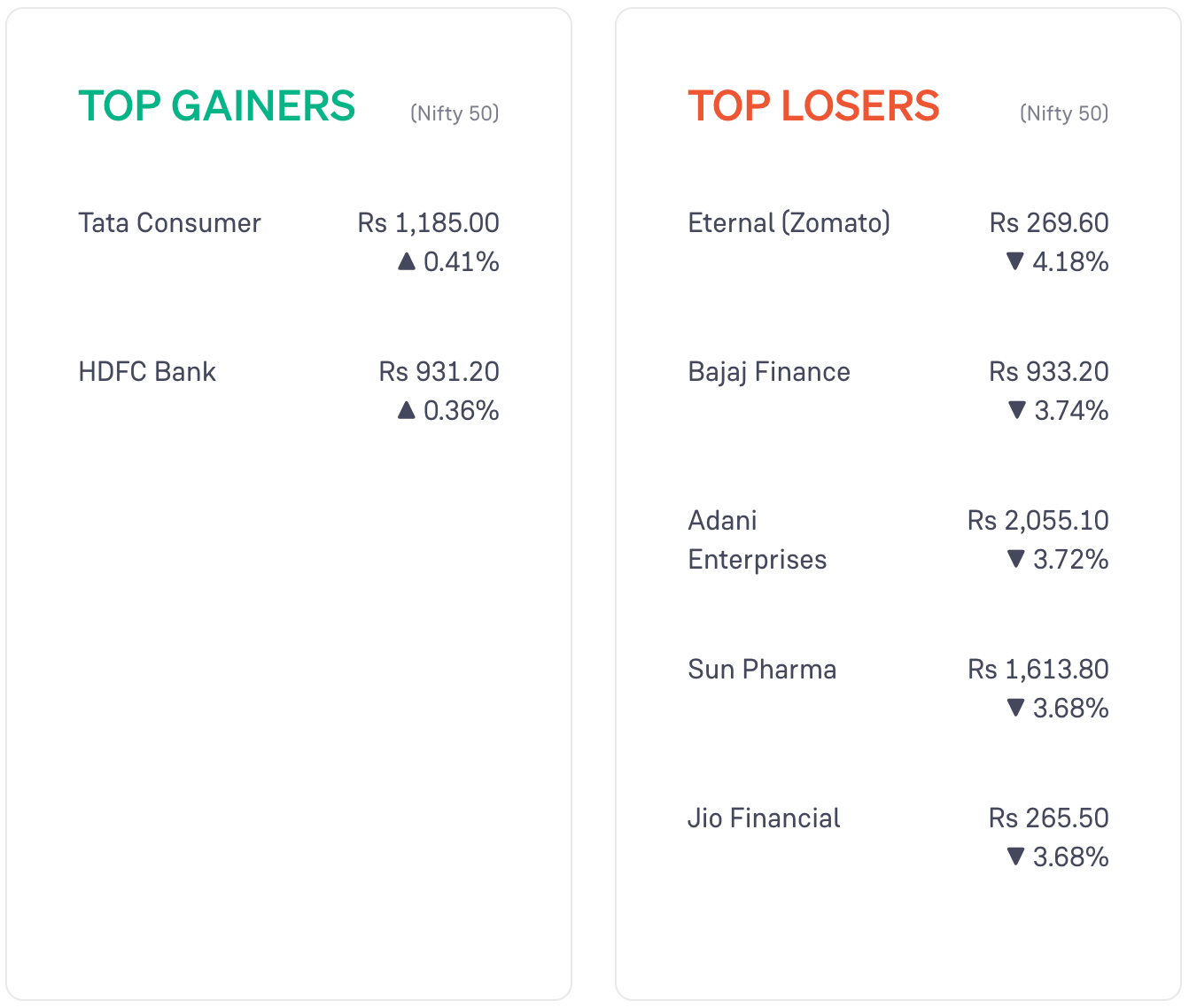
Markets opened above yesterday’s closing point and closed in red.
PSU bank stocks and media stocks rose the most today. Consumer durables stocks and realty stocks fell the most.
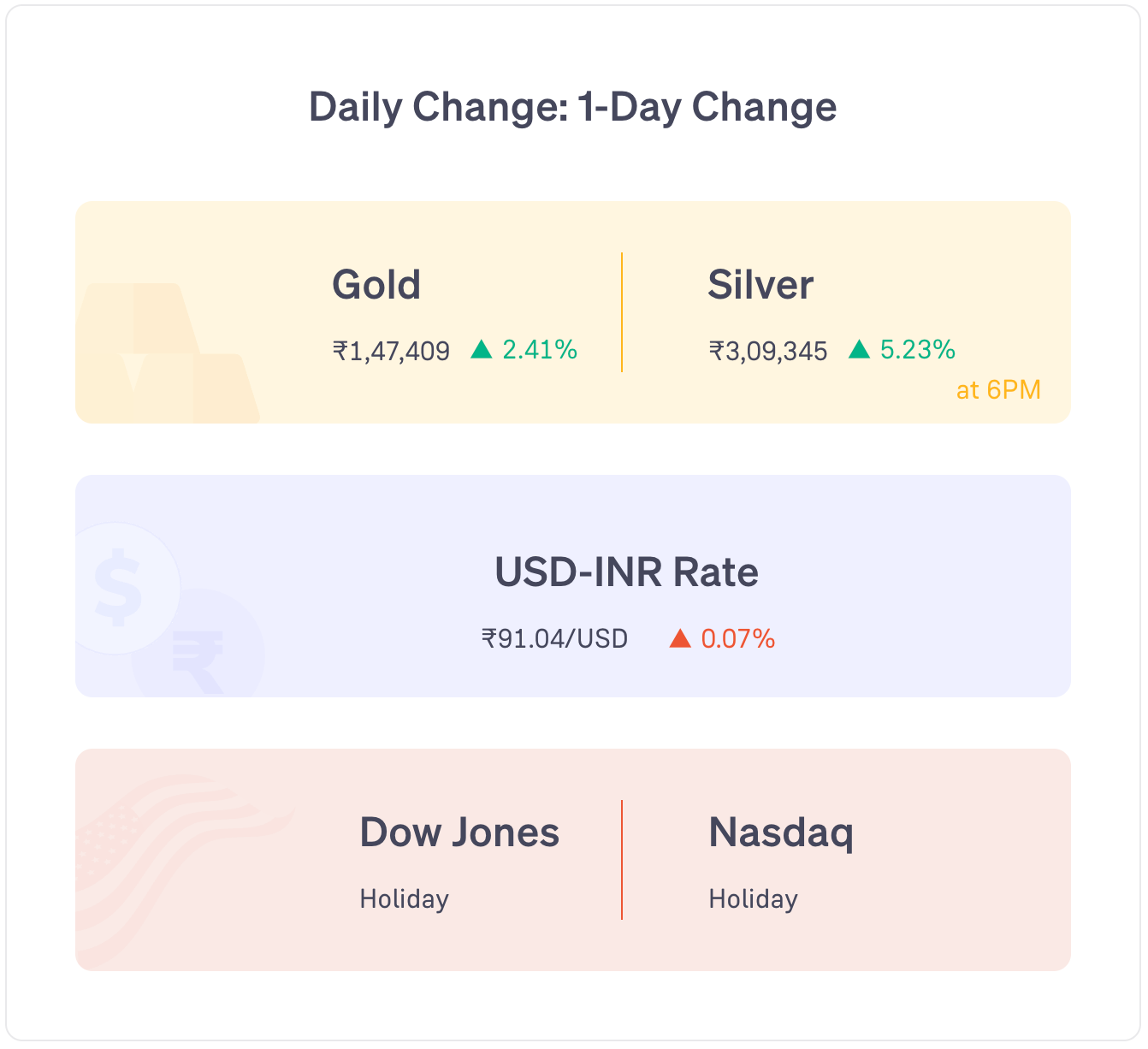
Global markets: US markets rose. Asian markets showed a mixed trend. Most European markets fell (as of 6 pm IST).
News
US President Trump threatened to impose tariffs on 8 European countries from 1 Feb unless they agree to support the ‘complete and total purchase’ of Greenland by the US. If a deal is not reached, Trump plans to raise the tariffs.
India’s infrastructure output of core sectors grew 3.7% year-on-year in Dec (vs 2.1% in Nov). Coal, fertilisers, steel, cement and electricity sectors saw a growth. Crude oil, natural gas and petroleum refinery products saw a decline in output.
India and the UAE signed a $3 billion, 10 year LNG supply deal and agreed to boost trade and defence ties.
SEBI has proposed an AUM threshold to identify ‘significant indices’. Any index tracked or benchmarked by a domestic mutual fund with AUM above Rs 20,000 crore will be subject to tighter regulations.
Shadowfax Technologies IPO has been subscribed 0.47 times. Retail subscription: 1.11 times. IPO closes on 22 Jan.
PhonePe received SEBI’s approval for its IPO: as per media reports.
Stocks Updates
Persistent Systems: net profit rose 17.7% year-on-year to Rs 439.45 crore in the Oct-Dec quarter. Dividend declared: Rs 22 per share. Record date: 27 Jan.
SRF: net profit rose 59.6% year-on-year to Rs 432.66 crore in the Oct-Dec quarter. Dividend declared: Rs 5 per share. Record date: 27 Jan.
JSW Energy: Company subsidiary JSW Thermal Energy Two Limited has signed a Power Purchase Agreement (PPA) with West Bengal State Electricity Distribution Company Limited to set up a 1,600 MW supercritical thermal power plant in Salboni, West Bengal.
Word of the Day
Working Capital Loan
It is a short term loan that helps businesses manage their day-to-day operations
It covers short term expenses like salaries, rent, supplier payments, etc.
It can be secured or unsecured, depending on the lender and business profile.
They help small businesses maintain smooth operations even during temporary cash flow shortages or seasonal fluctuations.
6 Day Course
Theme: corporate debt
Day 2: Tuesday
A company can borrow money in two major forms — corporate loans and corporate bonds.
Corporate bonds are issued by the company wanting to raise money. The investors (bond buyers) are technically lenders in this case.
A bond has a clearly defined amount, interest rate, and tenure.
Bonds are tradeable assets.
Let’s say you buy a bond from a company.
At the time of maturity of that bond, the company promises to give you the principal amount + interest.
But before the maturity period, you can sell this bond to another buyer — just like you can buy and sell shares.
Whoever owns the bond at the time of maturity will get the principal + interest.
Featured Question
Q. “Why new investments (both one time and SIP) were stopped for certain Mutual Funds?”
Mutual funds can stop, pause, or even reduce the money they are getting.
This happens when the fund manager thinks there are not enough opportunities to invest money.
Example: let’s say a mutual fund invests in only tech stocks. And, at that point in time, most tech stocks are extremely overvalued.
In such a situation, the fund manager will struggle to invest money that is flowing into the mutual fund.
The fund manager may choose to limit incoming money by stopping lump sum investments, putting a cap on the SIP amount, or stopping incoming money altogether.
This usually does not happen in case of large-cap mutual funds.
But in smaller niches, like small-cap funds, and some sectoral mutual funds, it does happen from time to time.
The fund manager reopens the mutual fund when he/she thinks there are opportunities available.
Did you like this edition?
Leave a feedback here!