
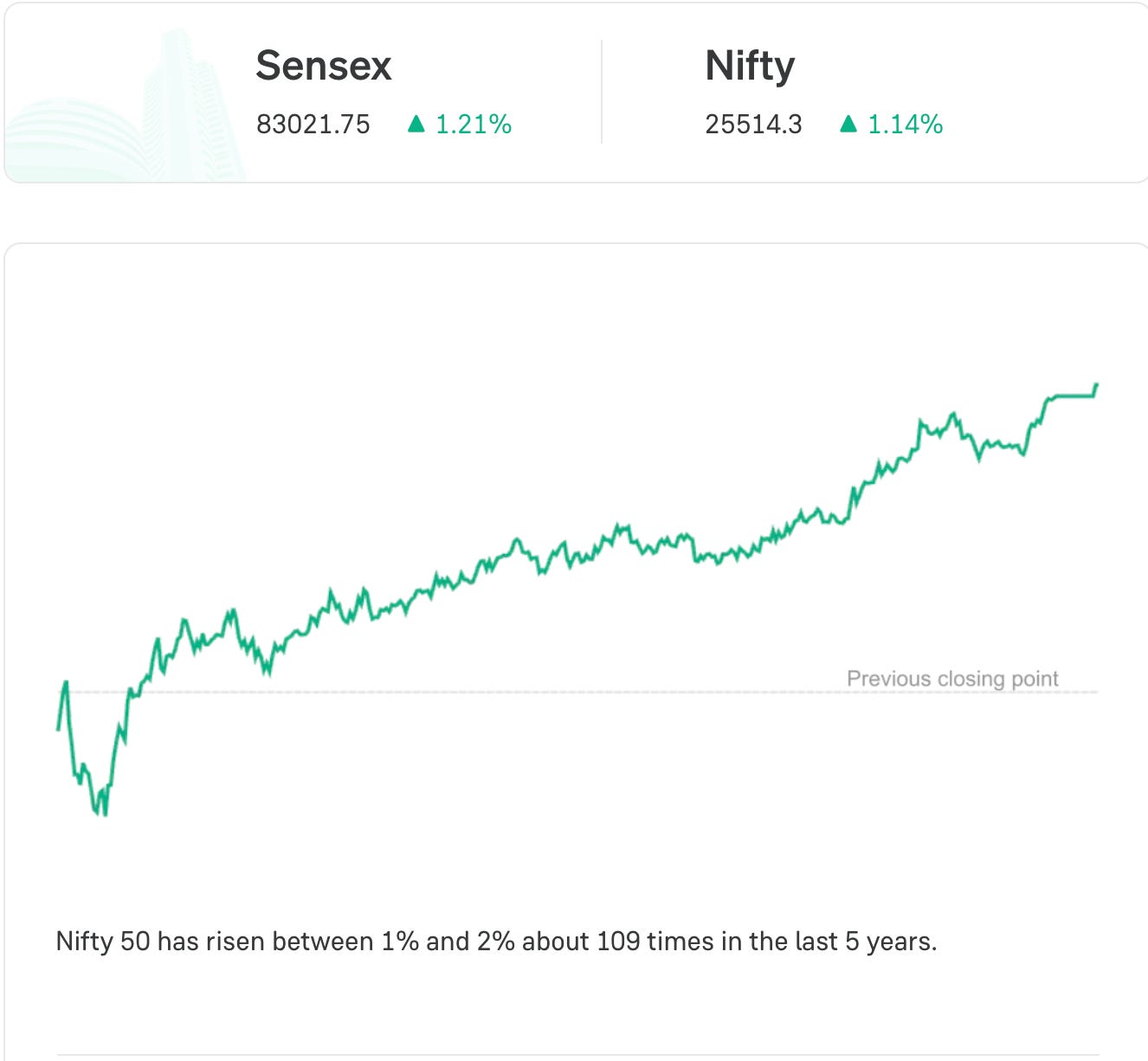
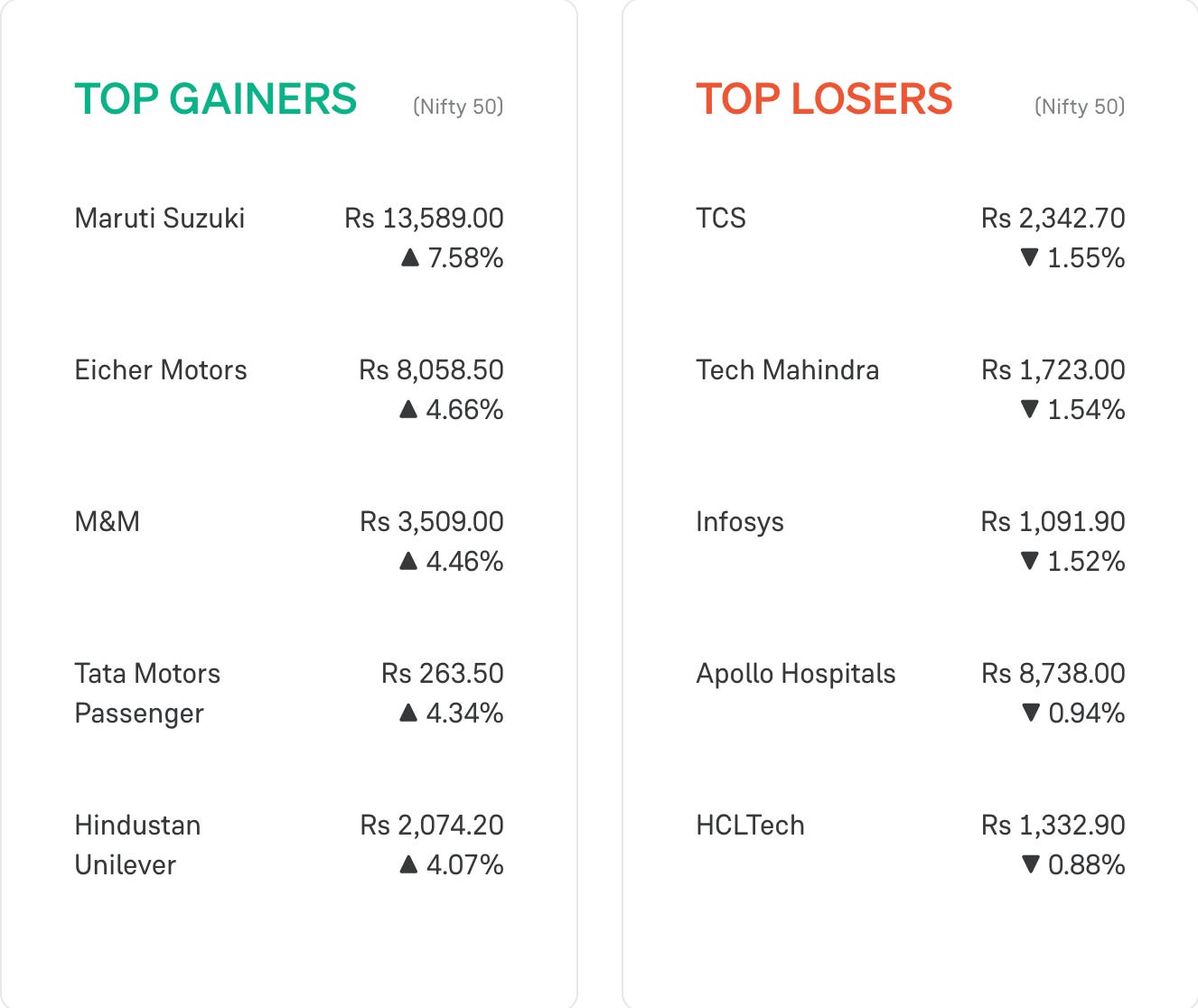
Markets closed significantly higher than yesterday’s closing point.
All sectors’ stocks rose today except for the IT stocks. Auto stocks rose the most, mainly due to fall in commodity prices.
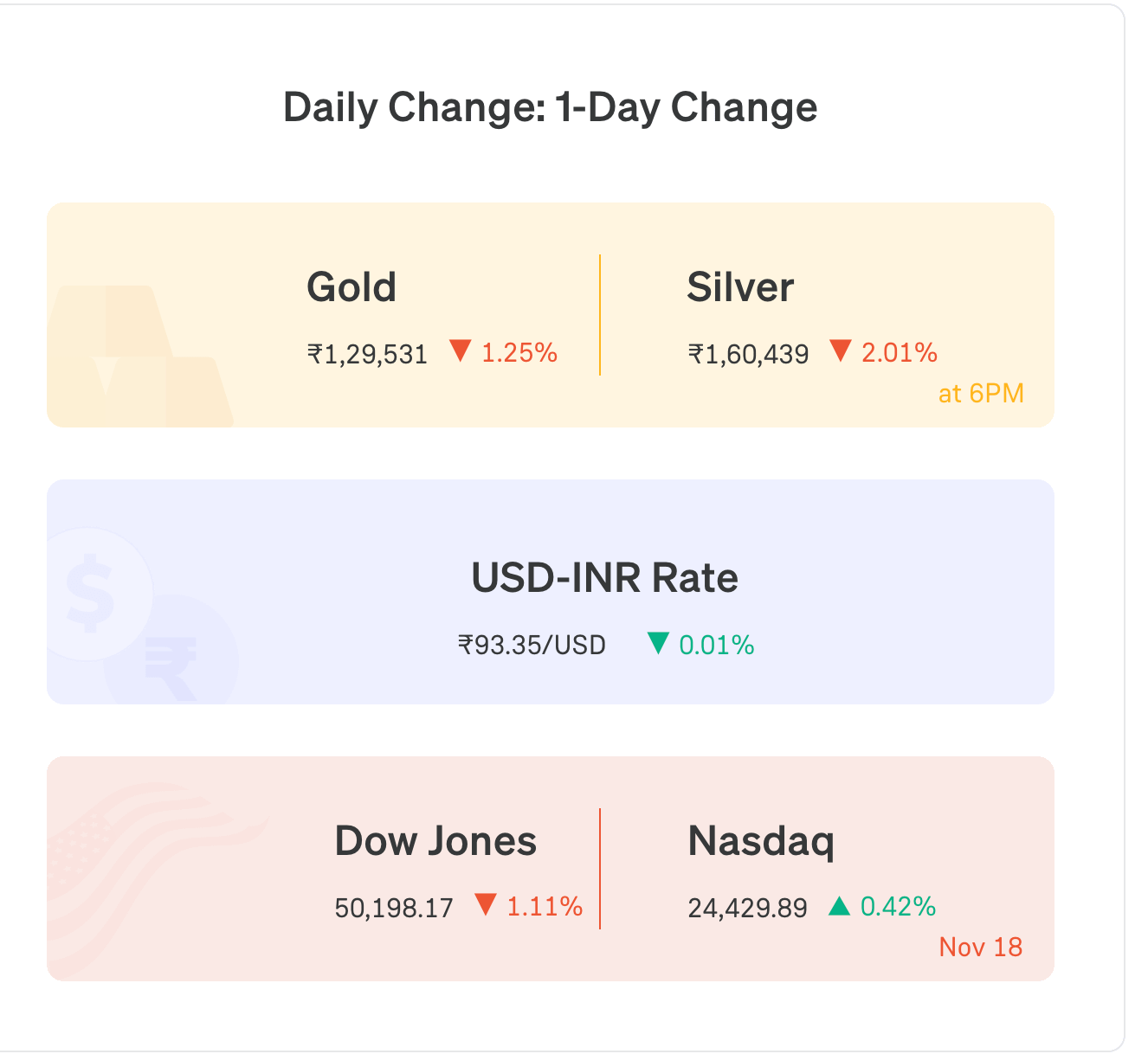
Global markets: US markets ended mixed on Wednesday. Asian markets showed a mixed trend on Thursday. European markets opened in red (as of 6 pm IST).
Note: We mentioned an incorrect Nifty 50 closing value in yesterday’s digest (18 Nov 2026). We apologise for the mistake. The correct closing value was 25,227.95, not 25,277.95. The percentage fall of 0.63% was correct.
News
India’s crude oil import bill rose 87.5% year-on-year to $19.5 billion in October, as per provisional Petroleum Planning and Analysis Cell (PPAC) data.
NLC India Renewables Ltd, a subsidiary of NLC India Ltd filed papers for an IPO. The IPO will comprise a fresh issue of Rs 3,300 crore and an offer for sale of 10 crore shares.
Mahanadi Coalfields’ Rs 8,981.12 crore IPO was subscribed 0.38 times on day 1. Retail subscription: 0.13 times. The IPO will close for subscription on 23 Nov.
Stock Updates
Infosys: subsidiary Infosys Singapore Pte Ltd plans to invest 1.59 billion yen for a 10.1% stake in Japan’s NTT DOCOMO Playspace, Inc. Infosys will also serve as its technology and AI partner.
Coal India: received a Letter of Intent from the Ministry of Heavy Industries to jointly set up a 1,200-tonne annual capacity rare-earth magnet manufacturing plant with NFTDC.
Adani Energy: won a transmission project in Bihar to carry electricity from Adani Power’s upcoming 2,400 MW Pirpainti plant. The project is expected to generate around Rs 500 crore in annual revenue after completion.
ICICI Prudential AMC: received SEBI approval to acquire ICICI Securities Ltd’s portfolio management services business. The acquisition is yet to be completed.
Jio Financial Services: invested Rs 123 crore in its 50:50 joint venture, Jio BlackRock Asset Management Pvt Ltd. BlackRock invested an equal amount.
Bank of Baroda: invested Rs 80.10 crore in subsidiary BOB Pension Fund Management Company Ltd.
Word of the Day
EBLR
It is an external benchmark based on which banks decide the interest rate of the loans they offer
In case of floating interest loans, the interest rate is calculated as EBLR + spread where the spread is fixed.
Example: car loan is EBLR + 3% pa. This means if you take this loan, your interest rate will always be EBLR + 3% per annum.
There are multiple external benchmarks that banks can use as EBLR for their loans.
Most banks choose the repo rate as their EBLR.
The EBLR system replaces an older system where MCLR + spread was the norm.
MCLR was calculated by the bank itself and therefore was less transparent.
6 Day Course
Theme: transaction charges
Day 4: Thursday
Now, let’s look at an example.
Say you bought 100 shares of a company where the share price was Rs 1,240 per share.
Total worth of shares: Rs 1,24,000
This is a delivery buy order.
So,
Brokerage = Rs 20 (on Groww 0.1% or Rs 20, whichever is lower)
STT on this = Rs 124 (0.1%)
Exchange charges (NSE) = Rs 3.81 (0.00307%)
SEBI turnover fees = Rs 0.12 (0.0001%)
Stamp duty = Rs 18.60 (0.015%) (applied on buy transactions only)
GST = Rs 4.31 (18% of the service charge)
DP charges = Rs 0 (no charges on buying)
Total = Rs 170.84
How would the charges differ if this were a sell order of the same share price and quantity?
The brokerage, STT, exchange charges, and SEBI turnover would be the same.
Stamp duty would be Rs 0. DP charges would now apply (because it is a sell order). We’re taking Rs 18.25 here.
GST would now come to Rs 7.59. Total charges = Rs 173.77.
————
Featured Question
Q. “PMS deducts their fee from the managed portfolio- What are the Tax implications on the fee for the investors- Does it deducted from the profits earned through the port folio and then calculated for Taxes on Investor”
Fees in PMS are deducted automatically by the PMS (similar to mutual funds).
It applies on the entire invested amount, not just the gains/profits (same as in case of mutual funds).
The one difference is that in case of mutual funds, the fees (expense ratio) is deducted on a daily basis.
In case of PMS, this happens every month or every quarter.
In case of performance fees, it is deducted only when there is a performance that crosses the hurdle rate and high water mark.
Since the PMS is selling your shares to get its fees, STCG tax or LTCG tax may be applicable.
In PMS, every transaction is treated as a transaction done by you in your own demat.
So you have to pay STCG and LTCG tax every financial year, based on the transactions done by the PMS.
From a taxation perspective, it is the same as buying and selling stocks from your own demat account.
The information presented in this post has been compiled and prepared by Groww Invest Tech Pvt Ltd and is intended solely for informational purposes. It is not tailored to any specific investment objectives, financial situations, or needs of any individual investor. The content should not be construed as investment, financial, legal, or tax advice and should not be relied upon as a substitute for professional consultation.
Investing in securities markets involves inherent risks. Investors are advised to carefully review all relevant documents and consider their own risk tolerance before making any investment decisions.
Mutual fund investments are subject to market risks; please read all scheme-related documents carefully. Past performance of financial instruments, schemes, or markets is not indicative of future results.
SEBI Reg Name: Groww Invest Tech Pvt Ltd | SEBI Reg No: INZ000301838 | RA No: INH200008662
Groww Invest Tech Pvt Ltd is registered with the Securities and Exchange Board of India (SEBI) under Registration No: INZ000301838, as a Research Analyst under No: INH200008662, as a Depository Participant under No: IN-DP-417-2019, and with the Association of Mutual Funds in India (AMFI) under ARN-111686.
SEBI registration details: View registered name and registration numbers
Did you like this edition?
Leave a feedback here!