
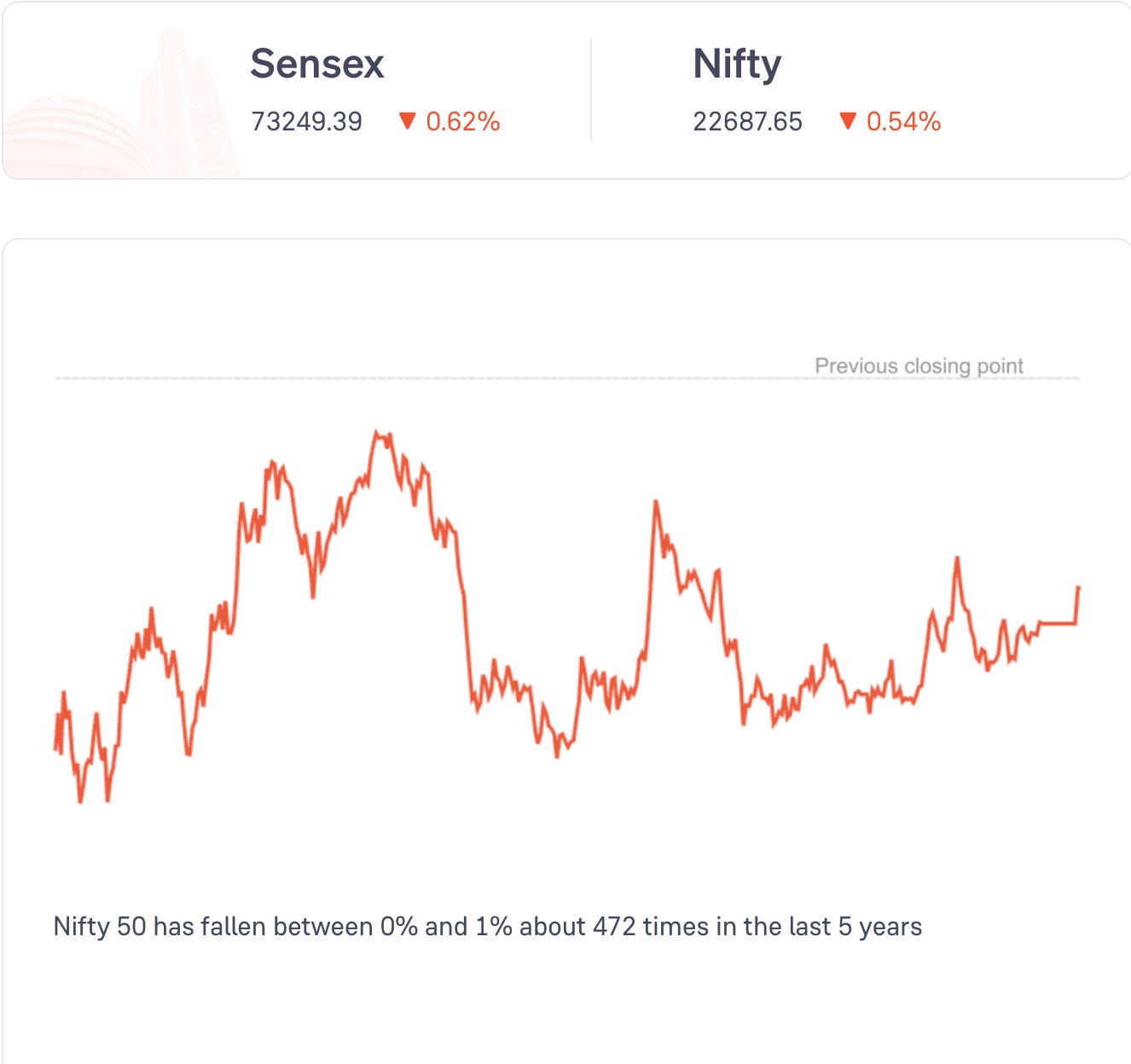
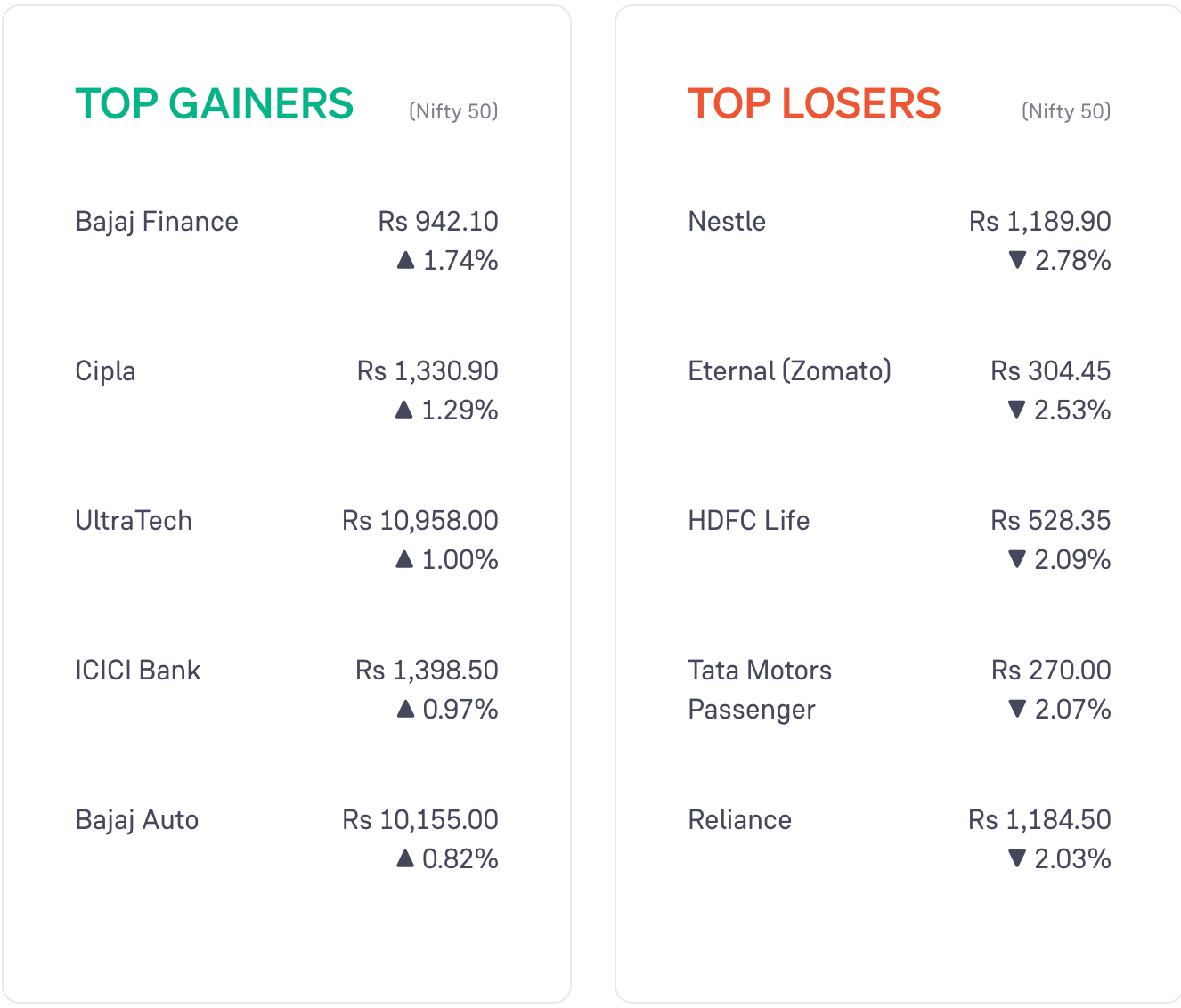
Markets closed lower compared to yesterday’s closing point.
Oil prices rose after the drone attacks on Saudi Aramco oilfield and raised concerns of further oil supply disruptions.This could have led to the fall.
Media stocks and FMCG stocks fell the most today. Pharma stocks and PSU Bank stocks rose the most.
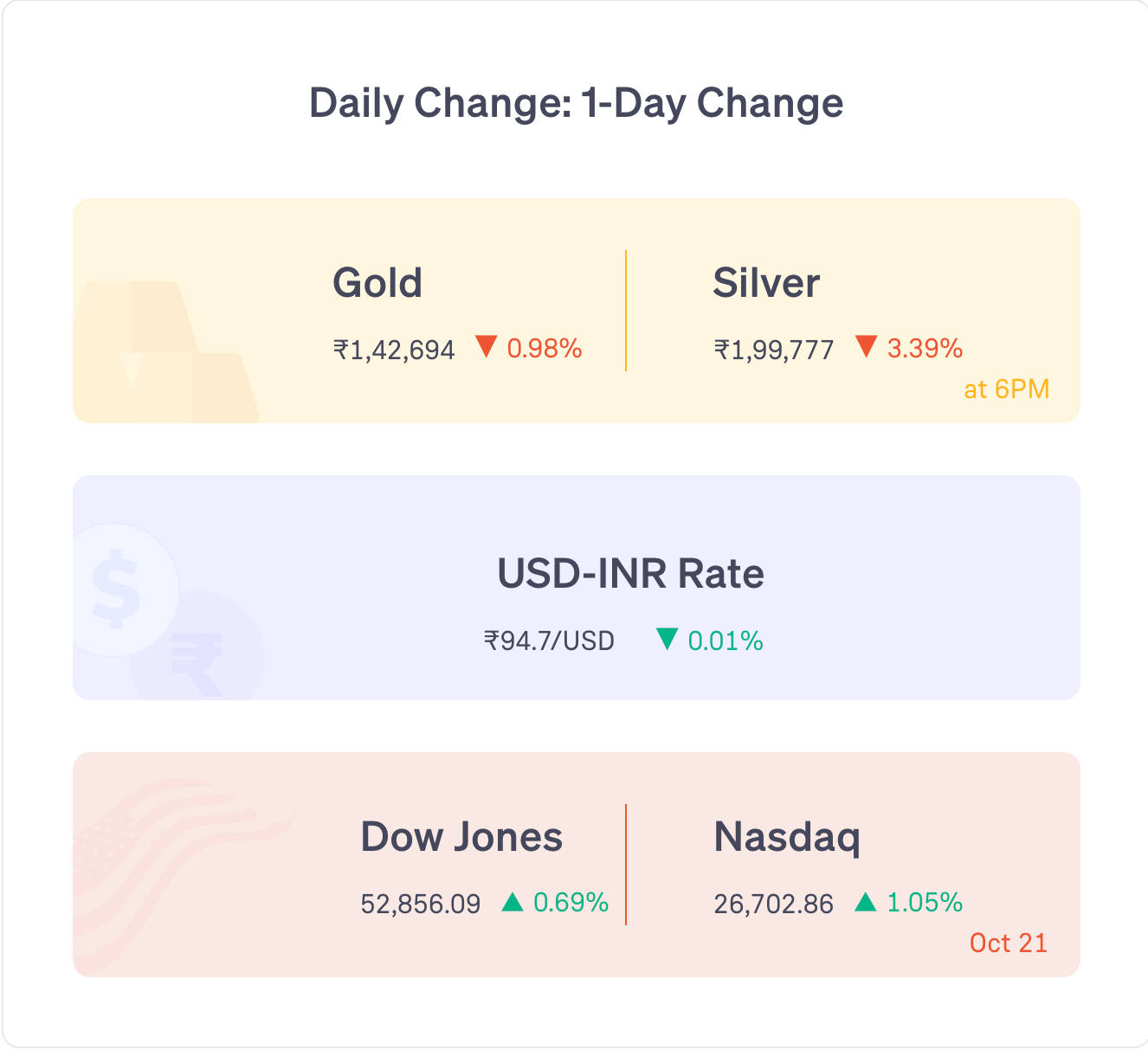
Global markets: US markets rose on Wednesday. Most Asian markets fell on Thursday. European markets also opened in red (as of 6 pm IST).
News
India’s crude oil imports rose 47% to $15.4 billion in September while volumes grew 6.8% to 21.7 million tonnes, as per media reports.
National Commodities and Derivatives Exchange (NCDEX) launched NDEX and FINNDEX, 2 rule based indices and entered the equity and equity derivatives market.
IPO Corner
Jio Platforms’ Rs 30,213 crore IPO was subscribed 5.55 times on day 2. Retail subscription: 1.53 times. The IPO will close for subscription on 23 Oct.
Paras Healthcare’s Rs 1,450 crore IPO was subscribed 0.34 times on day 2. Retail subscription: 1.31 times. The IPO will close for subscription on 23 Oct.
Fusion CX listed at Rs 305 on NSE, a premium of 5.54% over its issue price and closed 0.69% higher.
Stock Updates
Adani Energy: net profit rose 147.74% year-on-year to Rs 1,322.85 crore in the July-Sept quarter.
Adani Ports: subsidiary Adani International Ports Holdings Pte Ltd incorporated Indian Ocean Gateway Terminal in Oman to expand its international ports business.
Bharat Electronics: received new orders worth Rs 1,011 crore for radars, communication equipment, sonar systems, jammers and other services.
PFC: subsidiary PFC Consulting Ltd incorporated an SPV (Northern Region Power Transmission Ltd) for a transmission project in northern India.
Persistent Systems: launched a QIP to raise up to $450 million (about Rs 4,264.61 crore).
Word of the Day
MAB
It is the average balance amount a bank requires depositors to maintain in their bank account
MAB = Monthly Average Balance
It is calculated as the average balance across the month.
If the MAB falls below the limit, banks usually charge a penalty for that month.
The MAB is different for different banks, bank account types, and regions.
For example, some private banks have an MAB requirement of Rs 10,000 in urban areas.
Some banks have an MAB requirement of only Rs 250 in some rural areas.
There are also some bank account types that have an MAB requirement of Rs 0.
6 Day Course
Theme: dividends
Day 4: Thursday
Dividend yield is the total dividend paid compared to the share price.
Let’s say a company’s share price is Rs 100 and its total dividend is Rs 3.
So the dividend yield comes to 3%.
Many investors try to buy dividend paying stocks so that in the future, when its share price rises, and its dividend rises with it, dividend yield is very high (compared to their cost of buying the shares).
This is called yield on cost.
This is assuming that the share price rises, and the dividend also rises.
Example: a stock has a track record of paying a dividend yielding around 2%. Its current share price is Rs 100.
An investor buys this today. 3 years later, its share price and dividend have doubled. The dividend is Rs 4, and share price is Rs 200.
Since this investor bought the share at Rs 100, his yield on cost is 4% now.
This ideal-case scenario is what many dividend-stock investors like to chase.
————
Featured Question
Q. “How is on ex dividend date share price drops by declared dividend amount if share price is arrived by market mechanisms.”
It still arrives by market dynamics.
This is why the share price drop is never perfect. It is roughly the dividend amount.
Say a company’s share is trading at Rs 126. It has declared a dividend of Rs 3.
If you own shares before the ex dividend date, you will get the dividend of Rs 3.
But on that date, you will not.
Let’s say you had two options: you could buy the share before the ex-dividend date and get a dividend of Rs 3.
Or, you could buy on the ex dividend date. No dividend payment in this case.
Would you want to pay the same price on both days?
On the ex dividend date, the value of the shares is lower by Rs 3 in the eyes of the investor.
Investors are willing to pay a lower price for the share. Which is why its share price falls.
If this didn’t happen, investors would be able to buy the share for Rs 126 before the ex-dividend date, get the dividend of Rs 3, and then sell the share for Rs 126.
Since the dividend is being paid from the company’s balance, the company’s balances are worth that much less after the dividend.
So it makes sense that the investors want to pay that much less.
The information presented in this post has been compiled and prepared by Groww Invest Tech Pvt Ltd and is intended solely for informational purposes. It is not tailored to any specific investment objectives, financial situations, or needs of any individual investor. The content should not be construed as investment, financial, legal, or tax advice and should not be relied upon as a substitute for professional consultation.
Investing in securities markets involves inherent risks. Investors are advised to carefully review all relevant documents and consider their own risk tolerance before making any investment decisions.
Mutual fund investments are subject to market risks; please read all scheme-related documents carefully. Past performance of financial instruments, schemes, or markets is not indicative of future results.
SEBI Reg Name: Groww Invest Tech Pvt Ltd | SEBI Reg No: INZ000301838 | RA No: INH200008662
Groww Invest Tech Pvt Ltd is registered with the Securities and Exchange Board of India (SEBI) under Registration No: INZ000301838, as a Research Analyst under No: INH200008662, as a Depository Participant under No: IN-DP-417-2019, and with the Association of Mutual Funds in India (AMFI) under ARN-111686.
SEBI registration details: View registered name and registration numbers
Did you like this edition?
Leave a feedback here!