
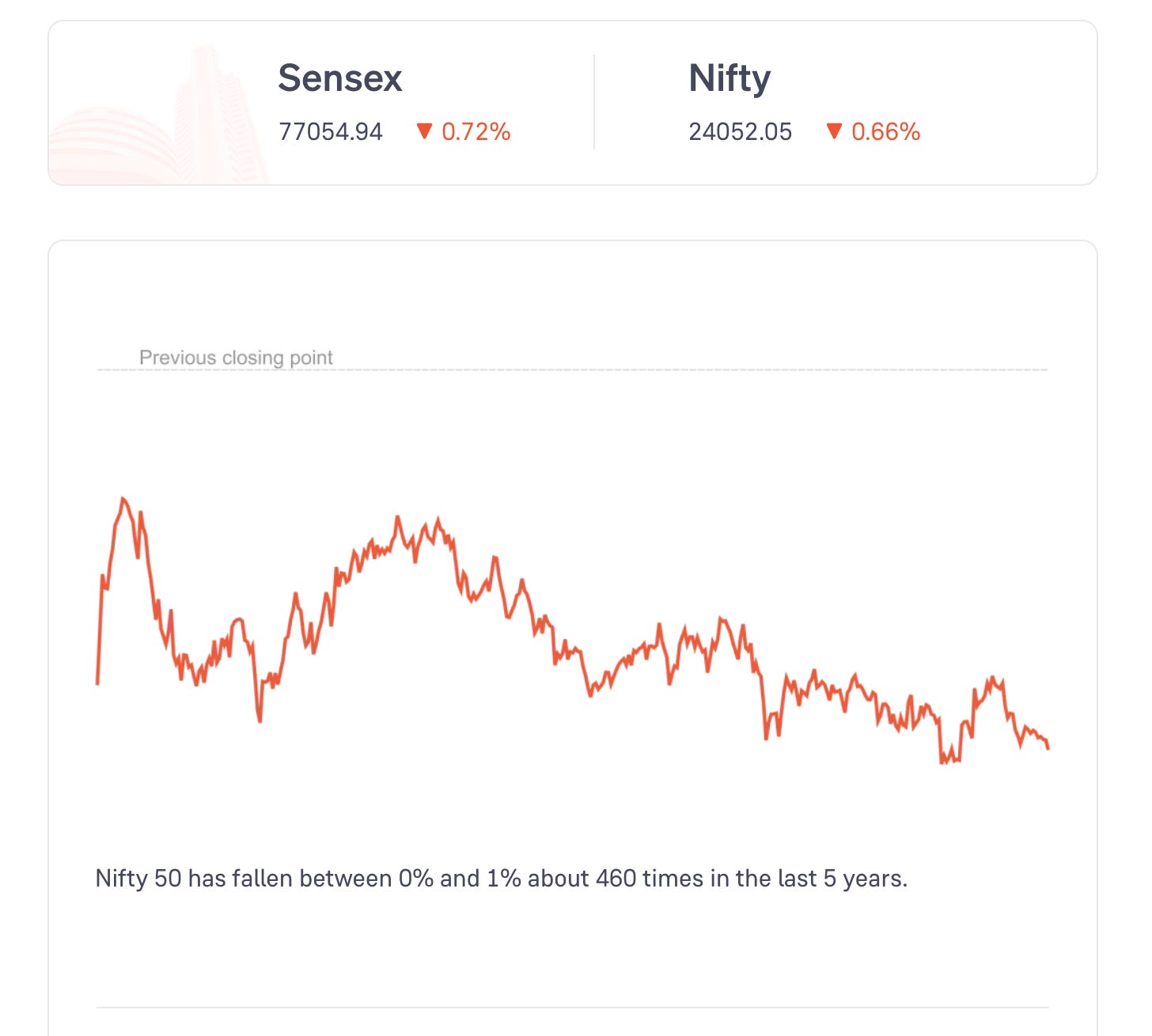
Markets closed below yesterday’s closing point.
The fall in the market may have been due to global concerns over fresh US-Iran tensions. The US said it may block Iranian ships and proposed a 20% charge on all cargo ships passing through the Strait of Hormuz.
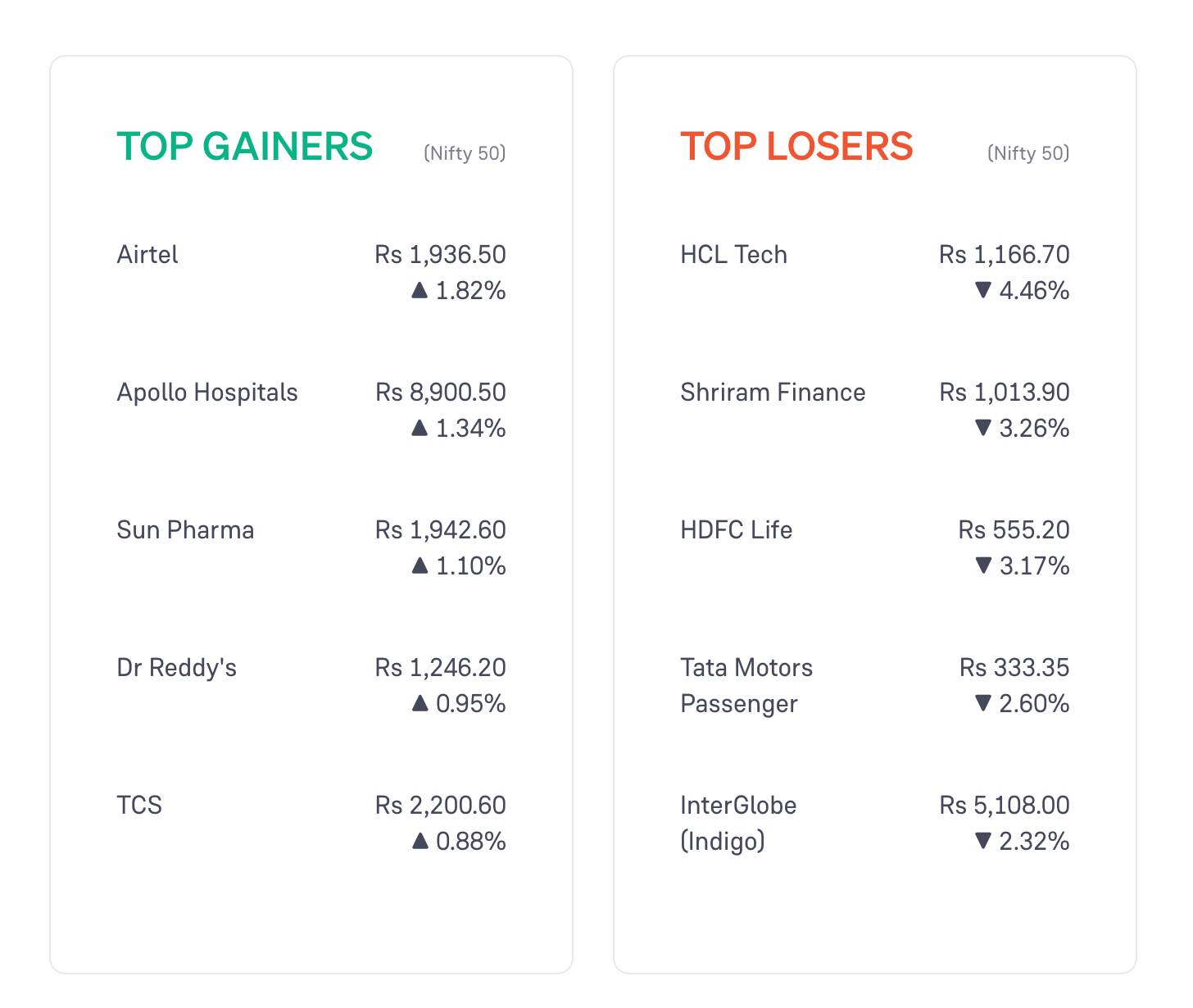
Realty stocks and PSU Bank stocks fell the most today. Pharma stocks and healthcare stocks rose the most.
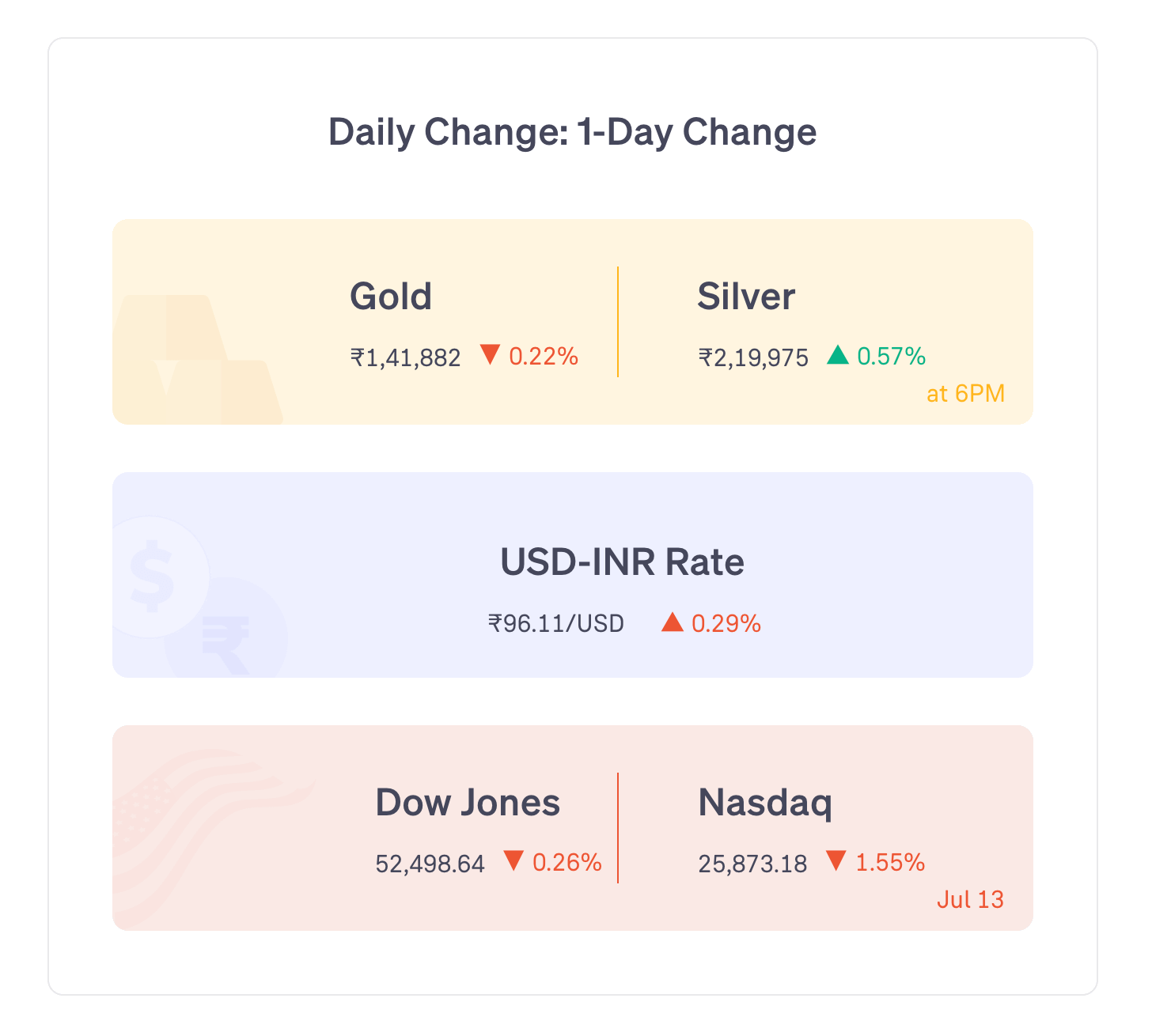
Global markets: US markets fell. Asian markets and European markets showed a mixed trend. (as of 6 pm IST).
News
India’s Wholesale Price Index inflation rose 9.87% year-on-year in June (vs 9.68% in May)
India’s net direct tax collections rose 16.4% year-on-year to over Rs 6.51 lakh crore as of 13 July, 2026.
MoSPI released the first Index of Services Production (ISP) for April 2026, covering 19 sub-sectors which cover 60% of the services sector. 17 out of 19 sub-sectors grew, with accommodation & food and retail trade growing the most. Air transport and railway transport were the only ones that fell.
The government has updated the Foreign Trade Policy to prohibit the import of goods made fully or partly using forced labour. The rule will come into effect 30 days after its publication in the Official Gazette.
US inflation fell 0.4% in June (vs a 0.5% rise in May). Core inflation, which excludes food and energy, stayed flat in June (vs a 0.2% rise in May).
SBI Funds Management IPO was subscribed 0.68 times. Retail subscription: 0.62 times. IPO closes on 16 July.
Stocks Updates
Grasim: subsidiary Aditya Birla Renewables, will acquire Sprng Energy’s holding company, Solenergi Power, from Shell for an enterprise value of Rs 17,200 crore.
Zydus Lifesciences: exchanges have sought clarification from the company after a media report said the Delhi High Court temporarily restricted the supply of its cancer drug Ikra in a patent dispute with AbbVie.
IDBI Bank: exchanges have sought clarification after a media report said the government is close to accepting Fairfax Financial’s revised offer for IDBI Bank’s privatisation.
Word of the Day
Indexation Benefit
It is a measure which aims to calculate tax while factoring in inflation
The idea is that over a period of time, prices rise because of inflation.
Say the inflation rate was 4% per annum. And your investments gave a return of 14% per annum.
If we factor in inflation, the actual rate of return was 10% (14% minus 4%).
Indexation benefit aims to tax only the real returns after accounting for inflation.
This reduces the burden of tax for the investor.
Indexation benefit is available only on some assets in India. Shares, equity mutual funds, and debt mutual funds do not get indexation benefits. Even FD returns do not get indexation benefits.
Earlier, it used to apply to debt mutual fund investments, bonds, etc.
6 Day Course
Theme: companies with extra cash
Day 2:Tuesday
Yesterday we spoke about dividends.
Today, let’s talk about share buybacks. It is another way companies handle extra earnings.
The net effect is similar to dividends. The method is different.
In buybacks, companies buy shares from the markets (using the extra earnings) and destroy them.
This reduces the total number of shares available.
Since the business remains the same, and the number of shares reduces, the earnings per share (EPS) goes up.
Since EPS goes up, the share price also usually goes up.
So in case of dividends, the company is directly depositing money into the back accounts of shareholders.
On the other hand, in case of buybacks, they are indirectly giving money to the shareholders. It is done by causing the share price to go up.
In case of dividends, the shareholders have to pay a tax immediately.
In case of buybacks, the share price increase does not attract any tax immediately. Only when the share is sold does the investor have to pay a capital gains tax.
————
Featured Question
Q. “When a company's Working Capital, Plant & Machinery, etc are remain constant then why Market Sensex down, it relects Share Price. No botheration/ change to Company's Capital, etc.”
This is a good observation.
A company releases its reports every quarter. Which means, between the two reports, nothing changes in the company’s reporting.
So why does the price change?
Because the share markets have all sorts of investors who are trying to do many different things.
For example: many are trying to predict what would happen to the company in the future.
Those who think something good is going to happen will try to buy more. Those who think the opposite will try to sell.
This buying and selling itself causes the price to change (because of changing supply and demand).
Then there are other types of investors in the market also who try to buy/sell based solely on price movements without caring about the company itself.
These are traders who play more on investor psychology than the business’ operations.
There are also global and local events happening that affect investors sentiments (greed and fear).
Many investors are buying and selling simply because someone else is doing so.
It’s a very complex system of buy and sell orders that leads to the price changing without the fundamentals of the company and its business changing.
The information presented in this post has been compiled and prepared by Groww Invest Tech Pvt Ltd and is intended solely for informational purposes. It is not tailored to any specific investment objectives, financial situations, or needs of any individual investor. The content should not be construed as investment, financial, legal, or tax advice and should not be relied upon as a substitute for professional consultation.
Investing in securities markets involves inherent risks. Investors are advised to carefully review all relevant documents and consider their own risk tolerance before making any investment decisions.
Mutual fund investments are subject to market risks; please read all scheme-related documents carefully. Past performance of financial instruments, schemes, or markets is not indicative of future results.
Groww Invest Tech Pvt Ltd is registered with the Securities and Exchange Board of India (SEBI) under Registration No: INZ000301838, as a Research Analyst under No: INH200008662, as a Depository Participant under No: IN-DP-417-2019, and with the Association of Mutual Funds in India (AMFI) under ARN-111686.
SEBI registration details: View registered name and registration numbers
Research Analyst Disclaimer: View Research Analyst disclaimer
Did you like this edition?
Leave a feedback here!
Nine