
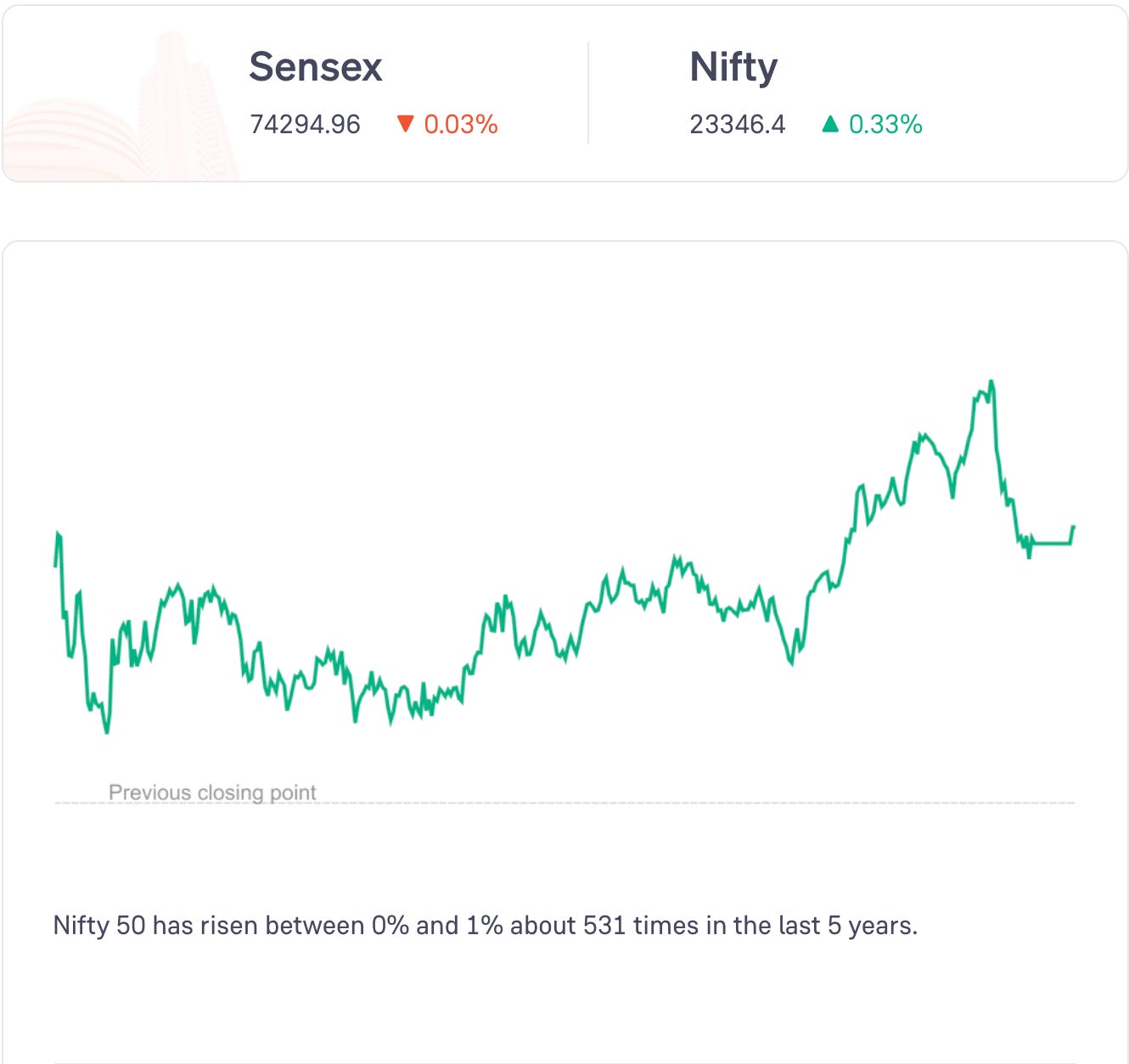
Markets ended mixed compared to yesterday’s closing point. Sensex ended in red after the CAS, while Nifty ended in green.
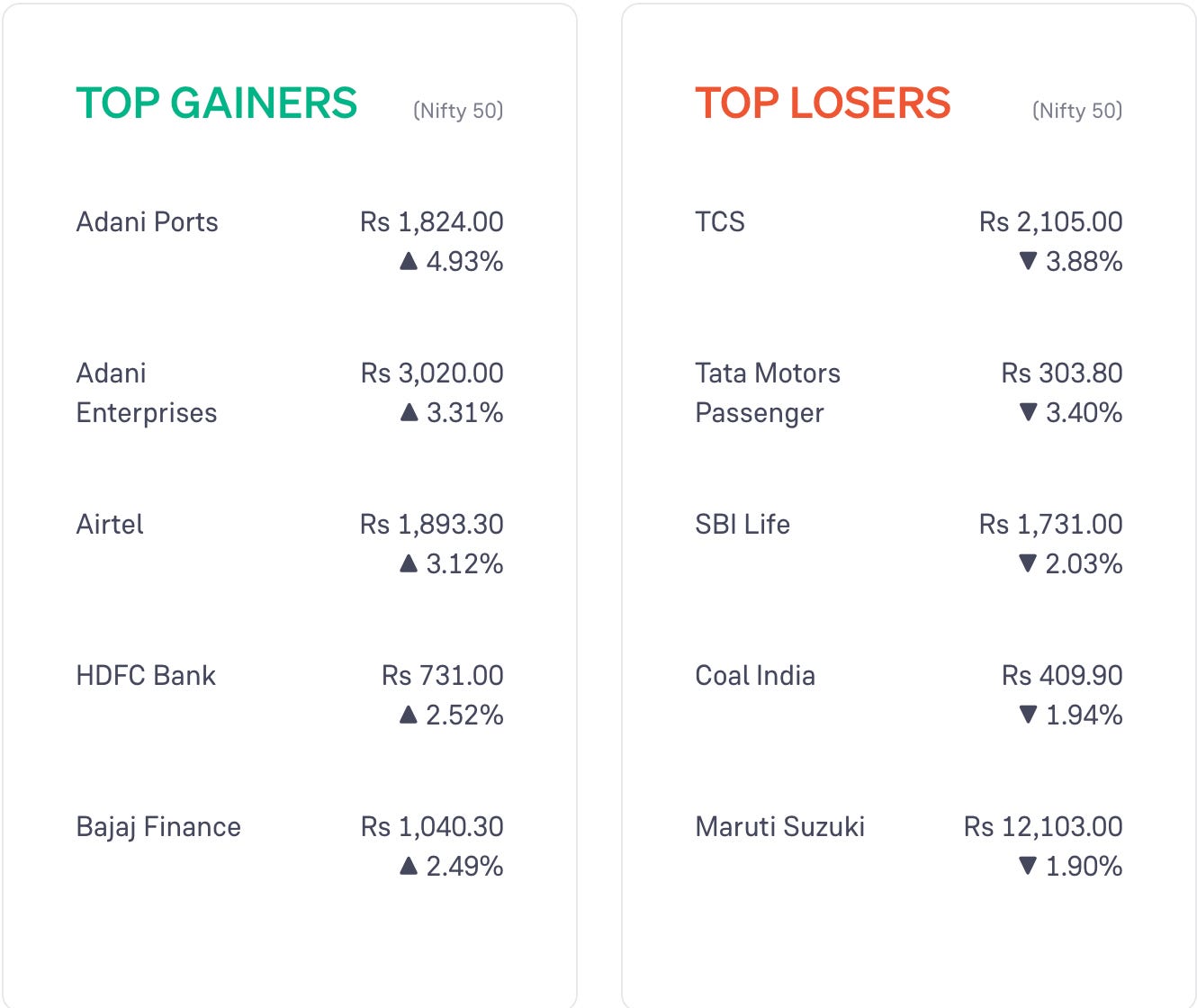
Metal stocks and media stocks rose the most today. IT stocks and consumer durable stocks fell the most.
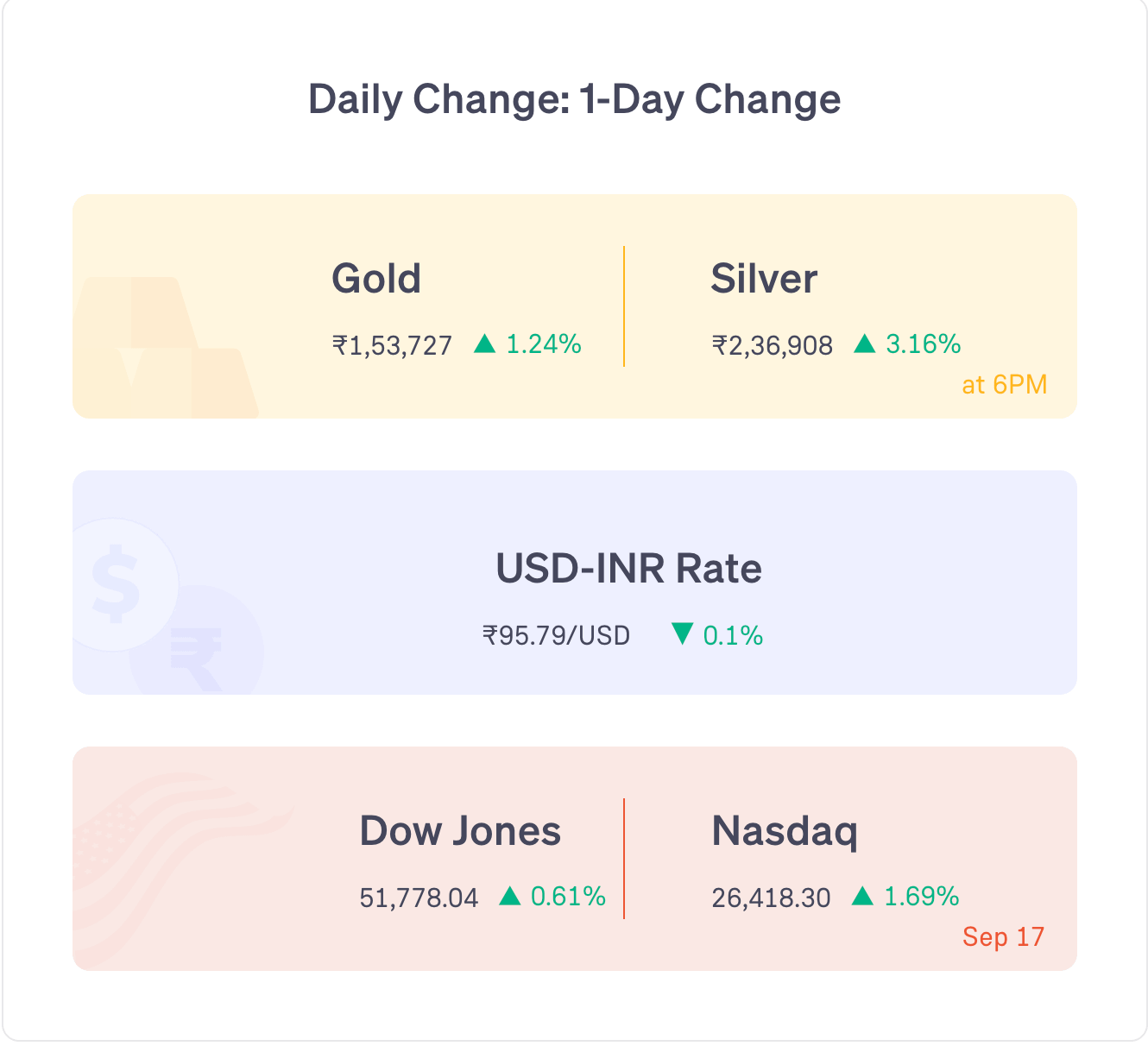
Global markets: US markets rose on Thursday. Most Asian markets rose on Friday while most European markets traded in red(as of 6 pm IST).
News
India’s forex reserves fell $4.92 billion to $780.78 billion for the week ended 11 Sep.
The government relaxed the existing 15 days’ stockholding limit on sugar for bulk consumers subject to conditions.
The government approved multiple railway projects; a 38.21 km rail line worth Rs 493 crore near Maharashtra-Telangana border and doubling the 10.86 km Chouk-Karjat section worth Rs 497 crore.
India’s net direct tax collections rose 12.96% year-on-year to Rs 12.12 lakh crore as of 17 Sep.
India’s crude oil imports fell 11.17% in August to 19.01 million metric tonnes, from July: Petroleum Planning and Analysis Cell.
Digital lending platform Social Worth Technologies (Fibe) got SEBI approval for IPO (fresh issue Rs 750 crore and OFS of 4 crore shares).
IPO Corner
NSE’s Rs 22,562 crore IPO was subscribed 1.16 times on day 2. Retail subscription: 0.72 times. The IPO will close for subscription on 21 September.
Hero Motors’ Rs 1,000 crore IPO was subscribed 6.66 times on day 3. Retail subscription: 8.23 times. The IPO closed for subscription.
SS Retail’s Rs 500 crore IPO was subscribed 103.30 times on day 3. Retail subscription: 36.36 times. The IPO closed for subscription.
Stock Updates
Asian Paints: started production at its new VAE facility (a chemical used to make paints) in Dahej, Gujarat, with an annual capacity of 1.5 lakh tonnes.
Power Grid: approved raising up to Rs 5,000 crore through unsecured bonds via private placement. The base issue is Rs 1,000 crore with a greenshoe option of Rs 4,000 crore. The bonds will have a 10-year tenor.
Grasim: its 45%-owned Canadian pulp joint venture (AV Group NB Inc.) will temporarily shut its Nackawic plant around the end of October due to weak market conditions.
Vedanta: approved issuing up to Rs 3,500 crore of unsecured NCDs through private placement in one or more series.
Mazagon Dock: signed an MoU to be the main shipyard in a proposed new shipbuilding cluster at Dugarajapatnam, Andhra Pradesh.
Dr Reddy’s: signed an exclusive agreement with Takeda (Japanese pharma company) to market and distribute QDENGA, India’s first approved dengue vaccine, in the private market.
Persistent Systems: reached the minimum shareholder acceptance needed for its takeover offer for Nagarro.
Word of the Day
Cash Drag
It is the lower performance caused because of holding cash.
As we know, cash gives some of the lowest returns possible.
So the more cash an investor keeps, the lower the returns.
When a portfolio (investment manager, mutual fund, PMS, etc) holds too much cash, the returns can suffer because a big portion of their investment is earning extremely low returns.
Keeping cash is not always a bad strategy. Many investors keep cash when the markets are overvalued for similar reasons.
6 Day Course
Theme: finding correct valuation
Day 5: Friday
Whatever we have discussed so far is still a bit of an ideal scenario.
There are many things that can go wrong.
Example: One common trap is: a company’s earnings might grow 3x in 5 years. But its stock price was already so high, it didn’t give good returns over 5 years.
So, determining if a company’s stock is correctly valued or not depends on its future earnings.
And it also depends on the current share price not being too high compared to the future earnings level.
Also, a lot can go wrong with the earnings itself. A company can end up not earning as much as expected because of various reasons — both within and outside its control.
By the way, great investors don’t always get this right. Even their estimates and valuation-judgements turn out wrong.
It is nearly impossible to be perfect in this.
Some mistakes are okay. Too many mistakes lead to poor returns or losses.
————
Featured Question
Q. “As we purchased Mutual Funds schemes and taxed for Capital Gains, do MF portfolio get taxed when they purchase Stocks in their portfolio at the time of redemption or frequent withdrawal?”
Investors have to pay STCG or LTCG tax when withdrawing from a mutual fund.
The same is not true for when a mutual fund buys/sells assets. This alone makes mutual funds more tax efficient.
They still have to pay STT, brokerage, and other relevant charges when transacting stocks or other assets.
Did you like this edition?
Leave a feedback here!