
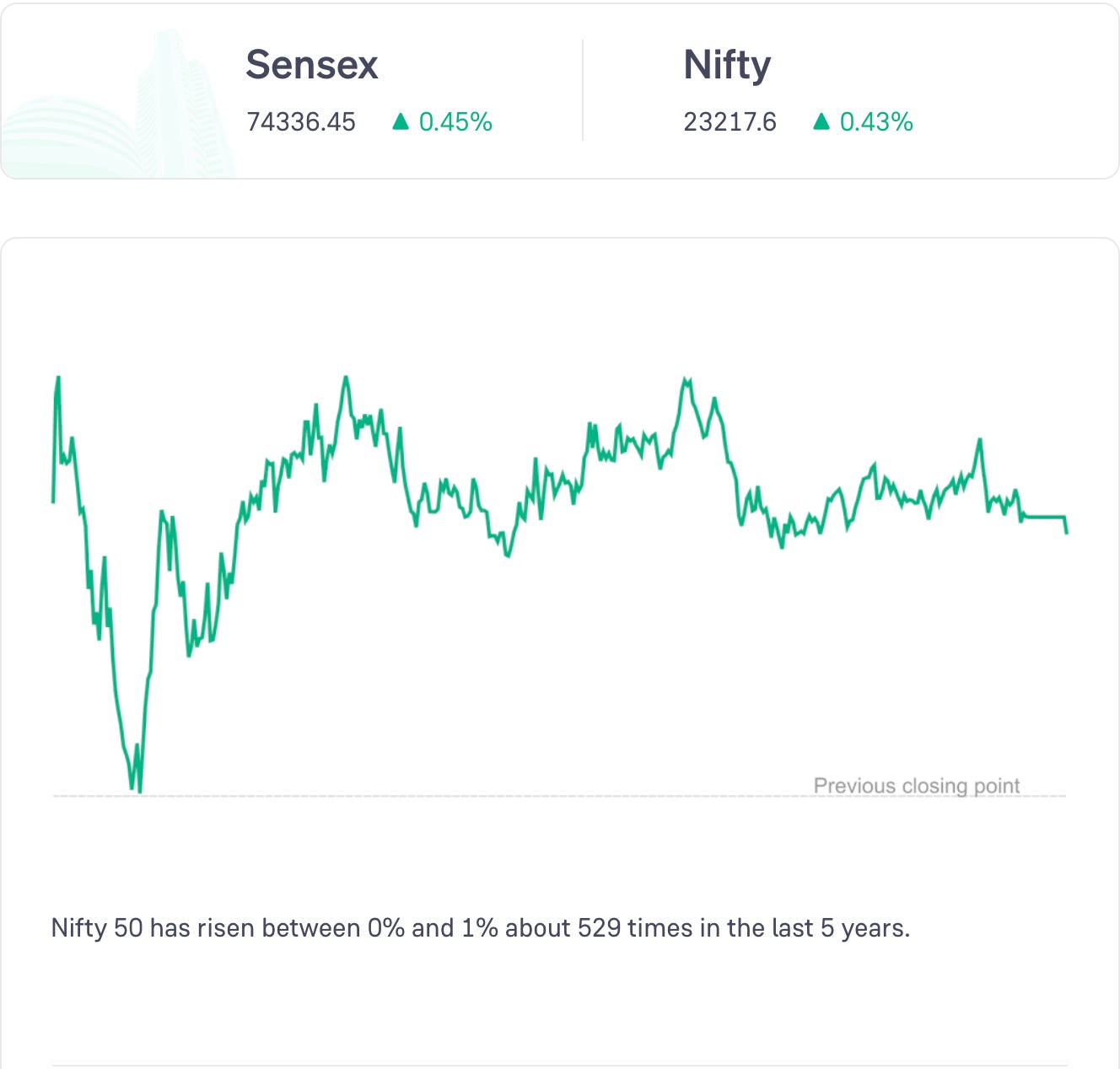
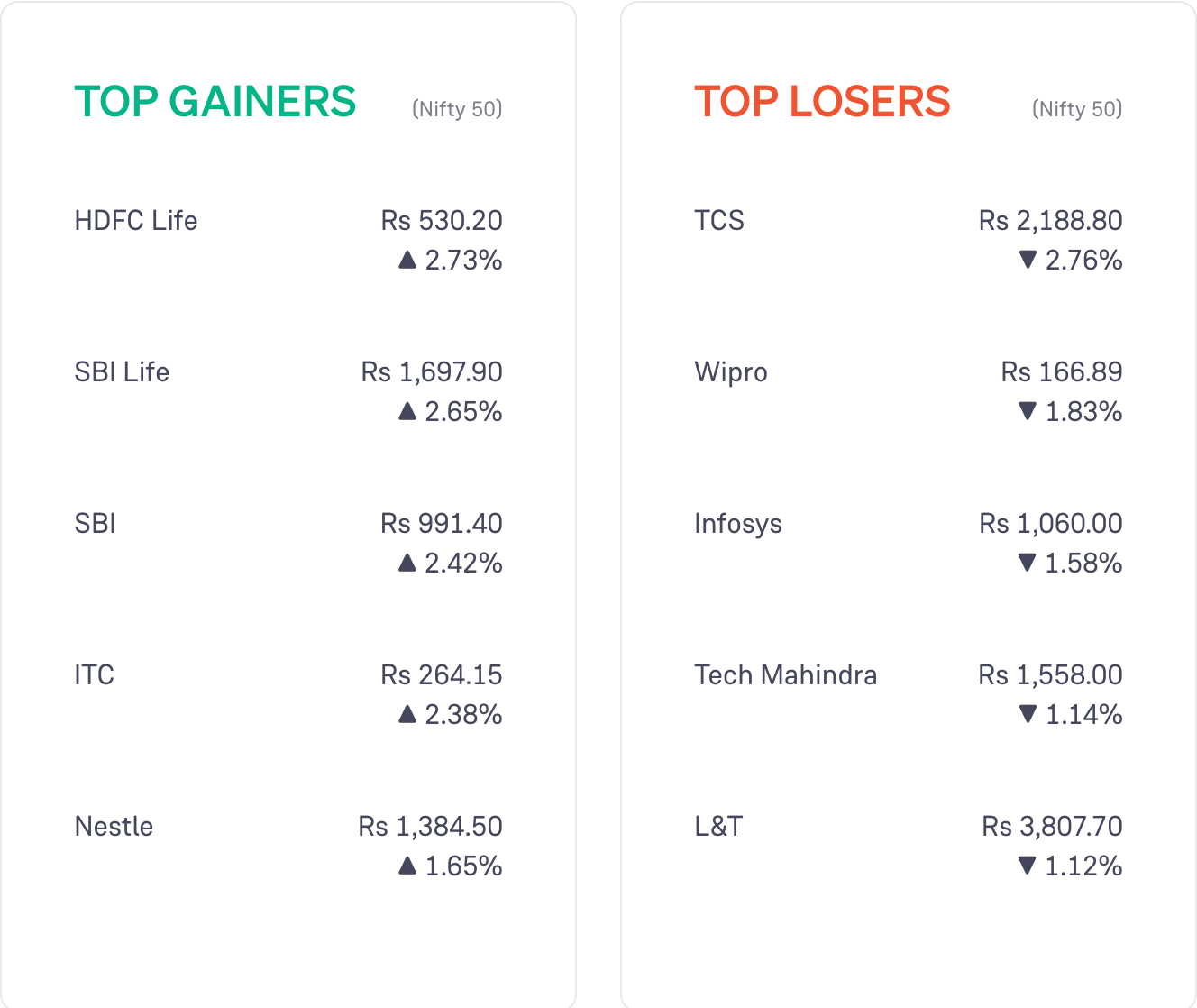
Markets closed higher than yesterday’s closing point after two days of fall.
FMCG stocks and PSU bank stocks rose the most today. IT stocks fell the most along with pharma stocks.
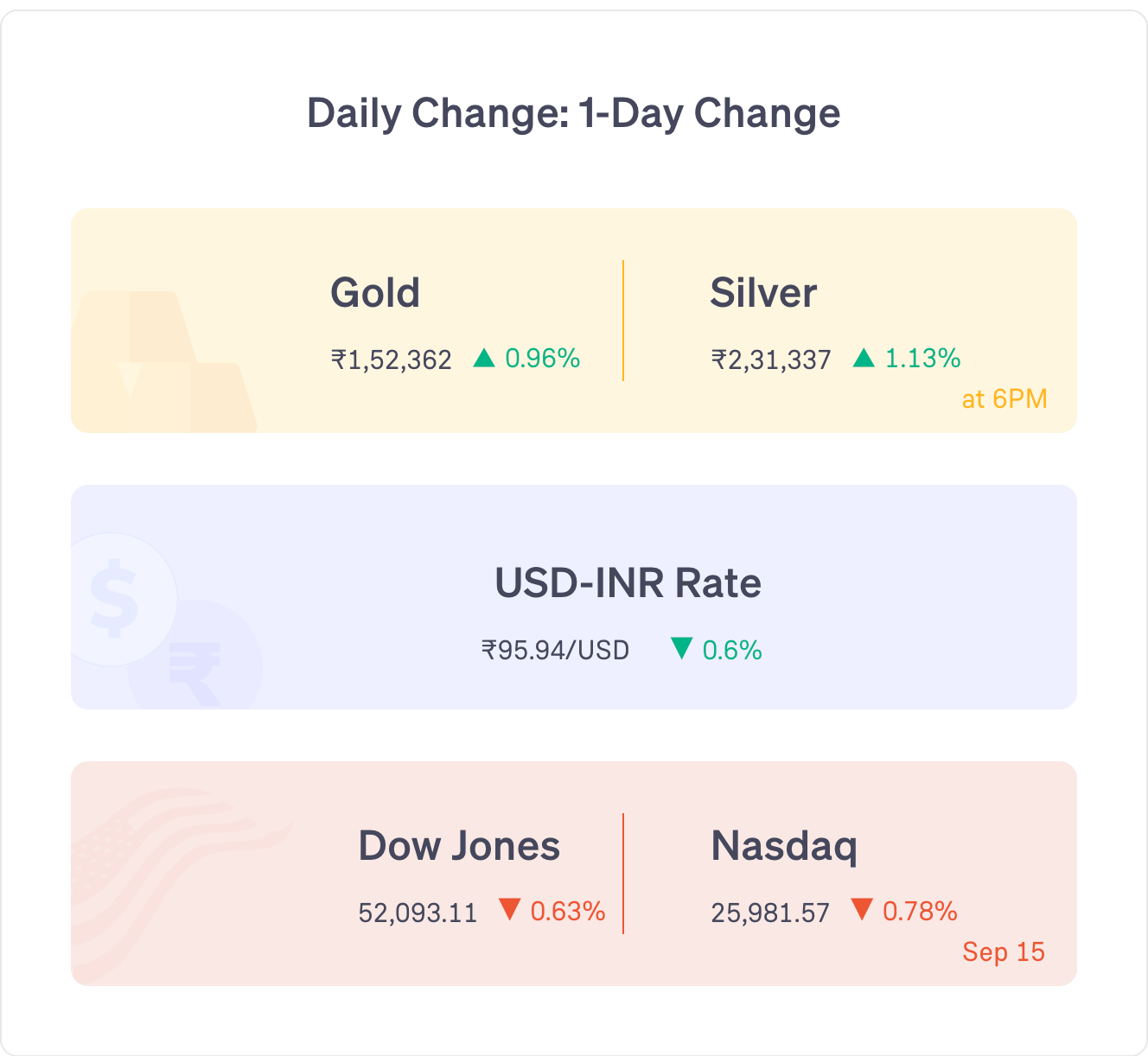
Global markets: US markets fell on Tuesday. Most Asian markets rose on Wednesday. Most European markets traded in green (as of 6 pm IST).
News
The government approved increasing the EPFO wage ceiling to Rs 25,000 per month from Rs 15,000 per month. As a result, an additional 51 lakh employees could come under mandatory coverage.
The government removed the requirement of certificate of registration for export consignments of up to Rs 3 lakh to lower entry barrier for MSMEs and first time exporters.
IPO Corner
Hero Motors’ Rs 1,000 crore IPO was subscribed 1.39 times on day 1. Retail subscription: 2.23 times. The IPO will close for subscription on 18 September.
SS Retail’s Rs 500 crore IPO was subscribed 1.44 times on day 1. Retail subscription: 2.20 times. The IPO will close for subscription on 18 September.
Prasol Chemicals listed at Rs 610 on NSE, a discount of 9.76% below its issue price and closed 0.74% lower.
Kanohar Electricals listed at Rs 685 on NSE, a premium of 8.34% over its issue price and closed 19.30% higher.
Glasswall Systems listed at Rs 194 on NSE, a premium of 6.59% over its issue price and closed 18.68% higher.
Stock Updates
Reliance: raised Rs 12,000 crore through unsecured NCDs at a 7.47% interest rate. The bonds will mature in September 2031.
Infosys: expanded its Indore development centre with a new 3.3 lakh sq ft software block. The center will support work in AI, cloud, cybersecurity and software development.
Samvardhana Motherson: its Indonesian subsidiary received an IDR 14.94 billion (around Rs 8.13 crore) tax penalty relating to the period before Motherson acquired it. It also provided a Rs 75 crore guarantee for another subsidiary, Yutaka Autoparts.
One 97 Comm (Paytm): from October 15, businesses receiving UPI payments above Rs 2,000 may have to pay a fee of up to 0.4%. Paytm expects this to increase revenue from merchant transactions that were earlier free.
Word of the Day
NPA
It is the part of a bank’s loan that is expected to be a total loss
NPA = Non Performing Asset.
When a borrower makes no EMI payment for 90 days, the lender categorises the loan as an NPA.
NPA is measured in terms of the total loan amount given by the lender.
Example: XYZ Bank’s NPA is 1.8%. This means that of the entire sum of money lent by the bank, 1.8% is not expected to be paid back.
NPA is an important metric for assessing any lender. A lower NPA is considered better.
6 Day Course
Theme: finding correct valuation
Day 3: Wednesday
Yesterday we saw how the PE ratio alone cannot tell us if a stock is overvalued/undervalued/fairly valued.
We also learnt that if a company is growing fast enough, a higher PE ratio can still mean the stock is undervalued.
To account for growth, another ratio was formulated.
PEG Ratio = PE Growth Ratio.
In this case, we take a company’s PE ratio and divide it by the earnings growth over the last 1 year.
A PEG ratio of 1 is considered ideal. More than 1 is considered high, and below 1 is considered low.
Of course different investors approach this method differently.
The challenge with PEG ratio is that it can easily miss companies that are about to turn around.
This makes it especially difficult for companies that operate in cyclical sectors.
————
Featured Question
Q. “If one is not in a position to sell the shares , how to treat the loss for tax purposes ..To make my question clear , I have purchased 100 shares earlier at Rs 50/- . One of my friend also purchased 100 number at 50/- . He is able to find a purchaser for rs 10/-at the time of de listing . His loss is rightfully accounted for ,for tax purpose . I did not find any person and as such the total amount is loss to me. Any benefit would accrue to me in tax angle .”
Long term losses in equity can be offset against long term gains.
This means that if you sell stocks (or equity mutual funds) for a loss, you can use that for tax advantage.
In the above case mentioned by you, the shares are still owned by you. No sale has taken place. You have not booked your loss.
And therefore, you cannot count it as a loss for tax purposes.
Did you like this edition?
Leave a feedback here!