
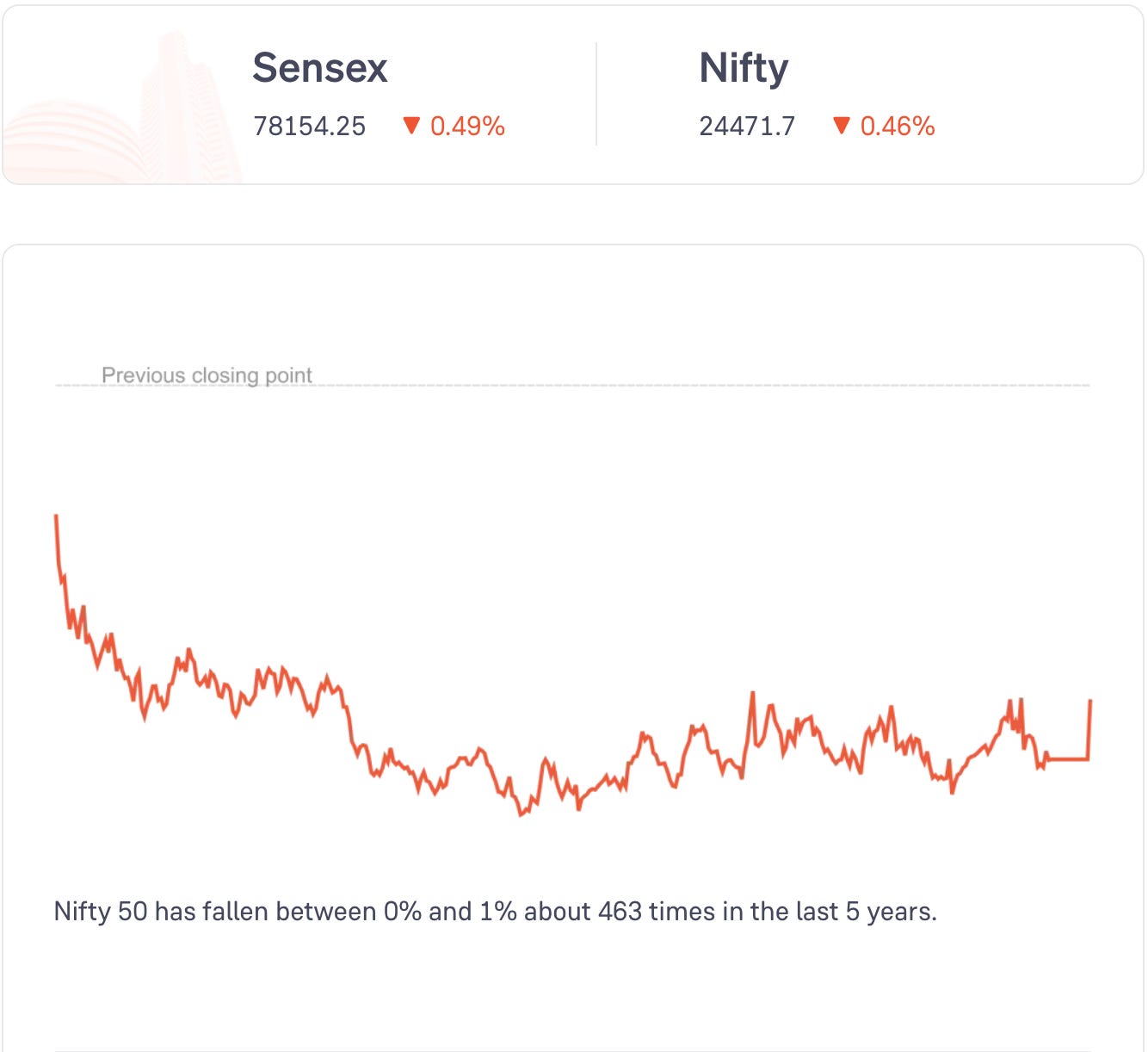
Markets closed lower than yesterday’s closing point.
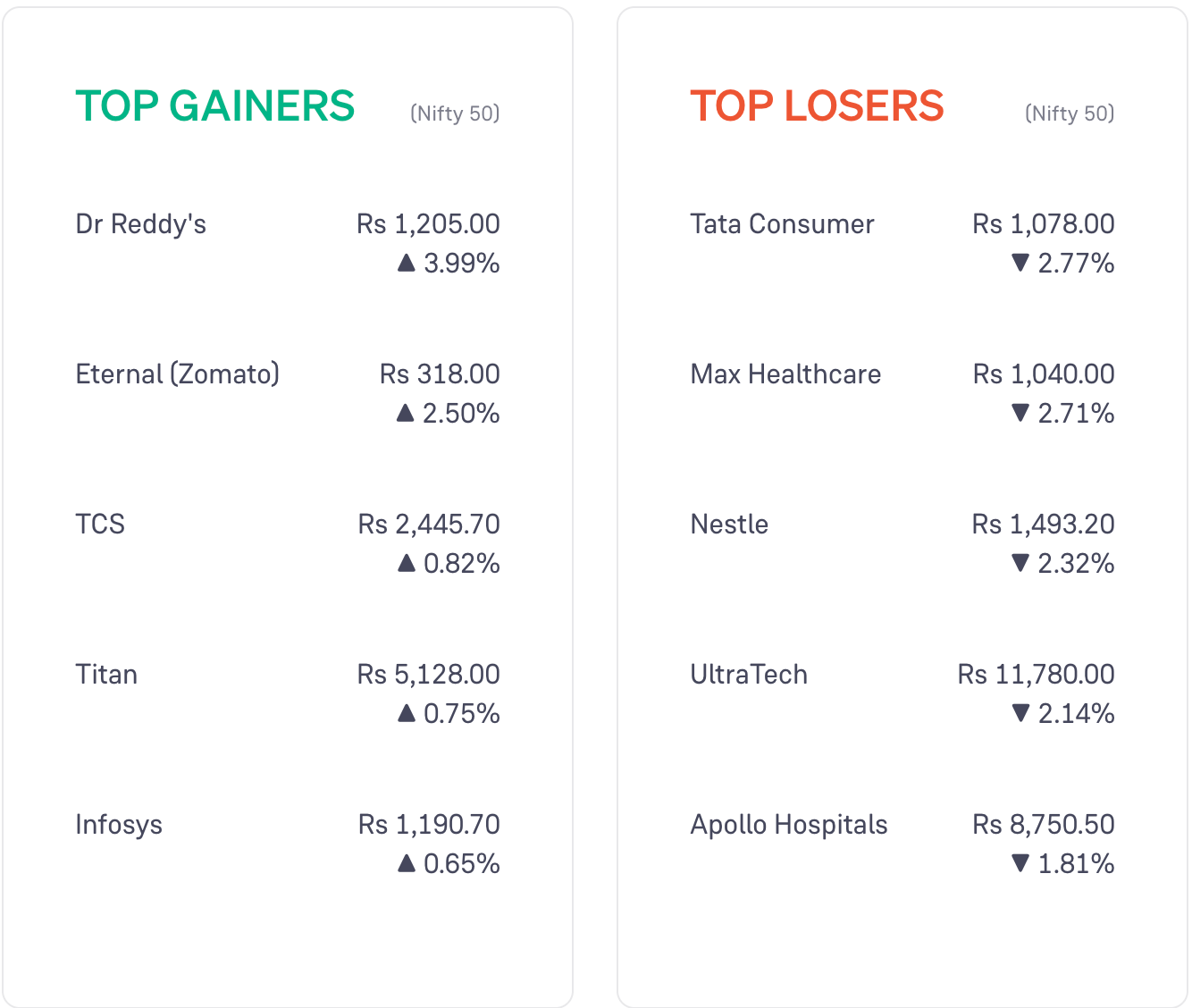
Cement stocks and FMCG stocks fell the most today. Pharma stocks and IT stocks rose the most.
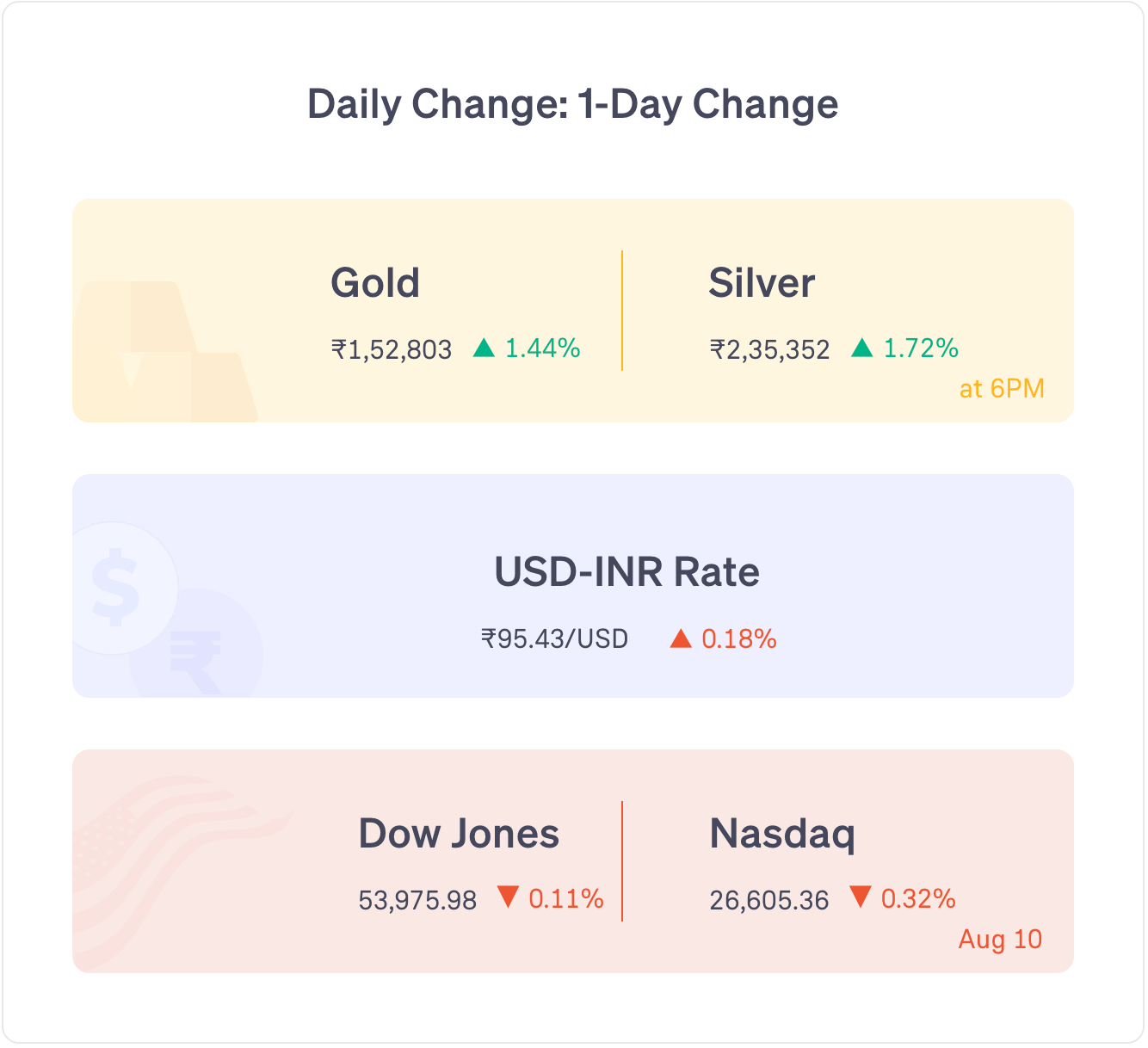
Global markets: US markets fell on Monday. Asian markets traded mixed on Tuesday. Most European markets rose (as of 6 pm IST).
News
Equity mutual fund inflows fell 15% to Rs 24,697.39 crore in July compared to Rs 28,973 crore in June. Debt funds saw a net inflow of Rs 1.87 lakh crore compared to net outflow of Rs 1.09 lakh crore in June.
Nifty 50 and Nifty 50 Equal Weight indices will be reshuffled on 30 September. Wipro will exit the index and the BSE Ltd stock will enter the index.
SBI Capital Markets will now sell 8.78 million NSE shares in the exchange’s proposed IPO, without changing the overall issue size, as per an addendum to its DRHP.
SEBI proposed widening the participation of FPIs in Exchange Traded Commodity Derivatives (ETCDs), including trade in non-agricultural and non-cash settled non-agricultural commodity derivatives.
The government approved the RBI’s proposal for introduction of one billion plastic notes of Rs 10 and Rs 20 for field trials. Plastic bank notes are proposed to be issued along with paper notes.
The government halved the incentives for electric two wheelers to Rs 2,500 per kWh from Rs 5,000 per kWh. The scheme has been extended by a year to 31 March 2028.
SEBI proposed raising the number of unique identification numbers for securities (ISIN) that can mature in a year for privately placed debt securities to 17 from 14 to ease refinancing pressures.
Milky Mist’s IPO was subscribed 0.79 times on day 1. Retail subscription: 0.96 times. The IPO will close for subscription on 13 August.
LEAP India IPO was subscribed 8.38 times on day 3. Retail subscription: 1.71 times. IPO closed for subscription.
Dhoot Transmission IPO was subscribed 3.94 times on day 2. Retail subscription: 2.97 times. IPO will close for subscription on 12 August.
Molbio Diagnostics IPO was subscribed 3.11 times on day 2. Retail subscription: 3.18 times. IPO will close for subscription on 12 August.
Stocks Updates
L&T: agreed to transfer its data centre and cloud services business to wholly owned subsidiary Vyoma.AI for Rs 1,400 crore. It will also transfer its entire stake in L&T Network Services Pvt Ltd to Vyoma for Rs 30 crore.
Avenue Supermarts (DMart): allotted commercial paper worth Rs 300 crore with a 90-day tenure at a coupon rate of 6.70%, maturing on 9 Nov 2026.
Grasim: started commercial production at its CPVC resin plant in Vilayat, Gujarat, developed in collaboration with Lubrizol Advanced Materials India. The plant has a planned capacity of about 50,000 tonnes per annum.
Siemens: net profit rose 406.74% year-on-year to Rs 2,143 crore in the April-June quarter. The company also reported a Rs 2,099 crore provisional gain from the sale of its Low Voltage Motors business.
Canara Bank: increased its MCLR by 5 basis points across tenures from one month to three years, effective 12 August. The one-year MCLR will rise to 8.80%, while the overnight MCLR remains unchanged at 7.95%.
Zydus Lifesciences: net profit fell 35.93% year-on-year to Rs 939.80 crore in the April-June quarter. During the quarter, the company completed the acquisition of US-based Assertio Holdings for about $166.4 million.
Godrej Consumer: appointed current CFO Aasif Malbari as Managing Director and CEO for five years effective 12 August, following the resignation of Sudhir Sitapati. Vishal Kedia was appointed interim CFO.
Ashok Leyland: allotted unsecured NCDs worth Rs 300 crore on a private placement basis with a 7.5% per annum coupon rate and mature on August 10, 2028.
Word of the Day
Gross Profit
It is the profit calculated by deducting the cost of making a product from the revenue
Gross profit takes into account only the cost of products sold.
This includes raw materials, labour charges, assembling costs, rent of factory, depreciation of the machines used, etc.
It does not factor other charges of running the company like the cost of R&D of developing the product, marketing, salaries of other employees like accountants, etc.
This is opposed to net profit that is calculated by subtracting all costs from the revenue.
Net profit includes everything, right from the raw materials, labour, depreciation, R&D cost, salaries, rent, debt repayment, taxes etc.
6 Day Course
Theme: micro-cap investing
Day 2: Tuesday
For this course, we are considering anything outside the 500 biggest companies as micro-cap.
One of the first characteristics to understand about this category of stocks is liquidity.
These companies are small and often, there aren’t enough shares being bought and sold.
This means that it is possible that investors might not be able to buy or sell when they wish to.
So, when the stock’s price might be at a level that’s attractive to buy at, there might not be many sellers.
Similarly, when the price shoots up, there might not be many buyers.
To make matters worse, it is possible that liquidity is good when you’re buying but becomes poor when you’re selling.
Looking at the historical daily trading volume can help in such cases though it does not guarantee anything.
————
Featured Question
Q. “I have shares of few compamies pocured years ago. I cannot remember the purchase price of these shares. How would I calculate LTCG if shares are sold now?. Is it my onus to pay LTGS while filing IT return?”
The question is, how long ago did you buy the shares?
If you bought shares 30-40 years ago, you will need to find the buying price somehow. It is necessary to calculate the tax you owe.
Do check out the 2018 tax change rule (Section 112A).
There is one potential relief in it.
Say you bought shares decades ago.
And say you are sure that the share price was much lower when you bought compared to the price on 31st January 2018.
Then, you will be able to use the share price on 31st January 2018 as your buying price.
Things get more complex if the selling price is lower than the price on 31st January 2018.
These calculations are a bit complicated. It is best to consult a Chartered Accountant (CA) for this.
If you bought some time in the last 20 or so years, chances are you bought the shares using a digital platform.
The buying price would most likely be recorded by your investment platform.
Most investment platforms automatically generate capital gains reports based on this buying price.
You can try to reach out to the platform to know this.
To answer your last question — yes, the onus to calculate and pay taxes is on you (the investor).
Did you like this edition?
Leave a feedback here!