
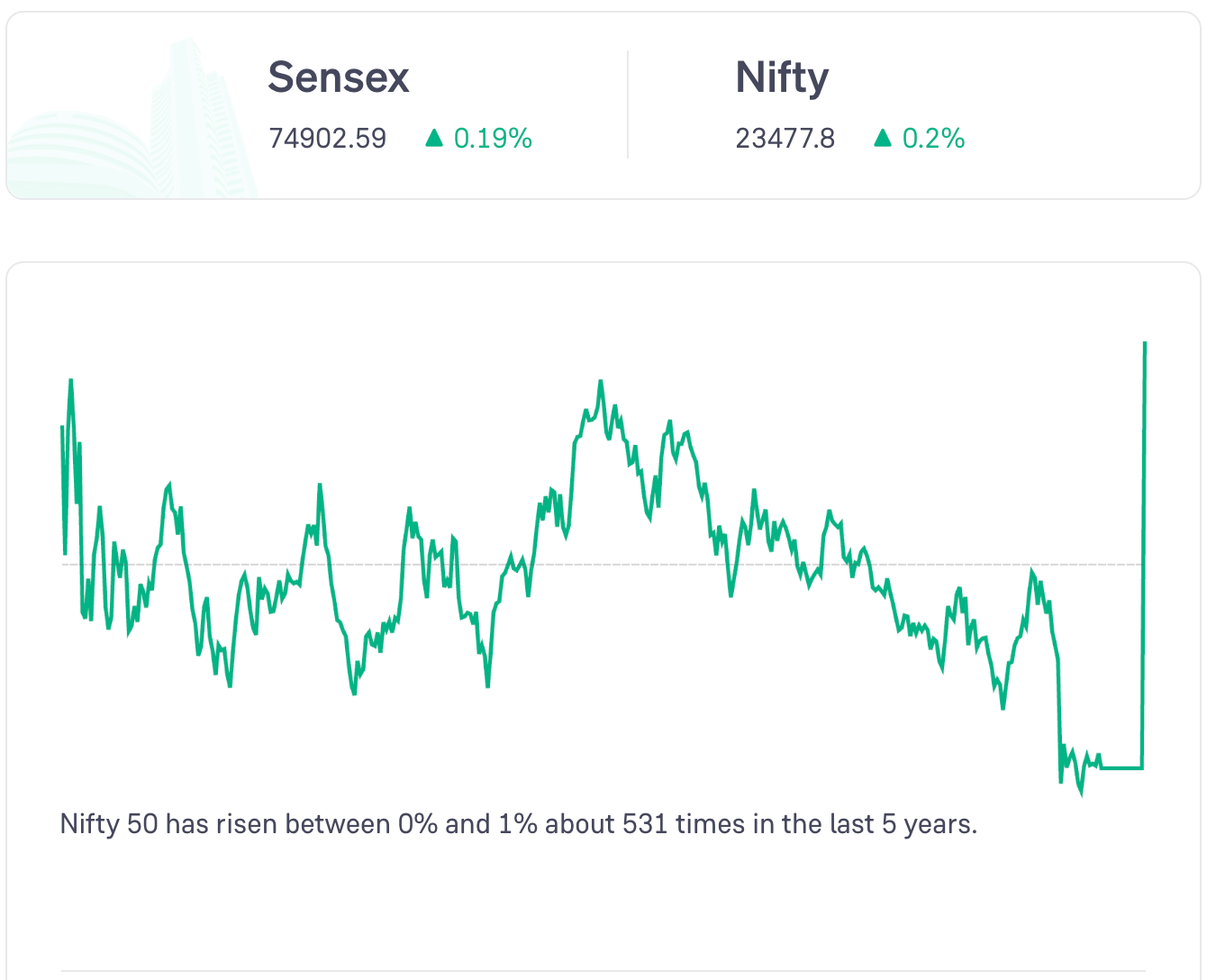
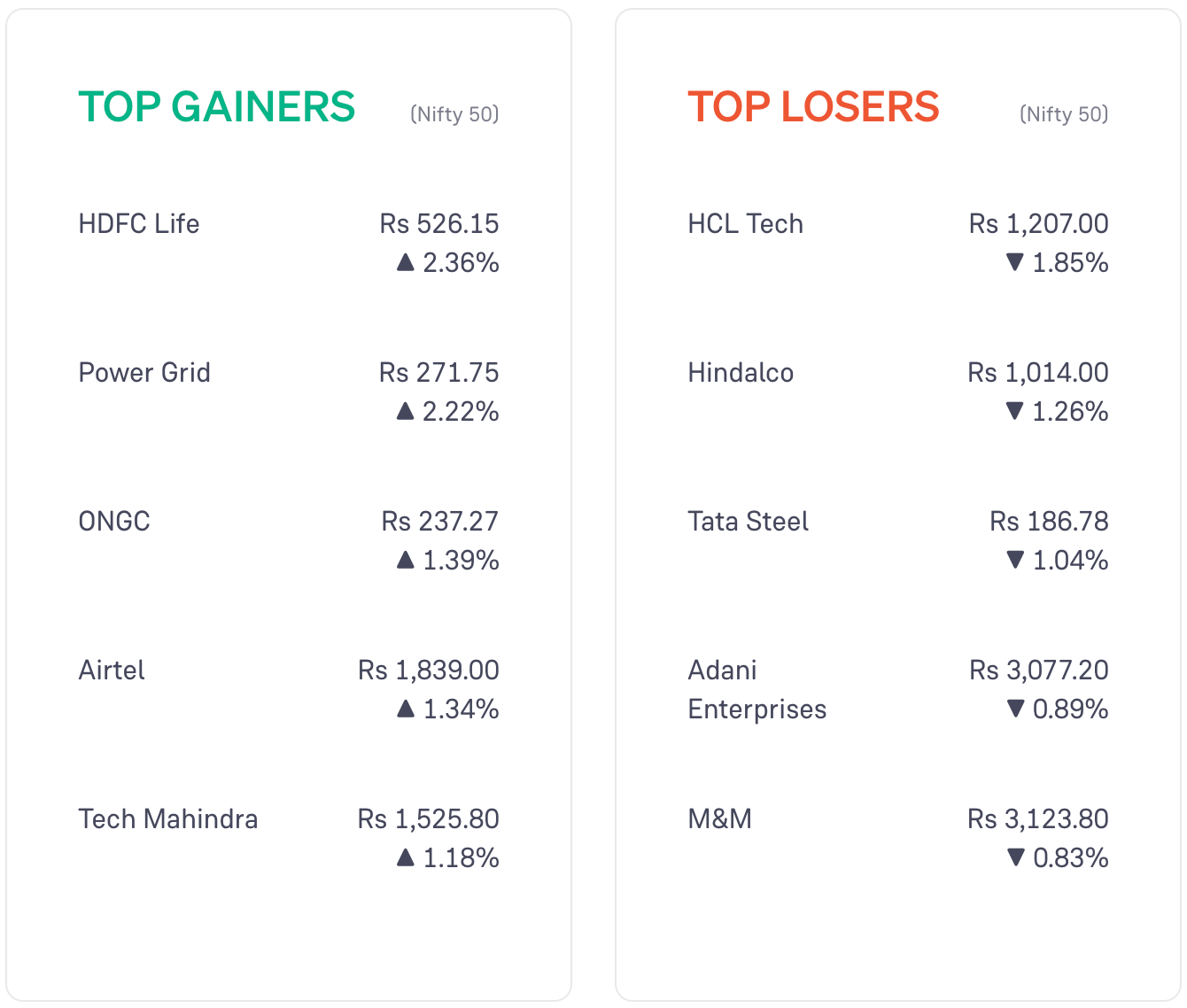
Markets closed higher compared to yesterday’s closing point, after three continuous days of fall.
Media stocks and PSU bank stocks rose the most today. Metal stocks and pharma stocks fell the most.
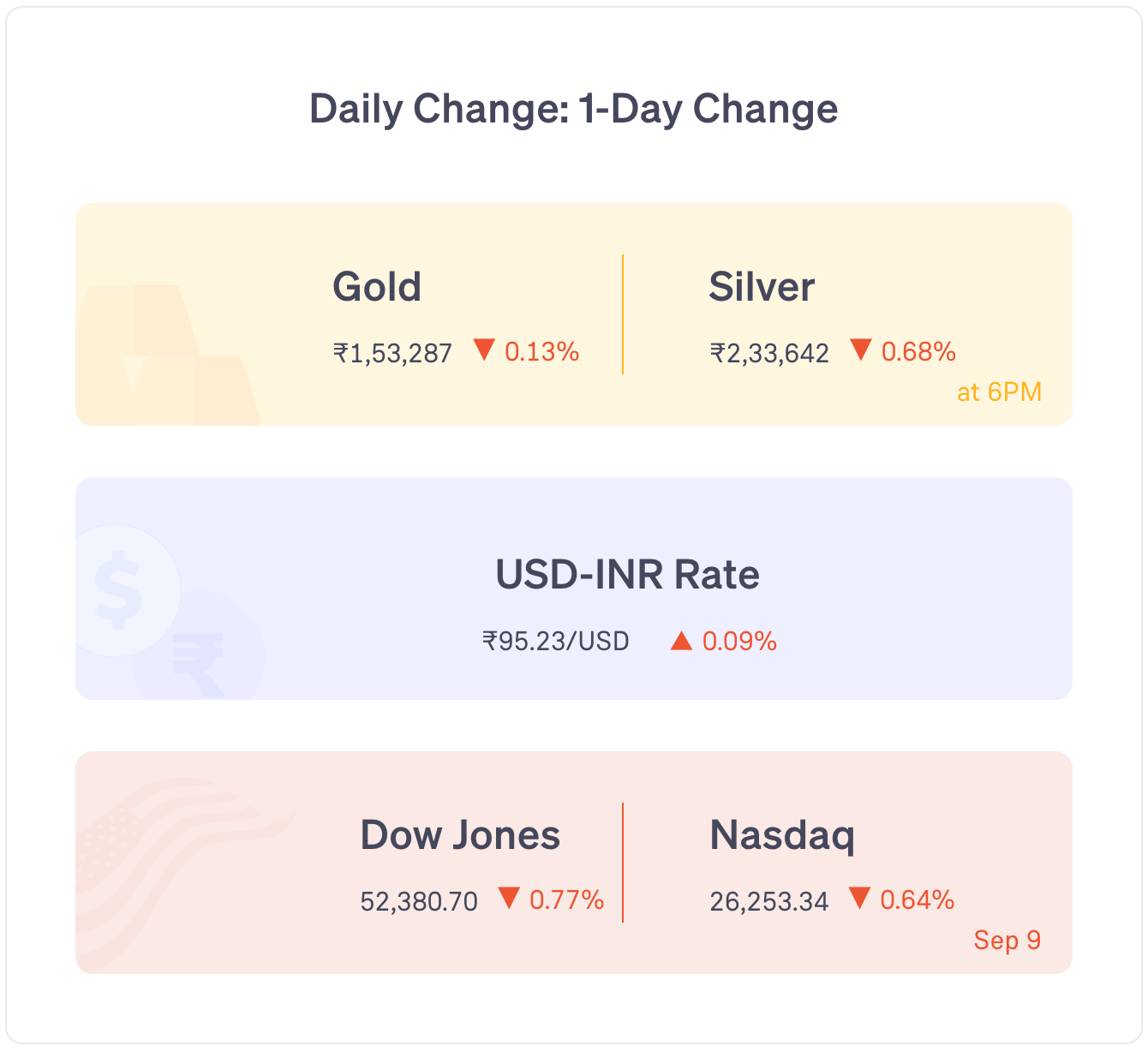
Global markets: US markets fell on Wednesday. Most Asian markets fell on Thursday. European markets traded mixed (as of 6 pm IST).
News
Equity mutual fund inflows rose 18.75% to Rs 29,328.62 crore in August. Debt funds saw an outflow of Rs 8,127 crore in August vs an inflow of Rs 1.87 lakh crore in July.
IPO Corner
Rentomojo Limited was subscribed 4.71 times on day 2. Retail subscription: 4.19 times. The IPO will close for subscription on 11 Sept.
Kanohar Electricals was subscribed 90.59 times on day 3. Retail subscription: 20.51 times. The IPO is closed for subscription.
Karamtara Engineering was subscribed 3.61 times on day 2. Retail subscription: 3.28 times. The IPO will close for subscription on 11 Sept.
Manipal Payment and Identity Solutions was subscribed 0.31 times on day 2. Retail subscription: 1.22 times. The IPO will close for subscription on 11 Sept.
Asset Reconstruction Company (India) Limited was subscribed 0.87 times on day 2. Retail subscription: 1.24 times. The IPO will close for subscription on 11 Sept.
Prasol Chemicals was subscribed 3.30 times on day 3. Retail subscription: 1.70 times. The IPO is closed for subscription.
Stock Updates
Titan: repaid Rs 1,000 crore of commercial paper after it matured on 10 September. The borrowing was originally raised in June.
Nestle India: won part of its GST appeal for FY2017-20 but must still pay Rs 1.30 crore plus interest and a penalty of about Rs 13 lakh.
Indian Bank: plans to sell 17.91% of its holding in NSE through the offer for sale in NSE’s proposed IPO. The sale is subject to approvals.
IDBI Bank: said it cannot confirm or deny reports that Fairfax may sell its IIFL Finance stake to fund a bid for IDBI Bank. The bank said it has no role in the reported matter.
Word of the Day
Delisting
It is the process by which a company removes itself from the share markets.
Post delisting, a company’s shares are no longer available for buying/selling on the exchange.
Delisting can be voluntary — this is if the company wants to delist itself. It offers to buy all existing shares for a certain price.
Delisting can also be involuntary — it can be delisted due to regulatory non-compliance, bankruptcy, etc. In this case, the shares continue to exist but are traded only OTC (Over The Counter).
6 Day Course
Theme: mutual fund ratings
Day 4: Thursday
Some mutual funds have a proven track record of being poor performers.
Their returns have been low for long periods, through different market cycles.
Such mutual funds are often rated extremely poorly.
Mutual fund ratings are great for filtering these out. In other words, they are very useful in helping an investor decide where not to invest.
But the opposite is not true.
Practically speaking, many good funds’ ratings change from okay-ish to very good and vice versa within a few years depending on their short-term performance.
As discussed in an earlier edition of this digest, such a rating is not useful.
Another method that may be useful to investors is to check how ratings of certain mutual funds change over time.
Such a method can ensure we know which mutual funds remain poorly rated for long periods.
————
Featured Question
Q. “What happens to the stocks during a Market crash? If everyone is panic selling then someone has to buy these stocks. Without anyone buying the Market shouldn’t crash. Please explain what exactly happens during a Market Crash?”
If there are no buyers and only sellers, no trade takes place.
In such a situation, a crash is not possible since the price would not change at all.
During a crash, what happens is that the number of sellers is very high, and the buyers are very low in number.
We all know how price-bidding works.
If you are desperate to buy something, you tend to keep bidding for a higher price.
During a crash, the reverse of that happens.
As sellers are panicking, they are willing to sell the shares at a lower price than others — leading to a continuous fall in share price.
The buyers in this case keep getting a lower price to buy shares at.
Why is the buyer buying?
In the stock markets, all kinds of investors exist. They all have different strategies and goals.
So clearly, the buyers would have their own reason to buy even during a crash.
Maybe they think the crash is temporary and unwarranted, and that they can get the shares for cheap. Maybe they expect a short turnaround in which they will sell. There can be hundreds of reasons for such buying.
The information presented in this post has been compiled and prepared by Groww Invest Tech Pvt Ltd and is intended solely for informational purposes. It is not tailored to any specific investment objectives, financial situations, or needs of any individual investor. The content should not be construed as investment, financial, legal, or tax advice and should not be relied upon as a substitute for professional consultation.
Investing in securities markets involves inherent risks. Investors are advised to carefully review all relevant documents and consider their own risk tolerance before making any investment decisions.
Mutual fund investments are subject to market risks; please read all scheme-related documents carefully. Past performance of financial instruments, schemes, or markets is not indicative of future results.
Groww Invest Tech Pvt Ltd is registered with the Securities and Exchange Board of India (SEBI) under Registration No: INZ000301838, as a Research Analyst under No: INH200008662, as a Depository Participant under No: IN-DP-417-2019, and with the Association of Mutual Funds in India (AMFI) under ARN-111686.
SEBI registration details: View registered name and registration numbers
Research Analyst Disclaimer: View Research Analyst disclaimer
Did you like this edition?
Leave a feedback here!