
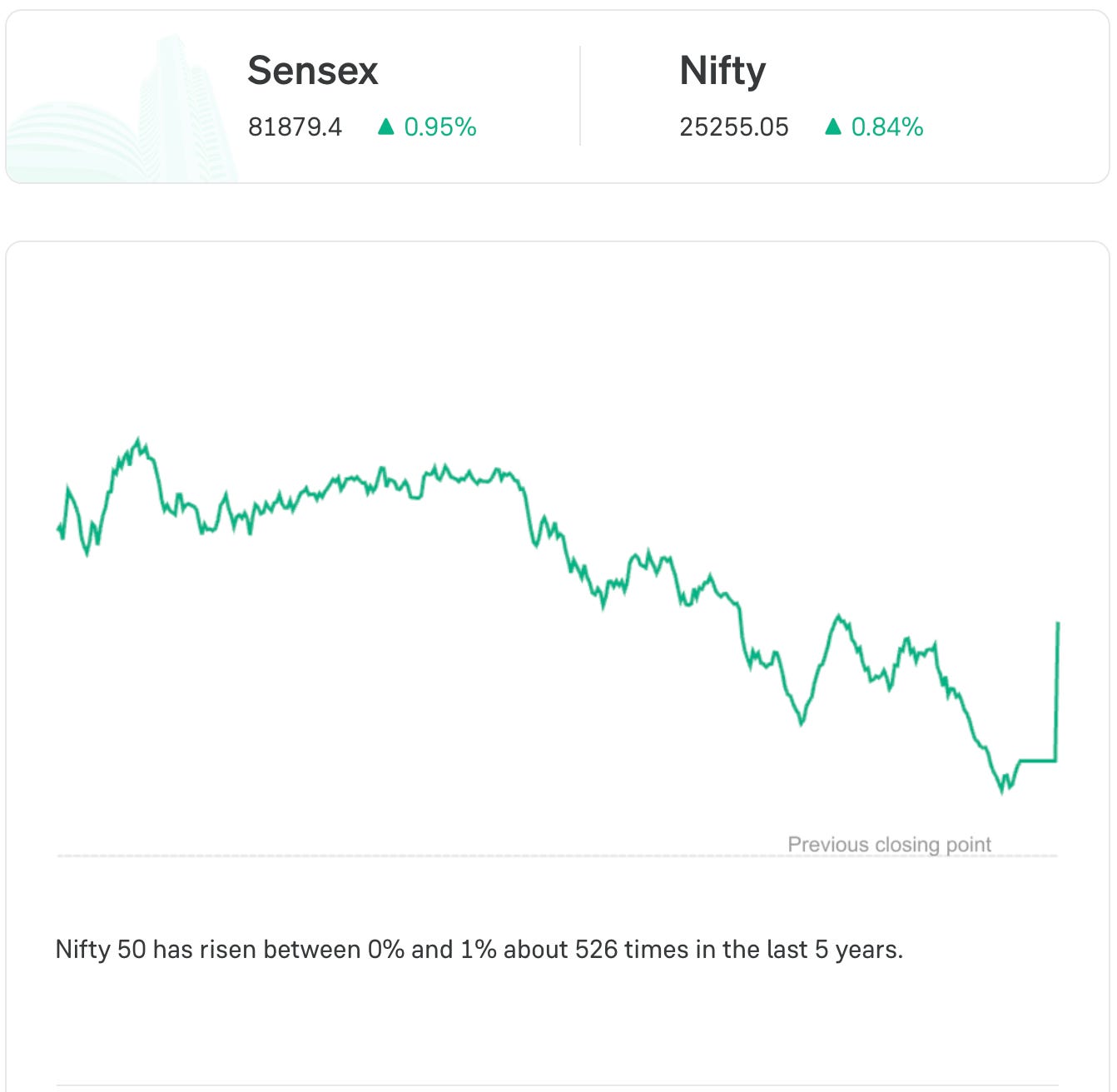
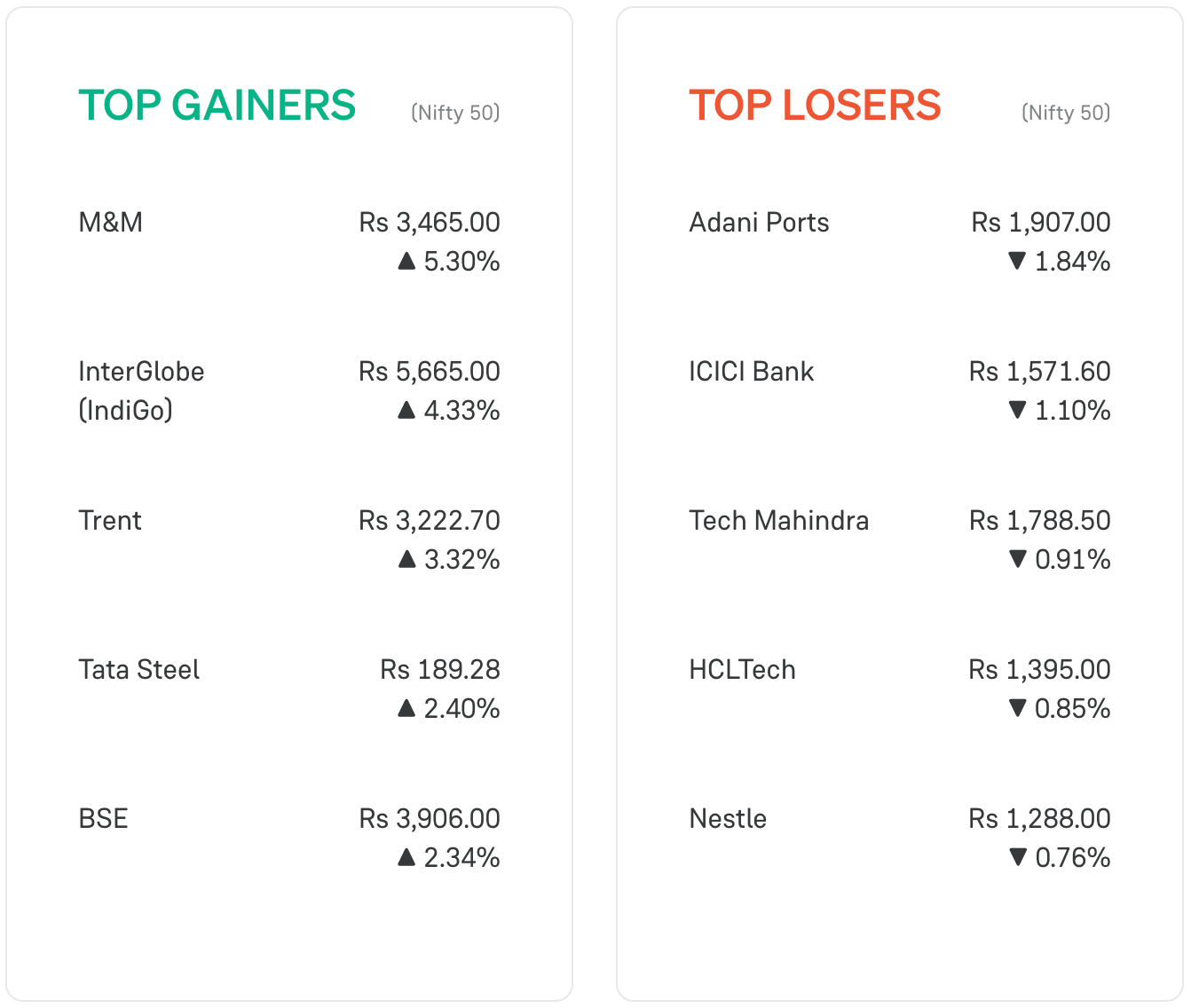
Markets closed higher than yesterday’s closing point.
PSU Bank stocks and auto stocks rose the most today. Realty stocks and healthcare stocks fell the most.
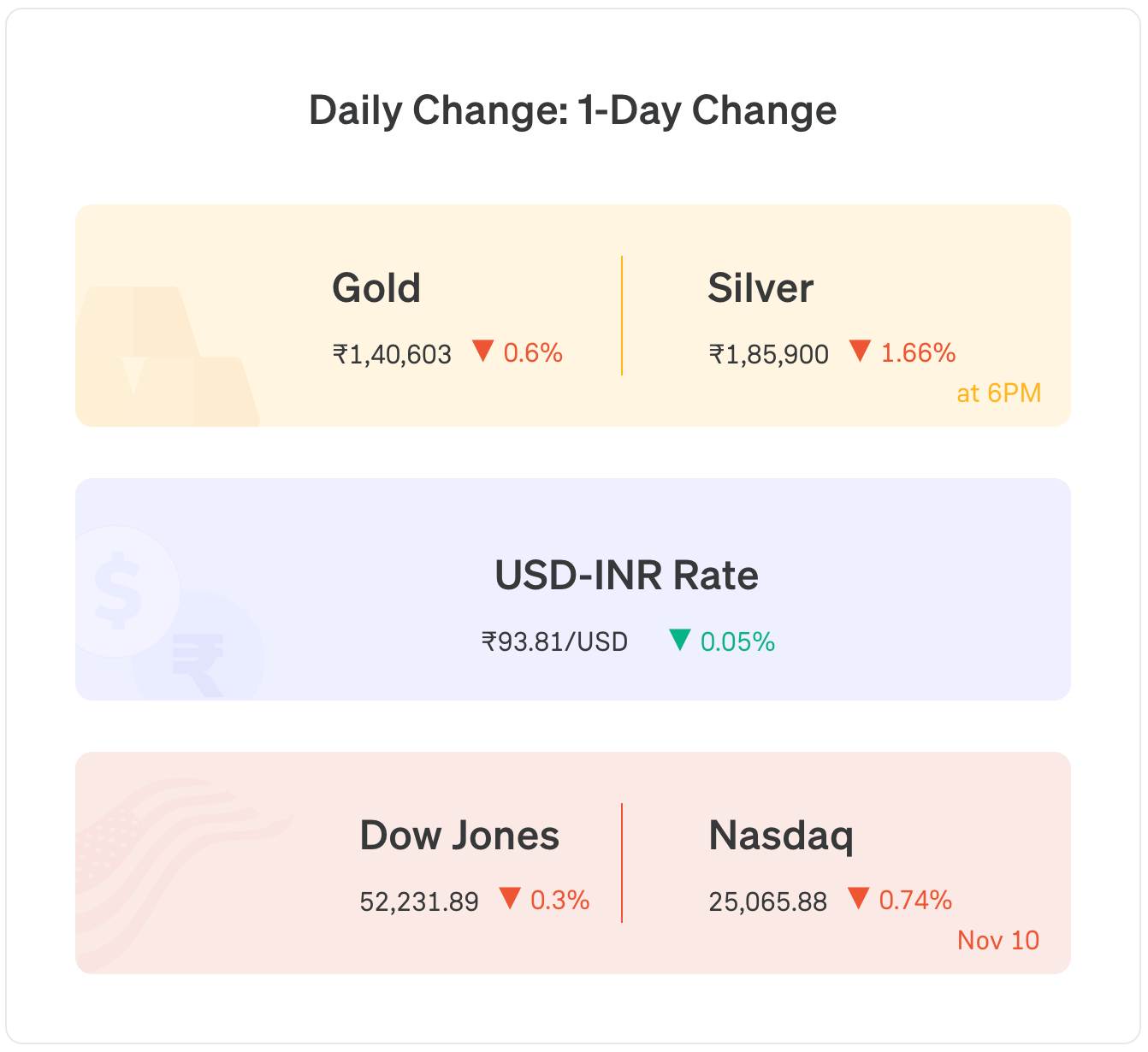
Global markets: US markets fell on Tuesday. Most European and Asian markets rose on Wednesday (as of 6 pm IST).
News
Equity mutual fund inflows fell 13.87% to Rs 32,993.63 crore in October compared to Rs 38,306.55 crore in September. Debt funds saw a net inflow of Rs 1.13 lakh crore compared to a net outflow of Rs 1.83 lakh crore.
India’s unemployment rate stood at 5.1% for the July-Sept quarter compared to 5.4% in the previous quarter. Rural unemployment rate fell to 4.3% from 4.8%, and urban unemployment rate stood at 6.8% vs 6.7%.
The government prohibits the export of lithium-ion battery black mass with immediate effect to strengthen domestic recycling and critical mineral recovery.
Stock Updates
BHEL: won an order worth Rs 600 crore to Rs 900 crore from Power Grid Corporation of India to supply two synchronous condensers at Kalyanpur, Gujarat.
Tata Power: net profit rose 48.58% year-on-year to Rs 1,366.11 crore in the July-Sept quarter. It also approved investing Rs 11,871 crore in an 1,800 MW pumped storage hydro project at Shirwata, Maharashtra.
HCLTech: partnered with US-based PTC Inc to launch a ready-to-use product lifecycle management (PLM) solution for semiconductor companies.
Word of the Day
Bullion
Bullion refers to precious metal commodities valued by their weight and purity
Gold and silver are commonly priced based on their bullion prices.
When talking of bullion, we are referring to the price of the metal purely by its weight and purity and no other additional value like jewellery making cost, sentimental or collectible value, etc.
Bullion is mostly held in coin, biscuit, bar, and ingot form.
Some coins have additional value because of being collectibles. They are not categorised bullion coins.
6 Day Course
Theme: stocks order matching
Day 3: Wednesday
Limit orders are placed with the exchange. It has a list of limit orders that are trying to sell (they are called ask) and another list of limit orders that are trying to buy (they are called bids).
The exchange matches orders based on price match (it tries to give limit order a match that is at the price they want or better). If there is a tie in price, then orders are matched using time (first come, first serve basis).
Say the lowest limit sell order for a stock is Rs 200 for 500 shares.
The second lowest limit sell order is for Rs 201 for 300 shares.
And now, a market buy order comes to the market for 800 shares. Market orders do not have price criteria. So the orders start getting matched with the best available matches.
So, first, this buy order is matched with the Rs 200 limit order. Here, 500 shares get traded.
Now, the remaining buy order of 300 shares is matched with the Rs 201 limit sell order.
The buyer was able to buy 500 shares at Rs 200 and 300 shares for Rs 201.
————
Featured Question
Q. “Titan: repaid Rs 850 crore worth of commercial paper on 9 Nov. Avenue Supermarts (DMart): repaid Rs 300 crore worth of commercial paper on 9 Nov What is this commercial paper? Never heard of it”
Commercial papers are offered by stable and well-rated companies. Not all companies can offer commercial papers.
Commercial papers are offered at a discount.
Which means, the commercial paper offers a certain amount in the future and investors can buy that commercial paper at discount in the present.
The difference between the future value and current offer price is the interest.
Example: XYZ company is offering a commercial paper with a value of Rs 100 on 31st Dec 2026, at a discounted price of Rs 99 today.
They are usually for a short duration, ranging from 7 days to 1 year.
It is unsecured which means, there is no collateral for this borrowing.
Companies use it because it works out cheaper for them than taking loans from banks.
Usually, commercial papers are bought by mutual funds, banks, insurance companies, etc.
The information presented in this post has been compiled and prepared by Groww Invest Tech Pvt Ltd and is intended solely for informational purposes. It is not tailored to any specific investment objectives, financial situations, or needs of any individual investor. The content should not be construed as investment, financial, legal, or tax advice and should not be relied upon as a substitute for professional consultation.
Investing in securities markets involves inherent risks. Investors are advised to carefully review all relevant documents and consider their own risk tolerance before making any investment decisions.
Mutual fund investments are subject to market risks; please read all scheme-related documents carefully. Past performance of financial instruments, schemes, or markets is not indicative of future results.
SEBI Reg Name: Groww Invest Tech Pvt Ltd | SEBI Reg No: INZ000301838 | RA No: INH200008662
Groww Invest Tech Pvt Ltd is registered with the Securities and Exchange Board of India (SEBI) under Registration No: INZ000301838, as a Research Analyst under No: INH200008662, as a Depository Participant under No: IN-DP-417-2019, and with the Association of Mutual Funds in India (AMFI) under ARN-111686.
SEBI registration details: View registered name and registration numbers
Did you like this edition?
Leave a feedback here!