

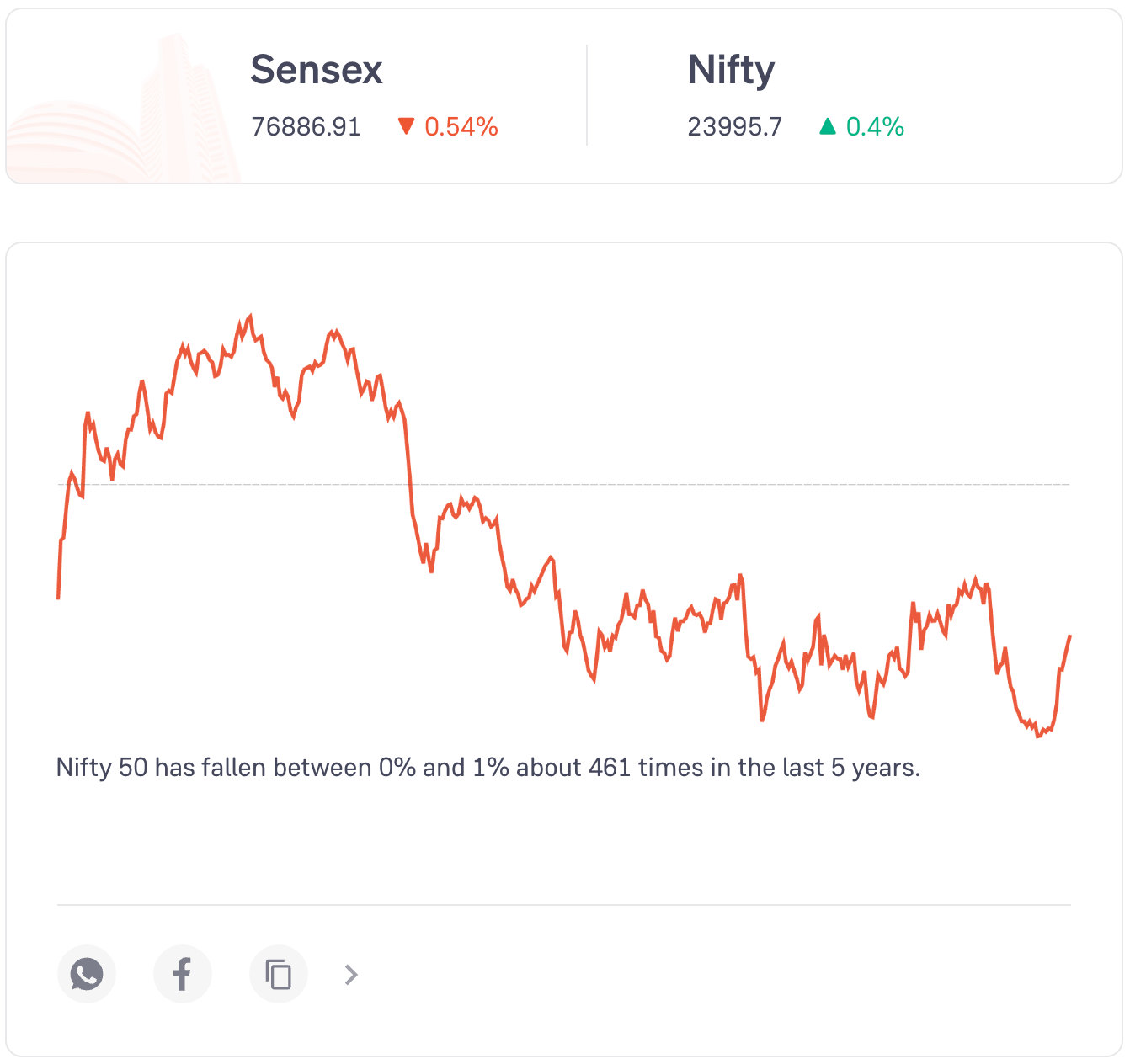
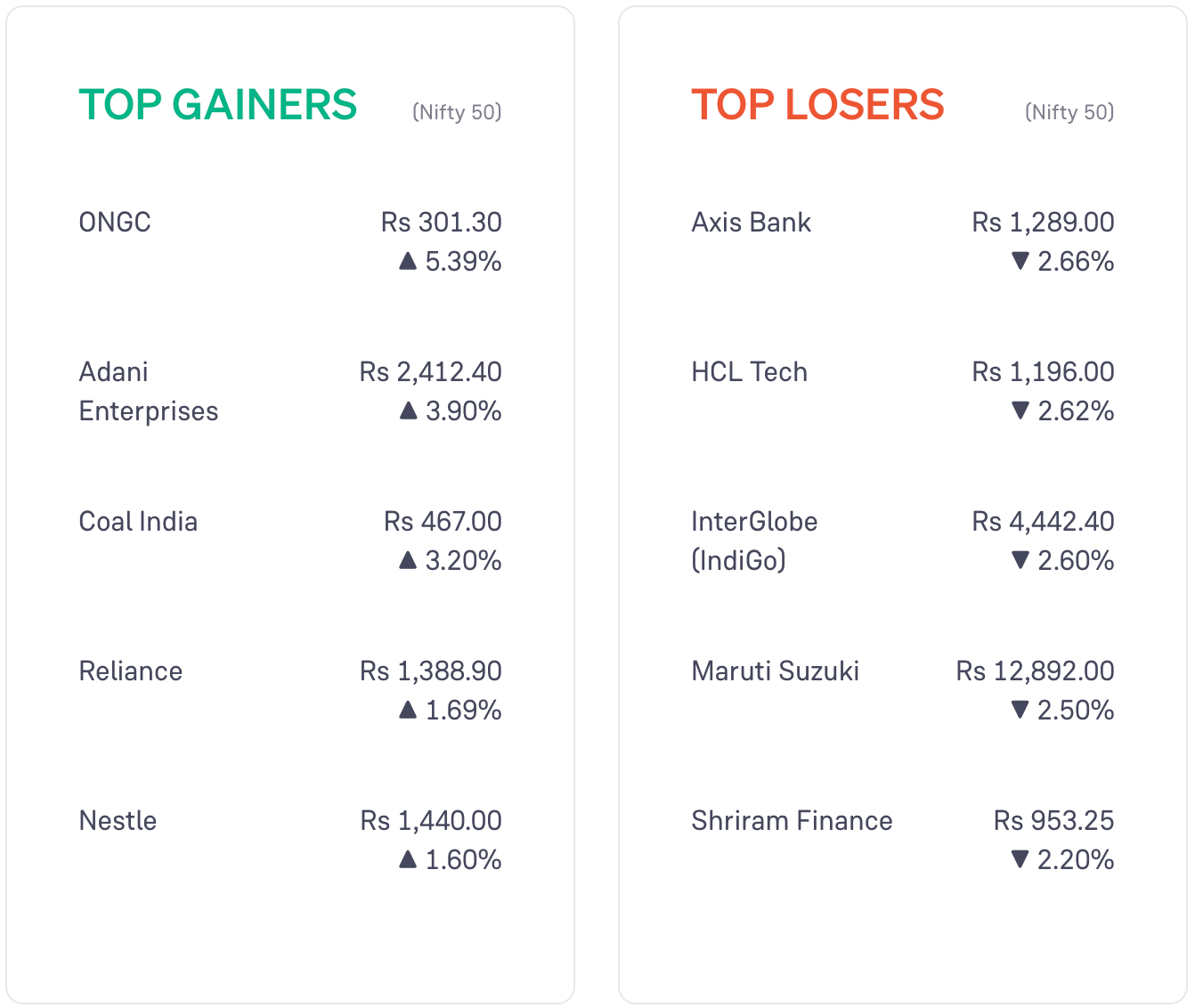
Markets opened below yesterday’s closing point.
Oil and gas stocks and chemicals stocks rose the most today. PSU bank stocks and private bank stocks fell the most.
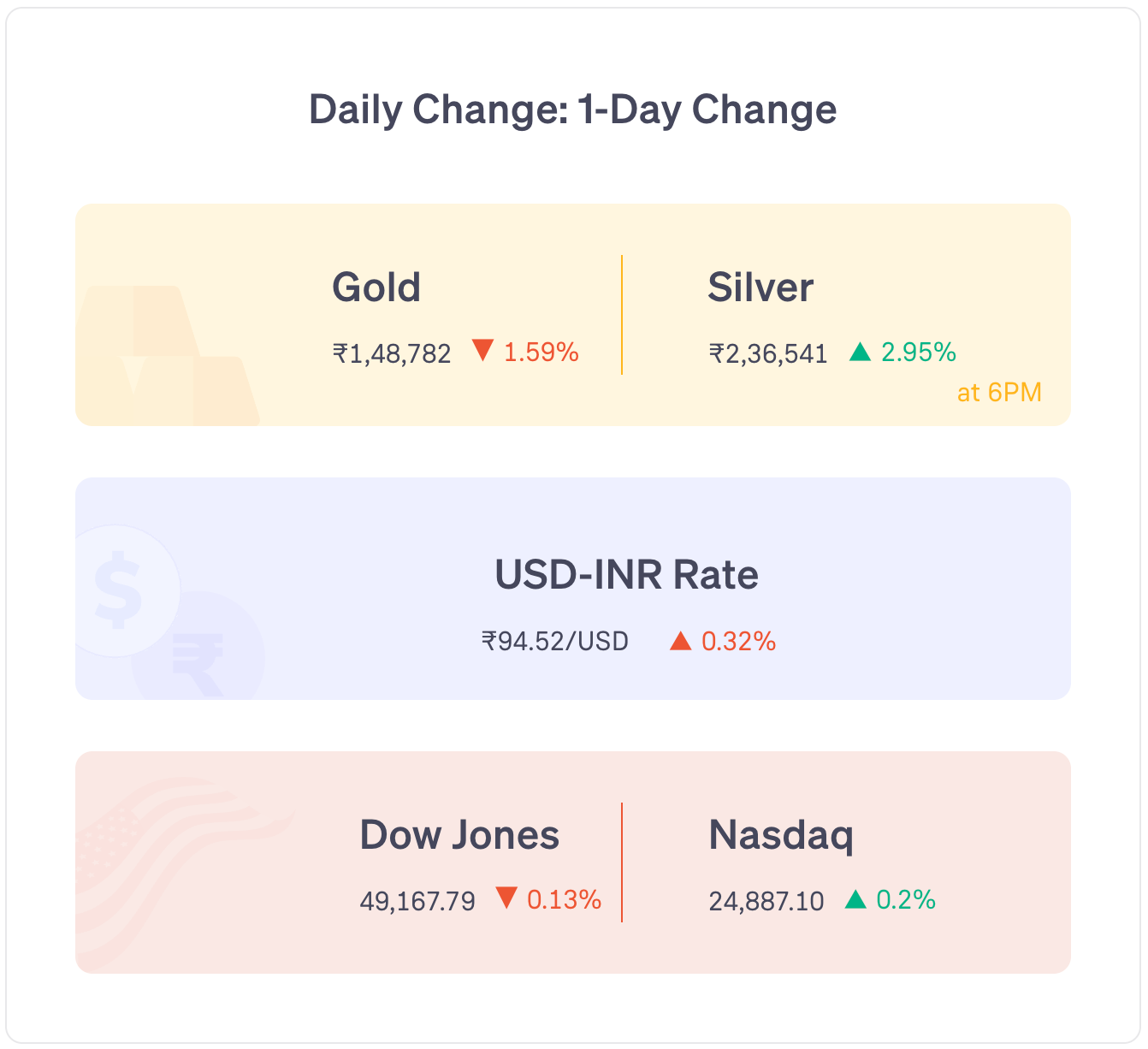
Global markets: Most US markets closed flat. Most Asian markets and most European markets fell (as of 6 pm IST).
News
India’s industrial output rose 4.1% year-on-year in March (vs 5.2% in Feb).
The RBI issued final norms on asset classification, provisioning, and income recognition for banks, introducing a new Expected Credit Loss (ECL) framework, effective April 2027. The new rules require banks to set aside money in advance for loans that might go bad in the future, instead of waiting for defaults to happen.
The United Arab Emirates has announced it will leave OPEC (Organization of the Petroleum Exporting Countries) effective 1 May 2026, which would cause a major shift in oil markets.
Stocks Updates
Bajaj Holdings: acquired Bajaj Finserv shares worth Rs 370.53 crore via a block deal, raising stake to around 38.41%.
Samvardhana Motherson: will acquire a 51% stake in Nissin Advanced Coating Indo Co Pvt Ltd from Nissin Electric Co Ltd, Japan, for Rs 9.23 crore, making it an indirect wholly owned subsidiary. It also approved the acquisition of a 49% stake in Vacuform for ZAR 45.18 million (around Rs 25.3 crore), making it a wholly owned subsidiary.
Trent: board fixed 29 May as the record date for the issuance of bonus equity shares in the ratio of 1:2 (one bonus share for every two held), subject to shareholder approval.
Maruti Suzuki: net profit fell 6.4% year-on-year to Rs 3,659 crore in the Jan-March quarter. Dividend announced: Rs 140 per share, with 7 Aug as the record date.
Coal India: net profit rose 11.9% year-on-year to Rs 14,626.75 crore in the Jan-March quarter. Dividend announced: Rs 5.25 per share.
Eternal (Zomato): net profit rose 346.2% year-on-year to Rs 174 crore in the Jan-March quarter.
REC: net profit fell 19.6% year-on-year to Rs 4,414.54 crore in the Jan-March quarter. Dividend announced: Rs 1.55 per share.
Word of the Day
Yield to Maturity (YTM)
It is the total return an investor can expect if they buy a bond and hold it until it matures.
It is assumed that all interest generated is reinvested in the same bond till its maturity.
A higher YTM usually means more profit, but it can also mean higher risk.
YTM helps you compare how much you could earn from different bonds.
It considers the bond’s current market price, face value, coupon interest payments, and the time remaining until maturity.
If the investor sells the bond before it matures, the actual return might be different.
6 Day Course
Theme: fund manager role
Day 2: Tuesday
In India, most fund managers either have an MBA, are CAs, or have an engineering + MBA degree.
These are common qualifications.
Qualifications like CFA, degree in economics, and other such related qualifications can also be seen with some fund managers.
Some fund managers also have less commonly seen degrees like maths degrees, data and technical degrees, risk management degrees, etc.
In addition to these qualifications, fund managers must clear some exams by NISM (National Institute of Securities Management).
Do note, technically speaking, an MBA/CA/CFA degree is not mandatory.
Featured Question
Q. “Why does a company payment dividends and can they backout from paying a dividend”
Companies pay dividends as a means of sharing profits the company is making.
Since shareholders are also owners of the company, they also deserve profits for their part of the ownership.
Companies keep aside money for future operations, growth, R&D, etc.
If they are still left with money that they do not have any use for, they give it to shareholders as dividends.
Many companies do not give dividends since they use that money for future growth.
Technically, companies can skip giving dividends. But many choose not to skip.
Every quarter, a company can announce dividends. Once a dividend is announced, they are legally liable to pay it.
But in case they choose not to announce, there is no legal requirement for them to continue paying dividends.
Most dividend giving companies try to stay consistent in giving dividends.
It is a way of showing investors that everything is stable and predictable in the company’s business.
Did you like this edition?
Leave a feedback here!