
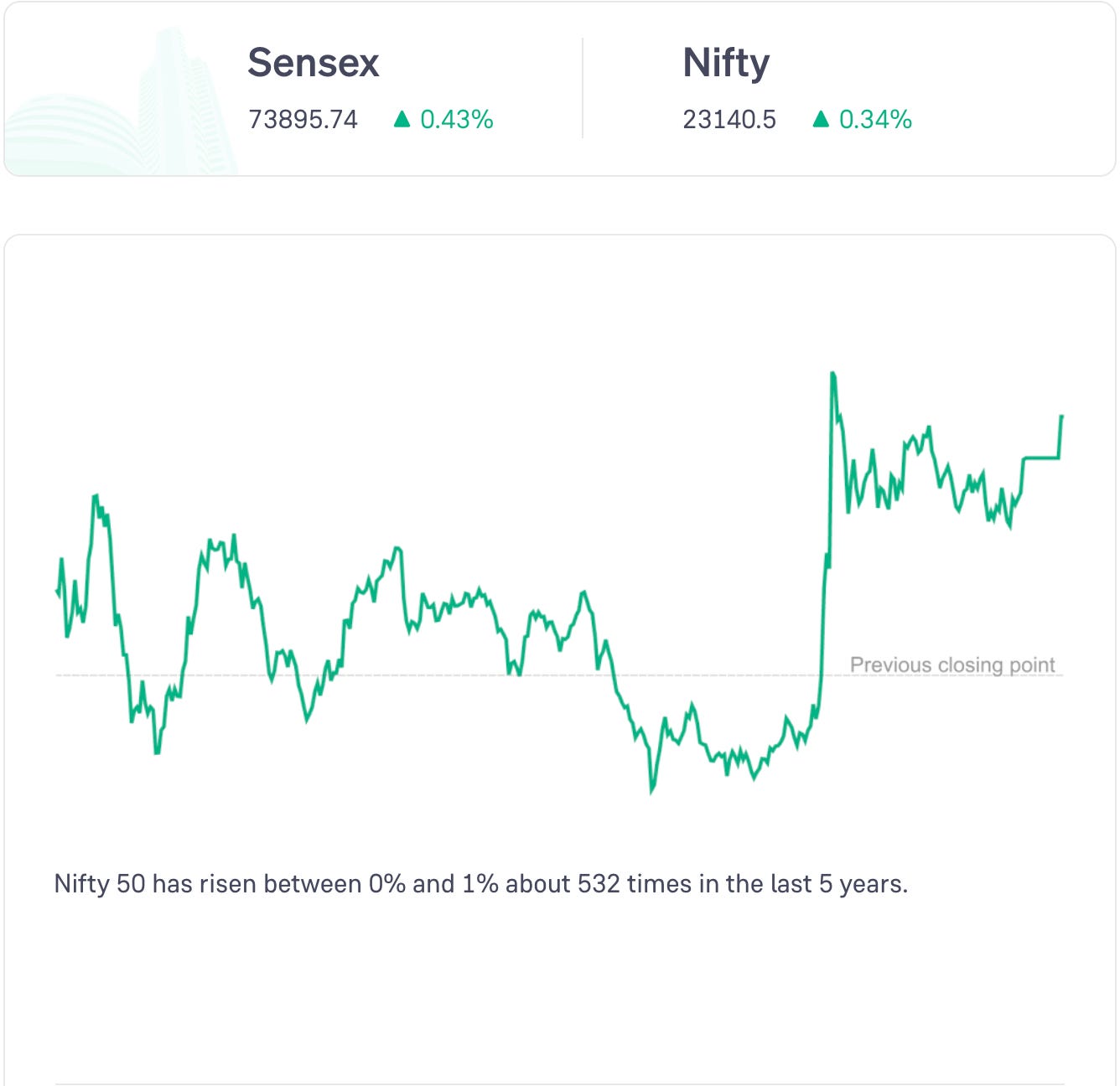
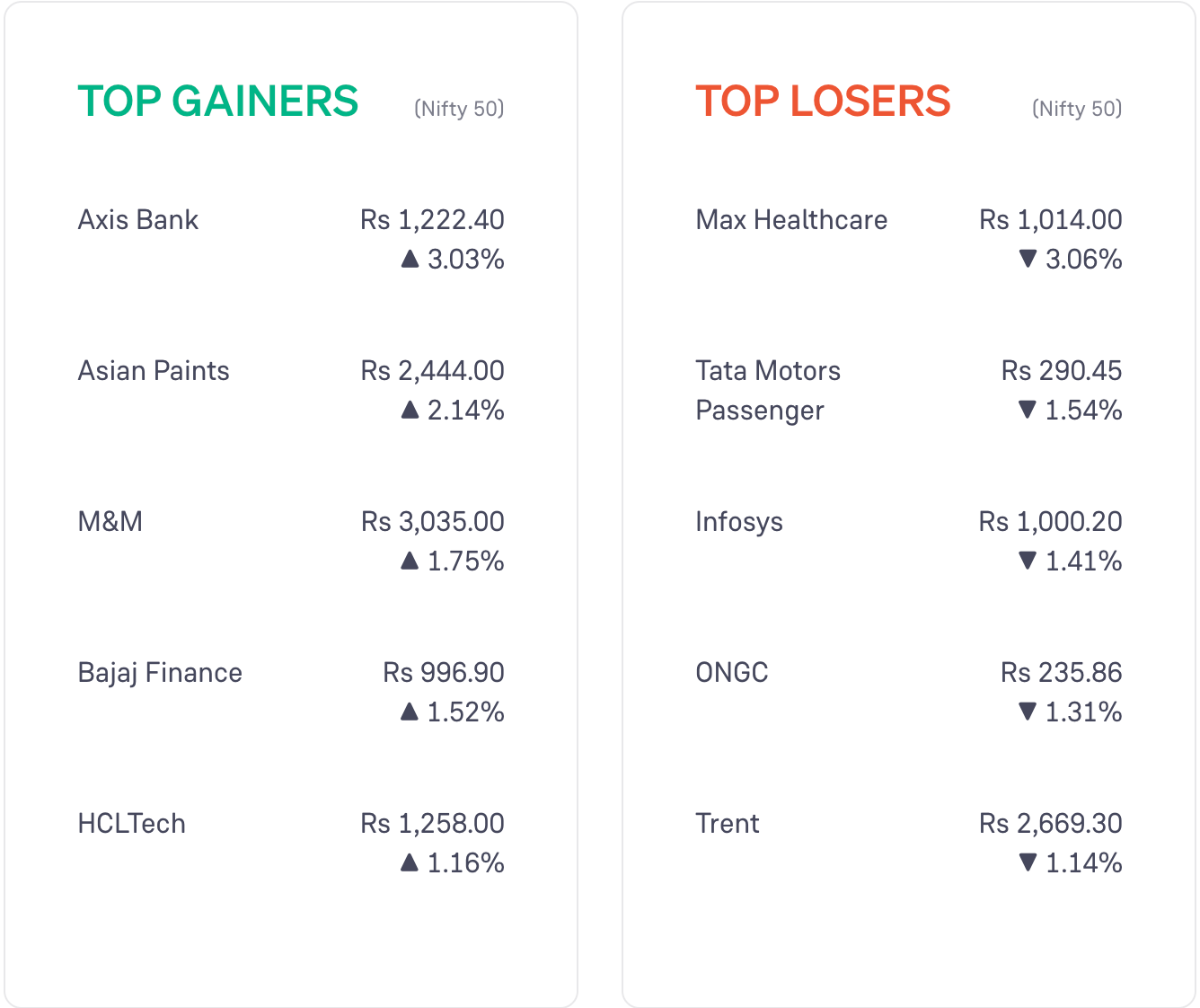
Markets ended higher compared to yesterday’s closing point.
Nifty and Sensex stayed in a range for most of the day and rose around 2 pm and closed in green.
Consumer durables stocks and realty stocks rose the most today. Healthcare stocks and media stocks fell the most.
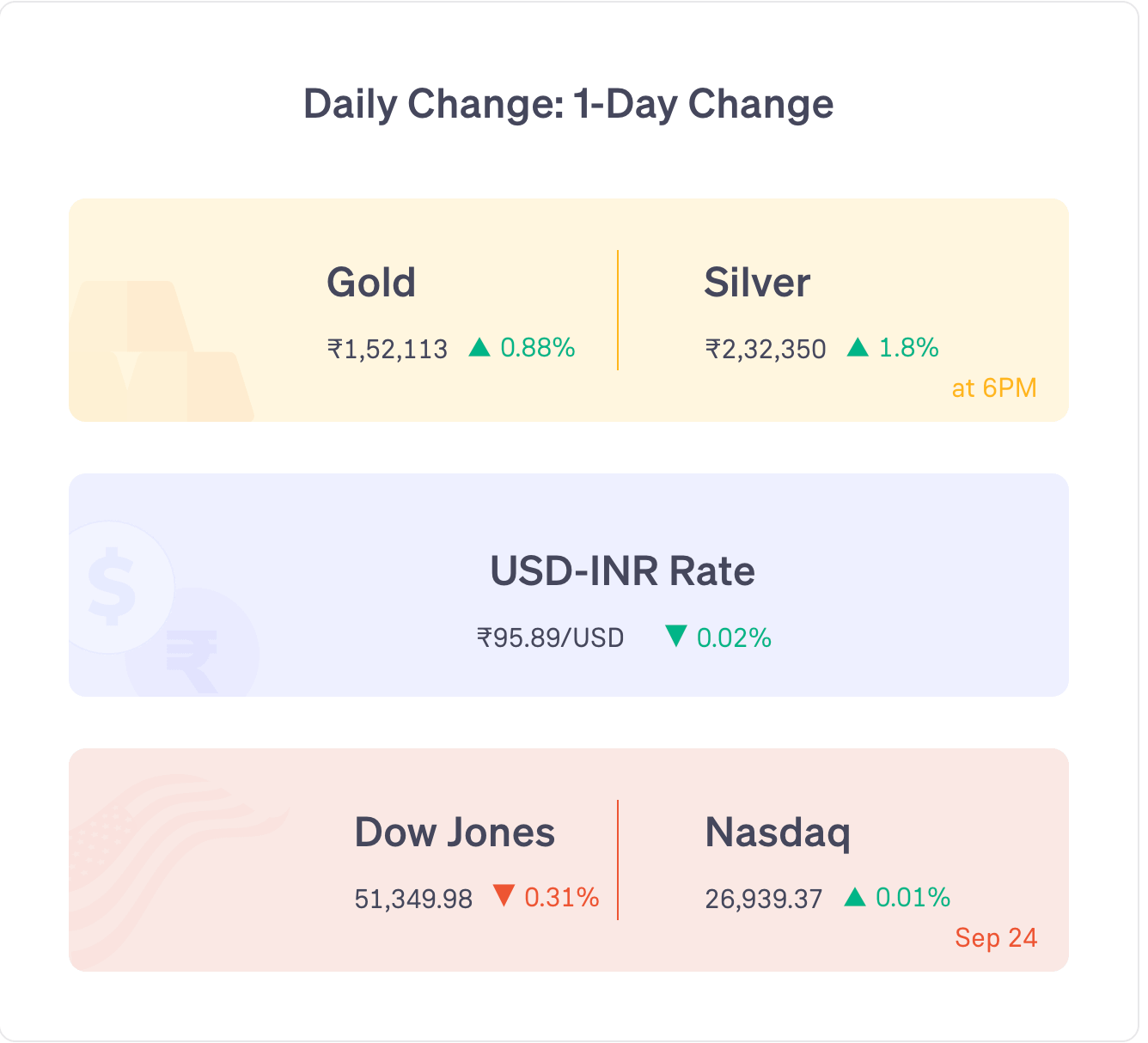
Global markets: US markets ended mixed on Thursday. Most Asian markets traded mixed on Friday. Most European markets traded in green (as of 6 pm IST).
News
India’s forex reserves fell $14.88 billion to $765.90 billion for the week ended 18 Sep.
India recorded the highest ever FDI inflow of $94.53 billion in FY25-26: Commerce Minister Piyush Goyal. The cumulative inflows between FY14-15 and FY25-26 stood at $843 billion.
Elevate Campuses’ Rs 2,100 crore IPO was subscribed 1.79 times on day 3. Retail subscription: 1.01 times. The IPO is closed for subscription.
Moneyview’s Rs 1,091.68 crore IPO was subscribed 6.01 times on day 2. Retail subscription: 5.18 times. The IPO will close for subscription on 28 Sep.
Orient Cables’ Rs 552 crore IPO was subscribed 1.96 times on day 1. Retail subscription: 2.43 times. The IPO will close for subscription on 29 Sep.
Stock Updates
SBI: changed the interest-payment date for one of its bond series from Sep 28 to Sep 27 due to a change in the bank working-day calendar.
Adani Power: NCLT Mumbai approved the merger of Vidarbha Industries Power, which operates a 600 MW thermal plant, into Adani Power.
JSW Steel: group company JSW One Platforms filed its DRHP with SEBI, BSE and NSE for an IPO.
SBI Life: received a GST demand of about Rs 1.13 crore relating to alleged excess input tax credit. The company plans to appeal.
Adani Energy: set up 8 new wholly owned subsidiaries for power generation, transmission, storage and distribution businesses. The combined initial investment is Rs 40 lakh.
Bank of Baroda: received Rs 1,372.35 crore from the sale of NSE shares through NSE’s IPO.
One 97 Comm (Paytm): increased its stake in Little Internet Pvt Ltd from 62.53% to 77.42%. It also completed its previously approved Rs 100 crore investment in Paytm Money Ltd.
LG Electronics: received a customs show-cause notice for about Rs 153.58 crore over alleged underpayment of customs duty on certain imported goods.
Word of the Day
Standard Deviation (SD)
It is a measure of how volatile stocks’ or mutual funds’ returns are.
A lower SD would mean lower deviation or volatility. A higher SD would mean a higher deviation.
Example: when conditions are good, mutual funds returns shoot up by a big margin. But when conditions are not favourable, the returns fall sharply. This would mean its SD is high.
SD is often used to indicate riskiness of stocks and mutual funds.
A high SD does not necessarily mean the stock or mutual fund is a bad performer.
Example: small cap mutual funds almost always have a higher SD than large cap mutual funds. But small cap mutual funds tend to usually give higher returns.
It does show that small cap mutual funds are riskier in nature.
6 Day Course
Theme: how fund managers handle money
Day 5: Friday
Whenever selling pressure increases (more withdrawals by investors than expected), fund managers have to sell against their planning.
This can hamper their plans.
So, they often try to prepare in advance for major inflows and outflows.
Example: investments increase after a period of good performance in the markets, withdrawals increase after poor performance, etc.
So, they keep ready the stocks/bonds/assets they will sell first in case the withdrawals increase.
Similarly, they keep ready a list of stocks/bonds/assets they will buy in case more than expected money comes in.
Featured Question
Q. “In an IPO, how very first listing price is decided or calculated? Why it is different from issue price”
What happens is that a company’s underwriters determine what they think is the right share price for the company.
They publish a price band that they think is the right level for a share.
Investors bid in this band. The issue price therefore is somewhere in this band.
Then, on the day the share is supposed to actually list on the stock markets, orders start being placed during the pre-market hours (9:00 am to 9:45 am in case of IPOs).
Based on the buy/sell order prices in this window, the share price is decided at the market opening time. For IPOs, this happens at 10:00 am.
The price we see at 10:00 am is the listing price.
So, if many investors start placing orders to buy shares at a much higher price than issue price, the listing price can shoot up.
————
Did you like this edition?
Leave a feedback here!