
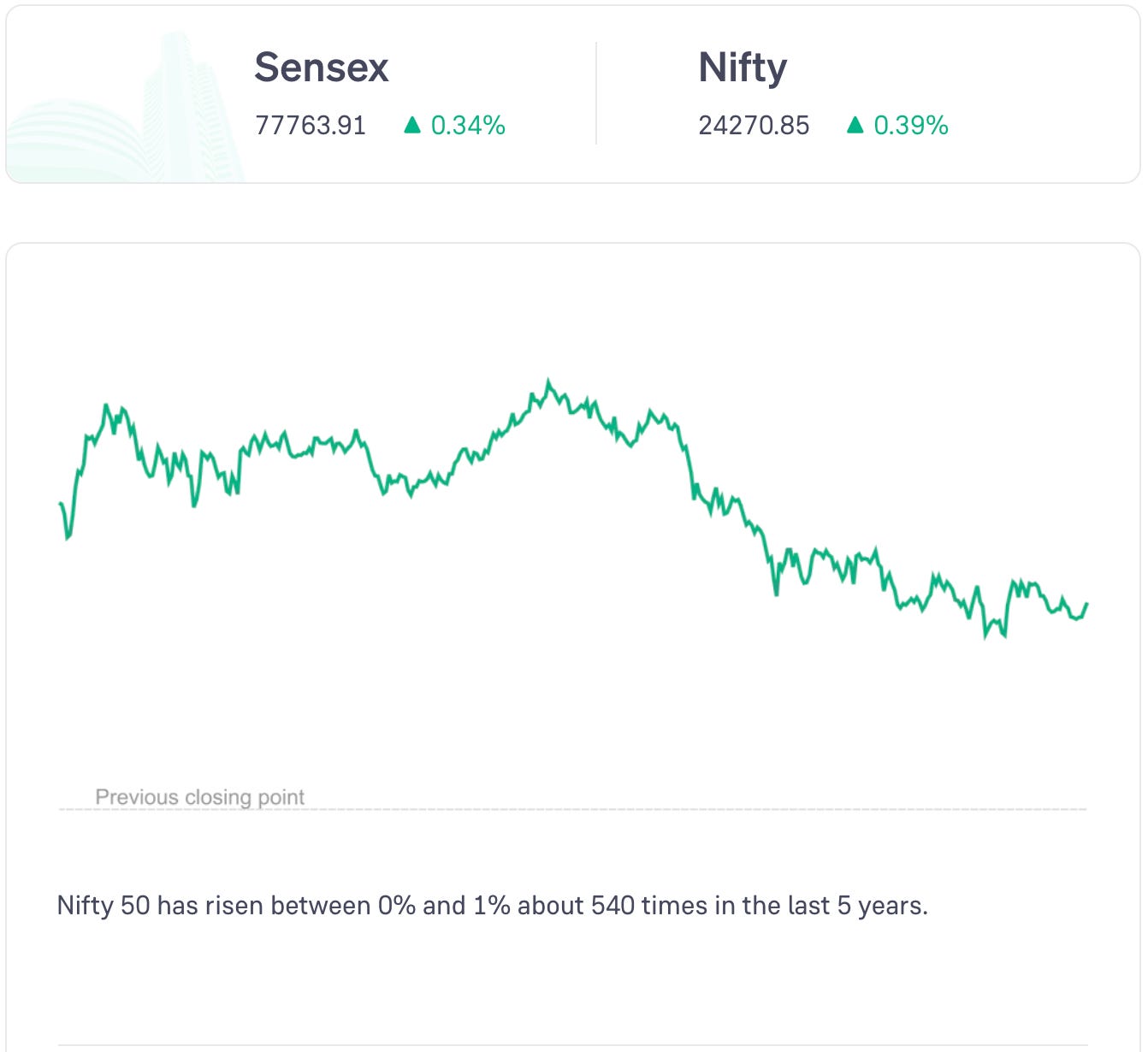
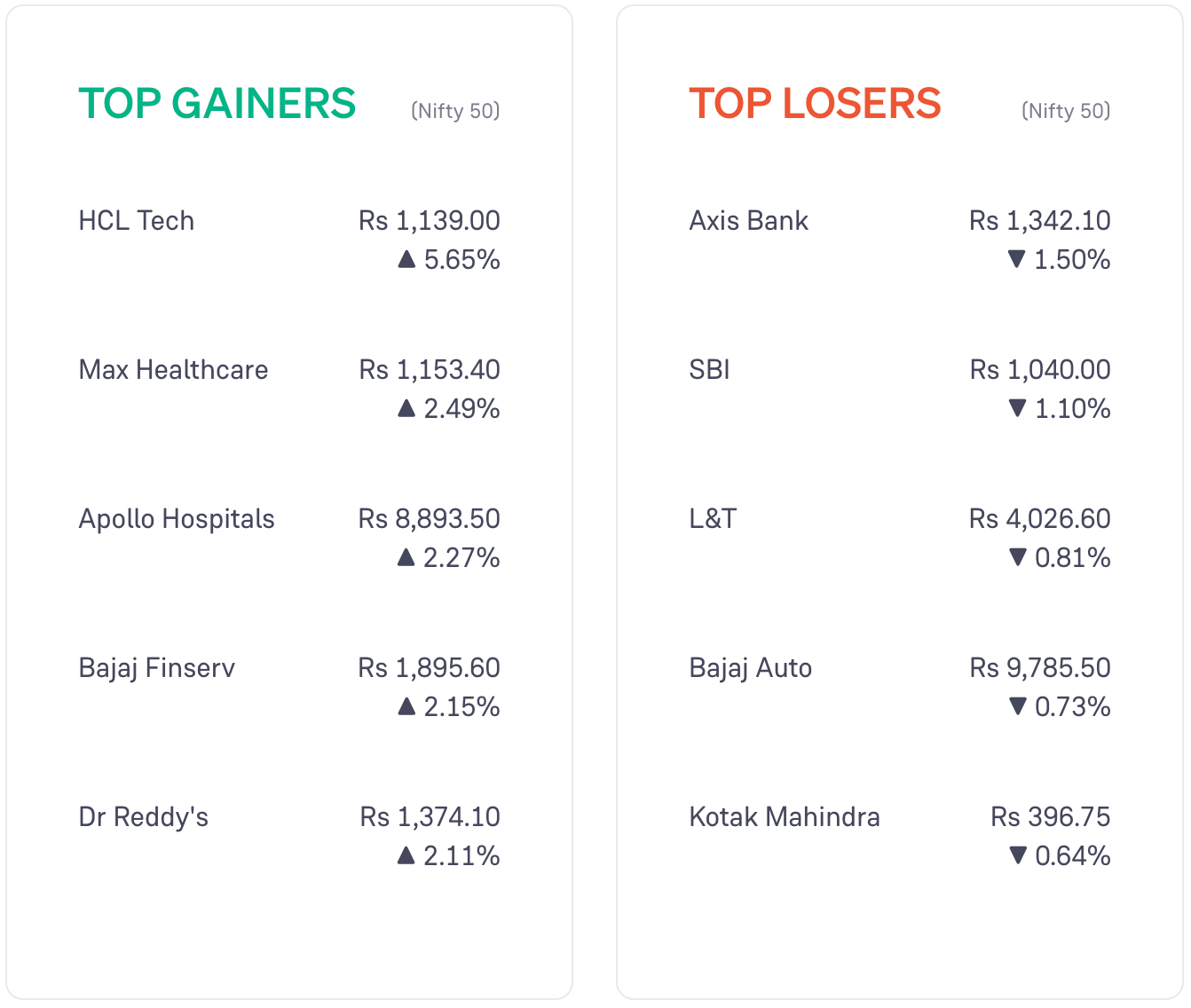
Markets opened above yesterday’s closing point.
Realty stocks and auto stocks rose the most today. PSU Bank stocks and media stocks fell the most.
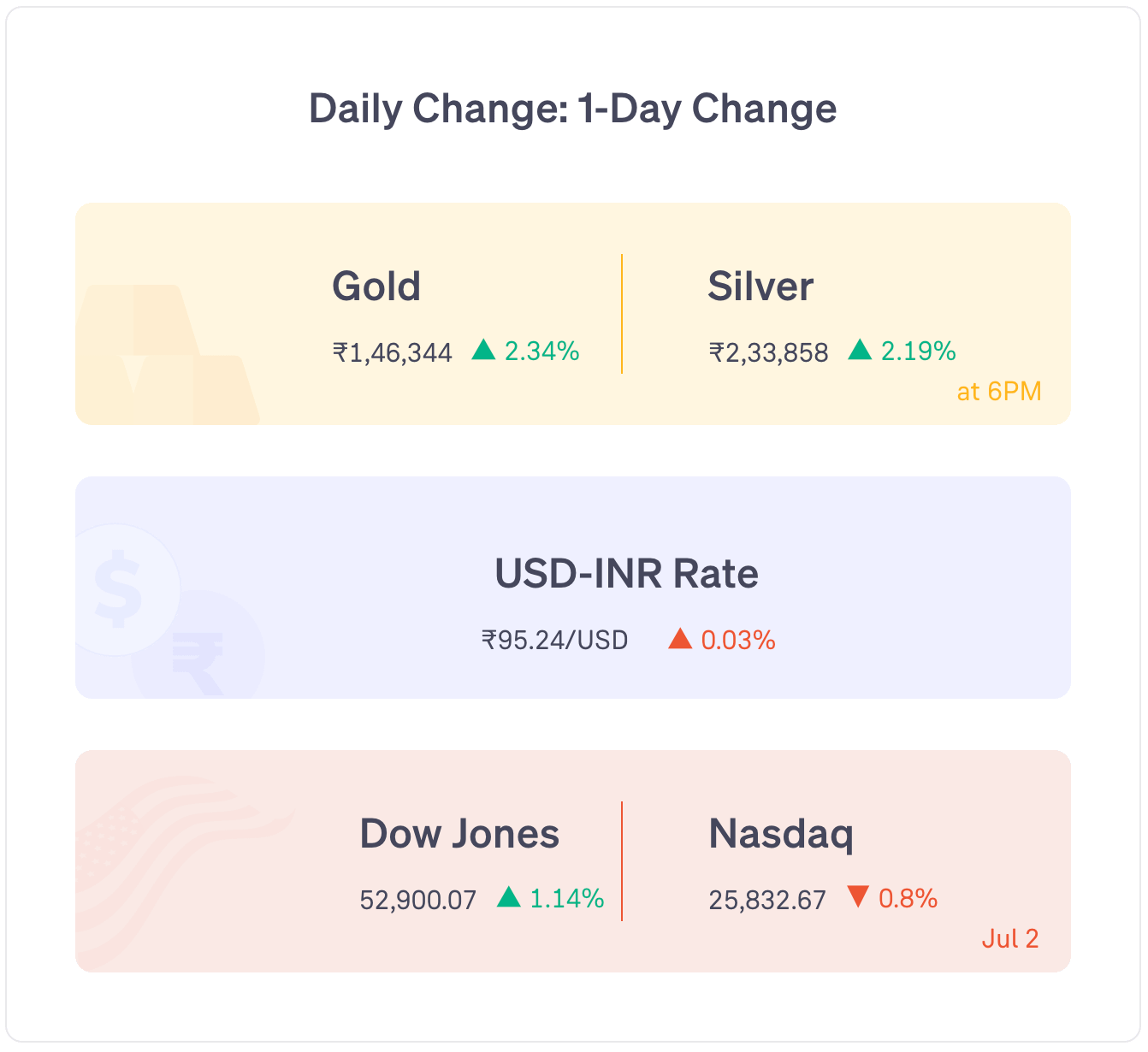
Global markets: US markets closed in the green. Asian markets and most European markets rose (as of 6 pm IST).
News
India’s composite PMI fell to 57.1 in June (vs 59.3 in May). Services PMI fell to 57.4 (vs 59.8 in May). This means overall economic activity grew less in June than in May.
India’s forex reserves fell by $5.65 billion to $666.93 billion in the week that ended on 26 June.
Stocks Updates
Adani Enterprises: opened its Qualified Institutions Placement (QIP) with a floor price of Rs 3,034.68 per share, with the option to offer up to a 5% discount.
JSW Steel: subsidiary, JSW Rayalaseema Steel Ltd, began development of a 2 MTPA integrated steel plant in Andhra Pradesh’s Rayalaseema region, with a total planned investment of Rs 16,350 crore.
HCLTech: signed a strategic partnership worth $1.14 billion with a Europe-headquartered Fortune Global 50 company.
BPCL: subsidiary BPRL Ventures BV completed the acquisition of the remaining 39.14% stake in IBV Brasil Petroleo Limitada for Rs 2,312 crore, increasing its holding to 100%.
Tata Power: subsidiary Tata Power Renewable Energy Ltd commissioned the 100.8 MW Jewali Wind Project in Dharashiv, Maharashtra, taking its total operational renewable capacity to 6.7 GW.
Zydus Lifesciences: signed an MoU with Apollo Hospitals to expand access to Guardant Health’s Shield Multi-Cancer Detection (MCD) blood test in India.
Word of the Day
Wholly Owned Subsidiary
It is a company that is fully owned by the parent company
A wholly owned subsidiary company’s shares are all 100% owned by the parent company.
Parent companies may establish or acquire such wholly owned subsidiary companies for various reasons.
Some of these reasons include regulatory requirements, legal separation, entering new markets, tax planning, acquisition, etc.
Subsidiaries that are not wholly owned are often called partly-owned subsidiaries or joint ventures.
6 Day Course
Theme: value trap
Day 5: Friday
Many times investors get drawn to companies that pay good dividends.
Many such companies tend to attract new investors. Sometimes, some of these companies end up becoming value traps.
Their dividends are inconsistent and fall later, resulting in those investments giving very poor returns.
Many times, companies rework their numbers to make them appealing like increasing Earnings-Per-Share (EPS) with the help of buybacks or using accounting tricks.
In such cases, the companies might suddenly appear better. The reality is that the company has not changed and is pretty much the same.
Such cases can also turn out to be value traps.
Another value trap happens when a company’s future looks promising but its direction is constantly changing.
The company is routinely changing its objectives and targets.
6 Day Course
Q. “How a benchmark is different from category average.”
Mutual funds always aim to generate returns higher than the benchmark.
The benchmark is usually an index in that category.
For example: large cap mutual funds often have the Nifty 50 index as their benchmark.
Category average tells you the average returns of all the mutual funds in that category.
Example:
XYZ large cap mutual fund’s 5-year return = 16% p.a.
Category average of large cap mutual funds 5-year = 15% p.a.
Nifty 50 index returns 5-year = 13% p.a.
So in this example, we see that XYZ mutual fund has given returns higher than the benchmark and the category average.
It is possible for the category average to be lower than benchmark.
That would mean that many mutual funds in that category have not been able to beat the benchmark.
It is also possible for a mutual funds’ returns to be below benchmark.
That would mean the mutual fund has not been able to give returns better than the benchmark.
The information presented in this post has been compiled and prepared by Groww Invest Tech Pvt Ltd and is intended solely for informational purposes. It is not tailored to any specific investment objectives, financial situations, or needs of any individual investor. The content should not be construed as investment, financial, legal, or tax advice and should not be relied upon as a substitute for professional consultation.
Investing in securities markets involves inherent risks. Investors are advised to carefully review all relevant documents and consider their own risk tolerance before making any investment decisions.
Mutual fund investments are subject to market risks; please read all scheme-related documents carefully. Past performance of financial instruments, schemes, or markets is not indicative of future results.
Groww Invest Tech Pvt Ltd is registered with the Securities and Exchange Board of India (SEBI) under Registration No: INZ000301838, as a Research Analyst under No: INH200008662, as a Depository Participant under No: IN-DP-417-2019, and with the Association of Mutual Funds in India (AMFI) under ARN-111686.
SEBI registration details: View registered name and registration numbers
Research Analyst Disclaimer: View Research Analyst disclaimer
Did you like this edition?
Leave a feedback here!