

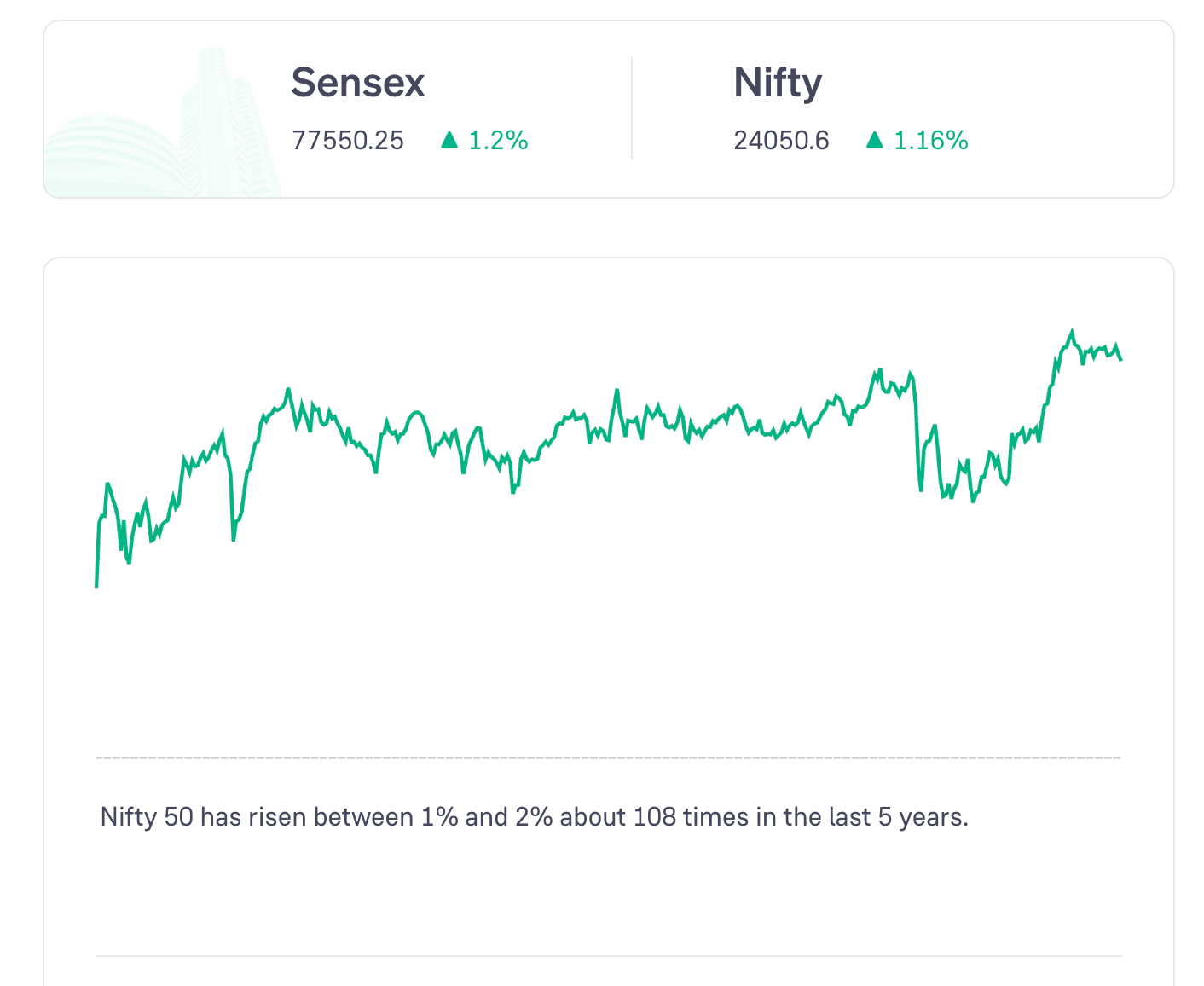
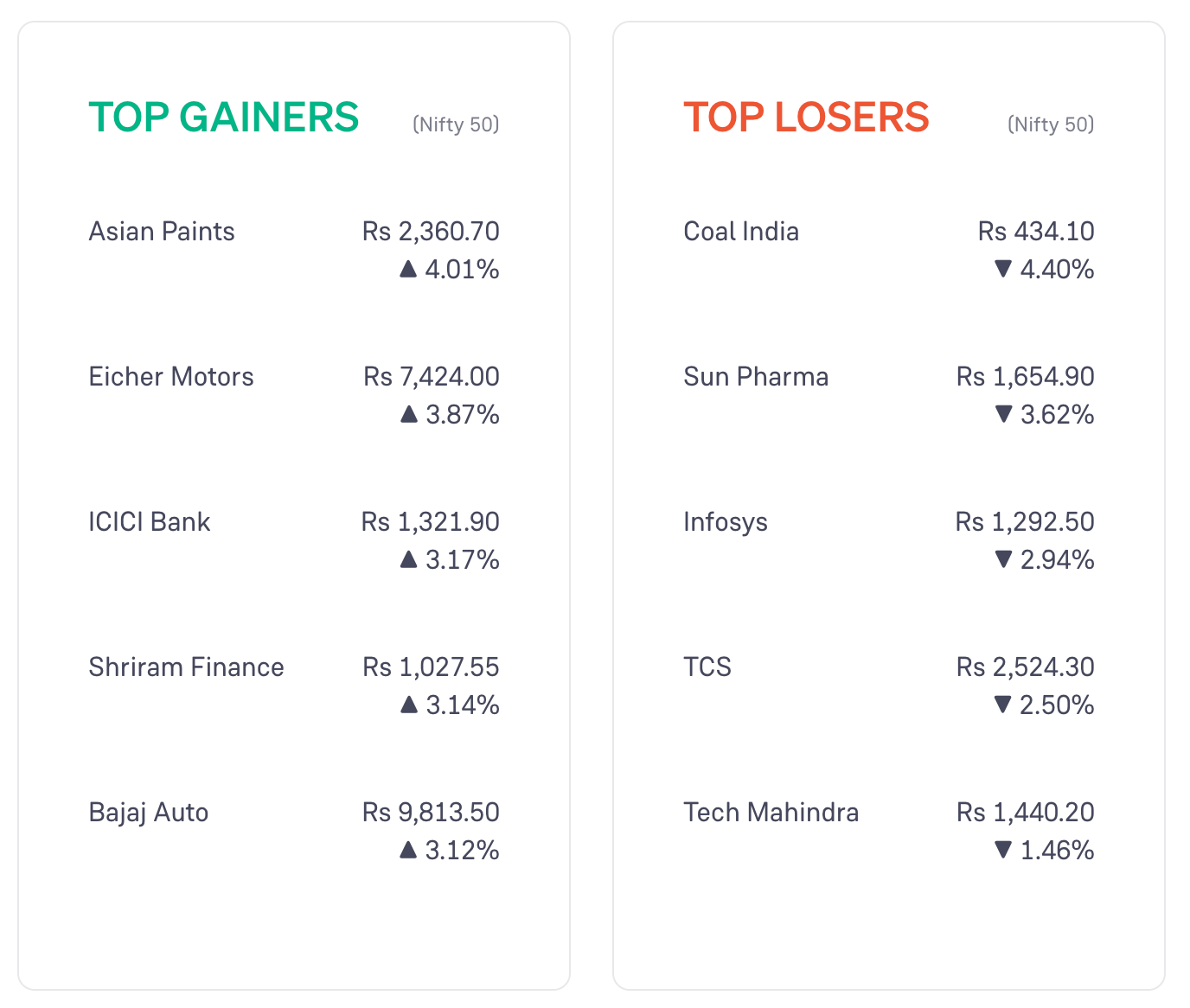
Markets opened above yesterday’s closing point.
All sectors’ stocks rose today except for the IT stocks. Auto stocks and realty stocks rose the most.
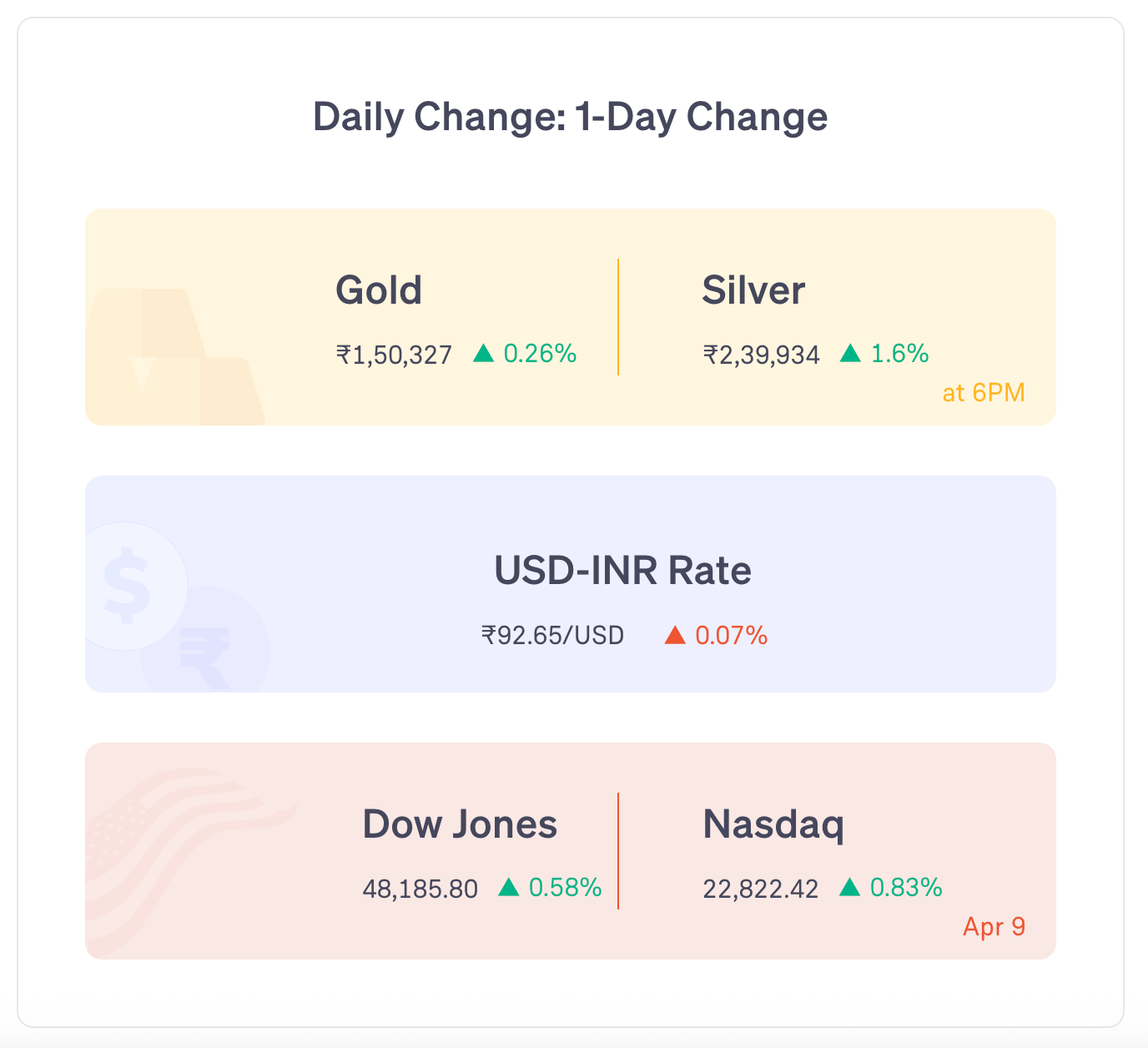
Global markets: US markets and Asian markets rose. European markets rose (as of 6 pm IST).
News
India’s forex reserves rose by $9.06 billion to $697.12 billion in the week that ended on 3 April.
The RBI has proposed measures to prevent online frauds, including a one-hour delay for digital transactions above Rs 10,000 via UPI or IMPS payment modes.
The US annual inflation rate rose to 3.3% in March (vs 2.4% in Feb).
China’s annual inflation rate fell to 1% in March (vs 1.3% in Feb).
Stocks Updates
Muthoot Finance: board declared an interim dividend of Rs 30 per share for FY26 with 17 April 2026 as the record date.
Apollo Hospitals: received NCLT order for proposed composite scheme involving Apollo Healthco, Keimed, and Apollo Healthtech.
JSW Energy: exercised call option to acquire the remaining 26% equity stake in JSW Mahanadi Power Company Ltd.
TCS: renewed its multi-year strategic partnership with Marks & Spencer to support M&S’s digital capabilities across its retail operations.
M&M: company’s wholly owned subsidiary, Mahindra Overseas Investment Company (Mauritius) Ltd, will sell its entire 99.04% stake in Turkish subsidiary Erkunt Foundry.
Sun Pharma: clarified that reports of a $12 billion Organon deal entering the final stage are speculative in nature and there is no material disclosure required.
Tata Steel: acquired the remaining stake in Tata Steel Colors Pvt Ltd (formerly Tata BlueScope Steel Pvt Ltd), making it a wholly owned subsidiary.
Word of the Day
XIRR
It is a method used to calculate the annual return on investments where money is invested or withdrawn at different times.
It stands for Extended Internal Rate of Return
It accounts for irregular cash flows, such as multiple investments made on different dates.
This gives a more accurate return, reflecting an investor’s personalised rate of return.
XIRR is ideal when used for long term investments.
6 Day Course
Theme: mutual fund AUM
Day 5: Friday
For reasons similar to those explained yesterday, a very large AUM can hamper a mutual fund’s speed.
When a lot of money flows into one stock, the stock price rises.
This means that the stock gets more expensive as the mutual fund is buying, effectively causing the mutual fund to reduce its own returns.
A similar problem occurs when they are selling too.
To remedy this problem, mutual funds often buy/sell shares over a period of time (could be days or weeks).
This often means they take time to buy/sell. In this period, a lot could happen.
Mutual funds have different ways of dealing with these challenges.
Many mutual funds have given good returns compared to others despite having larger AUMs.
But still, this is a valid concern especially in small-cap and mid-cap mutual funds’ cases.
Featured Question
Q. “What is step down subsidiary of a company ?”
A subsidiary company is a company that is owned by a larger company.
A step-down subsidiary is a company owned by a subsidiary company.
So, it looks like this:
1. Parent company
2. Subsidiary company
3. Step-down subsidiary
Parent company owns subsidiary company. Subsidiary company owns the step-down subsidiary company.
Subsidiary and step-down subsidiary companies are created for various reasons.
It could be because of tax, compliance, debt, etc.
Subsidiary companies and step-down subsidiary companies can be joint-ventures with other companies too.
While filing reports and audits, companies have to report numbers from their subsidiaries and step-down subsidiaries also.
The information presented in this post has been compiled and prepared by Groww Invest Tech Pvt Ltd and is intended solely for informational purposes. It is not tailored to any specific investment objectives, financial situations, or needs of any individual investor. The content should not be construed as investment, financial, legal, or tax advice and should not be relied upon as a substitute for professional consultation.
Investing in securities markets involves inherent risks. Investors are advised to carefully review all relevant documents and consider their own risk tolerance before making any investment decisions.
Mutual fund investments are subject to market risks; please read all scheme-related documents carefully. Past performance of financial instruments, schemes, or markets is not indicative of future results.
Groww Invest Tech Pvt Ltd is registered with the Securities and Exchange Board of India (SEBI) under Registration No: INZ000301838, as a Research Analyst under No: INH200008662, as a Depository Participant under No: IN-DP-417-2019, and with the Association of Mutual Funds in India (AMFI) under ARN-111686.
SEBI registration details: View registered name and registration numbers
Research Analyst Disclaimer: View Research Analyst disclaimer
Did you like this edition?
Leave a feedback here!