

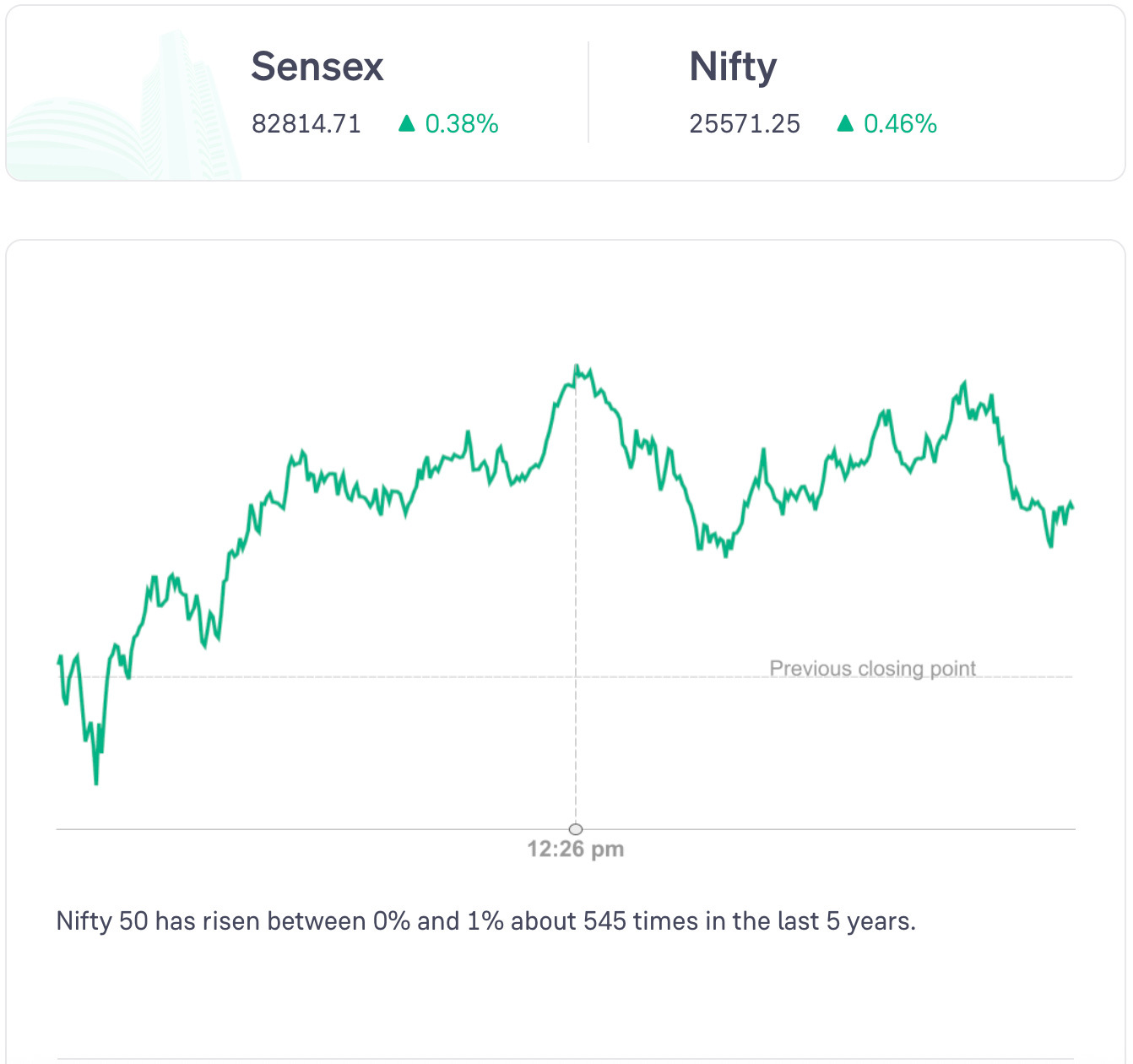
Markets opened above yesterday’s closing point.
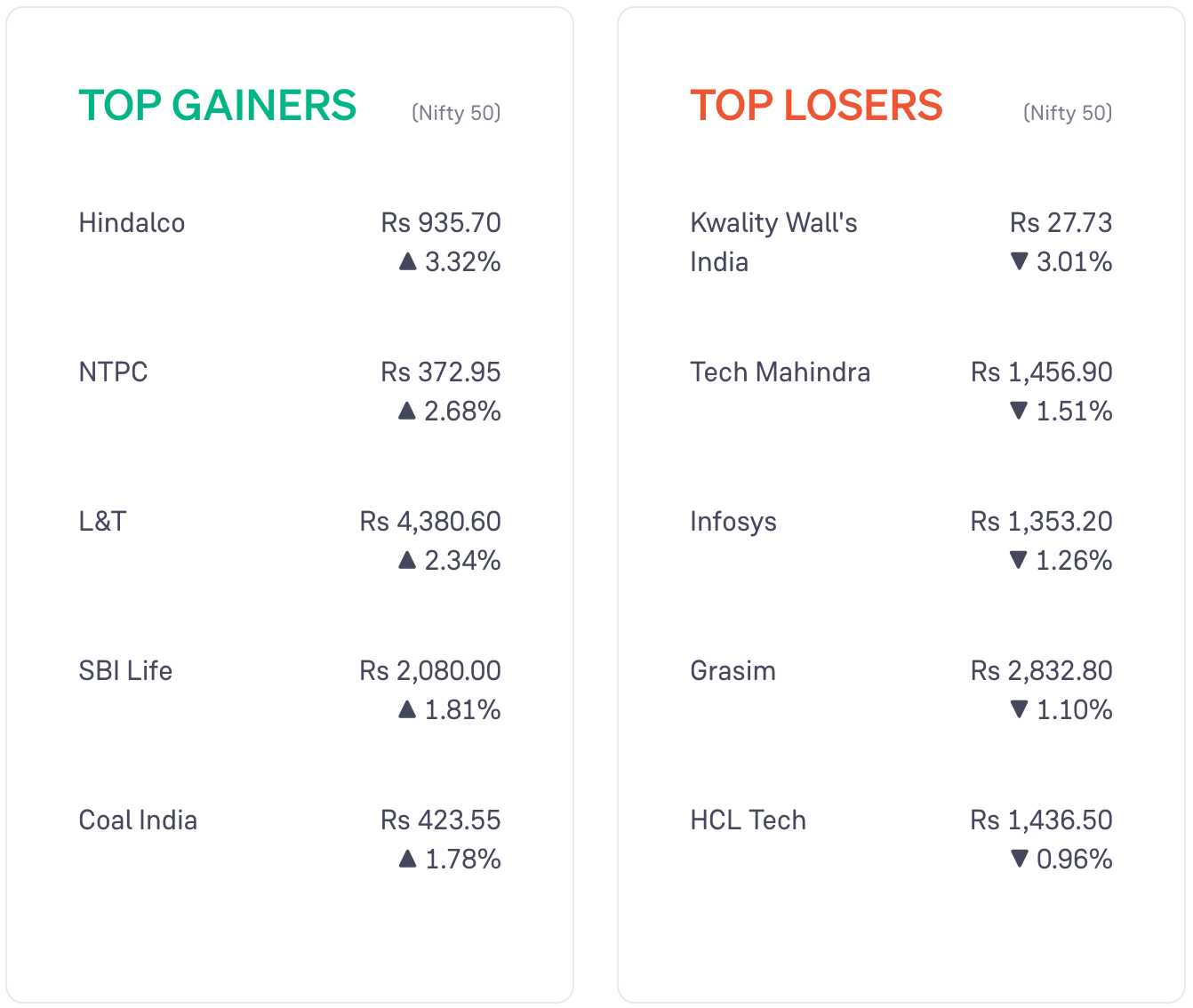
PSU bank stocks and metal stocks rose the most today. IT stocks and media stocks fell the most.
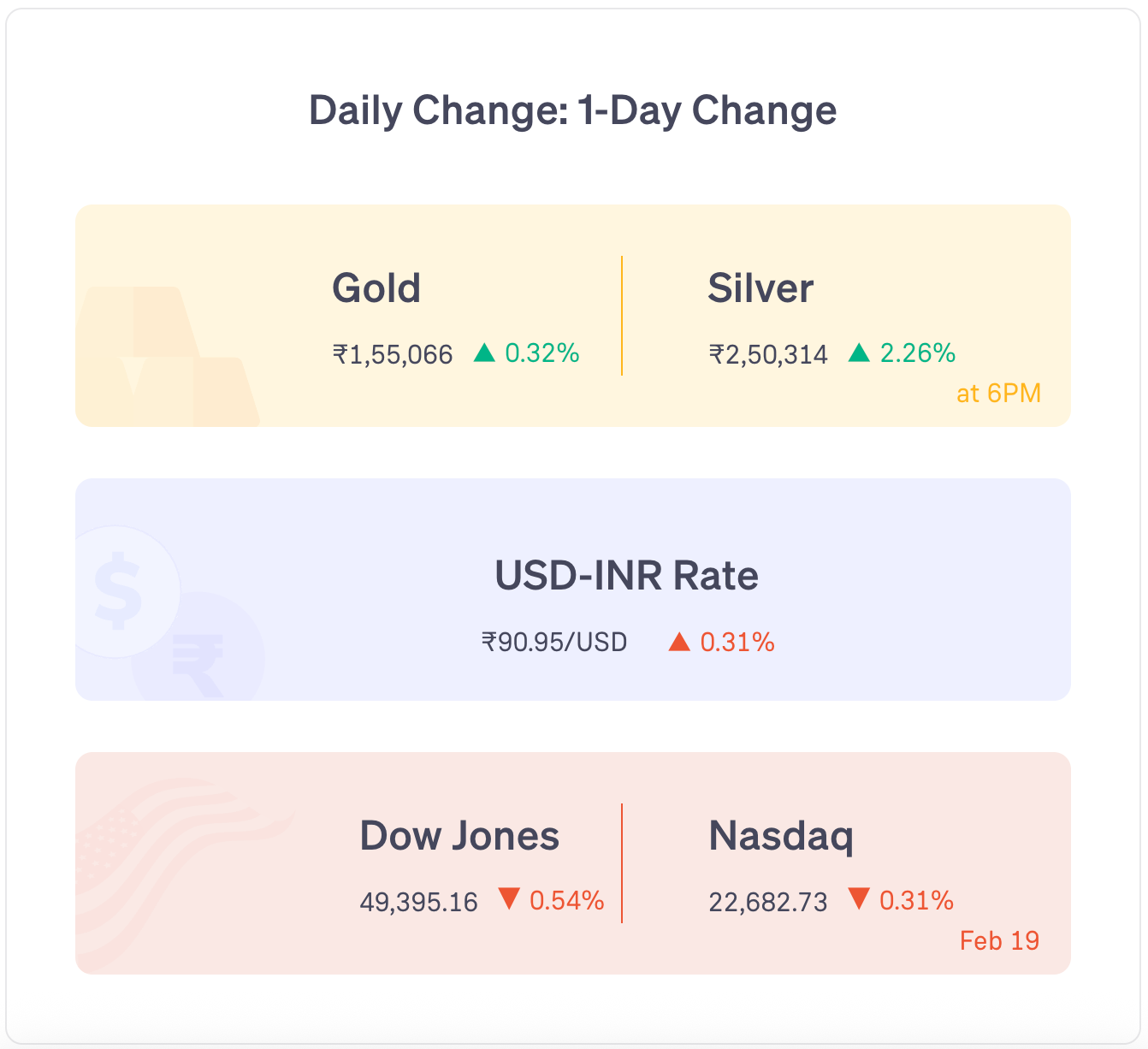
Global markets: US markets and most Asian markets fell. European markets rose (as of 6 pm IST).
News
India’s forex reserves rose by $8.66 billion to $725.73 billion in the week that ended on 13 Feb.
India’s manufacturing PMI rose to 57.5 in Feb (vs 55.4 in Jan) as per preliminary estimates. Services PMI fell marginally to 58.4 (vs 58.5 in Jan). Composite PMI (manufacturing + services) rose to 59.3 (vs 58.4 in Jan). This means economic activity rose more in Feb than in Jan.
India’s infrastructure output of 8 core industries grew 4% year-on-year in Jan (vs 4.7% in Dec).
The India-US trade deal is expected to come into effect in April 2026: Commerce and Industry Minister
Stocks Updates
NTPC Green: declared commercial operation of 165 MW at Khavda-II in Gujarat and 158.4 MW in Andhra Pradesh.
Bajaj Finance: allotted Rs 2,500 crore secured non-convertible debentures via private placement at interest rates of 7.40% and 7.55%.
ICICI Prudential: company’s GST appeal was dismissed, upholding a tax demand of Rs 984 crore, and the company plans to file an appeal again.
Zydus Lifesciences: announced closure of a USFDA inspection at its Ahmedabad injectable plant with no observations. It also launched India’s first indigenously developed biosimilar Aflibercept (ANYRA).
Word of the Day
Enterprise Value (EV)
It is a measure of a company’s total value
Unlike market capitalization, which includes only equity, EV shows the value of the entire company, taking into consideration equity, debt, and cash.
Investors use EV when looking at acquisitions to get a more accurate valuation of a business.
EV is also used for valuation ratios like EV/EBITDA or EV/sales to compare companies.
6 Day Course
Theme: mistakes made by experienced investors
Day 5: Friday
Another common trait experienced investors display is complexity bias.
Such investors might believe that a more complex process or business would lead to better returns. This is obviously not always true.
On similar lines, investors often feel the need to act. Experienced investors often tend to take action based on inputs — like buying/selling, reducing/increasing stake, etc.
It goes with the belief that they are more ‘aware’ and therefore must respond.
Many times, the best investment strategy is to not act and just sit.
Sunk cost is another common mistake made by experienced investors.
They wish to get their returns from an investment that has given them some loss.
Doing so, they forego other better investment options.
Featured Question
Q. “What is the rationale for stock price movement?. In my view there is no rationale at all. Ex. Some penny stocks, whose below average income in 2 digits and net profit in single digit are trading above Rs. 2000 with abnormal PEs and a well performing small cap & mid cap stocke with good track record are trading in the range of 100 - 200.”
Stock prices move because of supply and demand for the stocks.
Every move happens because of that.
Now, think about why supply and demand change. There can be thousands of reasons behind the supply and demand for a stock changing.
Some of those reasons can be directly related to the company. Better profits, increasing revenues, possibility of a new product doing well, market size growth, etc.
Then, there can be reasons that are less related to the company.
Here, investor psychology plays a role.
Many investors end up investing in a stock because they think it is in demand and will continue to be in demand. These investors are less concerned with the actual company or its numbers.
Every other kind of investor lies between these two: investors investing because of the company and investors investing because of other investors.
In the case of penny stocks, the price movement can be extreme.
Penny stocks often have low trading volumes. This means that very few stocks are being traded on the markets.
Since the trading volume is small, a few buy/sell orders can greatly change the stock price.
This leads to vastly different stock prices and therefore large swings.
Another thing to note is that the stock price is not indicative of the company’s size or its profits. A small company can have a lower share price and vice versa.
There is nothing wrong about it.
Did you like this edition?
Leave a feedback here!
Earlier format was better