
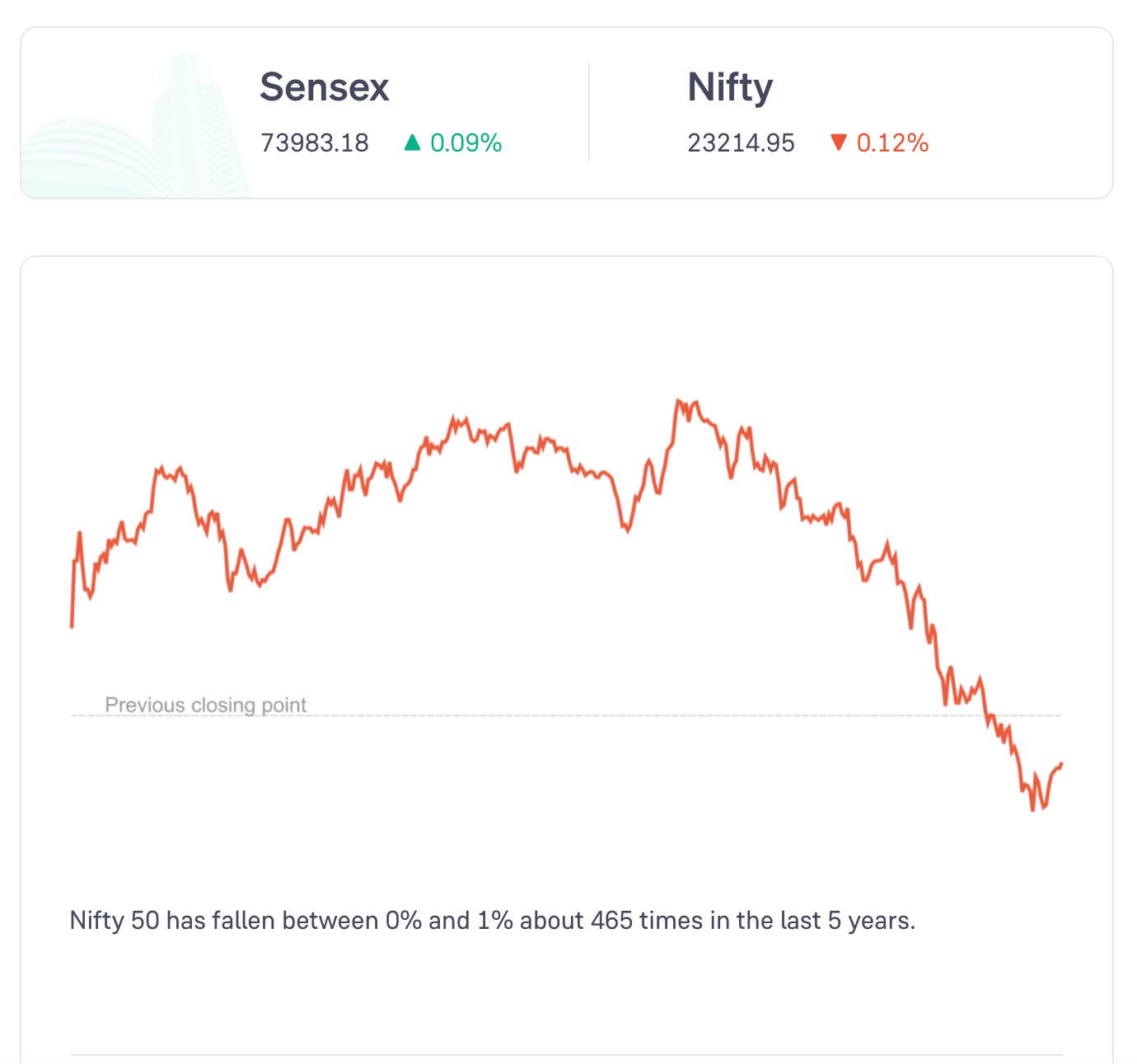
Markets opened above yesterday’s closing point.
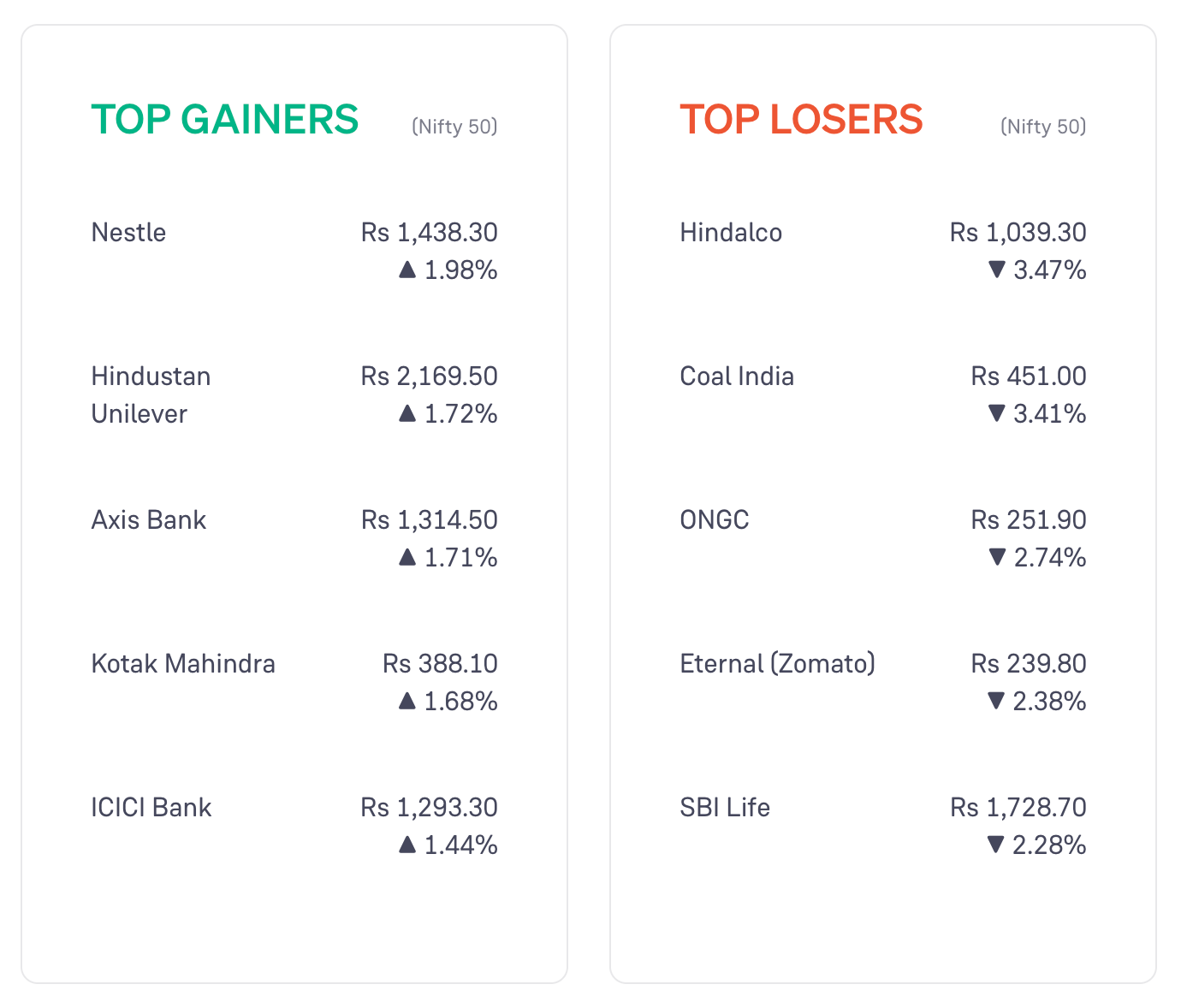
FMCG stocks and private bank stocks rose the most today. Media stocks and realty stocks fell the most.
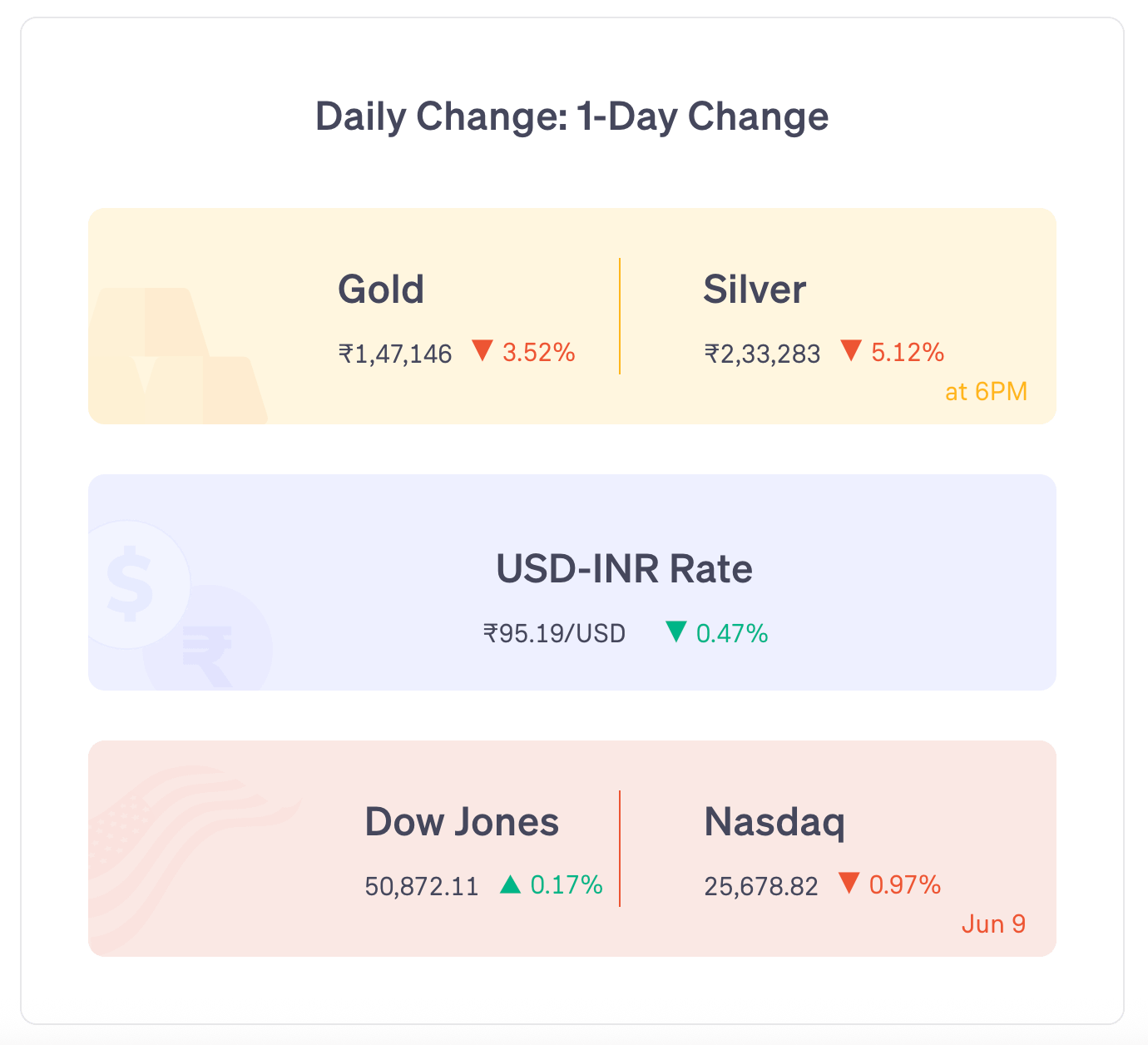
Global markets: Most US markets rose. Most Asian markets and European markets rose (as of 6 pm IST).
News
Fresh military strikes have taken place between the US and Iran, disrupting talks for a peace deal.
The government has approved Phase 2(A) of the Ahmedabad Metro Rail Project at a cost of Rs 2,169 crore.
China’s annual inflation rate stayed constant at 1.2% in May.
The US annual inflation rate rose to 4.2% in May (vs 3.8% in April).
CMR Green Technologies listed on the stock exchanges at a premium of 39.58% over the issue price and closed 25.62% up at the end of the day.
Stocks
Hindustan Zinc: signed an MoU with Sulfozyme Agro India Pvt Ltd under its Zinc Industrial Park initiative at Khankhala, Rajasthan, to support sustainable metal recovery and downstream zinc manufacturing.
Hyundai Motor India: said production at Chennai Plant-1 is expected to normalise by 22 June after disruption caused by a fire at supplier Mobis India’s facility.
Lenskart: acquired the remaining 3% stake in Quantduo Technologies Pvt Ltd (also known as GeoIQ), increasing its holding to 100% and making it a wholly owned subsidiary.
Reliance: partnered with Meta Platforms to develop a 168 MW AI-enabled data centre in Jamnagar, Gujarat, with Meta leasing capacity from the facility.
Eternal (Zomato): received a GST demand order of Rs 6.49 crore, along with interest and penalty, from Andhra Pradesh authorities, which it will challenge.
Word of the Day
Follow on Public Offer (FPO)
It is when a company that is already listed on the stock exchange issues new shares.
This is after the company has already launched its Initial Public Offering (IPO).
It is a way for companies to raise money for growth, expansion, or to reduce debt.
Compared to an IPO, an FPO usually has fewer regulatory steps, since the company is already public.
FPOs can also give existing investors a chance to buy more shares, sometimes at a discounted price.
6 Day Course
Theme: economy vs stock markets
Day 3: Wednesday
One key point to remember about the two is this: stock markets are forward-looking & the economy is backward looking.
What does this mean?
When the economy’s numbers are released (GDP, inflation, etc), they are about a past period.
So it tells us about how the economy has been doing so far.
Stock markets usually perform based on future expectations (they are forward looking). In some sense, it is based on the potential future.
So if the future looks bright, investors start investing more causing markets to go up. If the future looks negative, investors start selling and the markets fall.
This is why, sometimes, we see the markets rise when the economy at present isn’t looking great — investors might be expecting a better future. Vice versa is also possible.
Of course investors can be wrong too.
They might be expecting a dull future and the markets start performing well instead. And vice versa.
This is why we see different types of market sentiments even when GDP and other economic numbers look good or bad.
Featured Question
Q. “When referring to the whole world, one can say ‘stock markets’, referring to the stock markets of different countries. In the case of India, why does Grow use ‘stock markets’ instead of the singular ‘stock market’?”
This is because it is referring to the stock exchange where the trading is taking place.
A stock exchange is a marketplace where stocks are bought and sold. It is a meeting point for sellers and buyers.
Yes, this happens online now, so we don’t have to go to the actual stock exchanges. But the idea is still valid.
In India, there are two stock exchanges — BSE or Bombay Stock Exchange and NSE or National Stock Exchange.
This means there are two stock markets in India where investors can buy/sell shares.
Most of the big companies are listed on both of these exchanges. Which means, you can buy from one exchange and sell on another.
This is why both of them behave similarly.
This is why people say ‘stock markets’. They are referring to the two exchanges in India.
In the US, there are many more stock exchanges and therefore they too use ‘stock markets’.
Usually, when investors say ‘stock markets’ they are referring to the stock markets of their own country.
If they speak about another country’s stock markets, they mention the country. Example: “the South Korean stock markets were up today”.
Or, if they want to speak about the entire globe, they say so specifically.
Example: “the global stock markets saw good sentiments today”.
The information presented in this post has been compiled and prepared by Groww Invest Tech Pvt Ltd and is intended solely for informational purposes. It is not tailored to any specific investment objectives, financial situations, or needs of any individual investor. The content should not be construed as investment, financial, legal, or tax advice and should not be relied upon as a substitute for professional consultation.
Investing in securities markets involves inherent risks. Investors are advised to carefully review all relevant documents and consider their own risk tolerance before making any investment decisions.
Mutual fund investments are subject to market risks; please read all scheme-related documents carefully. Past performance of financial instruments, schemes, or markets is not indicative of future results.
Groww Invest Tech Pvt Ltd is registered with the Securities and Exchange Board of India (SEBI) under Registration No: INZ000301838, as a Research Analyst under No: INH200008662, as a Depository Participant under No: IN-DP-417-2019, and with the Association of Mutual Funds in India (AMFI) under ARN-111686.
SEBI registration details: View registered name and registration numbers
Research Analyst Disclaimer: View Research Analyst disclaimer
Did you like this edition?
Leave a feedback here!