

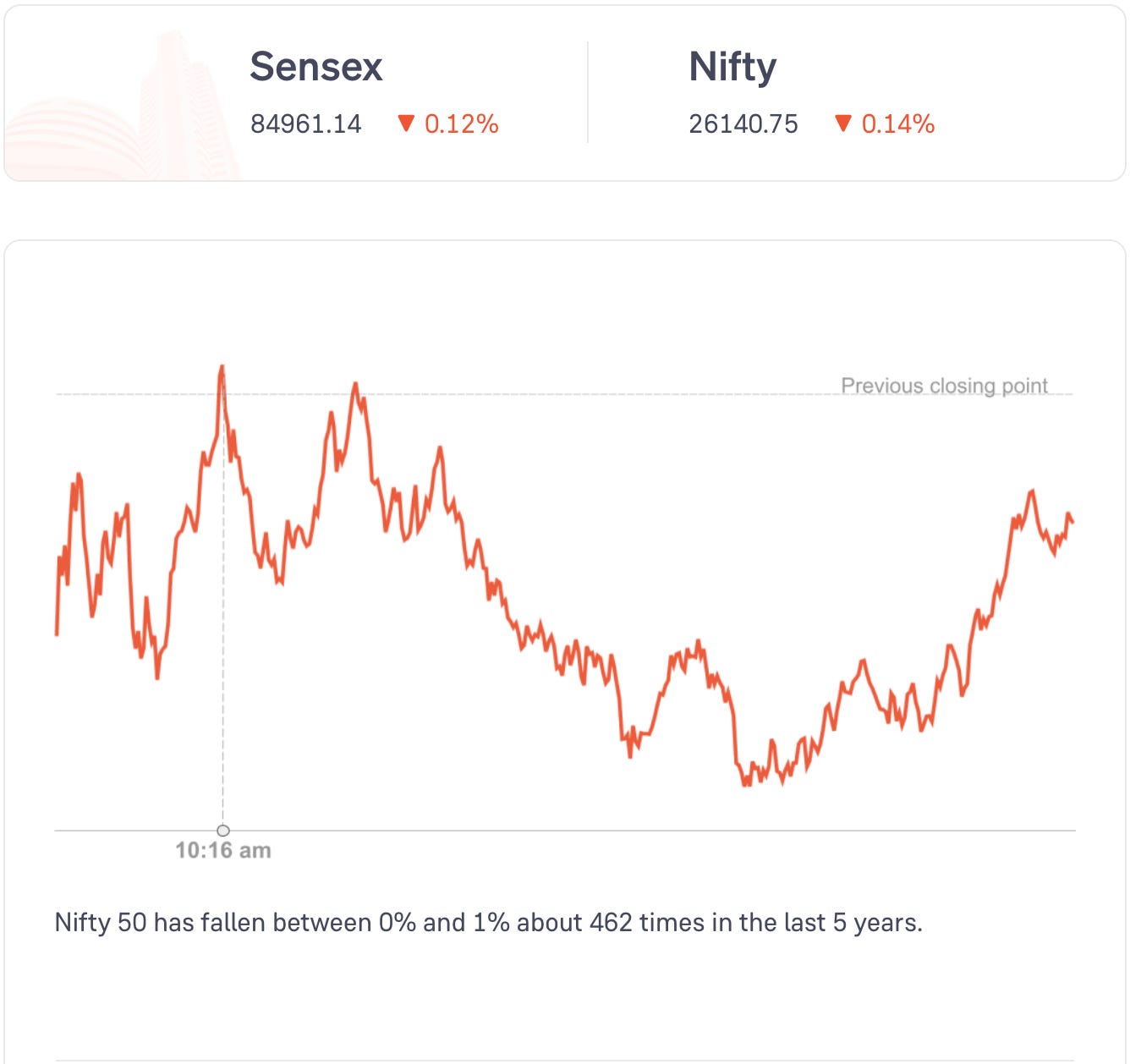
Markets opened below yesterday’s closing point.
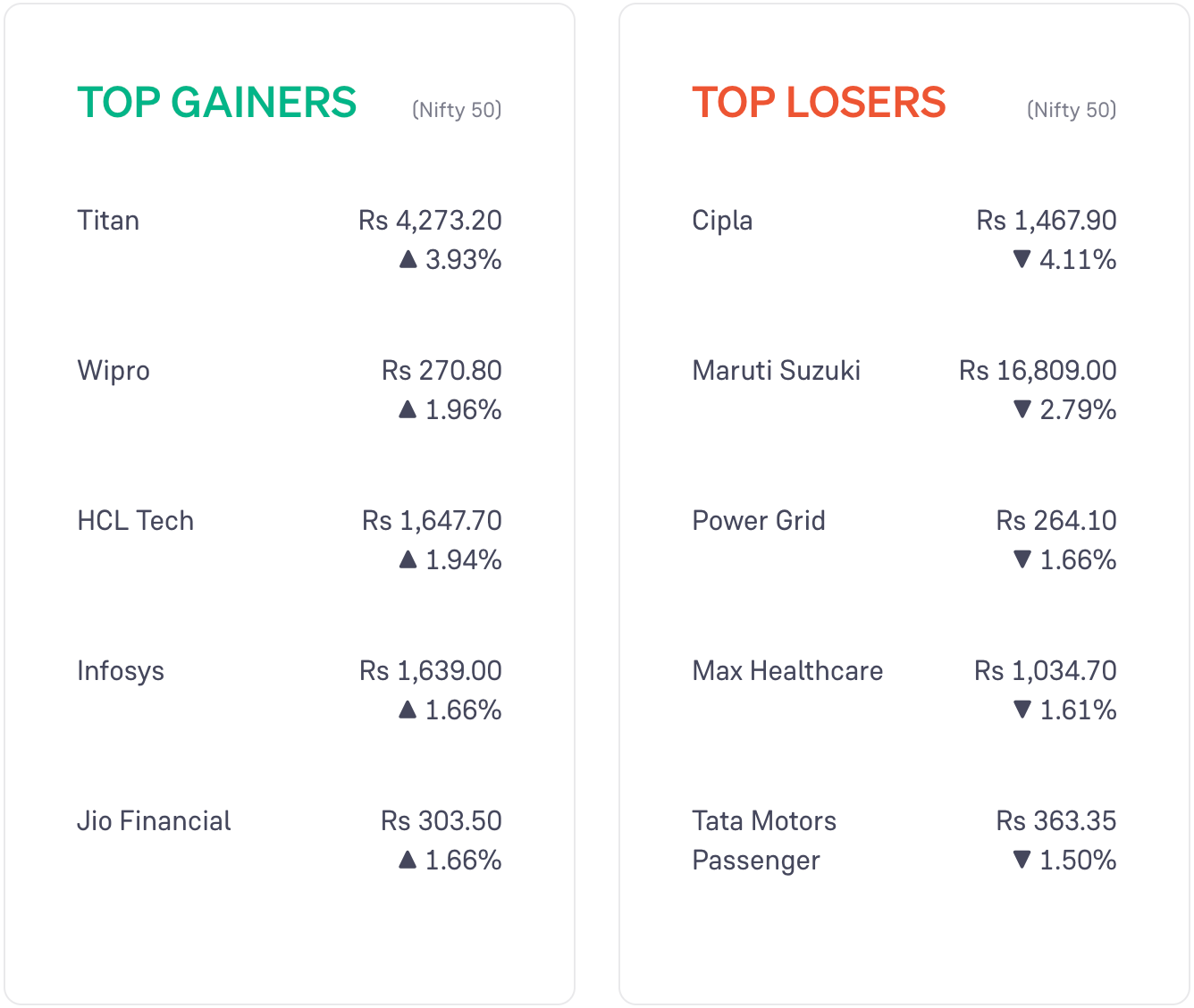
IT stocks and consumer durables stocks rose the most today. Auto stocks and oil and gas stocks fell the most.
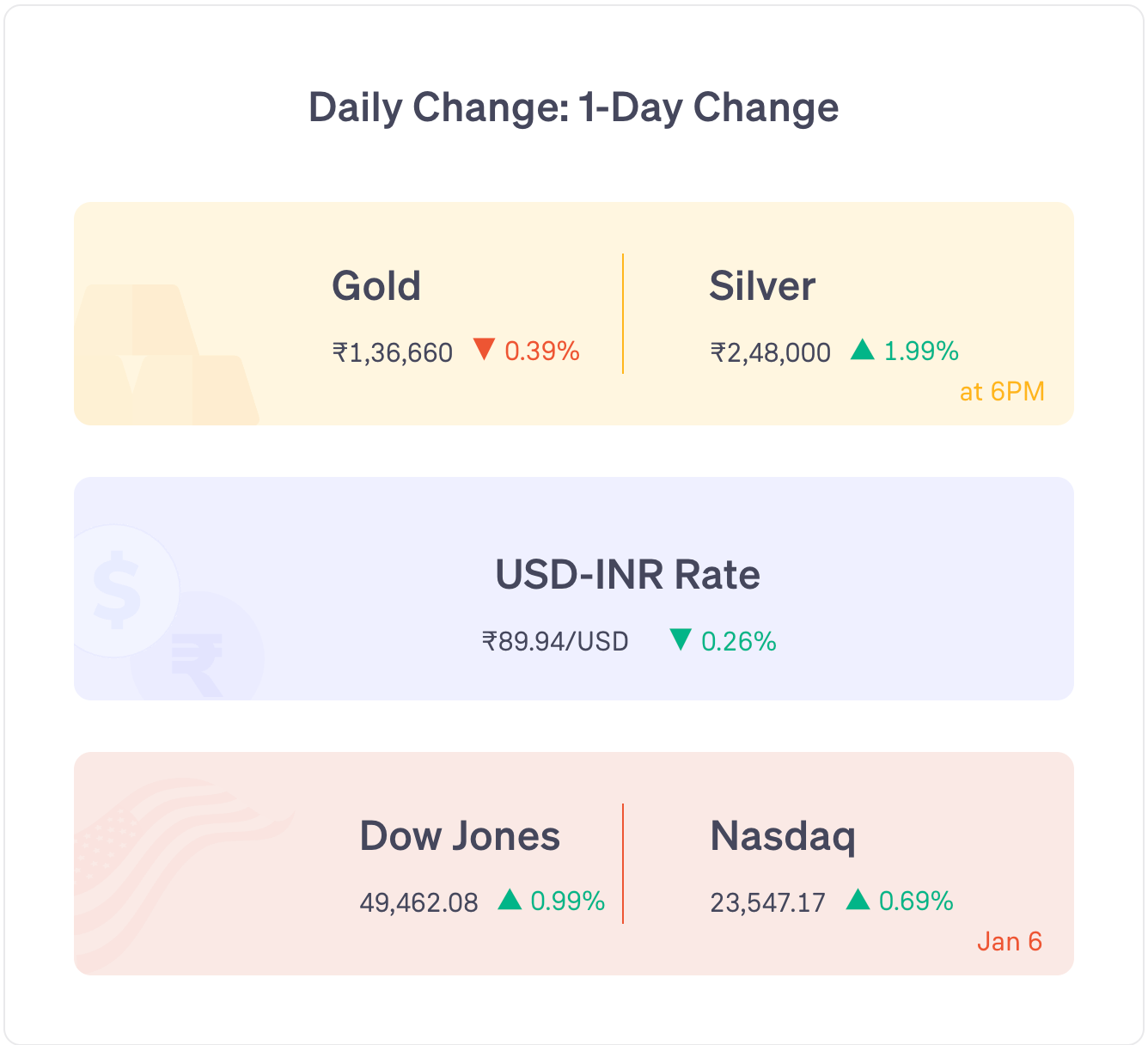
Global markets: US markets rose. Asian markets showed a mixed trend. Most European markets fell (as of 6 pm IST).
News
MoSPI has estimated 7.4% GDP growth for India in FY26, against 6.5% in FY25.
The Supreme Court has asked the central government to decide within four months on raising the current wage ceiling (Rs 15,000) for the employee provident fund.
The Indian Navy has deployed its First Training Squadron on a long-range training deployment to Singapore, Indonesia and Thailand to strengthen maritime ties.
Euro Area’s consumer price inflation eased to 2.0% in Dec 2025 (down from 2.1% in Nov).
Stocks Updates
REC: incorporated Munak Power Transmission Ltd as a wholly owned step-down subsidiary to develop a 400 kV substation and transmission lines in Haryana.
Adani Green: incorporated 3 wholly owned step-down subsidiaries, Adani Ecogen Seven, Eight and Six Ltd, for renewable power generation projects.
Eternal (Zomato): received a GST demand order of Rs 3.7 crore (including interest and penalty) for FY20 from West Bengal authorities, which it will challenge.
Adani Enterprises: approved early closure of its Rs 1,000 crore non-convertible debentures public issue on 8 Jan (vs the original 19 Jan schedule).
InterGlobe (IndiGo): inducted India’s first Airbus A321XLR to launch long-haul non-stop flights to Athens from Mumbai and Delhi in Jan 2026.
Word of the Day
REITs
These are companies that earn income by owning, managing, and renting high-value real estate.
It stands for Real Estate Investment Trusts.
They are similar to mutual funds. They pool investor money to buy and rent out properties (healthcare, residential, manufacturing, etc).
Different REIT types exist based on their public shareholding and the main source of income (rental, mortgage, etc).
6 Day Course
Theme: over-valued stocks
Day 3: Wednesday
So far, we discussed PE ratio, and PEG ratios.
Many companies are loss-making in their early high-growth phase.
Their PE ratio and PEG ratio cannot be calculated (it will be negative).
In such cases, one common method is industry-peer comparison.
What an investor can do is look at the other companies that are profitable in that industry. Based on the revenues and profits of that company, an investor can get a rough idea of the profit margins that can be earned.
Based on those estimated profits or earnings, an investor can then calculate a rough PE ratio and PEG ratio.
This is because early-stage fast growing companies tend to invest money heavily into their own future.
They rapidly eat up their own profits which they could have made if they were not investing so aggressively.
This method works fine in case of companies that have high revenues but not profits.
If the revenues are too low, this method will not work.
Featured Question
Q. “It is always a mix of opinion and thoughts to decide whethere to buy or rent a house. It would be great if you could provide insights/statistics on what would be the best decision to make the purchase purely based on numbers and keeping human emotions of owning a house aside.”
You are right about emotional value.
People do not buy houses based only on logic. This is why buying a house can never be a “wrong” or “right” decision.
You want to look at the argument keeping aside emotions completely. Here are some points to consider before buying a house.
-Expected appreciation of the house price over the next few years
-Annual cost of maintaining the house (maintenance charges, property tax, other unexpected charges)
-Home loan interest rates. If you buy a house, this will be a part of your expenditure. The lower it is, the more tempting it is to take a loan and buy a house
-Time horizon or tenure (if you plan to take a home loan)
-Interest rate cycle. As you know, interest rates can change. Try to understand the interest rate cycle. See if you can get a rough idea of where you are in the cycle. Then, try to get a rough idea about how interest rates are expected to change over the next few years
-Terms of prepayment. If you decide to pre-pay your home loan and close it early, are there any charges/penalties involved?
-Returns of other investment options available. If you can invest your money elsewhere and earn way more money, buying a house might not make so much sense
-Rental yield. If you do not plan on living in the house you buy, how much rent can you earn out of it when compared to the price of the house?
-Rent increase. If you decide not to buy a house and continue renting, how will the rent change in the future?
-Amount to pay from pocket vs taking a loan. If you have more money available in your bank, buying the house becomes easier, but so does investing the money somewhere else
There are obviously many other factors every person can consider.
These are some of the main pointers.
It is very necessary that you consider different scenarios. Try to run each scenario on a spread sheet and calculate the outcome of each scenario.
Of course there are many unknowns in this.
We cannot precisely predict how home prices, rents, interest rates, etc will change.
But calculating different scenarios can help us narrow down our decision.
Did you like this edition?
Leave a feedback here!