

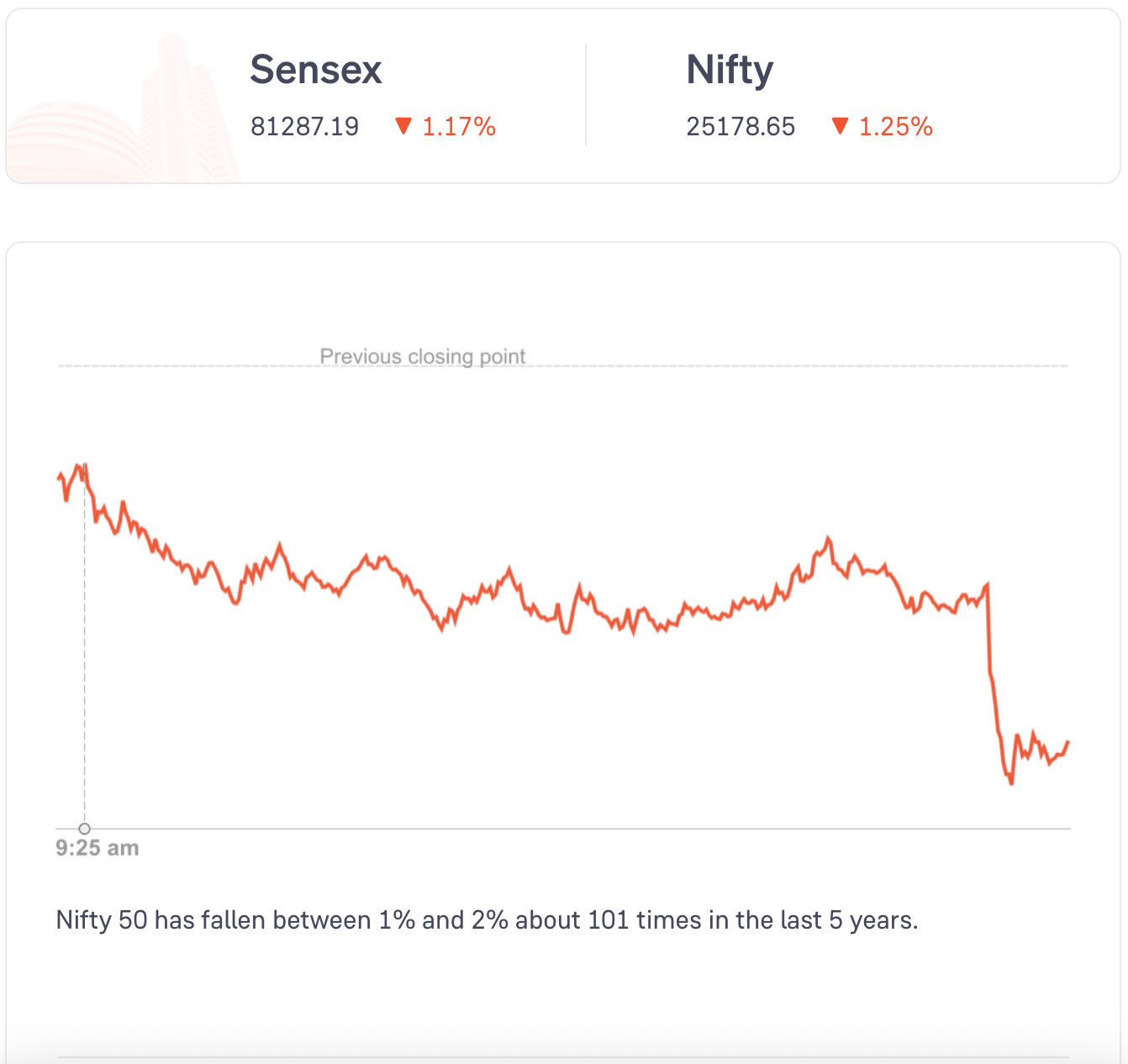
Markets opened below yesterday’s closing point.
Media stocks and consumer durables stocks rose the most today. Realty stocks and auto stocks fell the most.
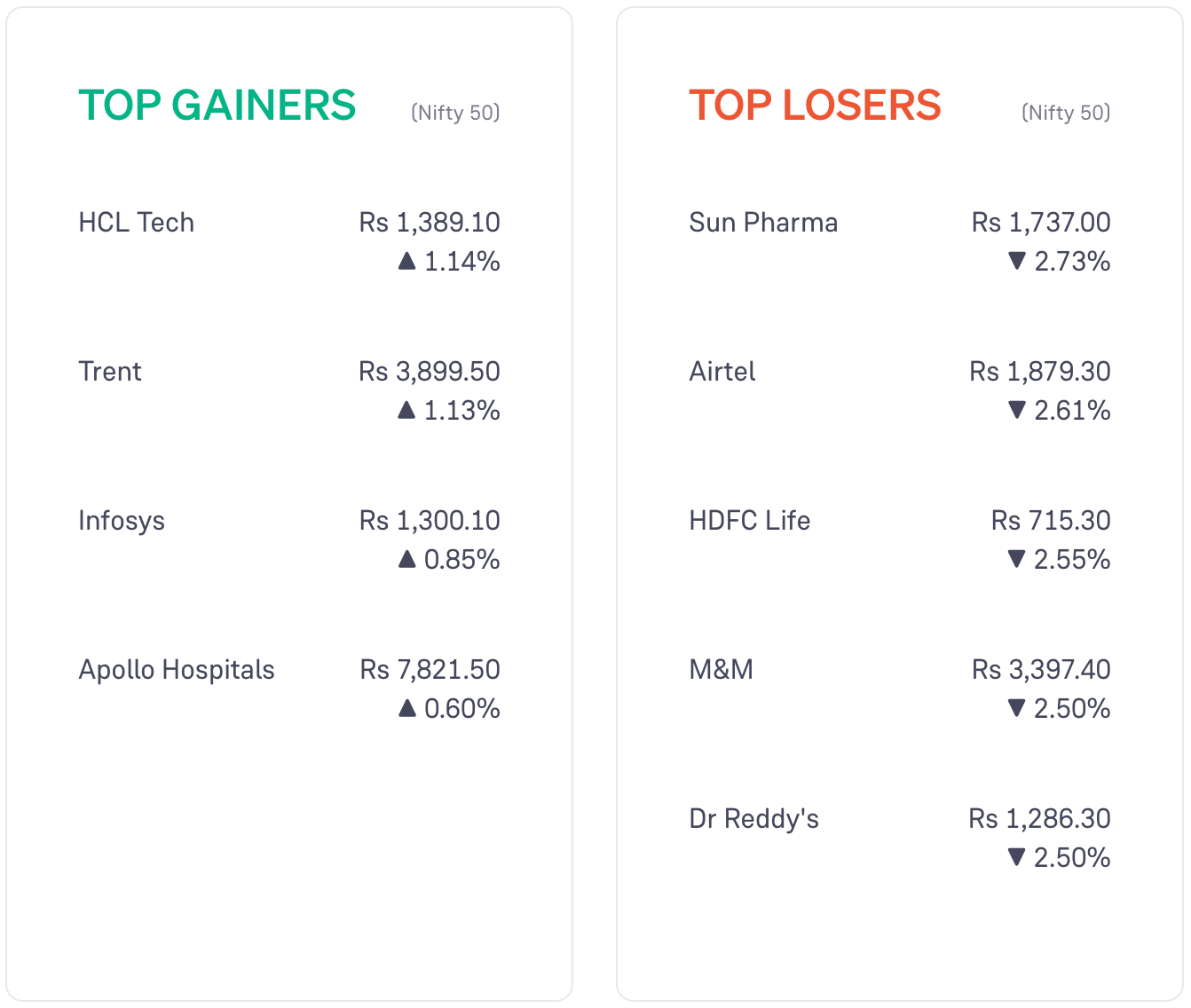
There are only 4 stocks in Nifty 50 that rose today. Hence, there are only 4 stocks in the ‘Top Gainers’ section.
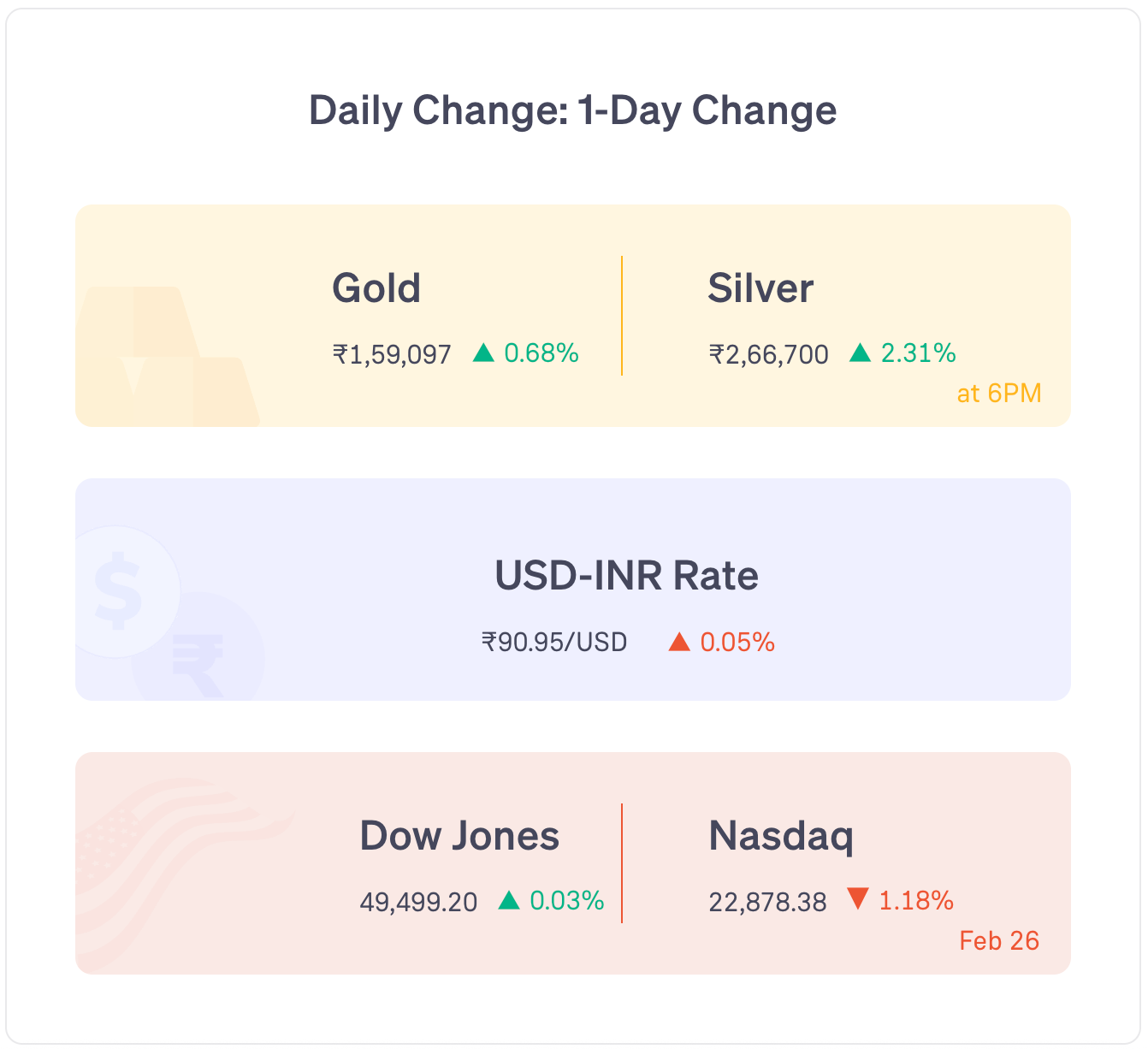
Global markets: US markets and Asian markets showed a mixed trend. Most European markets rose (as of 6 pm IST).
News
India’s real GDP grew 7.8% year-on-year in the Oct-Dec quarter (vs 8.4% in the previous quarter). GDP growth estimate for FY26 has been revised to 7.6%.
India’s forex reserves fell by $2.1 billion to $723.6 billion in the week that ended on 20 Feb.
Omnitech Engineering IPO was subscribed 1.14 times. Retail subscription: 0.33 times. IPO is closed for subscription.
Stocks Updates
LIC: began operations in International Financial Services Centre (IFSC) at GIFT City, Gandhinagar.
Canara Bank: raised Rs 5,000 crore through non-convertible debentures.
GAIL: will set up a greenfield wind power project of 178.2 MW in Maharashtra for Rs 1,736.25 crore.
PFC: will sell its step-down subsidiary ‘Saswad Transmission Ltd’ to Maharashtra State Electricity Transmission Company for Rs 3.79 crore.
Tata Steel: invested $264 million (Rs 2,401.5 crore) in its wholly owned subsidiary T Steel Holdings Pte. Ltd.
NTPC: received a GST demand order of Rs 19.97 crore (including tax and penalty) from Bihar authorities for FY20-21.
Word of the Day
Delisting
It is when a company’s shares are removed from a stock exchange
After the removal, the shares are no longer a listed security. Meaning, those shares are no longer traded on the exchange.
There are two types of delisting:
- Voluntary delisting: When the company exits the stock market on its own. It may operate as a private organisation after this.
- Involuntary delisting: When a company’s shares are delisted by SEBI, due to reasons like rule violations.
Investors have to sell the share after it is delisted. In most voluntary cases, the company offers to buy back shares from investors at a fixed price.
6 Day Course
Theme: SIF
Day 5: Friday
SIFs as a category of investments is still very new and developing/evolving.
To start an SIF, the condition is that a Chief Investment Officer must have more than 10 years of experience managing a fund greater than Rs 5,000 crore.
On the other hand, existing AMCs (mutual fund companies, for example) can launch SIFs if they have experience of greater than 3 years and an AUM of greater than Rs 10,000 crore.
Naturally, many newer SIFs are being launched by existing AMCs, especially those that already have mutual fund offerings.
SIFs are also subject to rules similar to mutual funds which means they must disclose their NAV values, regular detailed disclosures and audits, and so on.
The aim of SIFs is to offer an investment option with more flexibility and riskier investment strategies while still keeping things as transparent as mutual funds.
Featured Question
Q. “When I do SWF from a mutual fund, it works on First In First Out Basis. So, I will be using the units that have gained the maximum. Will my gains be diminished this way? Is it better to create multiple folios and use a recent folio for medium term goals?”
In terms of returns, it does not make any difference.
Whether you sell your newer units or older units, the total amount of money you are left with is still the same.
You have Rs 2 lakh invested. You withdraw Rs 50,000.
You are going to be left with Rs 1.5 lakh.
This is true no matter which units you sell.
So why sell the older units first? Older units are sold first because older units are taxed at a lower rate. So it helps investors save on their tax bill (if applicable).
So in such a case, making multiple folios will not help you earn more money.
Did you like this edition?
Leave a feedback here!
Whether Vedanta Ltd delisting will be Voluntary or inVoluntary. And how much time will it take to relisting of Vedanta shares in 5 new entities in NSE/BSE.
What will happen of vedanta shares during the transition period.