
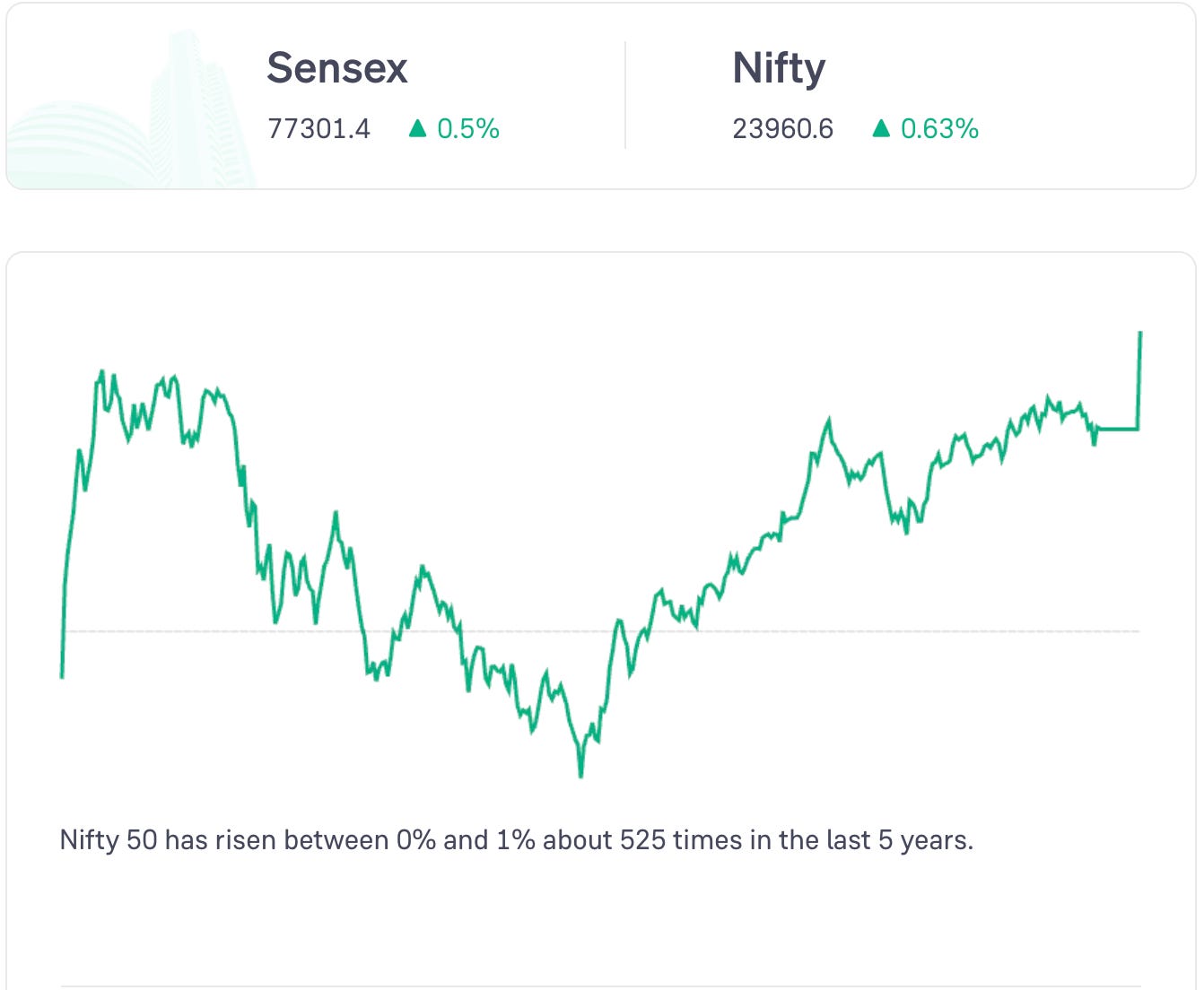
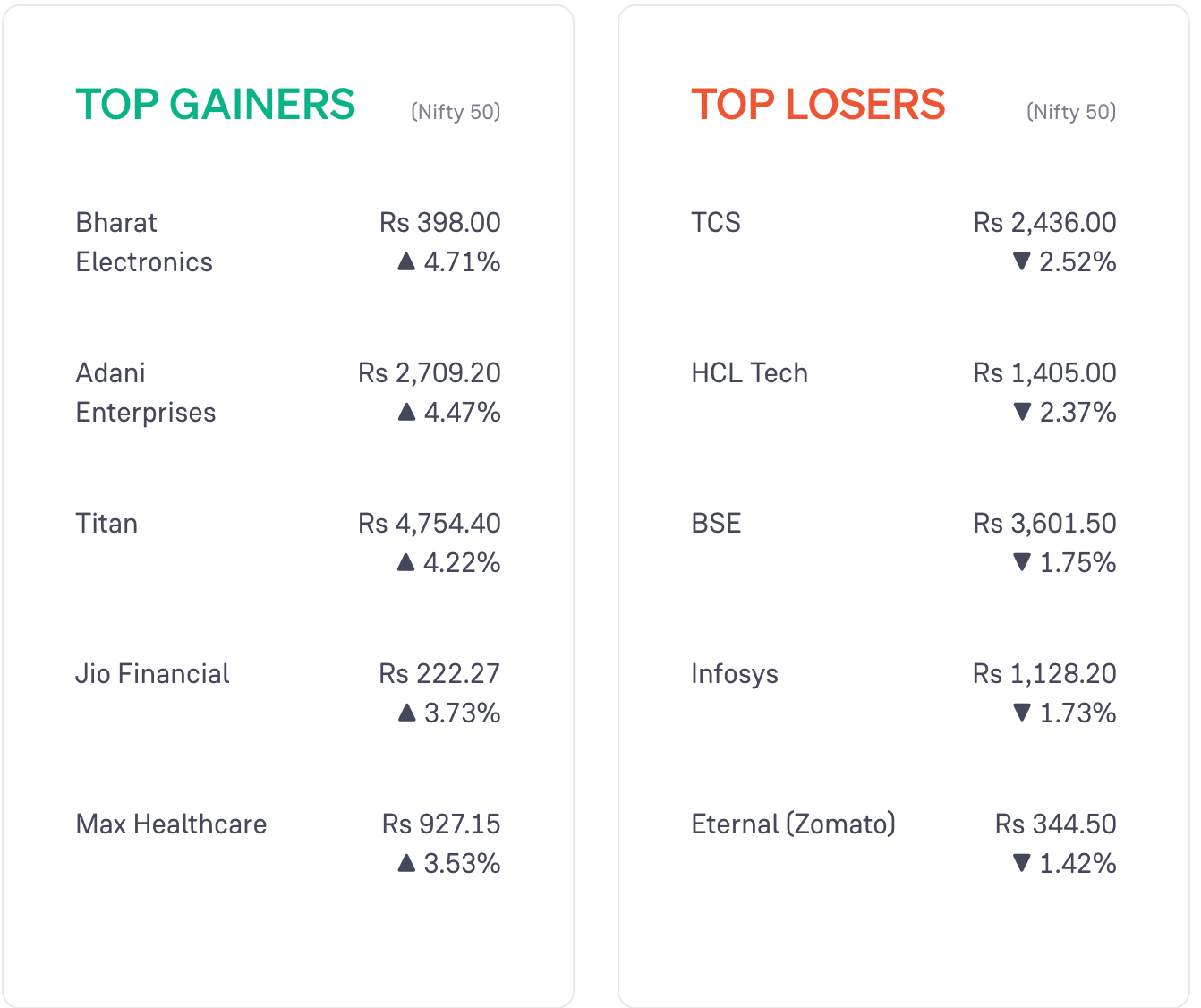
Markets closed higher compared to yesterday’s closing point.
All sectors’ stocks rose today except for the IT stocks. Media stocks and realty stocks rose the most.
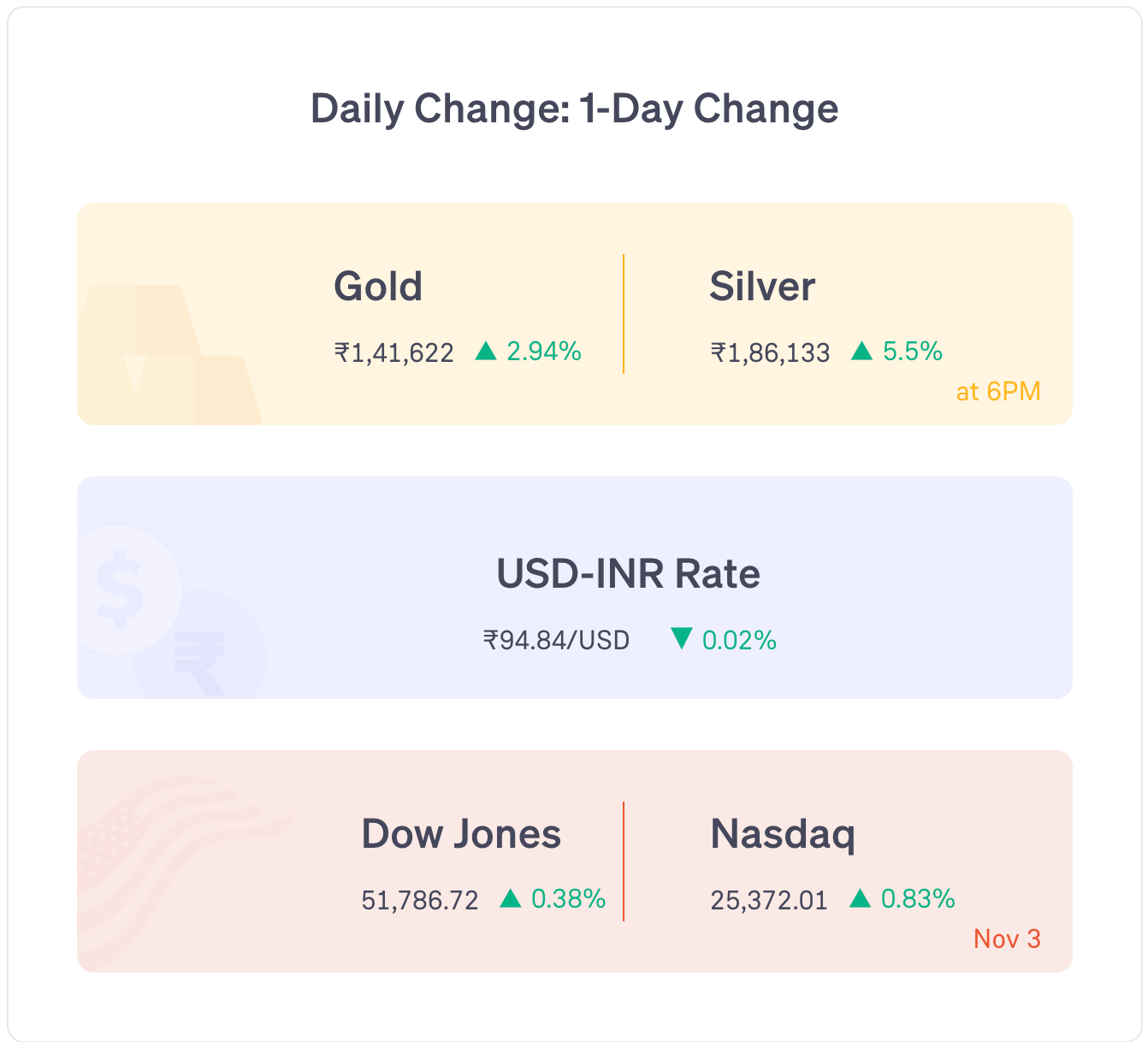
Global markets: US markets ended mixed on Tuesday. European markets and most Asian markets rose (as of 6 pm IST).
News
The government approved two schemes: Rs 14,500 crore to develop 92 GWh of electricity storage capacity by FY31, and Rs 2,814 crore to support four lithium and nickel processing plants.
RBI received bids worth Rs 73,907 crore for its Rs 50,000 crore reverse repo auction, up from Rs 23,905 crore a day earlier. The auction helps RBI temporarily absorb excess money from banks.
Stock Updates
Bajaj Finance: shareholders approved plans to raise up to Rs 17,500 crore, including Rs 11,700 crore through a QIP and Rs 5,800 crore through warrants issued to parent company Bajaj Finserv.
Kotak Mahindra: received Competition Commission of India (CCI) approval to acquire Deutsche Bank’s retail banking, private banking and wealth management businesses in India, subject to approvals.
Grasim: signed an MoU with Suzlon Energy, along with its subsidiary Aditya Birla Renewables Ltd, to develop wind turbines with recyclable blades on a pilot basis.
BHEL: won four orders from Adani Power to supply boilers, turbines and generators for four projects of 1,600 MW each. Each order is worth Rs 5,000 crore to 7,000 crore.
Lenskart: net profit rose 122.15% year-on-year to Rs 227.08 crore in the July-Sept quarter.
Zydus Lifesciences: net profit fell 26.60% year-on-year to Rs 925.50 crore in the July-Sept quarter. It also completed the acquisition of Sterling Biotech’s API business.
PFC: net profit rose 5.07% year-on-year to Rs 6,034.28 crore in the July-Sept quarter. Dividend declared: Rs 4.10 per share. Record date: 17 Nov.
Lloyds Metals: net profit rose 88.05% year-on-year to Rs 1,045.62 crore in the July-Sept quarter. It approved an Rs 3,240 crore power plant and up to Rs 625 crore investment in subsidiary Thriveni Earthmovers and Infra Pvt Ltd.
Nykaa: net profit rose 192.80% year-on-year to Rs 100.81 crore in the July-Sept quarter. It also approved acquiring an 82% stake in Simply Nam Beauty Pvt Ltd for up to Rs 33 crore.
Persistent Systems: raised Rs 7,000 crore by allotting NCDs at a coupon of 8.95% per year.
Lupin: net profit fell 21.83% year-on-year to Rs 1,155.26 crore in the July-Sept quarter.
Word of the Day
Iceberg Order
These are large orders that are executed in small tranches
These are mostly used by large investors, especially institutional investors.
In this, a large order is split into small orders that get executed one after the other.
This prevents the market from knowing how big the total order size is.
Example: XYZ mutual fund wants to buy 50 lakh shares of a company.
So it places an iceberg order where each order is only 5 lakh shares.
Once 5 lakh shares are bought, the next tranche of 5 lakh orders is placed until the investor has bought all 50 lakh shares.
So the market can only see 5 lakh shares’ worth of orders. They don’t know how many times this order will be placed, so they have no clue of the total size of the order.
6 Day Course
Theme: GMP in IPOs
Day 3: Wednesday
As soon as the price band of an IPO is announced, investors start discussing the GMP.
So, an investor might hear of GMP even while the subscription period is still on.
This is why some investors pay attention to the GMP while the subscription period is open.
The usual belief is that an IPO that is in high demand might end up with a higher GMP.
And therefore, such a stock upon listing will give high listing gains.
This assumption can work in a circular manner too, thus becoming very misleading.
More investors might subscribe to the shares, seeing a high subscription rate. This pushes the GMP up further.
Seeing a higher GMP, even more investors subscribe.
In such cases, the number of listing gain investors can become too high.
On the day of listing, many of these investors will sell, causing the price to crash instead of going up. Or it may go up to a far lesser extent than it would have otherwise.
————
Featured Question
Q. “In an IPO there is a price band. I think it means that investor bid at different prices in the price band . Then why allotment is done randomly in the case of retail investors when there is over subscription.”
In case of oversubscription, the issue price jumps to the max value in the price band.
So, technically speaking, all the shares are being offered at the max possible value in the price band.
There is nothing left to differentiate among the investors. All of them are being allotted shares at the same issue price.
At this point, the shares are allotted randomly or using a lottery system (for individual retail investors).
The information presented in this post has been compiled and prepared by Groww Invest Tech Pvt Ltd and is intended solely for informational purposes. It is not tailored to any specific investment objectives, financial situations, or needs of any individual investor. The content should not be construed as investment, financial, legal, or tax advice and should not be relied upon as a substitute for professional consultation.
Investing in securities markets involves inherent risks. Investors are advised to carefully review all relevant documents and consider their own risk tolerance before making any investment decisions.
Mutual fund investments are subject to market risks; please read all scheme-related documents carefully. Past performance of financial instruments, schemes, or markets is not indicative of future results.
SEBI Reg Name: Groww Invest Tech Pvt Ltd | SEBI Reg No: INZ000301838 | RA No: INH200008662
Groww Invest Tech Pvt Ltd is registered with the Securities and Exchange Board of India (SEBI) under Registration No: INZ000301838, as a Research Analyst under No: INH200008662, as a Depository Participant under No: IN-DP-417-2019, and with the Association of Mutual Funds in India (AMFI) under ARN-111686.
SEBI registration details: View registered name and registration numbers
Did you like this edition?
Leave a feedback here!