

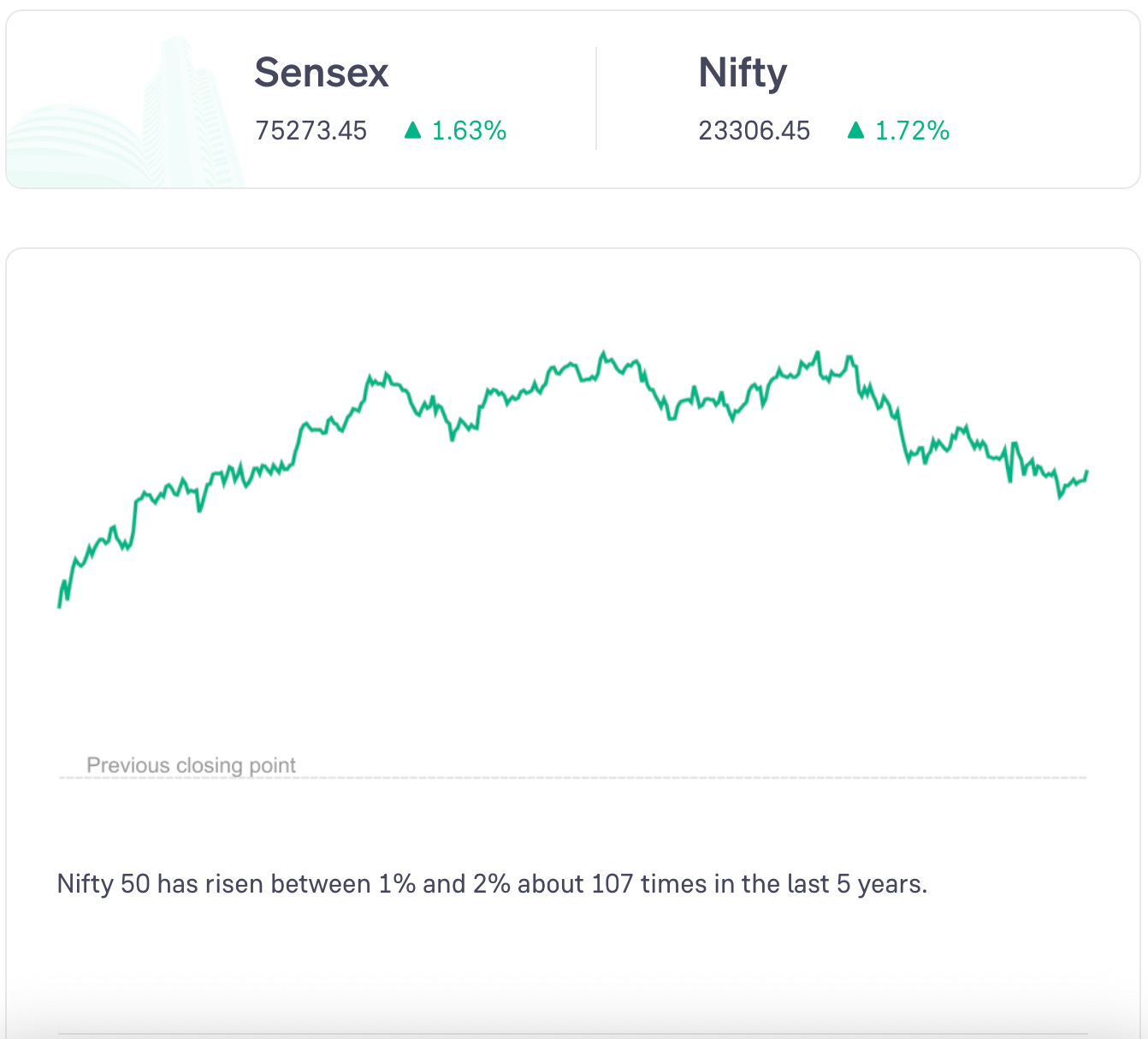
Markets opened above yesterday’s closing point.
All sectors’ stocks rose today. Consumer durables stocks and realty stocks rose the most.
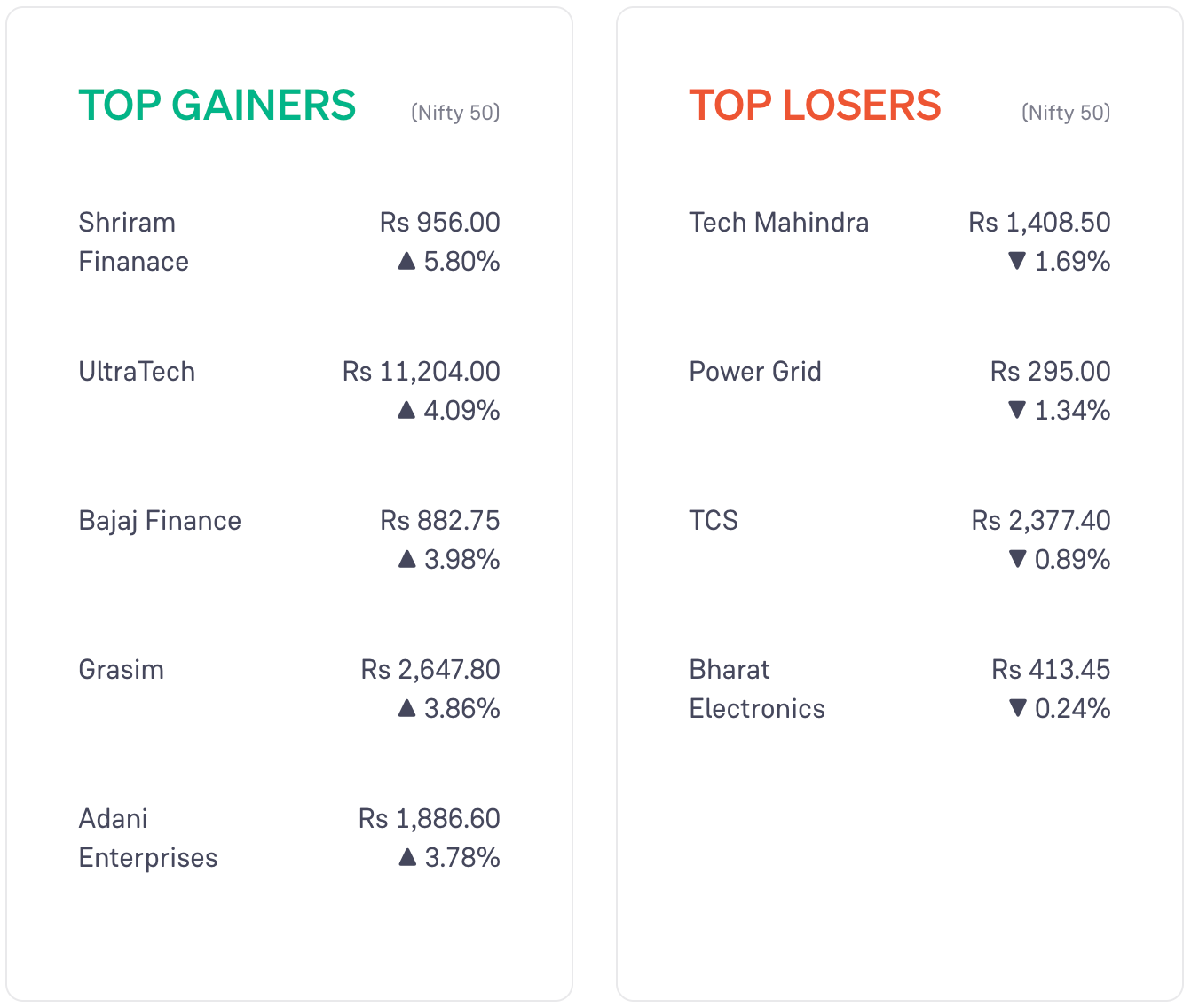
There are only 4 stocks in the Nifty 50 that fell today. Hence there are only 4 stocks in ‘Top Losers’ section.
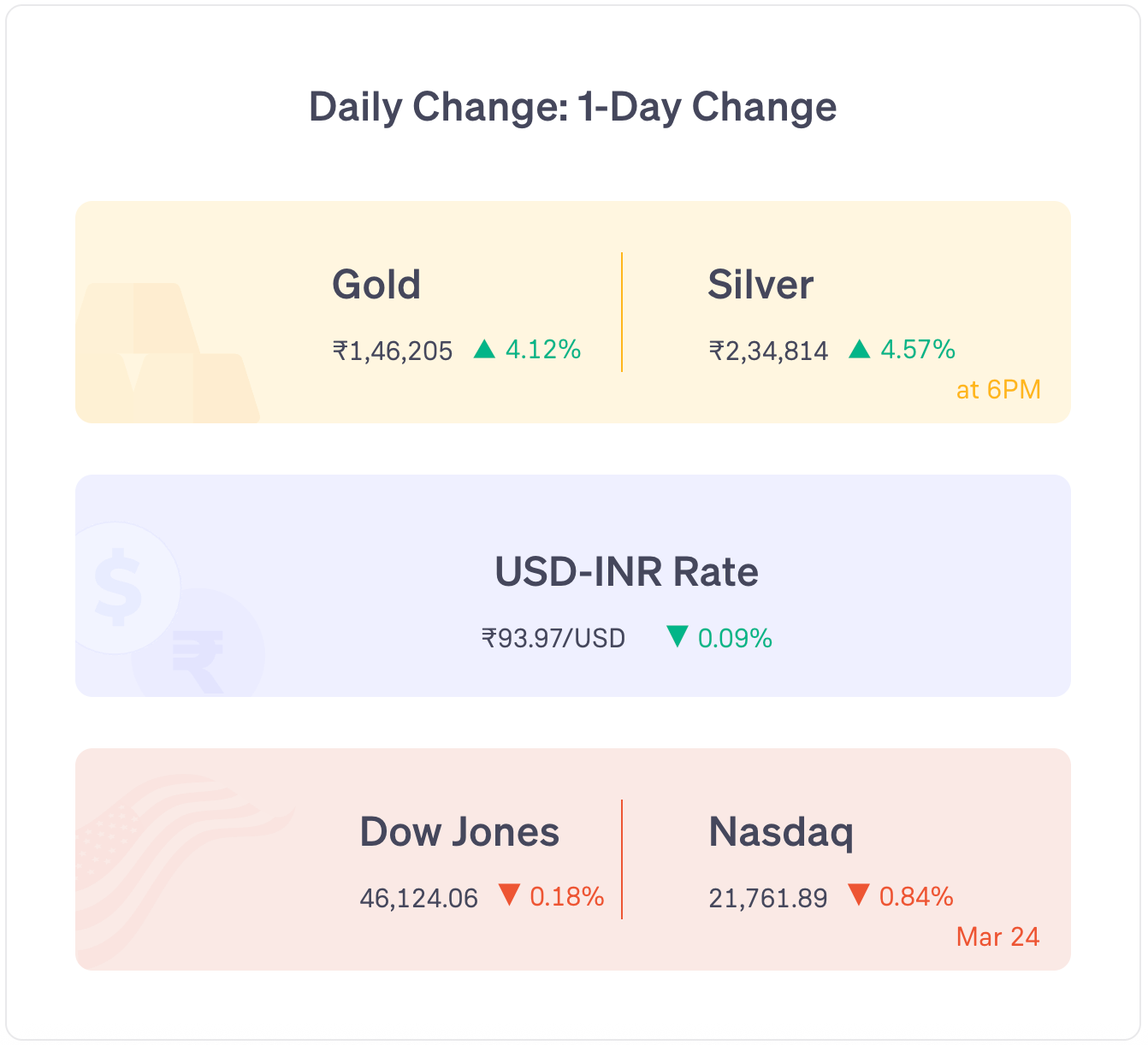
Global markets: US markets fell. Asian markets and European markets rose (as of 6 pm IST).
News
The government has approved a Rs 28,840 crore Modified UDAN scheme to improve regional air connectivity. The plan includes developing 100 airports and 200 helipads.
The government has approved Rs 1,800 crore to extend the immigration and visa system (IVFRT) for 5 years till March 2031 to make visa processing faster and more digital.
India has approved new climate targets aiming to cut emissions intensity by 47% and increase clean energy share to 60% by 2035.
The UK’s annual inflation rate stayed at 3% in Feb (same as Jan).
Powerica IPO has been subscribed 0.03 times. Retail subscription: 0.04 times. IPO closes on 27 March.
Stocks Updates
L&T: has won a significant order (Rs 1000 crore - Rs 2,500 crore) from the Assam government for building a water supply system in Guwahati.
Maruti Suzuki: will be investing Rs 10,189 crore in Khoraj, Gujarat, for a car manufacturing plant with capacity of 2.5 lakh cars per annum. Company’s existing total capacity is 24 lakh cars per annum.
Kotak Mahindra Bank: has completed the sale of its step-down subsidiary Infina Finance.
Tata Steel: has partnered with Hindustan Zinc for integrating low-carbon zinc in its steel manufacturing. It has also invested Rs 1,680.27 crore in its Singapore-based investment holdings subsidiary T Steel Holdings.
Tata Power: has executed a supplementary power purchase agreement for its Mundra power plant with Gujarat Urja Vikas Nigam.
Lupin: has received tentative approval from US FDA for its Pitolisant tablets, drug used to treat ailments like narcolepsy and cataplexy.
Word of the Day
Economic Moat
It is a company’s ability to have a competitive advantage over its competitors for a long time
The term was popularised by Warren Buffett through his shareholder letters and interviews.
A strong moat makes it difficult for competitors to copy the company’s business. It also indicates that it can earn high profits for many years.
Investors generally prefer such companies because their profits are more stable and predictable.
Economic moats can come from strong brand, lower costs, patents, technology, and other advantages that make it difficult for competitors to compete.
6 Day Course
Theme: biggest crude oil price spikes
Day 3: Wednesday
Similar to the oil shocks spoken so far, the third biggest crude oil price shock was also because of conflict.
Iraq attacked Kuwait in 1990. Iraq levelled many accusations against Kuwait.
One was that Kuwait was overproducing crude oil by slant drilling. This meant Iraq was accusing Kuwait of drilling and extracting Iraq’s oil.
Kuwait and Iraq combined were producing about 8% of the globe’s crude oil.
During the conflict, this supply got hampered in the chaos and resulted in reduced oil production.
This caused the oil price to surge up by over 100%.
In 1991, a coalition of 35 countries led by the US decided to launch a counter to Iraq. The aim was to make it stop the conflict against Kuwait.
In the meantime, other oil supplying countries increased their oil output resulting in reduced prices of crude oil.
Featured Question
Q. “is it possible that there’s a major difference in the market movement within a day for gold at the global level and at the domestic market?”
Yes, it is possible.
Many local factors also influence the price of gold on a more local level.
For example, a festival related to buying of gold in India could push the price of gold higher in India whereas the global gold price might not move much.
Similarly, the other local factors could cause gold prices to go up or down when compared to the global price.
In the longer run though, they do converge because no matter what factors are locally affecting price, gold is the same everywhere on earth.
Because things are always changing, local prices and global prices are also never perfectly in sync.
They are always moving slightly above/below compared to each other.
So a very high demand for gold in only one city can spike the price of gold in the city for some time. But eventually, new gold will rush into that city and the prices will fall in the city, and rise outside the city.
Thus, the prices are matched everywhere in the world.
Besides this, local policy changes like tax rules, importing rules, etc within a country can cause the price of gold to change compared to the global price.
The global gold price is usually mentioned in US dollars. But the US dollar’s exchange rate with different currencies is changing all the time.
This means that the price of gold in a certain country can change simply because of the change in currency exchange rates.
Did you like this edition?
Leave a feedback here!
Hallo sir please help me 95291 91386