
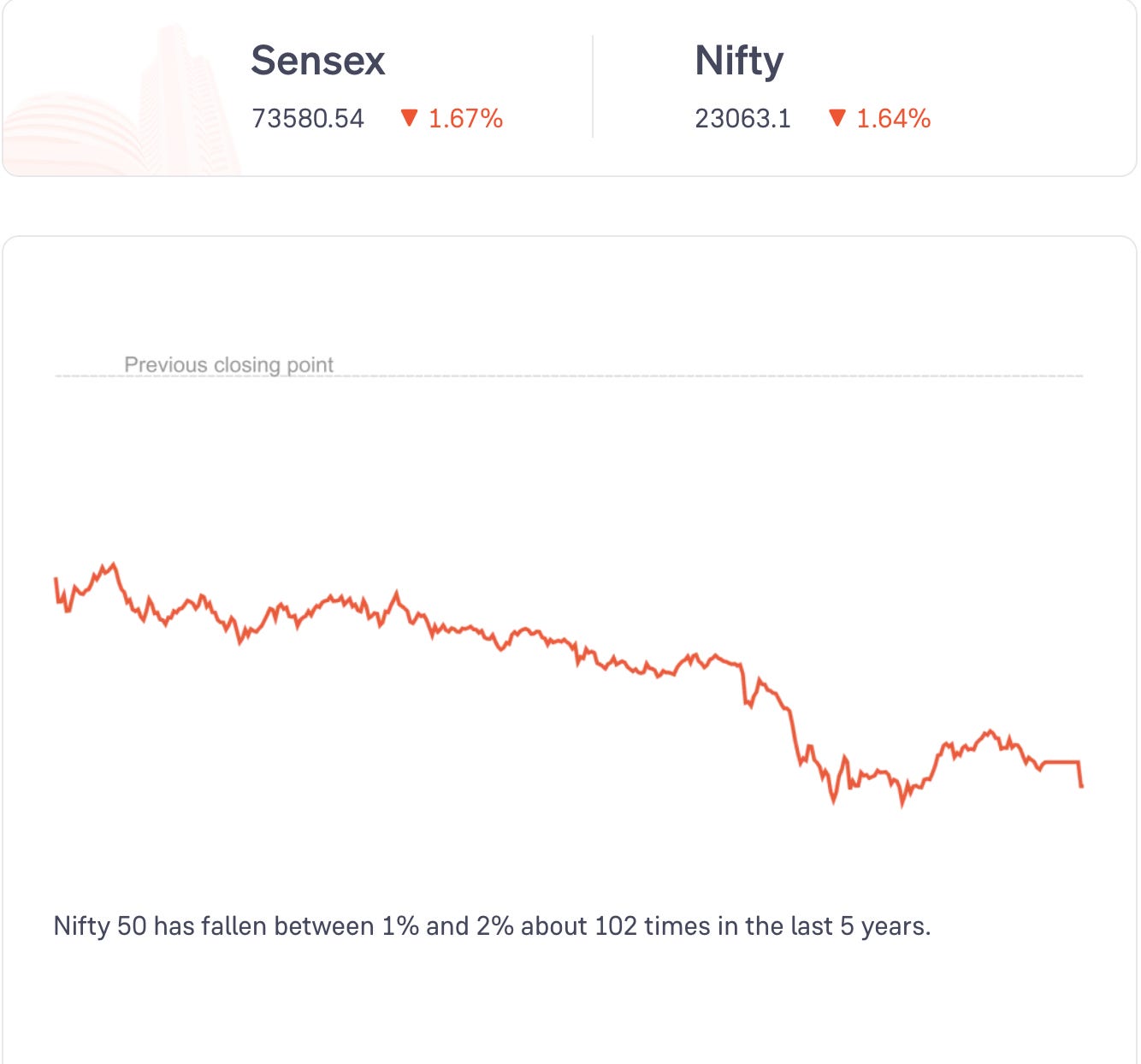
Markets ended significantly lower compared to yesterday’s closing point.
A sharp increase in US benchmark yields of over 5% (highest level since 2007) and oil prices rising over $105 a barrel, raised risk of foreign outflows and could have led to the fall.
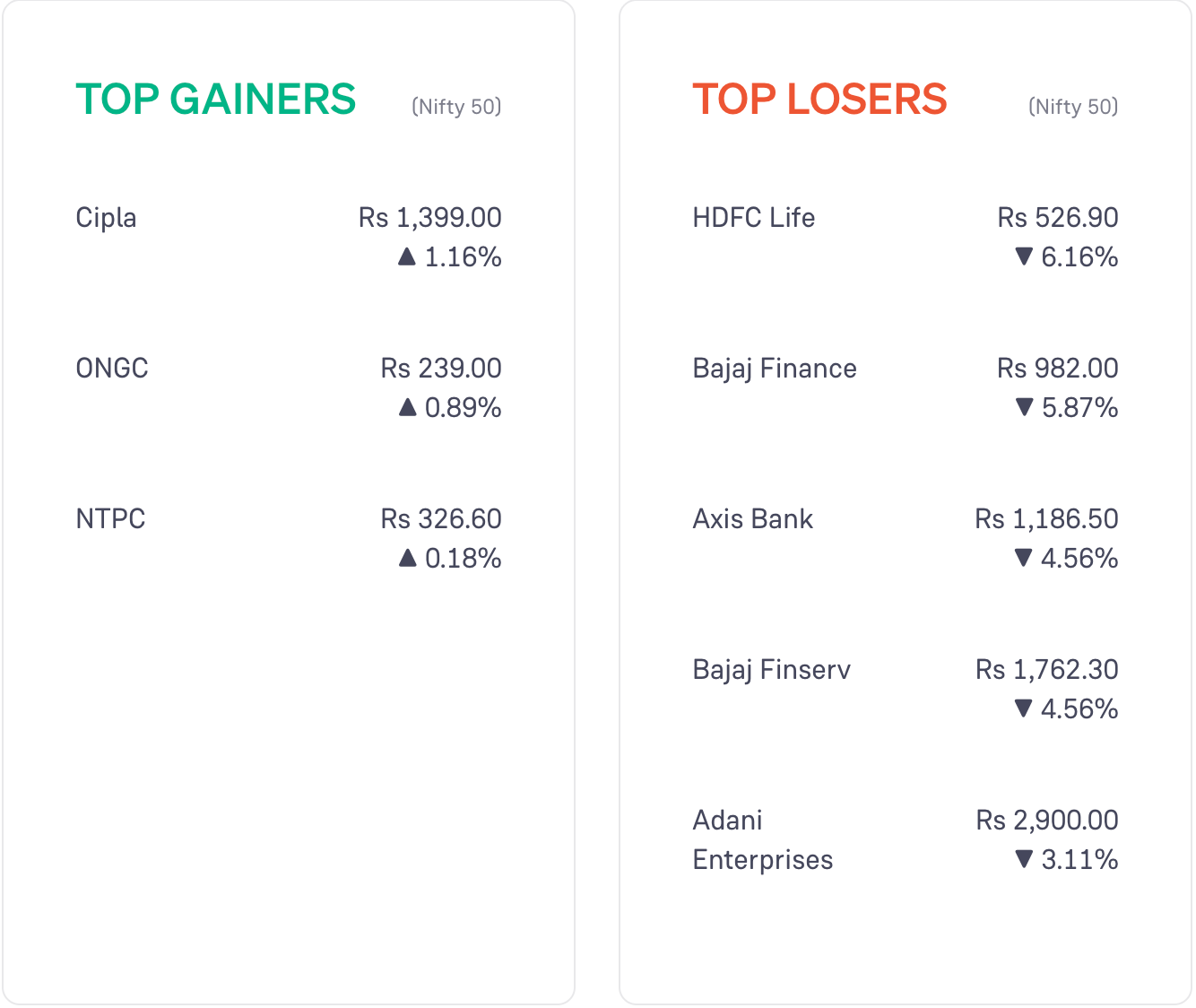
All sectors’ stocks fell. Private bank stocks and metal stocks fell the most. There were only 3 stocks in the Nifty 50 that rose today. Hence, there are only three stocks in the ‘Top Gainers’ section.
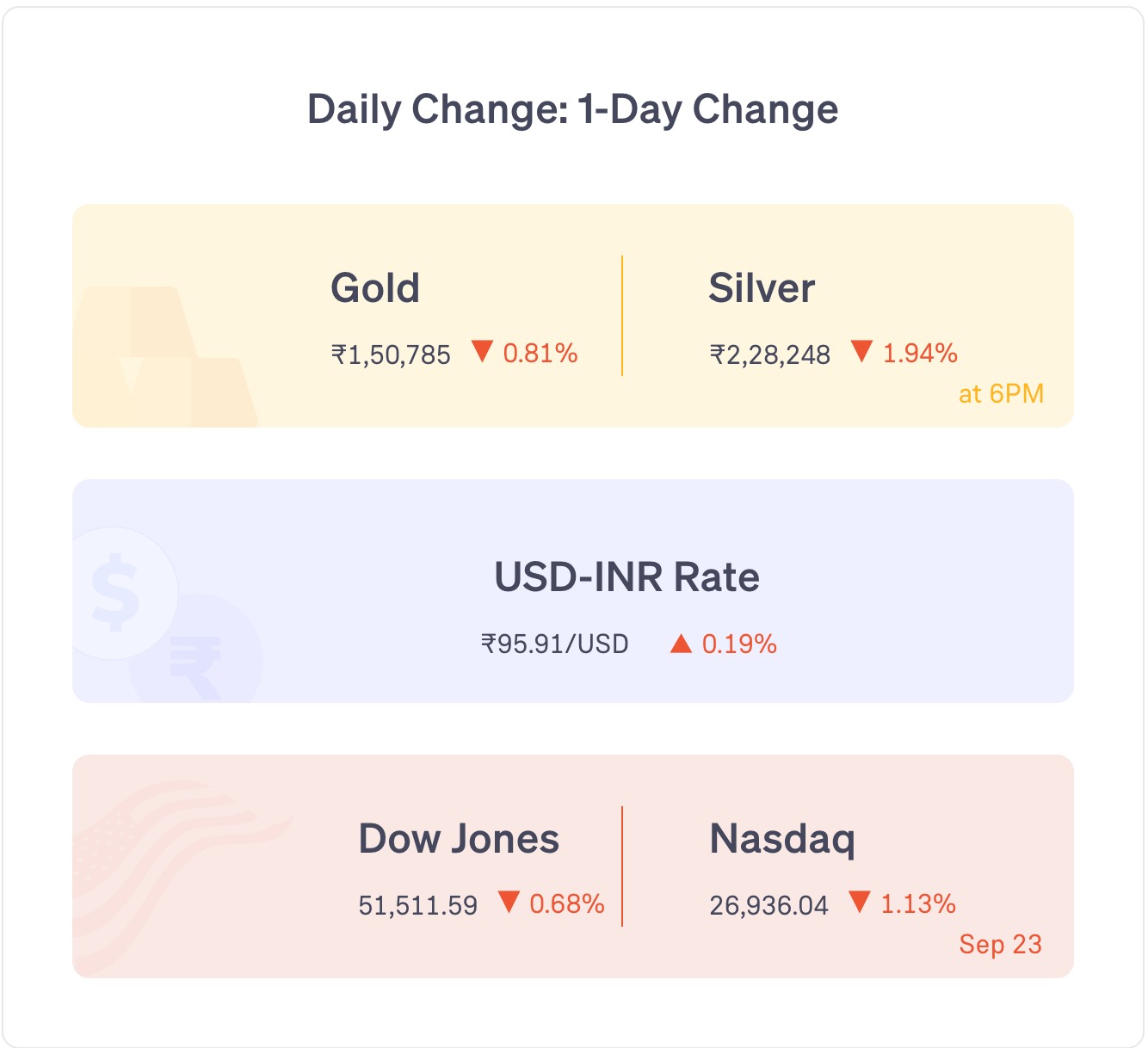
Global markets: US markets fell on Wednesday. Asian markets traded mixed on Thursday. Most European markets traded in red (as of 6 pm IST).
News
SEBI approved multiple decisions in its board meeting, including portfolio management regulations, Unified Common Advertisement Code (CAC), Depository Receipts (DRs) for REITs and InvITs, among others.
The government reduced customs duty on imported crude edible oils due to high international prices. Crude Sunflower Oil: 10% to nil, Crude Soybean Oil and Crude Palm Oil: 10% to 5%.
Finished steel production rose 4.1% year-on-year to 68.3 million tonnes between April and August.
The government extended anti-dumping duty on decor paper imports from China till Mar 2027. The duty imposed in Dec 2021 was $110-$542 per tonne for 5 years.
IPO Corner
NSE listed at Rs 1,800 on BSE, a premium of 0.84% over its issue price and closed 1.85% higher.
Varmora Granito’s Rs 1,096.04 crore IPO was subscribed 1.58 times on day 3. Retail subscription: 1.00 time. The IPO closed for subscription.
Elevate Campuses’ Rs 2,100 crore IPO was subscribed 0.23 times on day 2. Retail subscription: 0.23 times. The IPO will close for subscription on 25 Sep.
Moneyview’s Rs 1,091.68 crore IPO was subscribed 1.44 times on day 1. Retail subscription: 1.79 times. The IPO will close for subscription on 28 Sep.
Stock Updates
Maruti Suzuki: started operations at its first 300 kW green-hydrogen pilot plant at Manesar. It is also setting up a 10-tonne-per-day biogas plant and has approved four CBG projects worth Rs 561 crore.
UltraTech: added 4.6 mtpa of cement capacity, including 3.6 mtpa at a new plant in Andhra Pradesh and 1 mtpa through upgrades at existing plants.
Power Grid: acquired Barmer HVDC Power Transmission Ltd for Rs 18.98 crore. The project will transmit 6 GW of solar power from Rajasthan to Maharashtra through a roughly 1,000 km line.
Samvardhana Motherson: completed the previously announced sale of its indirect 26% stake in AES (India) Engineering Ltd to JV partner T-NET Japan.
Varun Beverages: its Zimbabwe arm signed an exclusive deal with Mondelez to distribute chocolates, biscuits, candy and gum from 1 October, using its existing network.
Lenskart: subsidiary NESO invested another Rs 2.71 crore in French eyewear brand Le Petit Lunetier, increasing its stake from 31.82% to 34.34%.
GMR Airports: subsidiary GMR Hospitality won the licence to operate food and beverage outlets at Terminal 3 of Delhi Airport until May 2036, with a possible 10-year extension. The deal is with another GMR Airports subsidiary.
Nykaa: completed its previously approved acquisition of a 51% stake in Aminu Wellness Pvt Ltd, making Aminu a subsidiary.
Word of the Day
MCLR
MCLR = Marginal Cost of Funds-based Lending Rate
All loans offered by a lender (bank or NBFC) have their interest rates linked to the MCLR.
So, it is something like (MCLR + x)%.
MCLR was in use earlier for all types of loans. But since this number was set by the bank, the banks took time to pass on the benefits of lower interest rates to borrowers.
So, for home, car, education, etc loans, MCLR has been replaced by a newer and faster system called ECLR.
MCLR is still predominantly used in corporate loans and working capital loans.
6 Day Course
Theme: how fund managers handle money
Day 4: Thursday
So far, we have spoken about how fund managers manage inflows from investors, outflows to investors, and storage of money in the mutual fund itself.
Now, let’s talk about how money is deployed into stocks/bonds/etc.
One of the most common ways to buy any asset is to stagger the purchase.
If the fund manager has decided to buy a certain quantity of a stock, the purchase is made over a few days or weeks.
Since they buy large volumes, their buying can push prices up. This method reduces the chance of a price spike caused by the fund’s buying.
Similarly, they also have a staggered approach to selling.
They also keep some cash for opportunistic buying — say a target stock or bond is available at a very attractive level.
Featured Question
Q. “Why is there a capital gains tax when we switch to another mutual fund or when there is an STP. Since the money is not coming to my account, I believe there should be no tax.”
This is because technically speaking, there is no “switch” option.
Whenever you switch, your investments are withdrawn and reinvested.
So for tax purposes, it is counted as withdrawing and reinvesting.
You are correct in arguing that the money never actually gets withdrawn (reaches you the investor). It stays in the same mutual fund.
But as per current tax regulations, this is how it is treated.
————
Did you like this edition?
Leave a feedback here!