
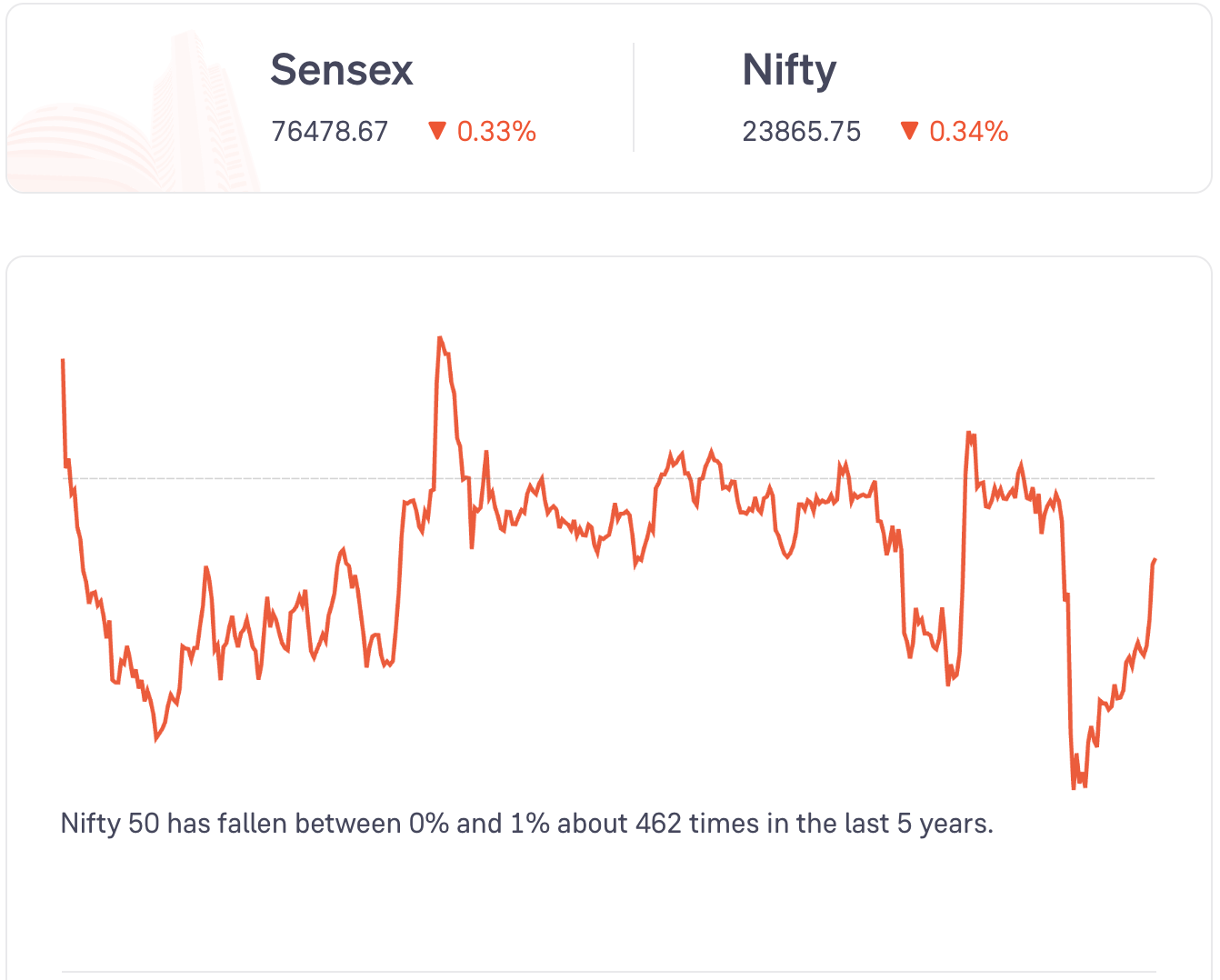
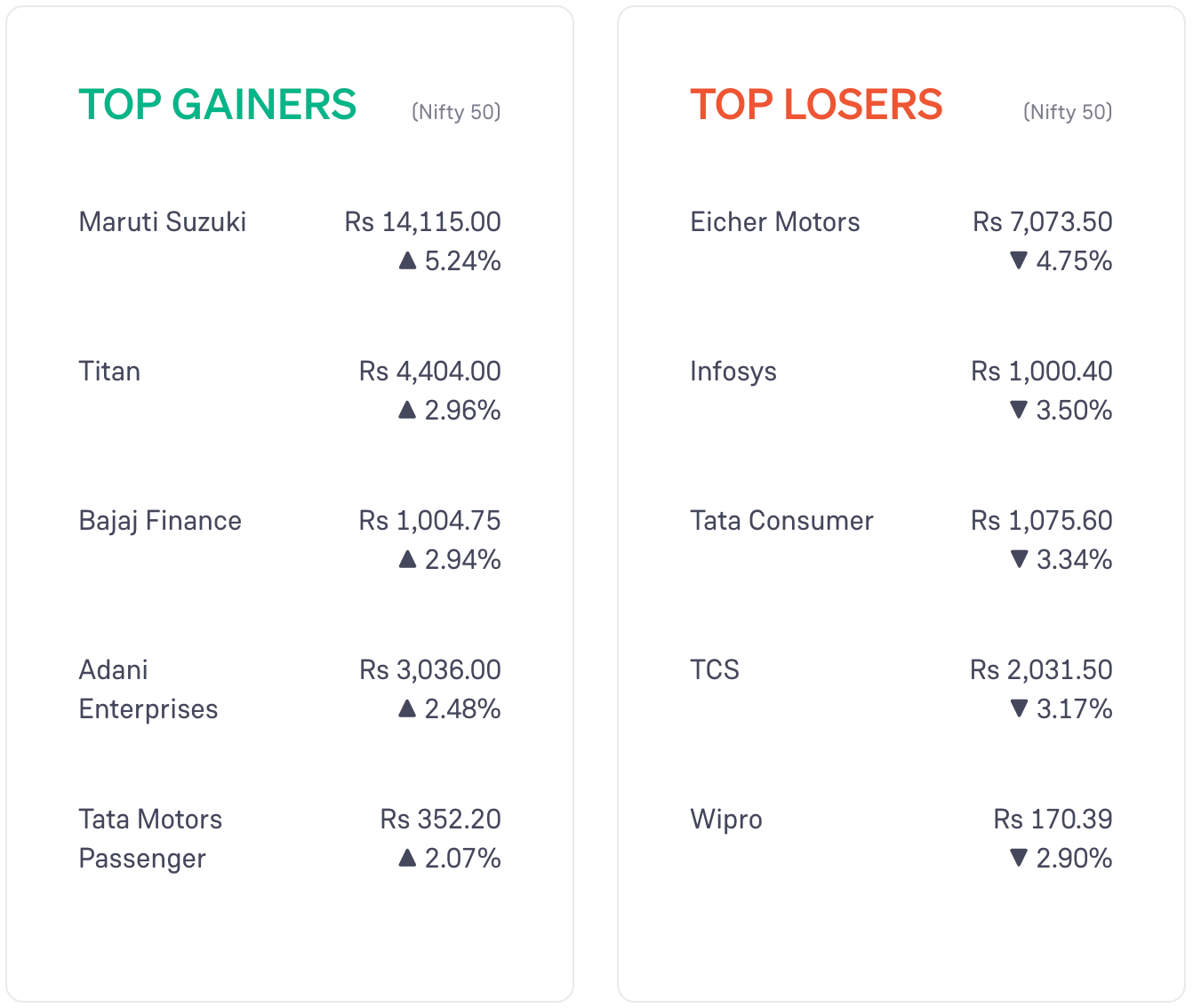
Markets opened above yesterday’s closing point.
Chemicals stocks and realty stocks rose the most today. IT stocks and media stocks fell the most.
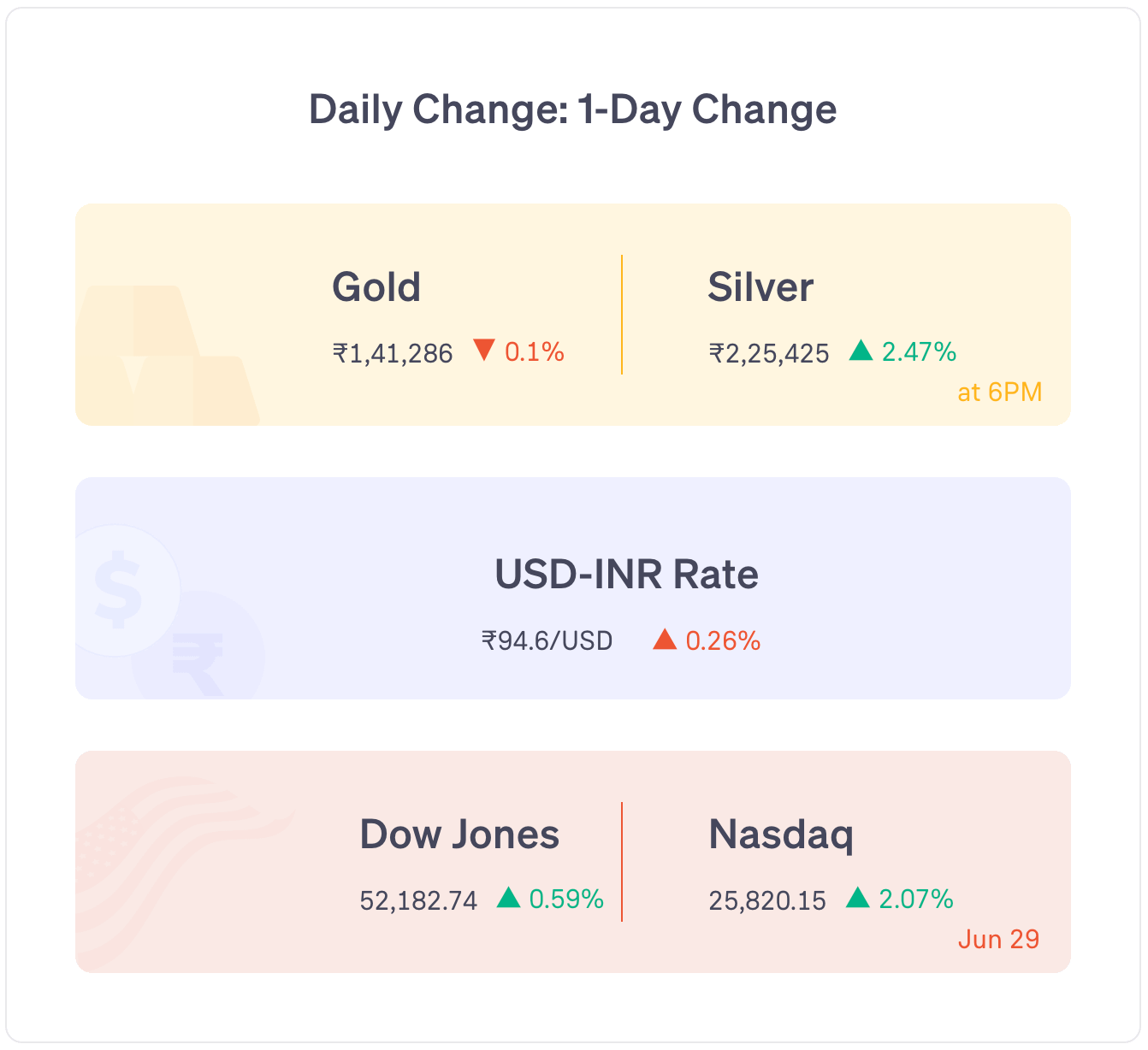
Global markets: US markets and most Asian markets rose. European markets rose (as of 6 pm IST).
News
The government has extended the customs duty exemption on key imported petrochemicals until 15 July 2026 to keep supplies stable and help manufacturers and consumers.
The government has lifted temporary fuel sale restrictions from 1 July, allowing bulk buyers to resume normal purchases as fuel supplies have stabilised. The restrictions, introduced on 12 June, had capped diesel sales at retail outlets at 200 litres per customer/vehicle per day.
Indian Railways has approved three projects: Rs 499 crore for doubling the 44.40 km Mansi–Saharsa section in Bihar, Rs 432 crore for Electronic Interlocking at 27 stations/cabins in Asansol Division, and Rs 200 crore for laying 48-fibre OFC over 1,696.2 route km across South Eastern Railway.
The government has kept interest rates on all small savings schemes, including PPF and NSC, unchanged for the ninth straight quarter from July to September 2026.
Stocks Updates
Maruti Suzuki: received an income tax penalty order of Rs 6.71 crore, which it will challenge.
Adani Ports: signed an agreement with MSC Group’s terminal arm, Terminal Investment Ltd (TiL), under which TiL will acquire a 49% stake in Adani Vizhinjam Port for $1.4 billion.
Kotak Mahindra: signed an agreement to acquire Deutsche Bank’s retail banking, private banking and wealth management business in India for around Rs 281.7 crore, subject to regulatory approvals.
NTPC: declared commercial operation of the remaining 41.6 MW capacity of its 176 MW Ramagundam Solar PV Project in Telangana, taking NTPC Group’s total installed capacity to 90,899 MW.
JSW Steel: completed its 50:50 joint venture with Japan’s JFE Steel for Bhushan Power & Steel after JFE acquired an additional 25% stake in JSW JFE Kalinga for Rs 7,875 crore.
Vodafone Idea (Vi): acquired a 26% stake in MTK Quantum Green Energy for Rs 4.33 crore to source cost-effective renewable energy through a captive solar power plant in Tamil Nadu.
Power Grid & PFC : subsidiary PFC Consulting Ltd transferred its wholly-owned SPV, Kakinada I Transmission Ltd to Power Grid for Rs 20.51 crore after Power Grid emerged as the successful bidder.
Tech Mahindra: company’s step-down wholly owned subsidiary, Leadcom Integrated Solutions Myanmar Ltd, was voluntarily liquidated with effect from 29 June.
Lodha Developers: allotted secured NCDs worth Rs 300 crore on a private placement basis.
Waaree Energies: subsidiary Waaree Solar Americas received an order to supply 236.22 MW solar modules from an international renewable energy infrastructure company.
Word of the Day
Installed Capacity
It is the electricity that can be produced at full capacity
A power plant does not always run at full capacity. Installed capacity is the max rated capacity of generating electricity of a power plant.
Installed capacity can be used for different groups also.
Example: total installed capacity of a company (total capacity of a power company across all its power plants).
Further, it can be used to describe the total installed capacity of cities, states, countries, etc.
It is measured in Megawatt (MW) or Gigawatts (GW) where:
1 GW = 1,000 MW
6 Day Course
Theme: value trap
Day 2: Tuesday
Many times, stock’s numbers decline due to temporary or cyclical reasons.
Example: a company’s revenues and profits might go low because of seasonal reasons or cyclical reasons.
This is a normal part of the functioning of that business and the numbers will come back up in a different part of the cycle.
But, in cases where the company is structurally going through a difficulty, the numbers will not come back as easily.
Example: a new competitor has made it very difficult for the company’s products to sell well.
In such a case, the low revenue/earnings and also low valuation is not a positive sign nor does it signal a good buying opportunity.
An investment in a stock that is losing and is likely to not bounce back is not always an investment.
More often, it might just act as a value trap.
6 Day Course
Q. “Can an individual invest more than 2 lakh rupees in ipo. Is it legal? Till how much amount can be invested in ipo?”
Yes, it is possible and is legal.
It’s just that the IPO category is different for such investors.
Different types of investors can invest different amounts in an IPO.
Based on your investment amount, you will be categorised into one of the following buckets.
-Up to Rs 2 lakh = individual/retail investor
-Rs 2 lakh to Rs 10 lakh = Small Non-Institutional Investors (NII) and High Net-worth Individual (HNI)
-Rs 10 and above = Big Non-Institutional Investors (NII)
The above is in the case of NIIs like HNIs, trusts, HUFs, NRIs, etc. There are institutional investors too like mutual funds, banks, private equity, etc that are not mentioned here.
Did you like this edition?
Leave a feedback here!