

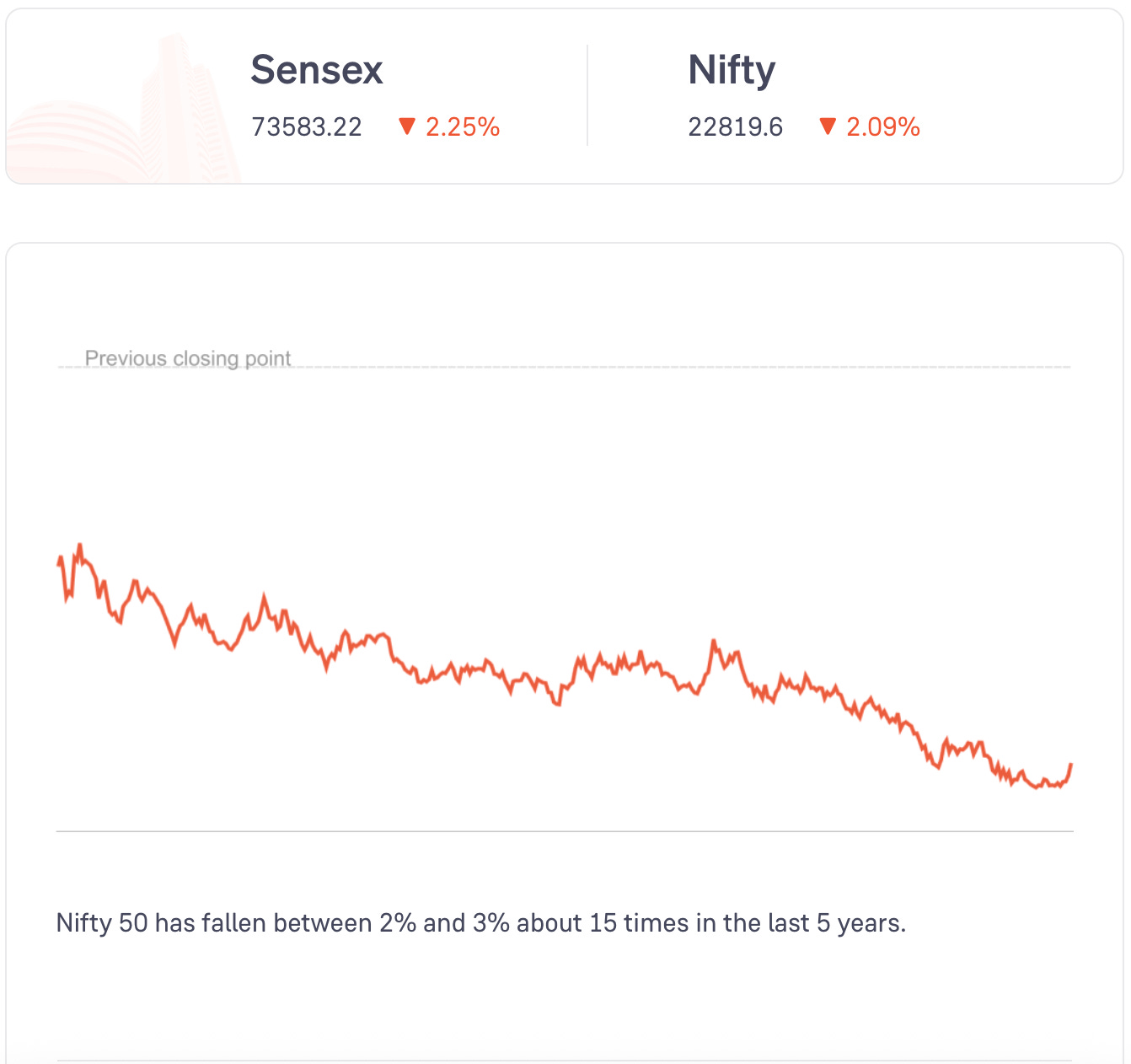
Markets opened below yesterday’s closing point.
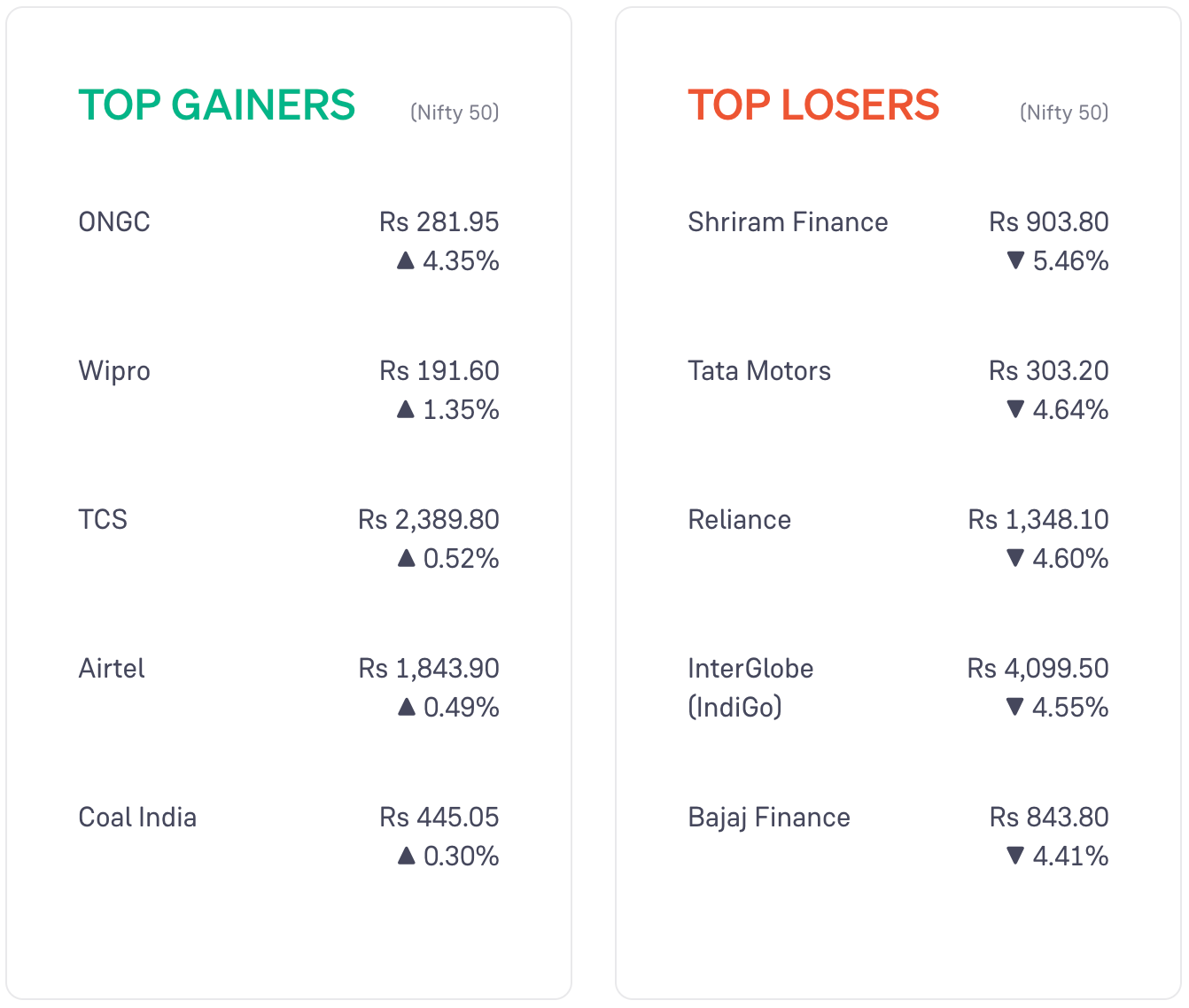
All sectors’ stocks fell today. PSU bank stocks and chemicals stocks fell the most.
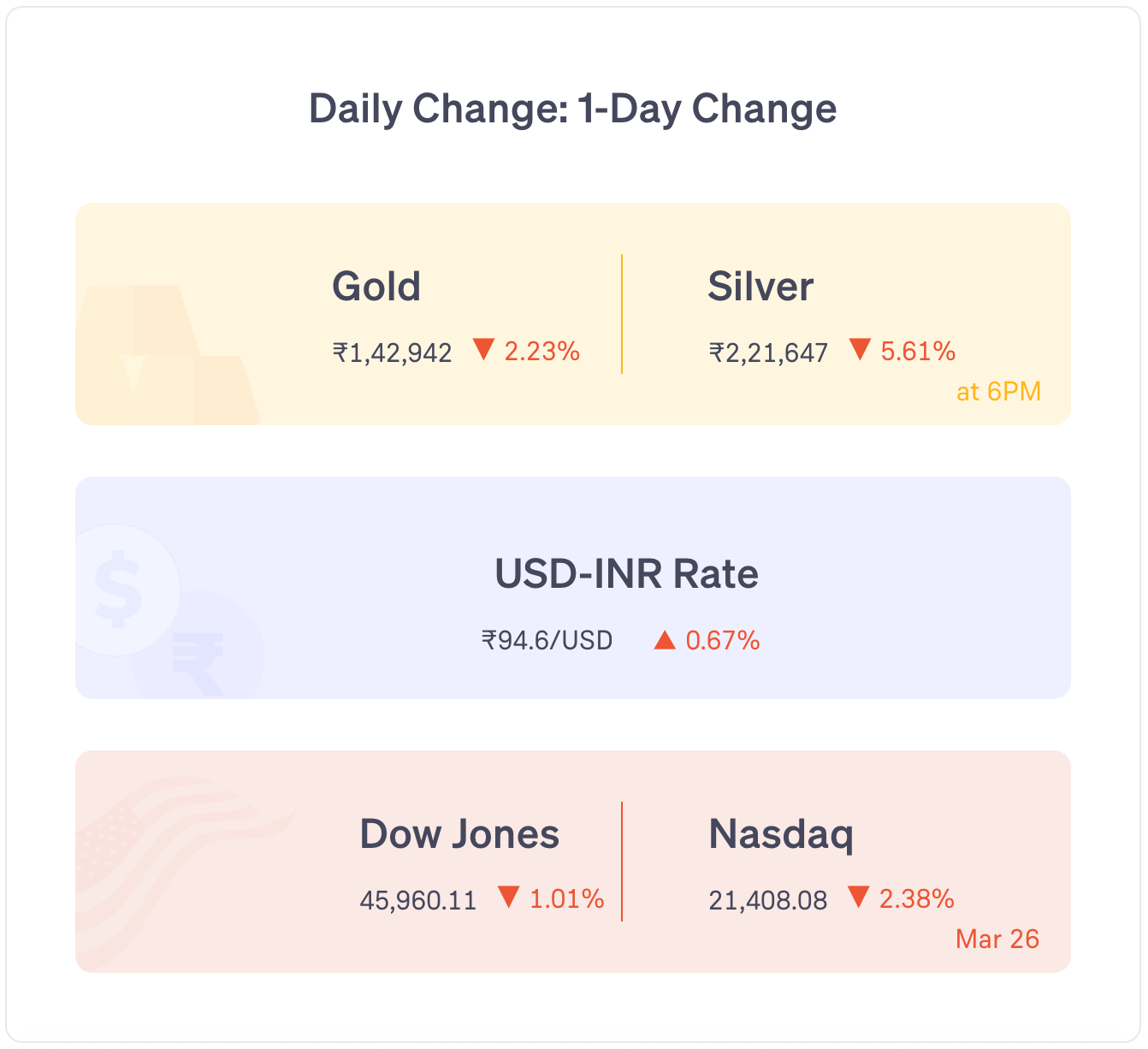
Global markets: US markets and most Asian markets fell. European markets fell (as of 6 pm IST).
News
Government has reduced excise duty on petrol and diesel by Rs 10/litre. The fuel prices won’t change, as the duty reduction is to accommodate underrecoveries by fuel companies.
The Defence Acquisition Council (DAC) has cleared equipment procurement proposals worth Rs 2.38 lakh crore for the Indian Armed Forces.
To support the country’s liquidity requirements, the RBI has injected Rs 55,837 crore into the economy via a three-day Variable Rate Repo (VRR) auction.
Stocks Updates
Power Finance Corp: transferred its subsidiary Wagdari Transmission Ltd to KCC Buildcon for Rs 4.41 crore.
Coal India: plans to invest Rs 3,300 crore to set up 8 new coking coal washeries by FY30 to improve coal quality and reduce imports. It has also formed a 50:50 joint venture with Damodar Valley Corporation for power generation and related businesses.
Mazagon Dock: increased its stake in Colombo Dockyard PLC to 51% after acquiring additional shares.
Interglobe (IndiGo): received a GST demand with Rs 42.9 crore penalty, which it plans to challenge.
Adani Ports: operationalized India’s first “Port of Refuge” to enhance maritime safety and emergency response infrastructure. It provides designated safe zones where distressed ships can seek shelter and receive emergency support like firefighting, salvage, and pollution control.
L&T: won multiple orders (Rs 1,000 crore to Rs 2,500 crore) for building projects including a glass plant in Gujarat and a 2-wheeler factory in Andhra Pradesh.
Reliance: denied media reports of purchasing Iranian crude oil, calling them false and misleading.
JSW Energy: completed acquisition of Raigarh Champa Rail Infrastructure for Rs 700 crore, making it a wholly owned subsidiary.
Word of the Day
Oligopoly
It is a market structure where a few companies control most of the industry
In an oligopoly, actions made by one of the big companies affect the other directly.
Example: if one major company reduces prices, the others usually have to reduce prices as well. It’s hard for new companies to enter this kind of market.
Existing players already have strong advantages in such market structure (example: a well-known brand, lots of money, a large customer base, or government licences).
There are 2 other types of markets like this:
-Monopoly: one single company dominates the entire market.
-Duopoly: two large companies dominate the market.
6 Day Course
Theme: biggest crude oil price spikes
Day 5: Friday
The last spike in this is the one experienced during the Great Recession in 2008.
The price of crude oil went up by about 50%.
One of the biggest reasons behind this surge was actually increased demand from China and India.
With an ever increasing middle class population, the consumption of fuel was rising and led to increased demand.
Another reason for the price surge was the money flowing into commodity markets (since the share markets were performing poorly).
Due to the financial crisis, the US dollar also weakened causing the price of the crude oil to go up (when measured in US dollars).
In some of these cases, the price of crude oil peaked much higher than where it is today.
Featured Question
Q. “How can an individual calculate Total Return Index (TRI) for its investment? Mostly the stock brokers in DEMAT account show only the absolute returns.”
TRI stands for Total Returns Index.
It is used in case of index investments.
So, let’s take the Nifty 50 index. The index may grow to a certain level after a certain period.
If you invested in an index fund of Nifty 50, would you get the same growth?
The answer is no, you would get higher returns than just Nifty 50.
Why?
Because Nifty 50 is calculated without dividends. Since dividends are paid in index funds (they get re-invested), the actual growth in case of index funds is higher.
This problem is solved by the TRI version of any index.
So, Nifty 50 TRI is an index that accounts for dividends too in its calculation.
Now, if you want to calculate something similar for your own stocks investments, you will have to add the dividend amount to your stocks’ returns.
If you re-invest the dividends you get in the same stock, you need to account for it in your calculation.
If you re-invest it in a different option or spend it, you will have to account for it accordingly.
Did you like this edition?
Leave a feedback here!