

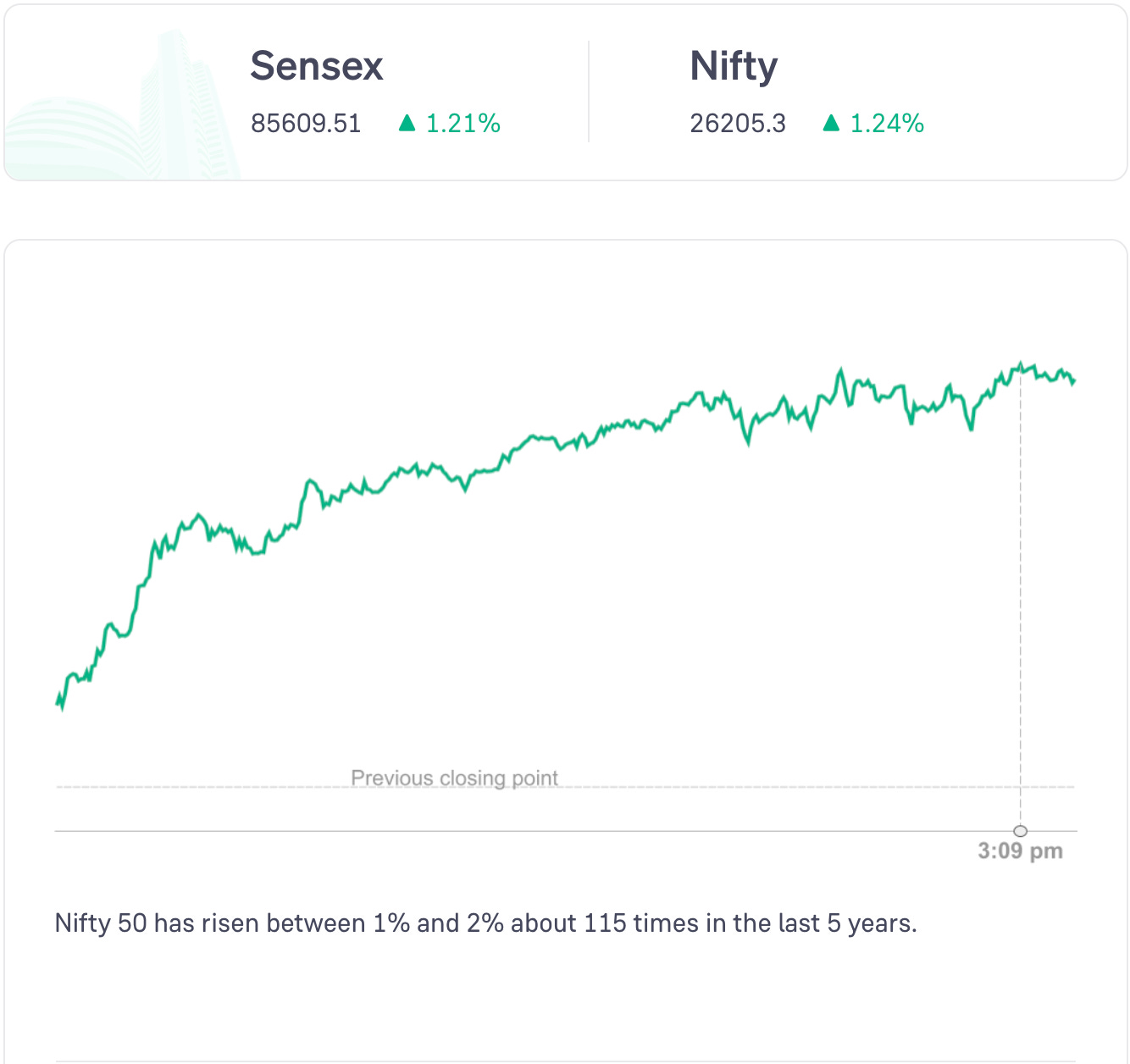
Markets opened above yesterday’s closing point.
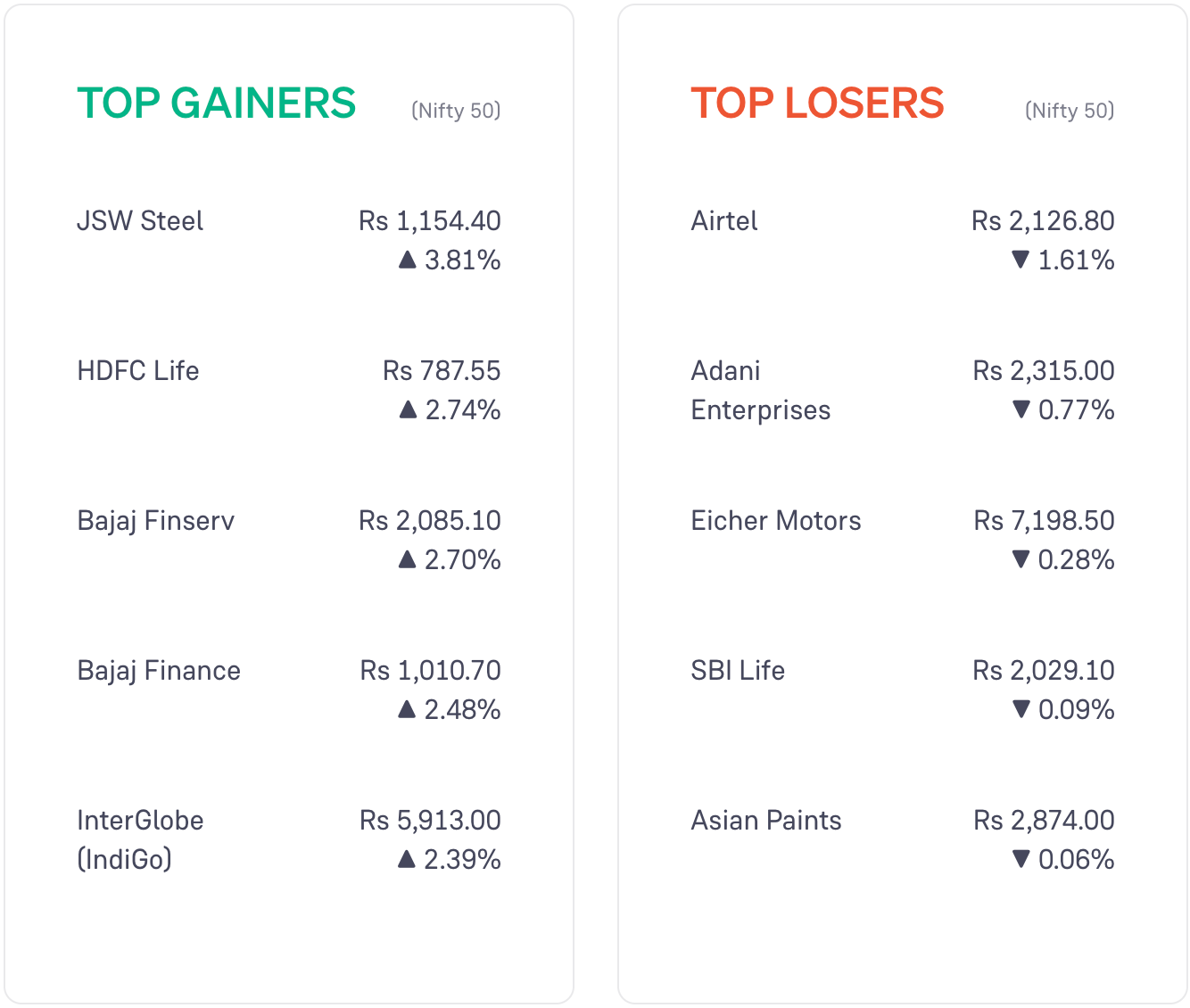
All sectors’ stocks rose today. Metal stocks and consumer durables stocks rose the most.
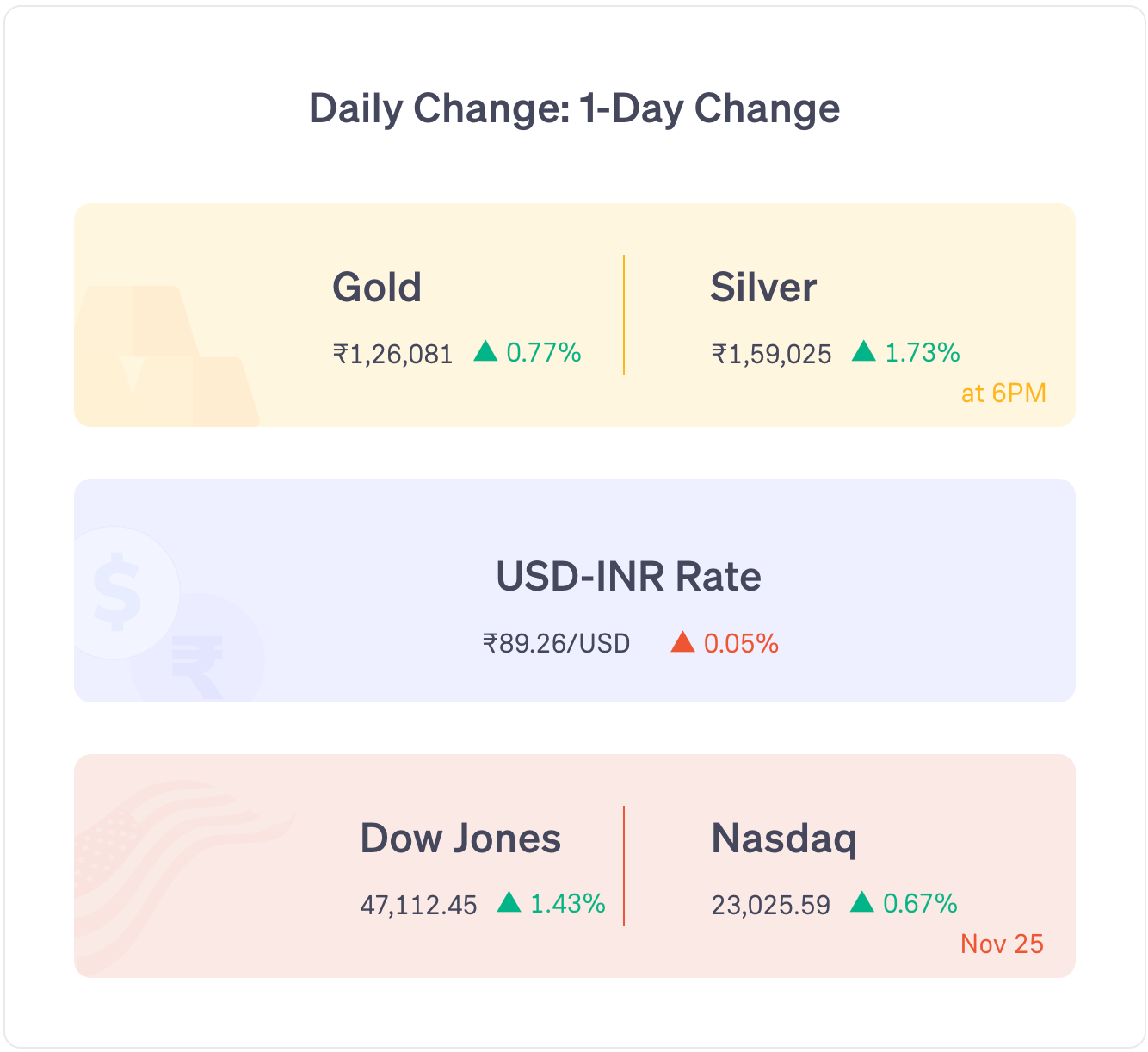
Global markets: US markets and most Asian markets rose. Most European markets rose (as of 6 pm IST).
News
The central government approved a Rs 7,280 crore scheme to promote domestic manufacturing of sintered Rare Earth Permanent Magnets (REPM) in India.
The central government approved 2 multitracking railway projects: Devbhumi Dwarka (Okha) to Kanalus (Gujarat) and Badlapur to Karjat (Maharashtra) with an estimated cost of Rs 2,781 crore.
SEBI proposed simplifying the process for issuing duplicate share certificates by raising the simplified‑documentation threshold from Rs 5 lakh to Rs 10 lakh and cutting down paperwork.
The Asian Development Bank approved a $400 million results-based lending programme to improve road infrastructure in Maharashtra.
Excelsoft Technologies IPO listed on the stock exchanges at a premium of 12.50% over the issue price and closed 4.97% up at the end of the day.
Stocks Updates
Airtel: company’s promoter group firm, Indian Continent Investment, sold a 0.56% stake worth Rs 7,200 crore to long-term investors.
Union Bank of India: confirmed it has timely paid Rs 71.8 crore annual interest on its Rs 1,000 crore bond on 26 Nov. It was also fined Rs 8.43 lakh by the RBI for deficiencies in soiled-note remittances and ATM cash-out issues.
Asian Paints: a step-down subsidiary will invest AED 140 million (around Rs 340 crore) to set up a second paint plant in Abu Dhabi’s KEZAD.
Havells India: will invest Rs 5.63 crore to acquire a 26% stake in Kundan Solar (Pali) Pvt Ltd to secure solar power and cut energy costs.
Info Edge: will invest Rs 5 crore in Smartweb and Rs 70 crore in Startup Investments, both wholly-owned subsidiaries, to support their funding and investment activities.
Axis Bank: allotted Rs 5,000 crore worth non-convertible debentures at 7.27% interest rate and a 10-year tenure on a private placement basis.
Word of the Day
Disposable Income
It is the money that is left after paying taxes
When a person earns income, a portion of it goes toward taxes or other mandatory payments.
Whatever remains after these payments is called disposable income.
This money can be used for daily expenses, savings, or personal lifestyle choices.
A higher disposable income allows the person to have more financial freedom.
6 Day Course
Theme: company designations
Day 3: Wednesday
Now lets talk about the directors.
Every listed company must have a board. The board consists of directors.
One of the board’s primary functions is to look after the shareholders’ interests (not just promoters’).
It appoints the senior management of a company including the CEO.
Large listed companies (top 2,000 biggest) must have 6 directors or more.
One-third of the directors must be independent directors (directors who are not executives in the company).
The board is responsible for deciding the general direction the company takes, appointing and keeping a check on senior executives, protecting shareholder rights, and legal compliance.
Featured Question
“Few days back I read an article that many countries are having loan above 100% of their GDP. Many others have nearly 70-80% of their GDP. If almost all the countries have loans. Who provide the loans as the institutions like IMF and World Bank are funded by these big countries.”
Countries’ governments get money in two main ways.
Taxes and loans.
When the government needs money to spend on infrastructure, defence, education, etc, it tries to raise that money from taxes.
But when a large spending requirement comes up suddenly, the government cannot just raise taxes.
This is why besides tax, they also take loans.
These loans can be from other countries, banks, and even their own citizens!
How does that happen?
The government offers bonds for investment. These bonds pay principal + interest.
This is basically a loan the government takes.
Most large countries keep taking loans and paying them back. It’s a continuous process.
When the loans/debt is too high, it gets risky. But some level of debt is considered healthy.
India’s debt is considered to be in the healthy zone.
Japan and the USA are in the uncomfortable zone.
Did you like this edition?
Leave a feedback here!