

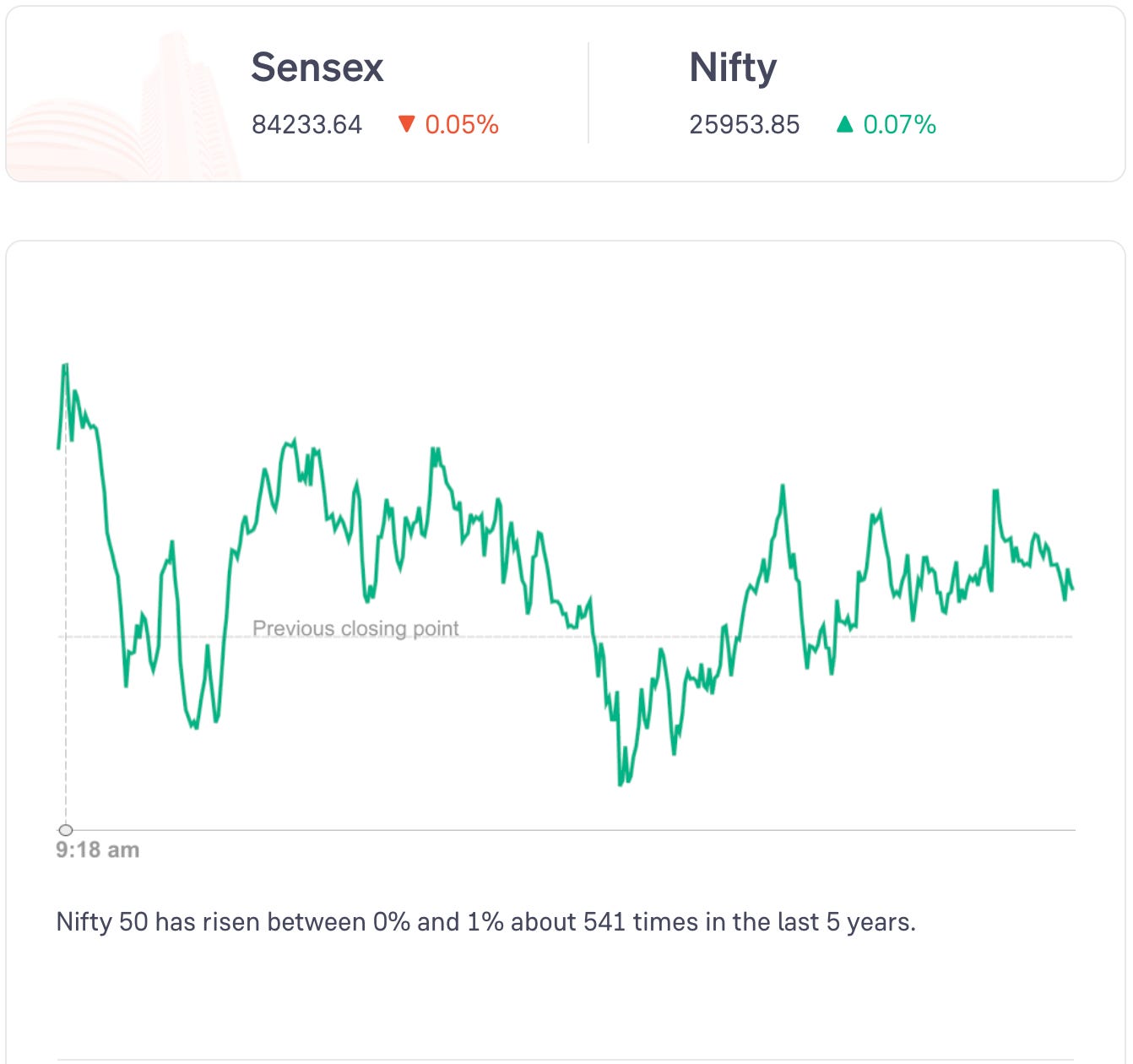
Markets opened above yesterday’s closing point.
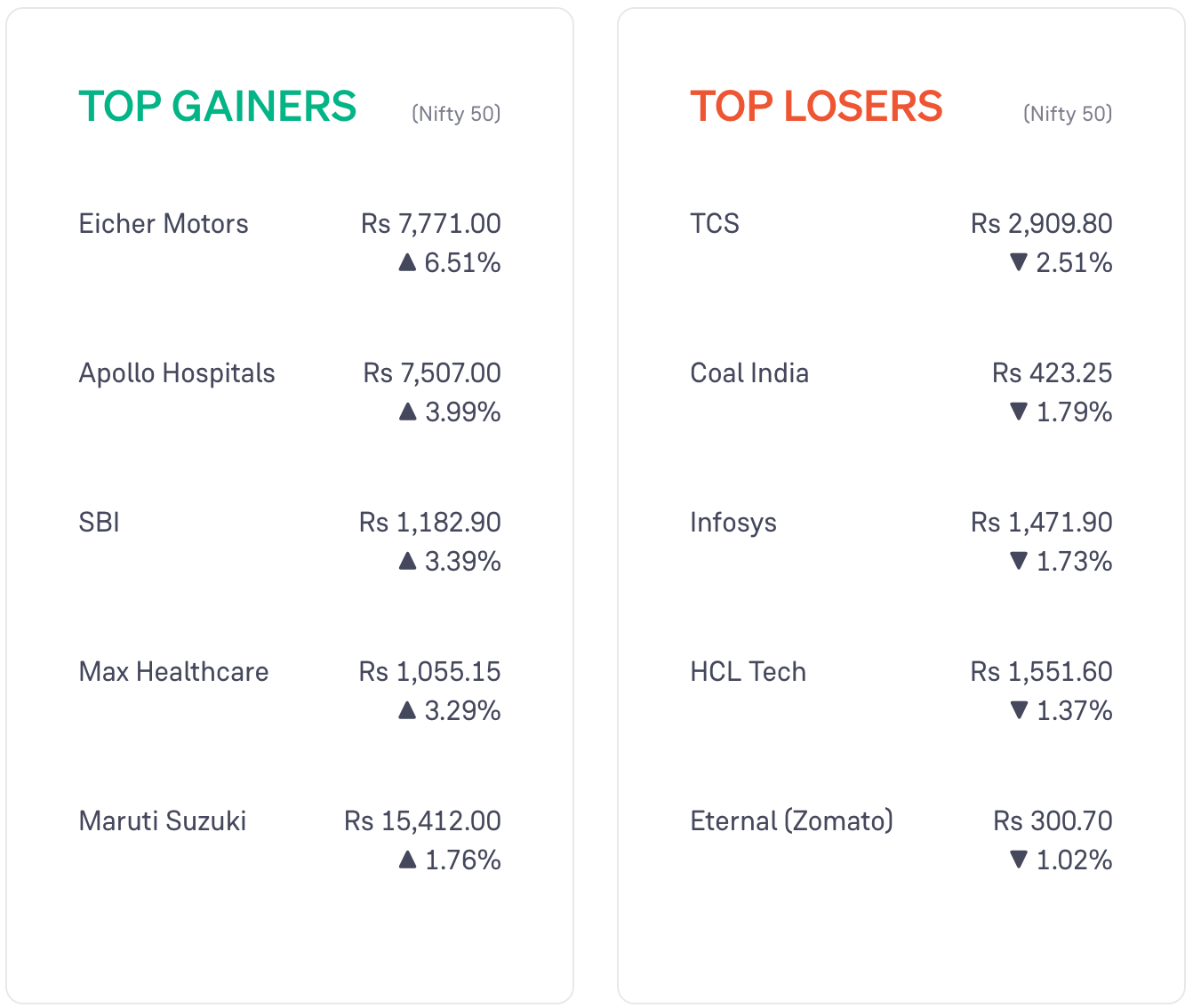
Healthcare stocks and auto stocks rose the most today. IT stocks and private bank stocks fell the most.
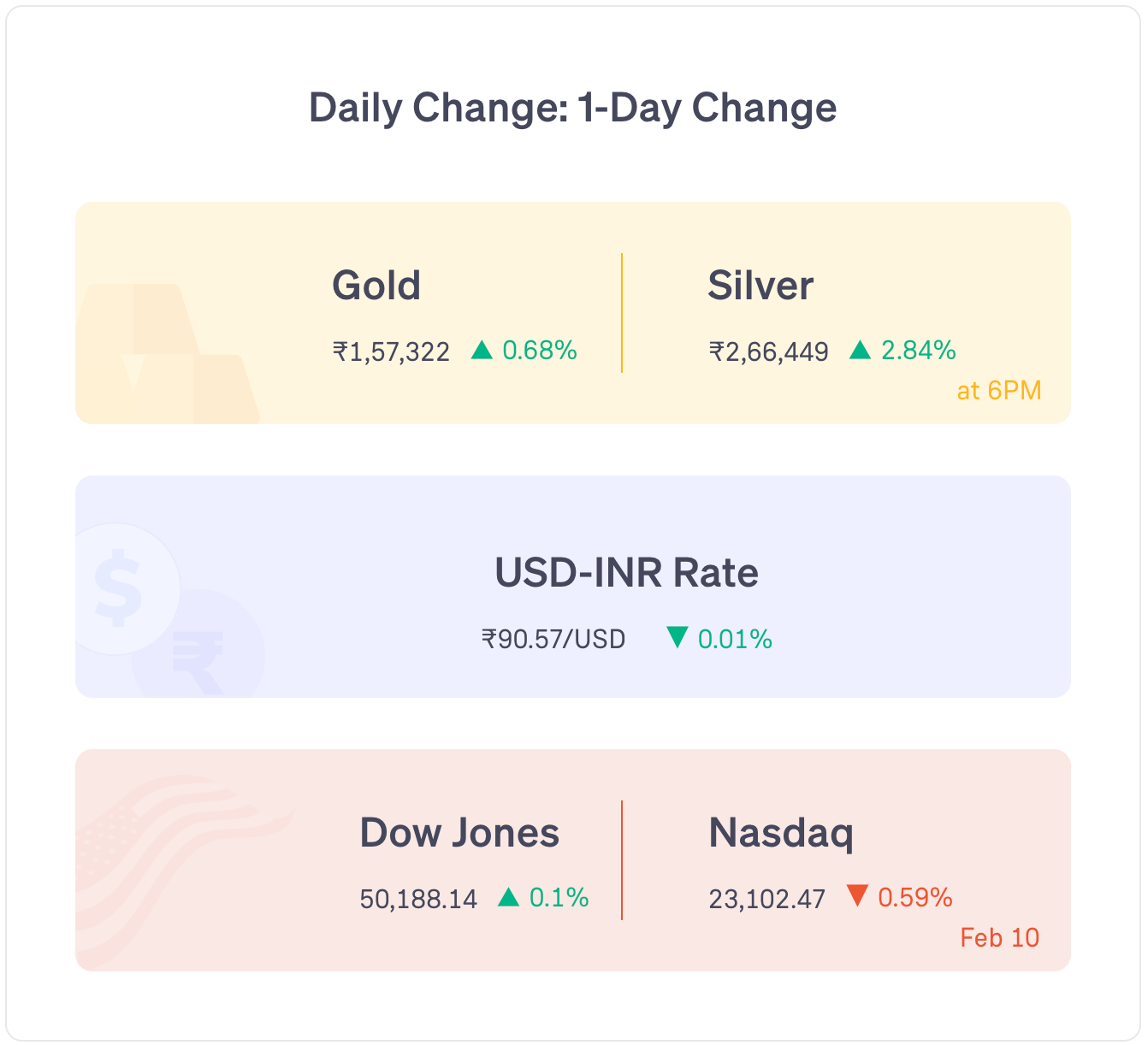
Global markets: Most US markets fell. Most Asian markets rose. European markets showed a mixed trend (as of 6 pm IST).
News
The US revised the trade factsheet of the India-US deal by removing the mention of pulses from the tariff discussions and changed a $500 billion purchase ‘commitment’ by India to an ‘intent’.
China’s annual inflation stood at 0.2% in Jan (vs 0.8% in Dec).
Fractal Analytics IPO was subscribed 2.66 times. Retail subscription: 1.03 times. IPO is closed for subscription.
Aye Finance IPO was subscribed 0.97 times. Retail subscription: 0.77 times. IPO is closed for subscription.
Stocks Updates
BHEL: the Government of India will sell a 5% stake in the company via offer for sale.
M&M: net profit rose 47% year-on-year to Rs 4,675 crore in the Oct-Dec quarter.
Adani Enterprises: a company subsidiary completed acquisition of a 51% stake in DPJ TOT Toll Roads for up to Rs 1,342 crore to expand its road infrastructure portfolio.
Cholamandalam Investment: issued Rs 1,040 crore worth of non-convertible debentures via private placement at a 8.40% interest rate with a 1 year 7 months tenure.
Divi’s Labs: net profit fell 1% year-on-year to Rs 583 crore in the Oct-Dec quarter.
Ashok Leyland: net profit rose 7% year-on-year to Rs 813 crore in the Oct-Dec quarter. The stock exchanges have asked for clarification on reports of a $200 million fundraising for its electric mobility unit.
Lenskart: net profit rose to Rs 131 crore in the Oct-Dec quarter (vs Rs 1.85 crore last year). The quarterly rise in profit was 28%.
Word of the Day
Offer-for-sale (OFS)
It is a method where existing shareholders (promotors or large investors) sell their shares to the public
The company does not receive the money, the selling shareholders do. No new capital for the company is created in an OFS.
The shares are usually sold at a price lower than the market price.
This is done when promoters need to reduce their stake or meet shareholding norms.
6 Day Course
Theme: how ETFs work
Day 3: Wednesday
Authorised Participants (AP) are responsible for the creation and redemption of ETF units.
APs have a special contract with the ETF AMC to perform this job.
Big banks, broker dealers, institutional trading firms, etc usually perform this duty.
Since ETFs are traded on the exchange, the price of 1 unit of the ETF can rise simply because of the increase in the demand for that ETF.
So in such a case, they’d create new units by buying the underlying asset.
Similarly, when the ETF price falls too much, they would buy units and get back shares/underlying assets. This would then be sold at market price.
This way, the price of the ETF matches the price of the underlying asset.
This crucial role is done by the AP.
Do note, the APs act for their profit opportunity. So they create units and buy units when there is an arbitrage opportunity.
Featured Question
Q. “When a company buy back shares, what does it mean? Company is making good profit or something else?”
When a company buys back shares, it is buying its own shares from the public.
Companies issue shares to raise money. In an IPO, for example, they sell new shares to investors.
When they buy back shares, they reduce the total number of shares in the market.
Many people see this as a positive sign. It can mean the company believes its shares are undervalued. It can also mean the company has extra cash.
However, a buyback does not always mean the company is doing very well.
Sometimes companies buy back shares to give out a positive message, but the reality might be different.
So a buyback alone is not enough to judge a company. You should always check its profits, cash flow, and debt levels to understand the full picture.
Did you like this edition?
Leave a feedback here!