
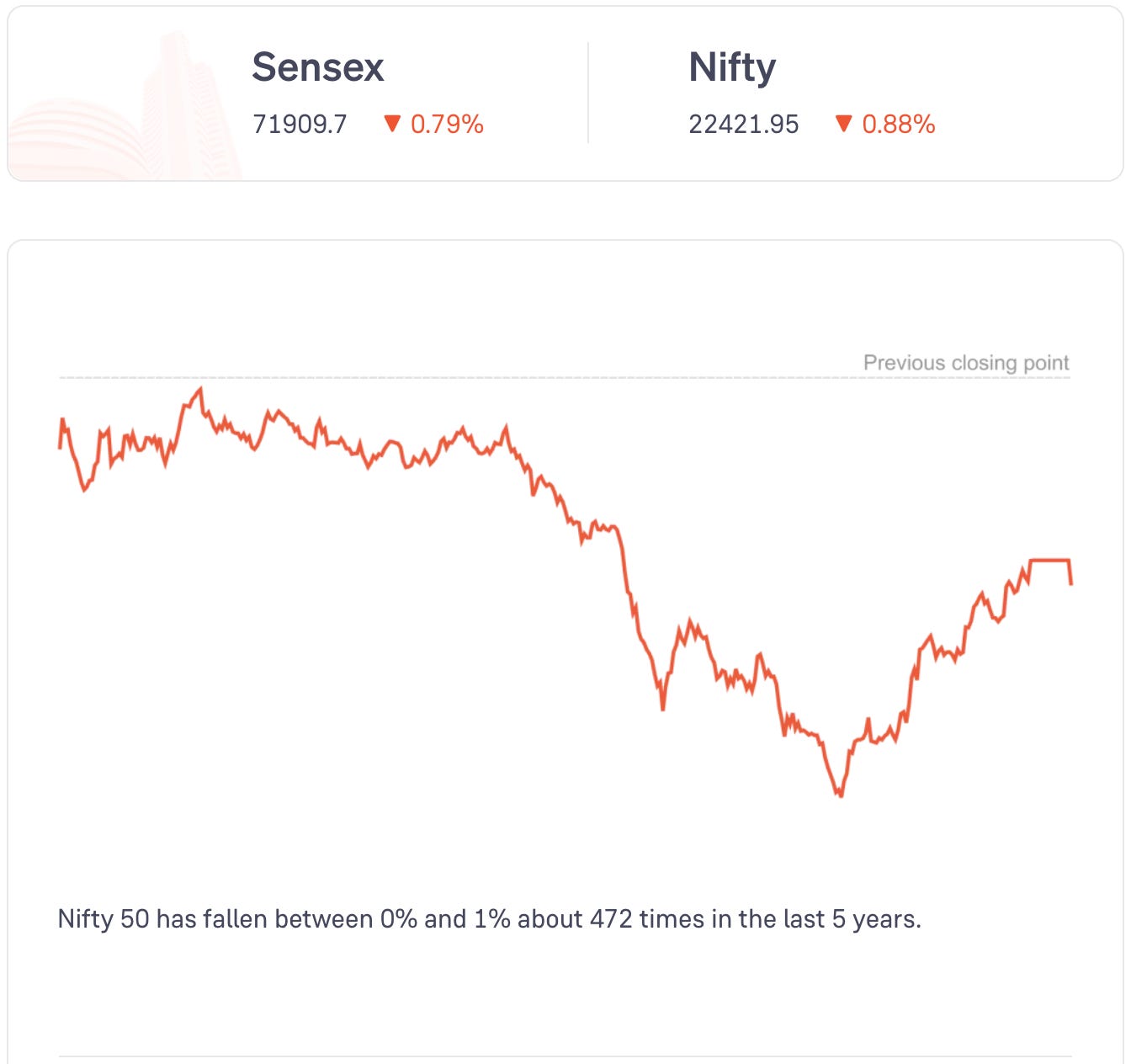
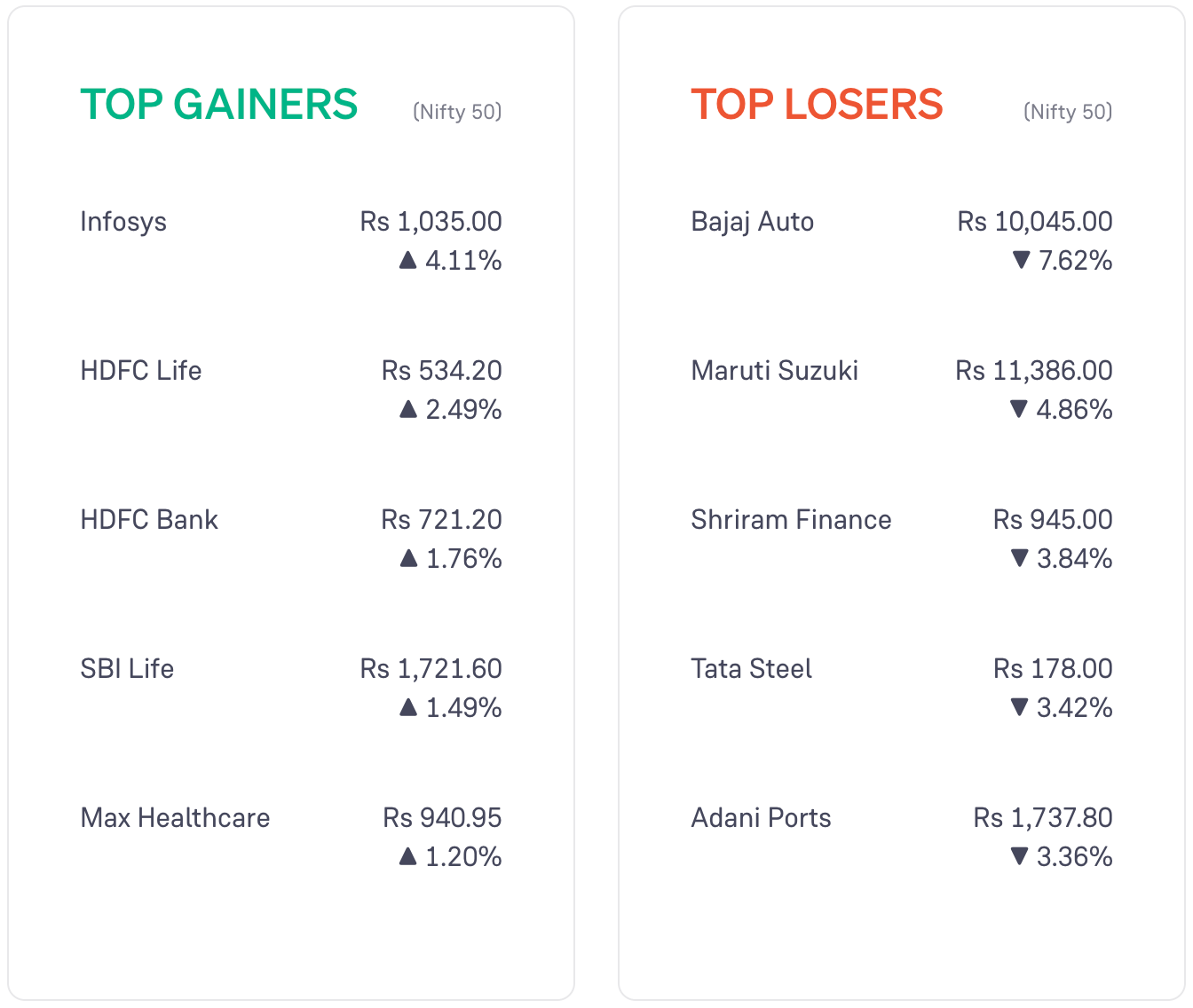
Markets ended lower compared to yesterday’s closing point.
Foreign investors sold shares worth over Rs 20,000 crore in the last two days as US benchmark bond yields rose to 5.34% (highest since 2002). This could have led to the fall.
All sectors’ stocks fell today except for IT stocks and private bank stocks. Auto stocks and metal stocks fell the most today.
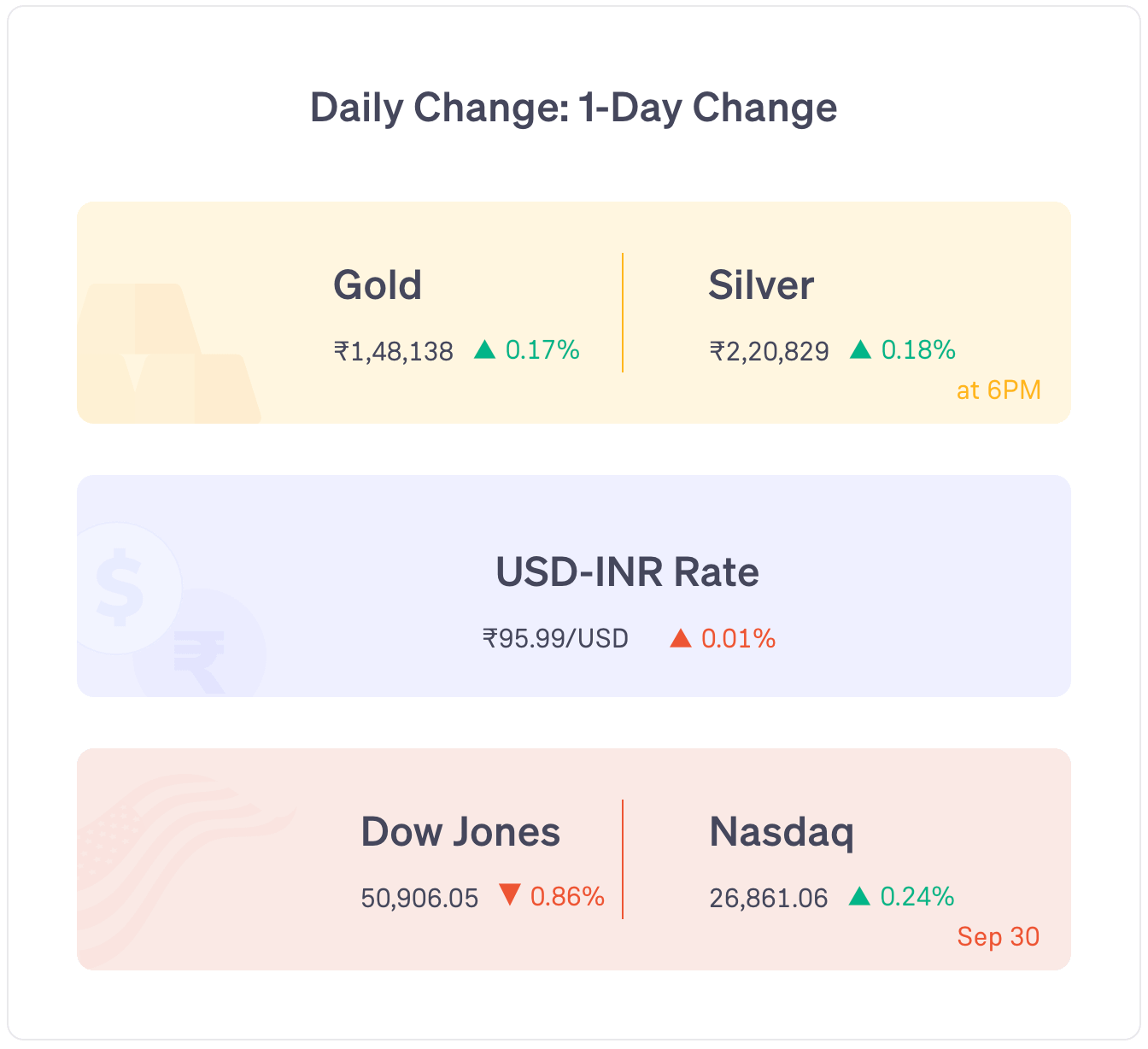
Global markets: US markets traded mixed on Wednesday. Most Asian markets rose on Thursday. Most European markets fell (as of 6 pm IST).
News
India’s gross GST collection rose 14.7% year-on-year to Rs 2.04 lakh crore in September.
The government cut sugar stockholding period to 15 days from 30 days and fixed the stock holding limit to 1,000 quintals with effect from 15 Oct to 30 Nov 2026, ahead of the festive season to prevent speculative trading.
Inox Clean Energy filed a DRHP for an IPO that will comprise a fresh issue of Rs 8,000 crore and an offer for sale of Rs 2,000 crore.
The government reduced windfall taxes on diesel to Rs 16 per litre (vs 20 earlier), and ATF to Rs 10.5 per litre (vs 15 earlier).
Carlsberg India, TMC Transformer (India) Ltd and 2 other companies received SEBI approval for IPO.
Moneyview listed at Rs 55 on NSE, a premium of 61.76% above its issue price and closed 57% higher.
Stock Updates
Reliance: raised about Rs 13,009 crore through 10-year unsecured NCDs at a 7.90% interest rate. The bonds will mature in October 2036.
ICICI Bank: received a Rs 229.14 crore GST show-cause notice, excluding potential interest and penalty.
Adani Ports: inaugurated the $750 million Phase II expansion of Colombo West International Terminal in Sri Lanka, doubling its container-handling capacity.
Kotak Mahindra: RBI approved Anup Kumar Saha as MD & CEO for three years from January 2027, subject to board and shareholder approval.
Adani Green: added 481.9 MW of solar and wind capacity and 3,081 MWh of battery storage in Gujarat. Its total battery-storage capacity has increased to 6,632 MWh.
Lupin: its Philippine business Multicare Pharmaceuticals bought back the remaining shares held by other investors, making it fully owned by Lupin’s subsidiary Nanomi.
Samvardhana Motherson: raised Rs 200 crore through 83-day commercial paper at 6.25% interest.
Wipro: completed its previously announced acquisition of select customer contracts from Alpha Net Consulting and its subsidiaries.
Varun Beverages: subsidiary Bevco’s Rs 13.15 crore acquisition of South Africa-based Crickley Dairy has been cancelled after a required condition was not met by the deadline.
Aurobindo Pharma: subsidiary Apitoria’s stake in A1 Biochem Labs will reduce from 100% to 80% after A1 Biochem’s promoter invested Rs 33.80 crore for a 20% stake.
Word of the Day
Standing Order
It is a transaction type where a bank account holder automates a payment.
Example: you can make a standing order in your bank account to transfer Rs 10,000 to your mother’s account on the 3rd day of every month.
It is useful wherever a recurring payment occurs and the payment amount is fixed.
Standing orders are set up by the account holder and are entirely in their control. It can be cancelled any time by the account holder.
This is opposed to a direct debit where you instruct your bank to pay a certain person/company/organisation automatically if they ask for it.
An example of this is some people automate electricity and phone bills.
Whenever a new bill is generated, the company requests the bank account for the money and the money gets automatically paid.
6 Day Course
Theme: US Fed rate changes
Day 4: Thursday
Now, let’s talk of the various assets involved and how to move into or away from them.
Let’s take a case where the US Fed interest rates have been increased.
US govt bonds: more money flows to them since they carry least-risk and higher than before returns.
High quality corporate US bonds: money usually flows since even their interest rates go up due to the US Fed rates.
Low quality junk bonds: money flows out of them since their risk is high.
Stocks of large stable US companies: small amounts of money may flow out into bonds.
Riskier stocks like tech and growth stocks: more money tends to flow out of these stocks.
Emerging market stocks (like India): money tends to flow out of these stocks.
Gold and silver: it depends but often, money flows out a bit.
Real estate: since higher interest rates mean less home loans will be taken, interest rates increasing is not good news for real estate. Money tends to flow out of real estate.
Riskier investments (venture capital, start ups): money tends to flow out of these sectors.
In short, whenever US Fed rates go up, money moves away from riskier investments into safer investments.
The opposite happens when US Fed rates are reduced.
Featured Question
Q. “Which are the other exchanges dealin in stocks in India otherthan BSE & NSE”
BSE and NSE are the main active stock exchanges in India.
There used to be many other exchanges also. Calcutta Stock Exchange, Madras Stock Exchange, Ahmedabad Stock Exchange, Delhi Stock Exchange, etc. But they are all inactive now.
There are other exchanges as well but most of them deal in other products (not stocks) like commodities. But there, stock trading is not available to them.
————
The information presented in this post has been compiled and prepared by Groww Invest Tech Pvt Ltd and is intended solely for informational purposes. It is not tailored to any specific investment objectives, financial situations, or needs of any individual investor. The content should not be construed as investment, financial, legal, or tax advice and should not be relied upon as a substitute for professional consultation.
Investing in securities markets involves inherent risks. Investors are advised to carefully review all relevant documents and consider their own risk tolerance before making any investment decisions.
Mutual fund investments are subject to market risks; please read all scheme-related documents carefully. Past performance of financial instruments, schemes, or markets is not indicative of future results.
Groww Invest Tech Pvt Ltd is registered with the Securities and Exchange Board of India (SEBI) under Registration No: INZ000301838, as a Research Analyst under No: INH200008662, as a Depository Participant under No: IN-DP-417-2019, and with the Association of Mutual Funds in India (AMFI) under ARN-111686.
SEBI registration details: View registered name and registration numbers
Research Analyst Disclaimer: View Research Analyst disclaimer
Did you like this edition?
Leave a feedback here!