

In the world of logistics, there are some shipments that simply cannot afford to be late.
Take a batch of life-saving vaccines, for example.
They must stay within a strict, frozen temperature range throughout the journey. Even a small deviation, even for a short window, can render the entire batch useless.
And vaccines are just one part of it.
Pharmaceutical deliveries are incredibly delicate; they carry blood samples, plasma, insulin or important medical supplies that might make the difference between life and death for someone waiting in a hospital hundreds of kilometers away.
Because of this, it is not enough for such goods to be handled carefully. They must also move within defined and predictable time windows.
In cases like these, logistics become a critical function.
Because when the stakes are high, the system handling the delivery matters just as much as the product itself.
Which is where air express logistics comes in.
Air express logistics means moving time-sensitive shipments using air transport, typically with guaranteed delivery timelines.
Unlike standard cargo, which prioritises cost and volume, air express is built around speed and reliability.
Within India, this segment is handled by a mix of airline operators and specialised logistics companies.
But one company continues to remain central to how this ecosystem functions.
Blue Dart.
According to industry sources, Blue Dart is among the leading players in India’s air express segment, with an estimated share of over 45% in the organised air express market.
Building India’s Early Logistics Network
Blue Dart began as a courier company in India in 1983, at a time when the country’s logistics infrastructure was still in its early stages of development.
A major early turning point came in 1984, when the company became the exclusive Indian partner for FedEx’s international shipments.
This partnership exposed Blue Dart to global standards of logistics execution around tracking systems, time-definite delivery, and operational discipline.
The partnership continued until 2002 when FedEx began expanding its own independent operations in India.
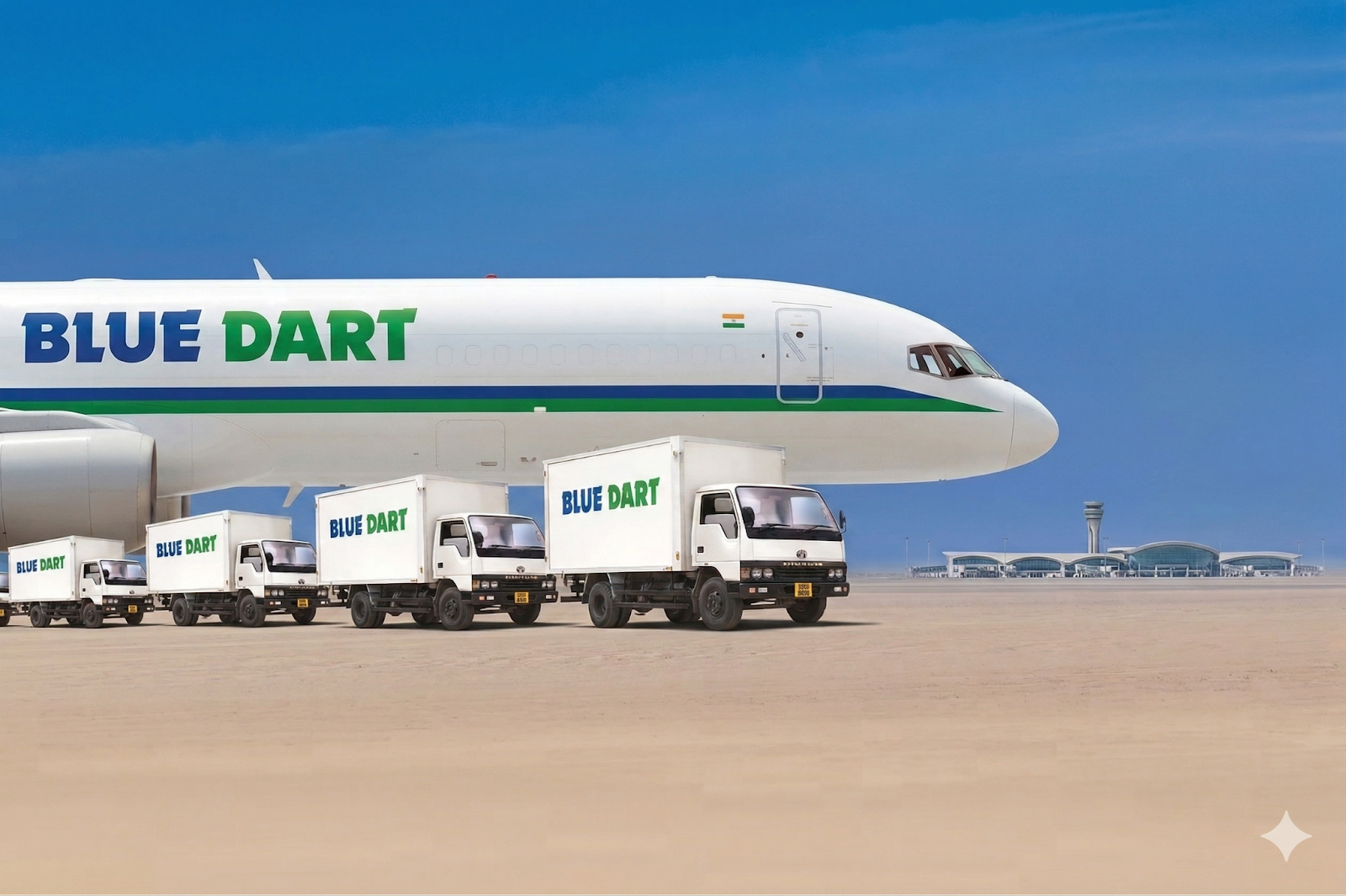
By 1994, Blue Dart realized that relying on passenger planes was a bottleneck. They took a massive structural step by setting up Blue Dart Aviation, officially taking to the skies with their own 2 dedicated cargo jets in 1996.
In 2005, DHL acquired a majority stake in the company, integrating Blue Dart into a global logistics network while it continued to operate independently in the domestic express segment.
Which raises a simple question.
In a business where speed and reliability are expected, reliability is essential, and competition is increasing, what exactly protects Blue Dart’s position?
Infrastructure and Integrated System
The company’s physical infrastructure is a key reason that sets it apart from its competitors.
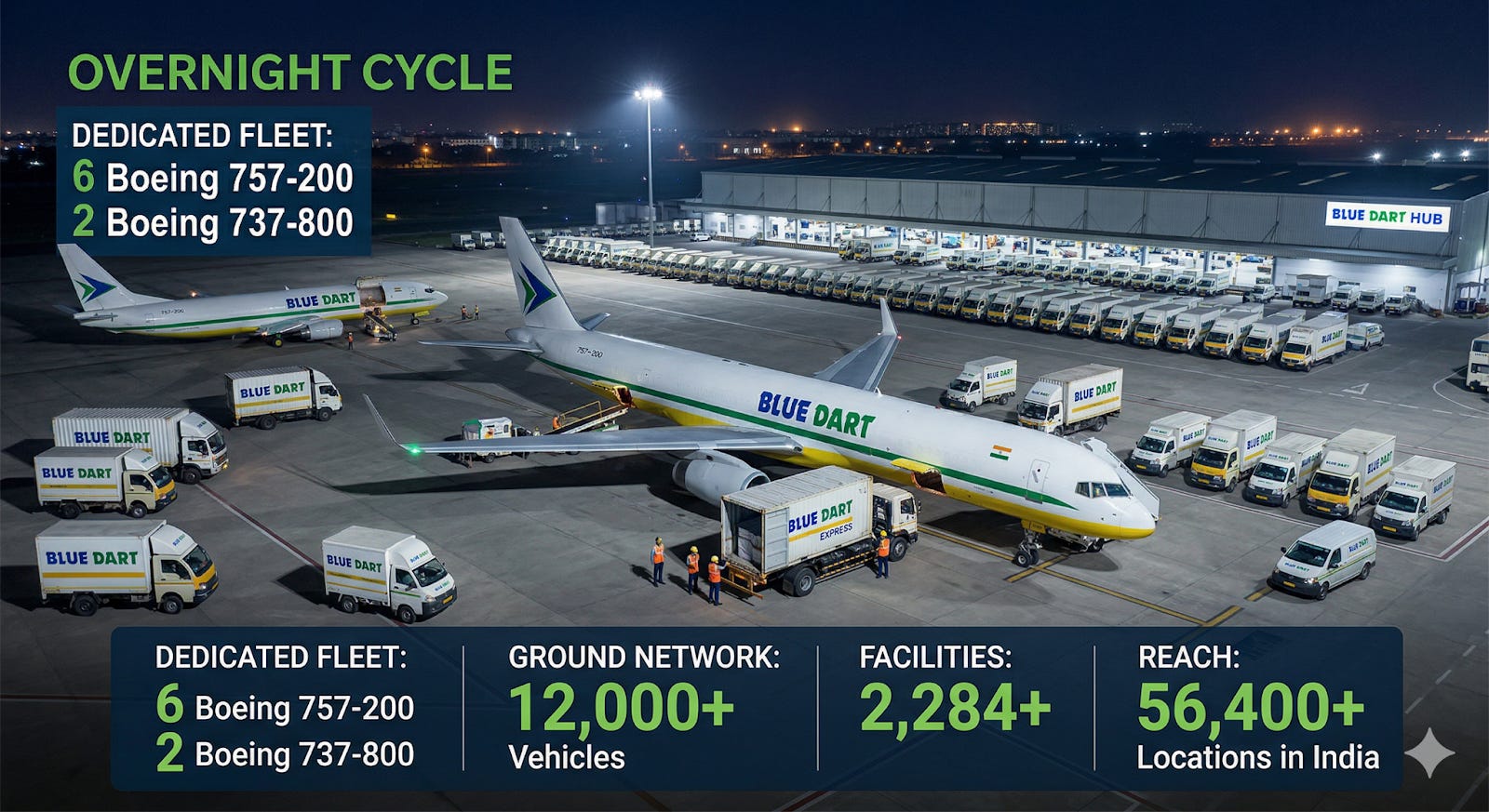
As of 2026, the company operates its own dedicated fleet of aircraft with 6 Boeing 757-200 and 2 Boeing 737 freighter aircraft.
Along with that, it also has an on ground distribution system of more than 12,000 vehicles, 2,284 facilities, and coverage across more than 56,400 locations in India.
On the surface, India’s air cargo ecosystem looks crowded. Major airlines such as IndiGo, Air India Group, SpiceJet (through SpiceXpress), and Amazon Air (through Quikjet) all participate in air freight movement.
But the way they operate is fundamentally different.
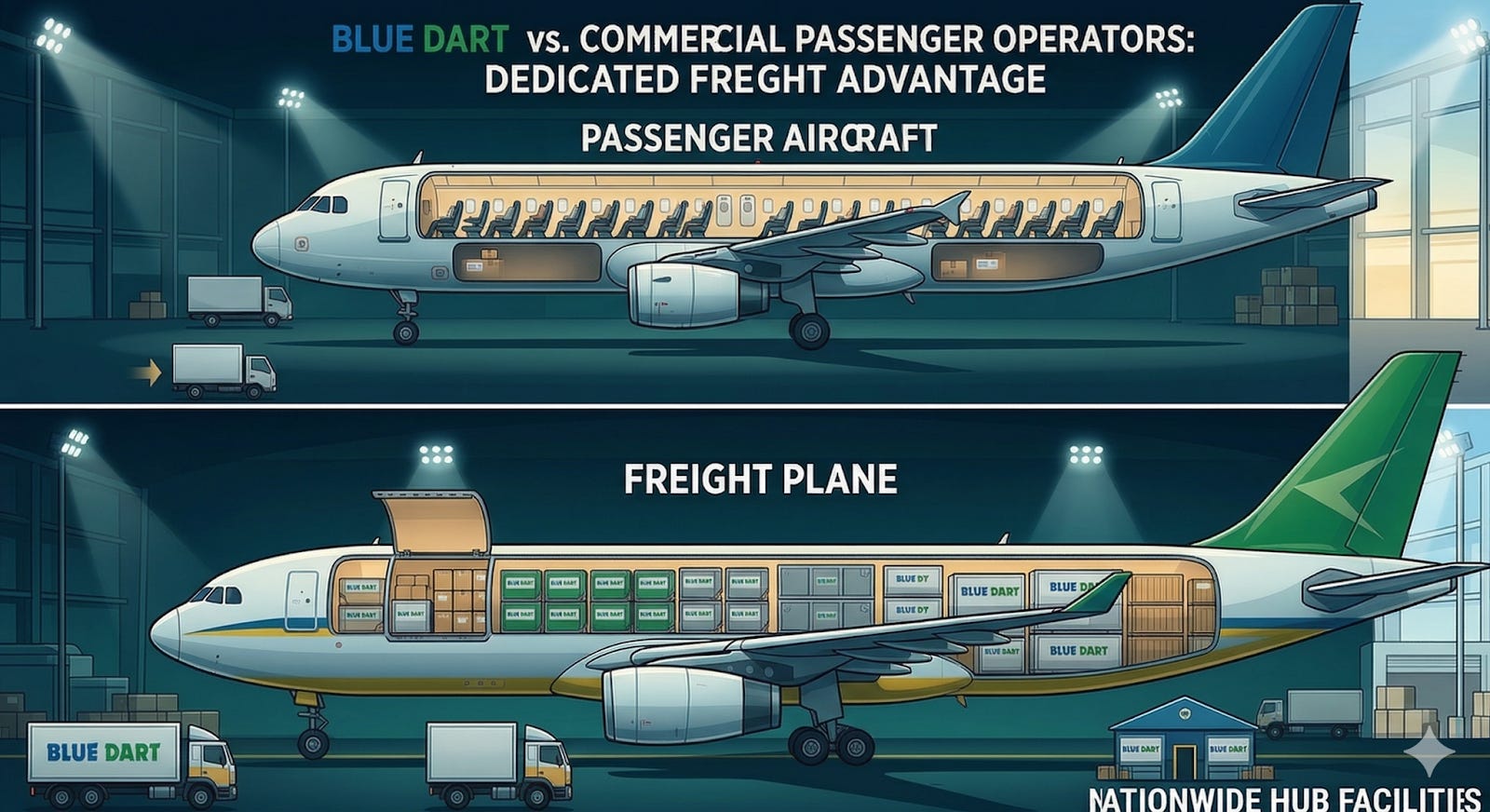
These airlines carry most of the cargo in the belly space of passenger aircraft. Here, flight schedules are dictated by passenger demand rather than cargo needs. This makes the cargo movement dependent on passenger routes and timings, essentially limiting flexibility for time-sensitive shipments.
Airlines like IndiGo and SpiceJet do have their own dedicated airplanes for cargo transport. They are used by logistics players like Delhivery who depend on third-party airline partners for air transport.
This is where Blue Dart’s model stands apart.
It is not just about the fleet of aircraft.
Blue Dart’s model is integrated. They have vehicles for road transport. Their fleet is scheduled specifically for cargo movement. Because these pieces are part of the same system, operations can be planned end-to-end rather than in fragments.
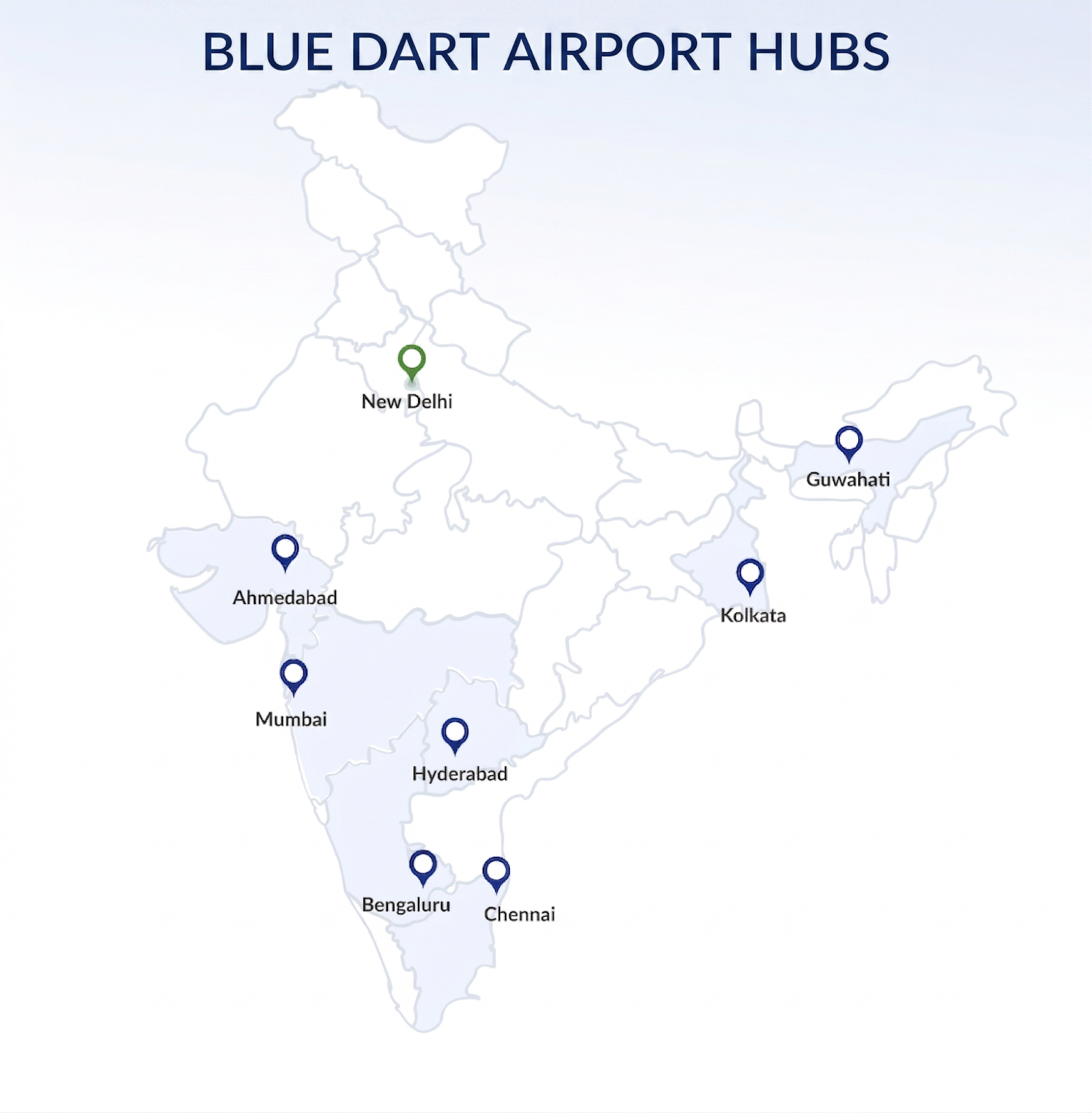
Even the warehouses across its seven airport hubs are equipped with X-ray screening systems, which allows freight to be processed immediately without additional security cooling delays.
This intricate integrated system allows operations to be planned around delivery timelines, especially overnight shipments that need next-morning delivery.
So while competitors may handle higher parcel volumes, Blue Dart can operate at a higher yield per shipment, driven by its focus on time-critical and premium air express cargo rather than low-cost, large-scale ground parcels.
The Regulatory Barriers in Air Cargo
Setting up an airline in India, be it a cargo or passenger, involves climbing over many regulatory barriers.
Even Blue Dart took nearly two years before its aircraft began operations.
Beyond regulation, a bigger constraint is airport capacity, especially take-off and landing slots at major airports.
Globally, congested airports follow a system called grandfathering, where airlines retain allocated slots as long as they are used for at least 80% of the season.
This gradually locks in early entrants and makes it difficult for new players to access prime time windows.
Blue Dart, having established its aviation operations early, secured access to key late-night slots. Today, most of these slots are effectively unavailable to new entrants.
This is important because air express logistics depend on a fixed overnight cycle. Pickups at the end of the business day, late-night flights, and early morning sorting for next-day delivery. Without access to these windows, replicating a reliable overnight network becomes difficult, even with aircraft in place.
For a new cargo airline, competing with Blue Dart, building a comparable overnight network without access to these windows becomes extremely difficult.
When Switching Becomes Operationally Expensive
A large part of Blue Dart’s business comes from the B2B segment, which contributes around 70% of its revenue.
This includes industries such as pharmaceuticals, banking, automotive, and consumer electronics, where delivery timelines are closely linked to business operations.
In this segment, Blue Dart is not just used as a courier service. It is often integrated into how companies move goods internally.
The company connects its systems with client software such as ERP platforms and warehouse management systems. This allows shipments to be created, tracked, and managed automatically within the client’s own workflow.
Once this integration is in place, logistics stops being a manual process.
Switching to another provider is no longer just a pricing decision. It involves reworking API integrations, changing workflows, and managing the risk of operational disruption during transition.
Because of this, even small differences in price are often not enough to justify switching.
Over time, this creates a form of technological switching cost, where the relationship is held not just by service quality, but by system-level integration.
Trust as a Moat
Some shipments cannot be evaluated on price efficiency or delivery speed alone. They are evaluated on a far more basic question. Can this system be trusted to not fail?
Over time, Blue Dart has moved into exactly this category of logistics.
We’ve already seen the nature of such shipments. Pharmaceutical samples that must stay within strict temperature conditions, banking instruments that cannot be misplaced, and other high-sensitivity flows where even minor failure is unacceptable.
And this is where things get more interesting.
In such systems, carrier selection is often not purely market-driven. It is shaped through long-term vendor approvals, compliance checks, and audits built over years of performance.
One example appears in a 2024 and 2021 public tender document of Bharatiya Reserve Bank Note Mudran Pvt. Ltd. (BRBNMPL), a subsidiary of the RBI responsible for the printing of currency.
Blue Dart is listed as the ‘Air Cargo Carrier on Charter Service’ for currency movement.
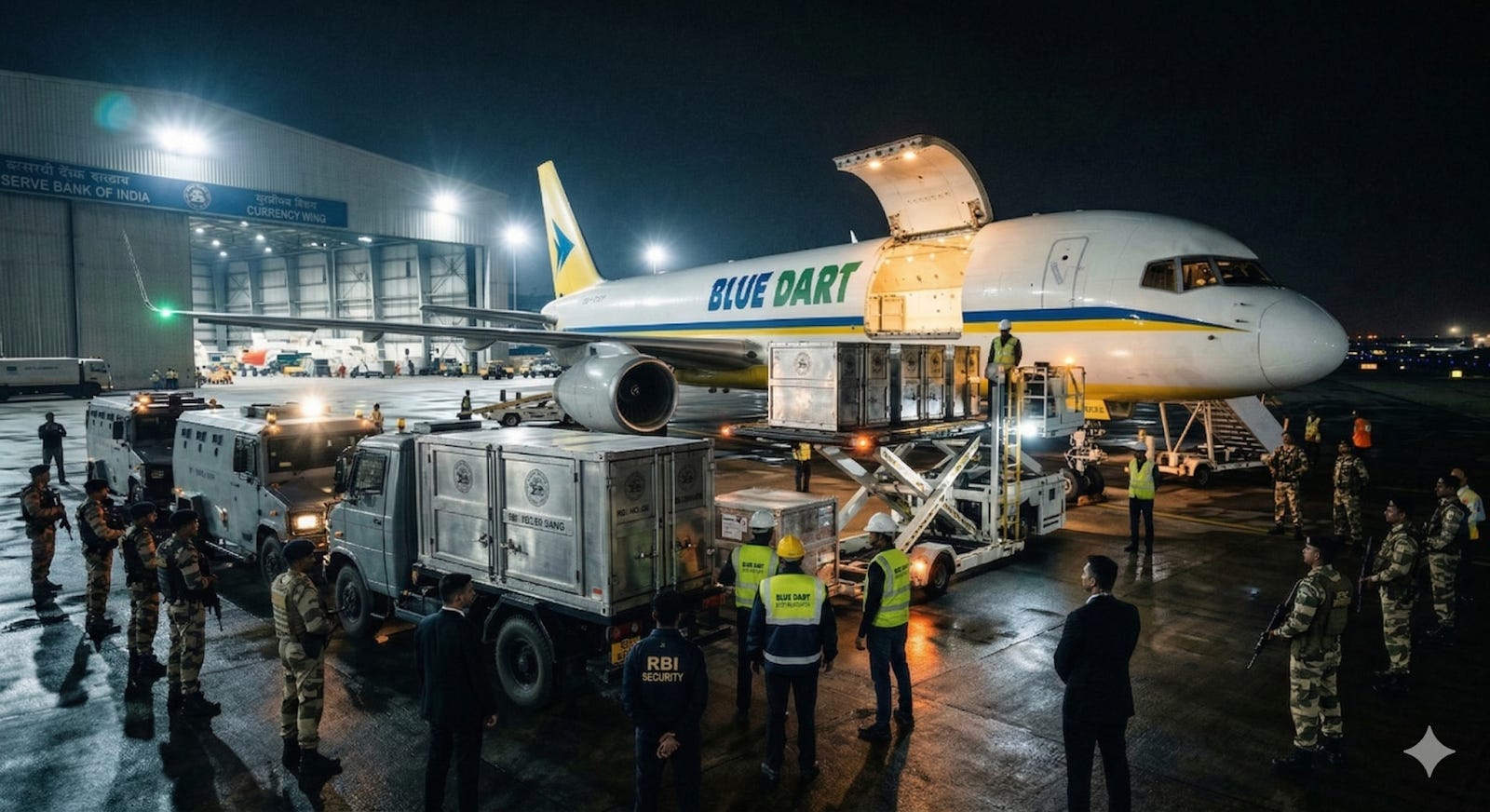
Think about what that actually implies. This is not a normal parcel flow.
This is freshly printed cash moving across the country where delay, misplacement, or error is not an inconvenience, but a massive systemic risk.
And in systems like these, once a provider is embedded, the relationship is no longer just commercial. It becomes institutional.
And an institutional trust becomes one of the hardest moats to break.
Because competitors cannot just offer a better price. They need to compete with something that already works.
This positioning was also visible during the Covid-19 pandemic. Blue Dart provided its services transporting medical supplies along with the Air Force and other private airlines for the government’s Lifeline Udaan Initiative.
This included airlifting oxygen, distributing vaccines, and in some cases even enabling last-mile delivery of medical supplies through drones.
Blue Dart’s moat is further supported by its 75% parent, the DHL Group, which gives it access to global logistics networks and cross-border capabilities.
With the government removing the Rs 10 lakh export cap on courier shipments in 2026, the company is also better positioned in handling higher-value export flows from India.
At the same time, competitive pressure remains visible. Amazon is building its own air cargo system through Quikjet. The aim is to reduce dependence on external partners like Blue Dart and slowly internalising high-value e-commerce flows.
Blue Dart operates on a premium approach, while players like Delhivery are scaling on a lower-cost, tech-driven model. And when the market is sensitive to price changes this creates pressure on whether customers will continue paying for premium service in all cases.
Fuel costs also remain an external risk that pricing changes can’t fully offset.
Yet despite these pressures, Blue Dart’s position is defined less by competition and more by structure.
Control over night air networks, deep physical infrastructure, and long-standing institutional relationships have created a system where switching is difficult and reliability is assured.
So the next time you roll up your sleeve for a vaccine, remember that there’s a chance it came on a Blue Dart plane.
Whenever I order something online and see it's being handled by Blue Dart, I know it will reach on or before time.. 😅
Yes. They are too good. I can't forget their timely supply of medicines and diagnostic kits during Corona lock-down period.