

Stitching was always a manual process.
Someone had to drive it through different cloth pieces.
Even long after the textile mill was invented, stitching was done by hand.
Until the mid 1800s that is.
Inventors were eager to invent something that could stitch.
As you expect, solutions started becoming available.
But unlike some inventions, stitching did not have a single dominant invention. It was a bunch of scattered inventions.
Elias Howe had invented the needle with the eye in the front instead of the back of the needle.
Allen Wilson had invented the four motion feed. Before this invention, the cloth pieces being stitched together had to be pulled by hand.
Isaac Singer’s contribution to stitching was that he invented the foot-operated machine along with the vertical orientation of the needle.
Grover & Baker came up with the idea of a two-thread sewing machine that made stitches much more durable.
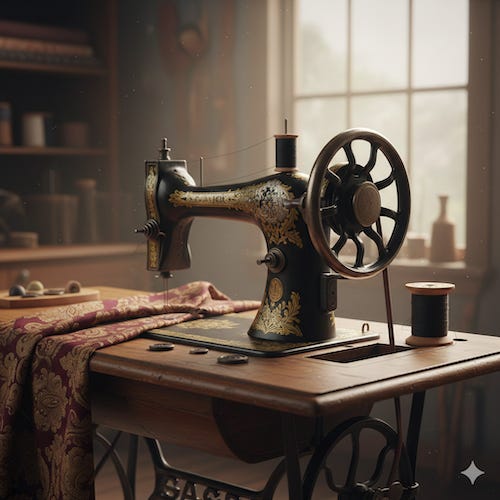
Each of these inventions on their own made a day-and-night difference to the experience of stitching. If you know a little about stitching, you’d recognise that these technologies are still very much in use today.
But together, all of these inventions when placed in one machine, made a world-class sewing machine.
Patent Owners
Together they were so good, that if you were going to make a sewing machine, you had to be using all of these inventions.
Individually, they didn’t make that much of a difference. Together, game changing experience.
You can probably sense a problem here.
What was happening was that each of these inventors and their companies were already making full sewing machines complete with all different inventions.
But the patents belonged to each of the individual inventors. And nobody had taken anybody else’s permission before using the inventions on their own machine.
The result?
They were all suing each other for infringement.
Instead of working on improving their machines and lowering costs, they were busy paying their lawyers and running to the courts.
In 1856, one of the company’s lawyers came up with a novel idea.
He was concerned about the money the company was spending on legal fees and he proposed the companies sign a treaty.
They would merge their patents. So no more suing each other.
The idea was liked, and signatures were made.
As a result, the companies could each manufacture the sewing machines without worrying about being sued. They focussed their energy on lowering costs, distribution, and marketing.
Mind you, only these companies had a free run.
Any other company who was not a part of this treaty that tried to make a full sewing machine had to pay heavy royalties or face legal charges from the treaty signers.
Result
This worked.
Free from fighting each other, the companies focussed on their business. The Sewing machine cost came down from roughly $125 to about $100.
But the quality and reliability of the machines advanced by leaps and bounds.
Sewing machine sales went up roughly 50 times.
Sewing machines became common in households. The sewing machine became an industry by itself. Different kinds of workers manufactured, serviced, and sold sewing machines across the world.
Patents exist for a reason.
They are meant to reward the inventors for their effort. The government allows the inventor a limited amount of monopoly.
Without this controlled and limited monopoly, inventors and innovators would not feel incentivized to develop solutions for years.
But it is also not meant to reward the inventor too much. Once an invention is made, the inventor cannot sit on it forever and earn from the monopoly.
Most patents have an expiration date. Once the patent expires, the invention becomes royalty free and may be copied by anyone.
The case of the sewing machines shows us this trait of patents very well.
The patents protected different inventors and their interests.
It also shows the demerits of patents. Its ability to stifle innovation.
The treaty signed by these 4 parties enabled them to make sewing machines freely while carefully keeping competitors at bay.
This is proven by the fact that when the patents to each of the sewing machine parts expired, the cost fell sharply and sales rose just as fast.
The price of one machine fell from about $100 to the $30-$40 range. Sales increased a further six times.
Intellectual Property: Patents
Things have not changed much in the world of patents.
Companies apply for patents, and fight each other over them. Sometimes, companies form groups and share patents while keeping others out.
Some companies are in the business of owning patents while not being in the business of actually inventing anything.
Earlier, patent owners owned the right to entire machines.
These days, patents are often over smaller parts that make up a larger machine. And so, just like in the case of the sewing machine, modern machine makers use a barrage of parts and pay several different royalties to patent owners.
And of course, many times, they don’t pay royalties and dispute the matters in courts.
Companies operating in the pharmaceutical sector, battery & energy sector, semiconductor sector, and telecommunications industry tend to be extremely heavy on patents.
Examples
Look at any pharmaceutical company. They are almost all involved in long legal fights with their rivals.

Disputes can be about alleged copying of formulations, using a smaller ingredient in a larger formulation, formulations being suspiciously similar to the patent owners’ formulations, etc.
You would have heard about Indian pharmaceutical companies involved in making generics.
Indian pharmaceutical companies specialise in manufacturing cheap medicines, the patents of which have expired.
Another sector that locks horns a lot is the telecommunications industry.
Nearly every company involved in that space has multiple legal cases running. Players like the chip makers, component makers, antenna manufacturers, battery makers, screen makers, etc are all locking horns.
And then, there are also companies that specialise in buying patent rights and then asking royalties.
These companies buy patents in bulk from companies and entities that have shut down.
Then, they view the patents and try to find existing products that have the same or similar technology.
Now, even if the royalty demand is invalid, the matter would go to court. The legal fees involved are often high. So most tech companies choose to just settle.
Patents as a Moat
Clearly, patents can serve as a massive moat for a company.
But just having lots of patents to its name does not prove a company’s patents have potential.
Investors investing in stocks of sectors where patents matter can check a few things.
In the company’s financial statements, look at the ‘intangible assets’ sections.
Under this heading, you may find the companies’ list of patents. See how these are growing, and how essential these are to the companies’ operations.
Looking at the speed with which new patents are being filed is an excellent way to judge if a company’s moat will continue to last.
Often, important patents are registered in multiple countries. The more foundational the patent, the more vital it would be to the company.
The more global a patent is in its nature, the more important it becomes.
The world of patents is quite interesting.
In the right hands, patents can enable companies’ continued innovation.
But of course, in the wrong environment, it can become a giant money sink in the form of legal fees.
Quick Takes
+ India’s manufacturing PMI rose to 55.4 in Jan (vs 55 in Dec). This means manufacturing activity rose more in Jan than in Dec.
+ SEBI announced a one‑year special window from 5 Feb for investors to transfer and dematerialise physical shares bought or sold before 1 April 2019, including pending or rejected requests.
+ US President Trump announced that tariffs on India will be cut from 50% to 18%. India has welcomed the reduction. Trump also mentioned that India has agreed to stop buying Russian oil, though India has not confirmed this. A joint statement is expected to be issued shortly.
+ India’s composite PMI (manufacturing + services) rose to 58.4 in Jan (vs 57.8 in Dec). Services PMI rose to 58.5 (vs 58 in Dec). This means economic activity grew more in Jan than in Dec.
+ The Bank of England kept their benchmark rate unchanged at 3.75%.
+ India and the US are expected to sign a joint statement on their trade deal within 4 to 5 days and a formal legal agreement is likely by mid-March 2026: Commerce and Industry Minister
+ The RBI has kept the benchmark interest rate unchanged at 5.25%.
+ India forex reserves rose by $14.36 billion to $723.77 billion in the week that ended on 30 Jan.
The information contained in this Groww Digest is purely for knowledge. This Groww Digest does not contain any recommendations or advice.
Team Groww Digest