

Walk into an electronics store and pick up a TV, a phone, or a washing machine.
You’ll see big brand names. Samsung, Xiaomi, Motorola, LG.
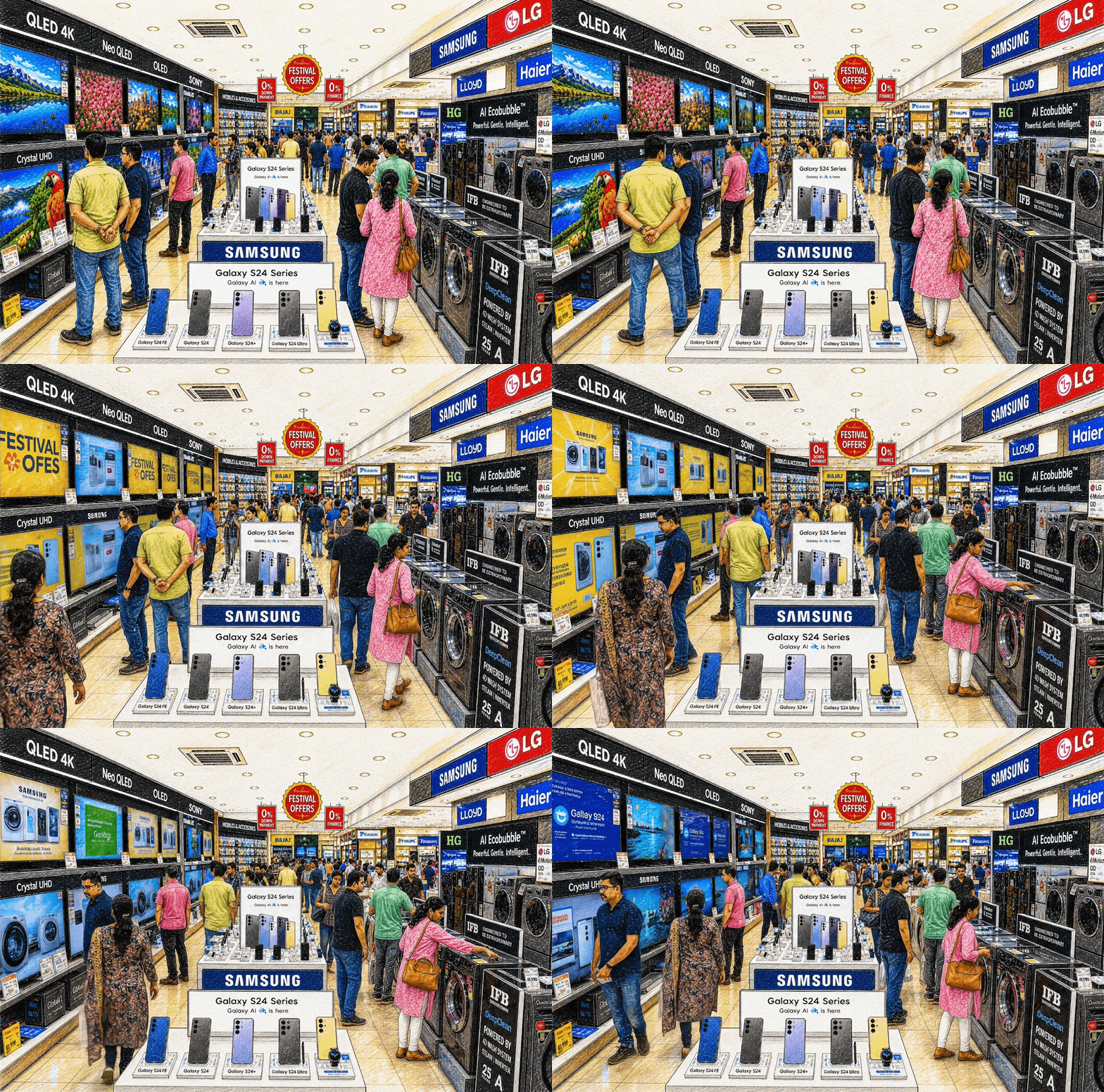
But here’s something most people don’t realise. Many of these products, even though they have different brand names, are actually made by the same company.
There’s a company working quietly in the background.
You don’t see its name on the product, but it plays a huge role in making it.
That company is Dixon Technologies.
In 2024, India sold about 16 million TVs. Dixon made more than half of them.
That means every second TV sold in India was likely made in a Dixon factory, even if it had a different brand name on it.
And it’s not just TVs.
Dixon also makes washing machines, smartphones, set-top boxes, wearables, telecom equipment, and even small but important parts that go inside these products.
So while you see many different brands on the outside, behind the scenes, one company is helping build a large part of India’s electronics.
Dixon is not a name you think of when buying an electronic product.
That’s because Dixon Technologies is not meant to be seen by consumers.
Instead, it works behind the scenes and is trusted by big brands to manufacture their products.
But a company doesn’t earn this kind of trust overnight.
It’s not built with just a few big deals or a short period of fast growth.
Dixon’s strength has been built slowly, over many years.
Through a series of long-term decisions, it has created a strong and lasting advantage in manufacturing.
This week, we’ll understand how Dixon built this foundation, why it worked, and why it has been so difficult for others to copy the same mix of scale, consistency, and trust.
Starting Early in a Changing India
The story of Dixon Technologies does not start with scale. It starts with timing.
The company was incorporated in 1993, at a point when India itself was going through a structural shift. Just two years earlier, economic liberalisation had begun. Before that, India had very high import taxes, more than 80%, which made foreign goods very expensive. Over the next few years, these taxes were reduced to around 30%, and the rupee lost value, which made it cheaper to export from India.
But the bigger opportunity was something less obvious.
India allowed companies to import electronic parts easily, but not finished products. This created a very specific situation where global brands could not easily import finished products at scale but could bring in parts and assemble them locally.
So if a company wanted to sell TVs or other electronics in India, it needed a local manufacturing partner.
Dixon focused on solving that problem.
Over time, it started working with clients like Goldstar, which later became LG Electronics. As LG expanded its presence in India through the late 1990s, Dixon expanded with it. But what mattered more was the nature of this relationship. LG was not simply looking for a low-cost manufacturer; it needed a partner that could deliver consistently and maintain quality across large volumes.
Dixon gradually built that capability.
At the same time, it did not restrict itself to a single product. It started manufacturing 14-inch televisions, Sega video game consoles, Philips video recorders, and push-button phones for Bharti Airtel. On the surface, this may look like diversification, but in reality it was a way of building deeper manufacturing capability across different product types, each with its own requirements but relying on the same core strengths.
This approach helped Dixon become more capable without depending too much on one product or one client.
At the same time, demand in India was growing fast.

During the 1990s and 2000s, more households started buying televisions as satellite channels like Zee TV, Sun TV, and Star TV became popular. Manufacturing output in India grew significantly during this period, and a large part of that growth came from new products made possible by access to imported components.
Dixon was positioned exactly where this demand turned into manufacturing.
A clear turning point came in 2006.
Dixon received a large order from the Tamil Nadu government to manufacture 2.5 million CRT televisions. Completing such a big order on time and with consistent quality proved that Dixon could handle large-scale production. This was an important moment for the company.
After this, Dixon kept expanding, but in a careful way.
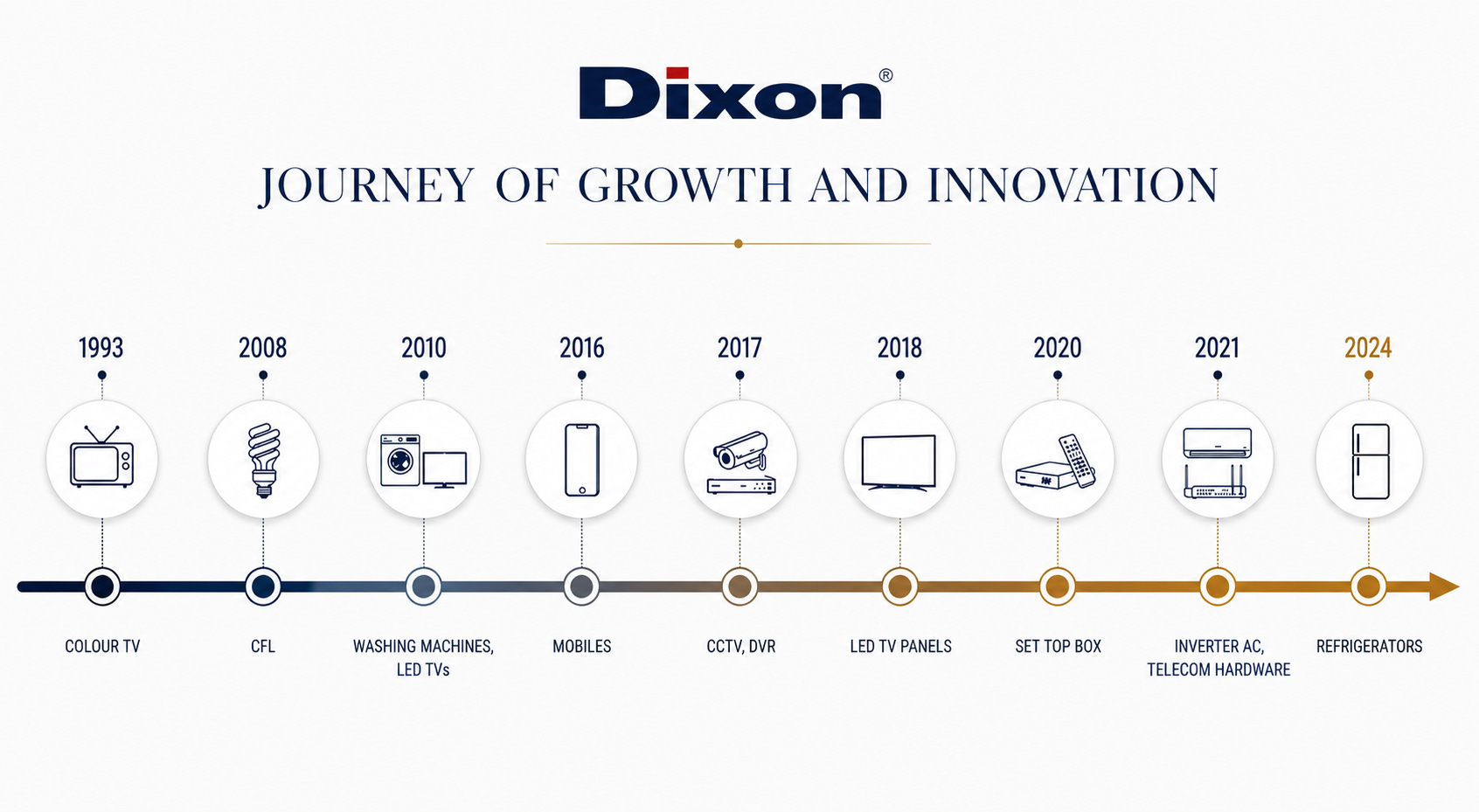
It moved into lighting in 2008, LED TVs and washing machines in 2010, and mobiles in 2016. They also started making refrigerators by 2024.
This expansion followed a simple strategy. Move into related areas where it could use what it already knew instead of trying completely new and risky businesses. By the late 2000s, Dixon had also added products like air conditioners, microwave ovens, and DVD players, mostly by working with the same clients.
This was important because Dixon wasn’t starting from scratch each time. It was growing within the same network, working with the same clients across different products.
Over time, this did more than just increase production.
It built trust.
In contract manufacturing, trust is everything. Clients want a partner who can deliver consistently without problems. Every successful order made Dixon more reliable in the eyes of its clients. On the other hand, switching to a new manufacturer would involve risk, delays, and uncertainty.
So as Dixon kept delivering, it became harder for clients to replace it.
This is where Dixon’s advantage started to form.
Every time India started pushing electronics manufacturing more aggressively, Dixon was not building capability from scratch. It was scaling what it had already developed over time.
Scale and Cost Advantage
Dixon’s scale is not something built overnight. It’s the result of steady growth over nearly 30 years.
The company followed a simple cycle. As it produced more, its costs went down. Lower costs attracted more clients. More clients increased production volumes. And higher volumes again reduced costs. This cycle kept repeating over time. By the time others started noticing this opportunity, Dixon was already far ahead.
Today, that scale is visible in its operations. Dixon runs around 25 factories spread across about 4.5 million square feet, employs roughly 35,000 people, and is even building a new 1 million square foot plant in Noida. This kind of scale takes decades to build.
One of the biggest benefits of this scale is in purchasing raw materials.
In electronics manufacturing, most of the cost (around 80-90%) comes from components and raw materials. Dixon buys components at a scale. 50 million smartphones. 240 million LED bulbs a year. This makes it one of the most important customers for suppliers in Taiwan, Korea, and China.
This gives Dixon clear advantages. It gets better prices, more flexible payment terms, and priority supply during shortages. Since profit margins in this business are usually small, even a slight cost advantage can make a big difference. Smaller competitors, who buy in lower quantities, don’t get these benefits and over time, this gap keeps increasing.
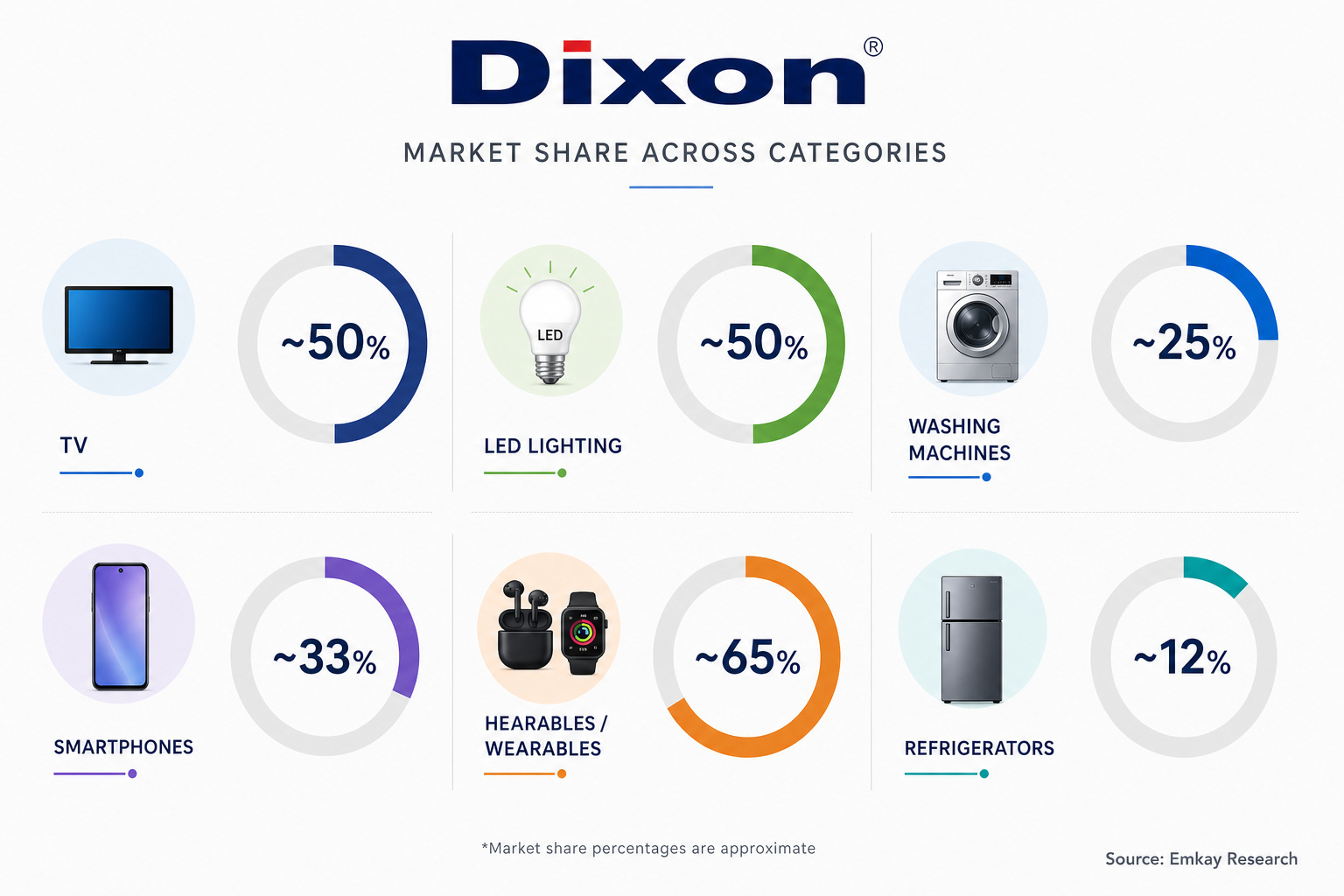
Dixon’s strength also comes from being present across many product categories. It has about 33% share in smartphones EMS, 50% in LED lamps, 50% in LED TVs, 20 to 25% in washing machines, and 65% in hearables and wearables.
It is also the fourth largest LED lamp manufacturer globally. This spread reduces risk. If demand slows in one segment, other segments can support growth.
Its presence across states adds another layer of advantage. These factories create jobs and support local economies, so governments actively support Dixon with policies, faster approvals, and incentives. This kind of relationship is difficult for smaller companies to build.
In the end, this advantage comes from time.
It took 30 years to build supplier networks, trained teams, quality systems, and experience across multiple products. A new competitor can invest money to build factories, but it cannot quickly recreate decades of learning, relationships, and timing.
That is what makes Dixon’s position hard to replicate.
Deep Integration: Why Clients Can’t Easily Leave
Dixon’s second advantage comes from how deeply it is woven into its clients’ businesses.
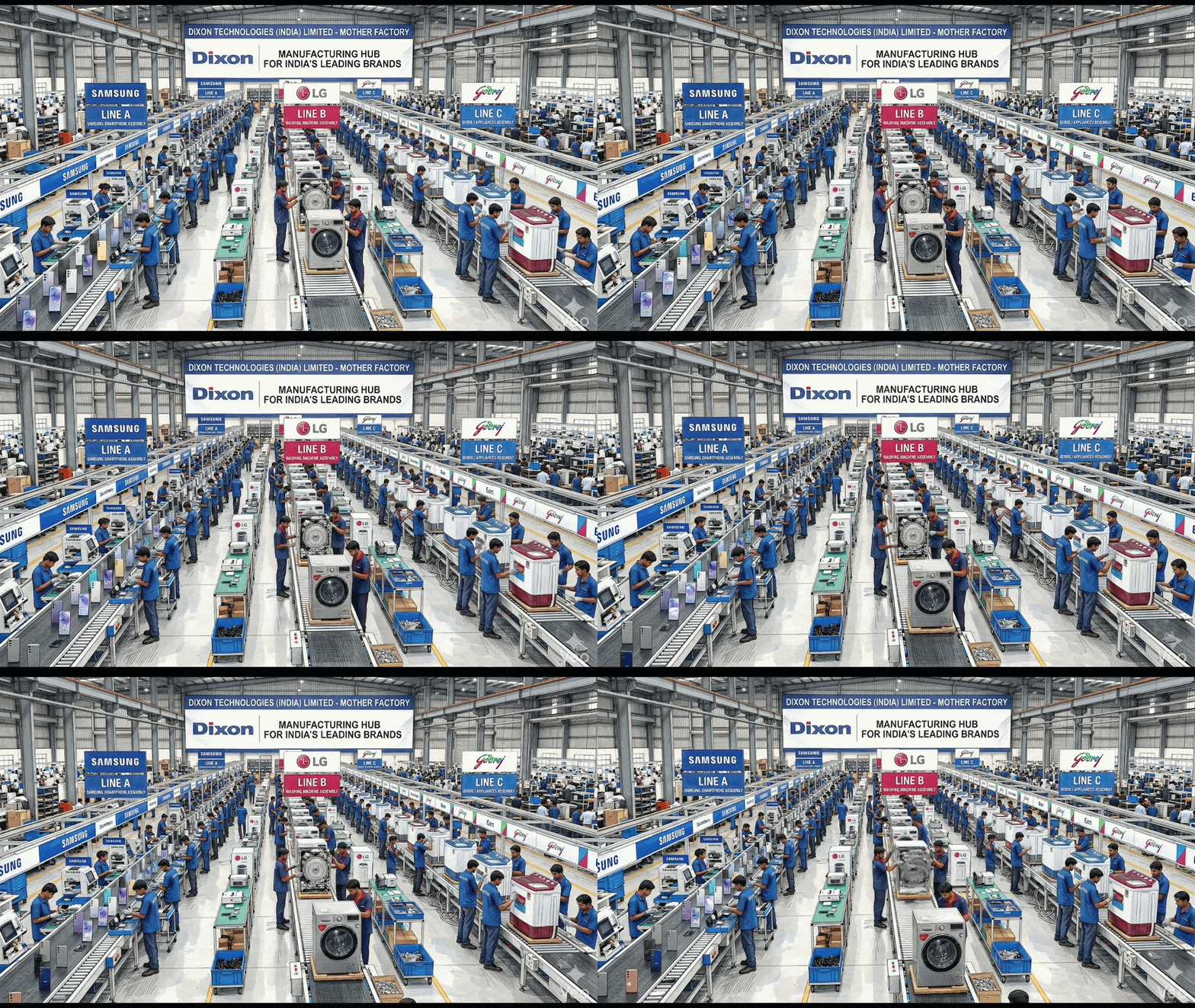
Dixon does not just put products together. It builds its entire production line around each brand’s specific needs, from which parts go in, to how things are tested, to what quality levels are required. Over years, this becomes second nature to its factories and teams. A brand that wants to leave does not just need to find another manufacturer. It has to rebuild everything it had with Dixon, from scratch.
But there is a deeper layer to this.
In most cases, the brand comes to Dixon with a complete design and says: build this for me. Dixon just executes. Switching here is painful, involving a new factory, new teams, and months of testing, but it can be done.
There is a different kind of relationship, though, where the brand simply says: I want a washing machine. Dixon then designs the product, decides what goes inside it, builds the tools to make it, and runs the entire production. The brand sells it under its own name. But Dixon owns everything behind it.
If the brand wants to move to someone else, it cannot take the product with it. The design stays with Dixon. The tools stay with Dixon. The supplier network stays with Dixon. Starting over elsewhere takes 12 to 18 months and carries serious risk of defects and delays.
Every washing machine that Samsung, Panasonic, and Godrej sell in India was designed by Dixon. Dixon even convinced Panasonic, which used to arrive with its own designs, to hand that responsibility over entirely. The washing machine business earns around 11% margins. Smartphones, where brands own their designs and Dixon just assembles, earns around 3.3%. The margin gap shows what it means to be genuinely hard to replace.
This lock-in is also growing. In lighting, the share of products designed by Dixon has gone from 40% in 2018 to 87% today. In televisions, Dixon produces 60 to 65% of all units sold in India. Across washing machines, lighting, and TVs, brands spend 50 to 70% of their manufacturing budgets with Dixon. The longest relationships, Panasonic, Samsung, Philips, Godrej, go back over a decade. The longer a brand stays, the harder it becomes to leave.
This moat does have a limit.
In older, simpler categories like washing machines and light bulbs, Dixon owns the design completely and the lock-in is real. In smartphones, it mostly still just assembles what brands tell it to. Motorola, which at one point was responsible for 72% of Dixon’s phone assembly business, shifted 23% of its volumes to another manufacturer. Dixon’s share price fell 35% in three months.
Where Dixon owns the design, brands cannot easily walk away. Where it does not, they can. Dixon is steadily moving more of its business toward the first kind.
Policy and First-Mover Advantage
Dixon’s third advantage comes from how it positioned itself around government policy before others were paying attention.
When the PLI scheme for mobile phones launched in April 2020, it offered 4 to 6% incentives on incremental sales. 16 companies were approved, including Samsung, Foxconn, Wistron, Lava, and Micromax. But the benefits only went to companies that were already operational and could scale immediately. Most approved players were still building capacity. Dixon was already running.
Through Padget Electronics and its Noida plant, Dixon became the first company out of all 16 approved entities to receive PLI disbursement, collecting Rs 53.28 crore in a single quarter in 2021 while others were still setting up.
The industry that followed was enormous. Mobile production in India grew from Rs 18,000 crore in FY2014-15 to Rs 5.45 lakh crore by FY2024-25, a 28x increase in a decade. In FY15, mobile phone imports made up 78% of the market by value. By FY23 that had fallen to 4%. Domestic production now meets over 99% of demand, and smartphones have become one of India’s largest export categories.
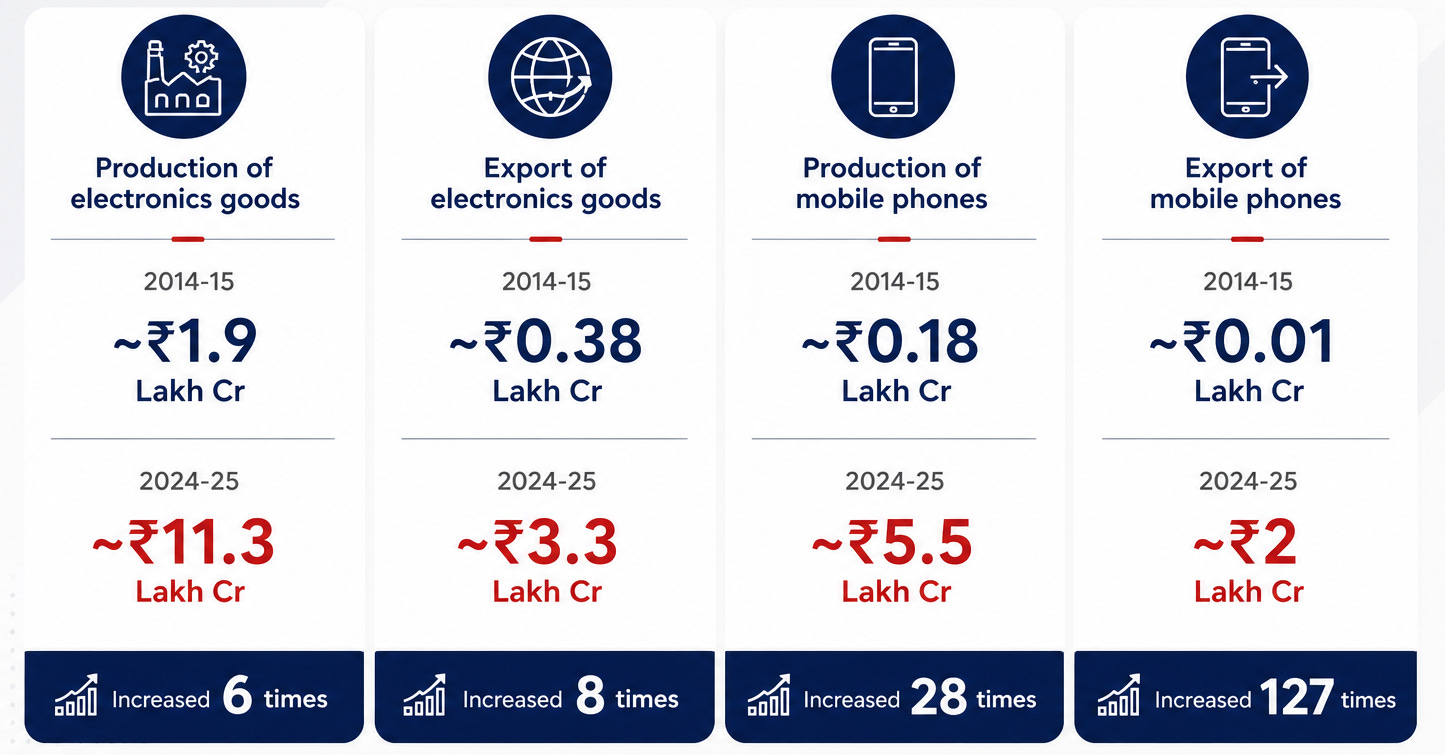
Dixon was already inside this system when the wave hit.
A key advantage for Dixon comes from Press Note 3, which requires government approval for Chinese investment into India. Since critical components like displays and camera modules depend on Chinese technology, any company trying to make these locally needs a Chinese partner and a 12 to 24 month approval process. Dixon has already cleared this multiple times — Longcheer in 2025, HKC in 2026, while competitors would need to start from scratch.
The HKC joint venture targets smartphone displays below Rs 15,000, a segment entirely dependent on Chinese imports today. Trials begin Q2 FY27. If it works, Dixon becomes one of the only local sources for a component every affordable phone in India currently imports.
The mobile PLI scheme ended in March 2026, reducing direct incentive support. Future schemes, including IT hardware PLI and a possible PLI 2.0 with an outlay of Rs 46,000 crore, may continue support, but policy benefits are not permanent guarantees.
The real strength here was never just the incentives.
It was the ability to be first, collect benefits while others were setting up, secure regulatory approvals that take years to navigate, and build Chinese technology partnerships through structures that new entrants would need to replicate from scratch. By the time a competitor works through the same approvals, Dixon has already built the factory, ramped the volumes, and locked in the customers.
Design, Quality and Trust
Dixon’s fourth advantage is the hardest to copy and the easiest to underestimate.
Big global brands like Google or Samsung don’t just pick any manufacturer. They do strict checks on things like quality, worker conditions, environment, and processes—and they repeat these checks every year. If a company fails, the partnership can end. In fact, most factories don’t even pass these checks.
Dixon has been passing them for 30 years, working with some of the toughest global brands.
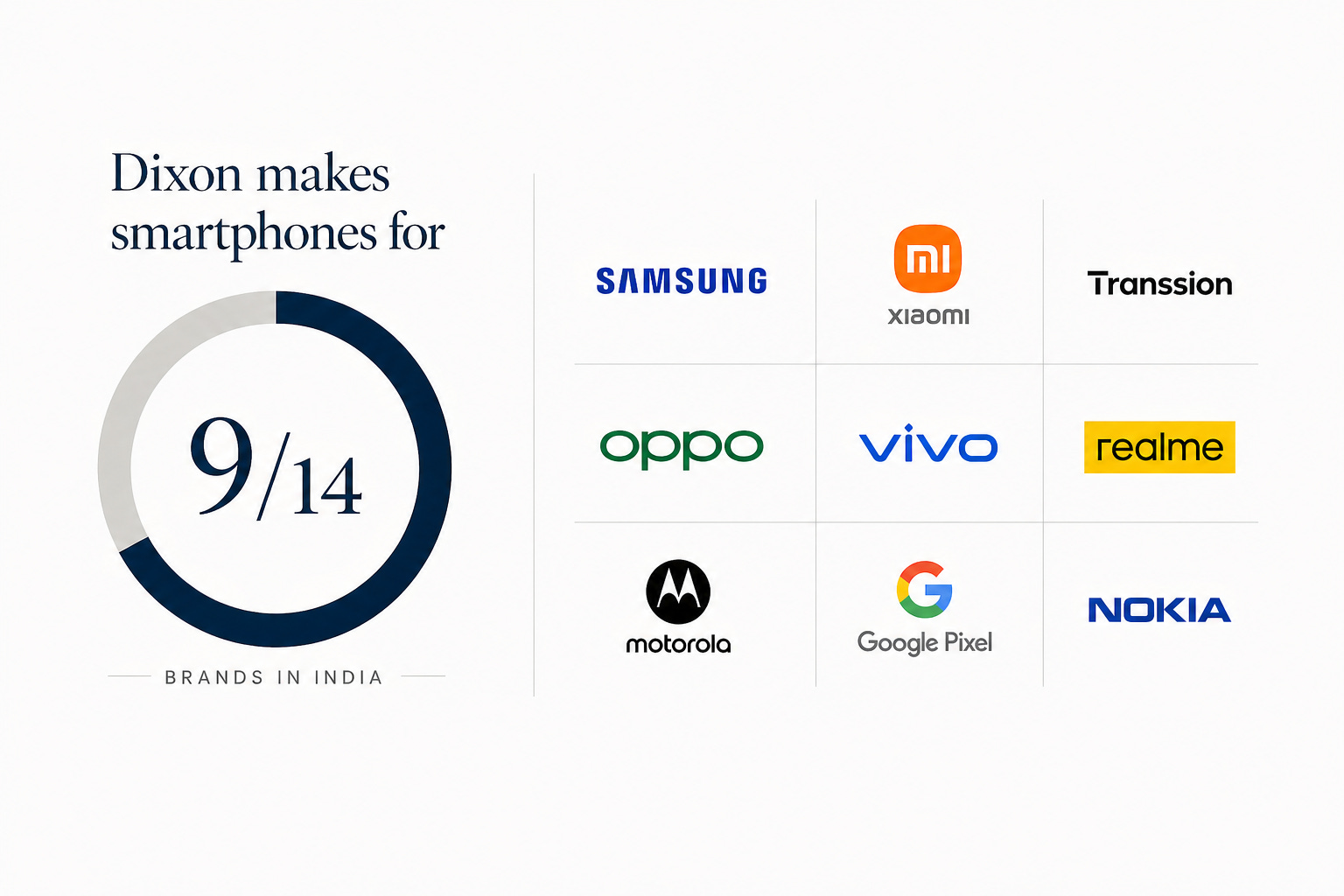
Today, it makes phones for 9 out of the 14 smartphone brands in India—including Samsung, Xiaomi, Motorola, Nokia, Oppo, Realme, and Google. Each of these partnerships took years to build, and once Dixon earns trust from one big brand, it becomes easier to win the next.
When companies like Nothing, Vivo, or Intel look for a manufacturing partner in India, Dixon is often the first choice because of its strong track record.
This is reflected in its growth. Dixon’s smartphone production rose 196% in Q2 2025, making it India’s largest manufacturer by volume. Its market share jumped from 8% to 22% in a year, while Indian players overall increased their share from 9% to 36%.
Google is the clearest proof of where accumulated trust leads.
Dixon became the first contract manufacturer in India to receive sublicensing rights for both Android TV and Google TV. Once it had those licences, it became the only factory in India where any brand could walk in and get a Google-platform TV built without going through the same 12 to 18 month approval process themselves. That trust then extended to smartphones.
Dixon’s subsidiary, Padget Electronics, partnered with Compal to make Google Pixel phones in India, mainly for export to the US and Europe.
For each Pixel phone, Dixon earns about Rs 25,000 to Rs26,000. Normally, it earns around ₹9,000 per smartphone. So Pixel phones bring in almost 3 times more revenue per phone. This kind of opportunity came because global brands already trust Dixon.
There’s also a bigger opportunity. If Google starts making 30% of its Pixel phones in India, it could mean orders worth Rs 90,000 to Rs 1,00,000 crore. And Dixon is one of the top companies likely to get that business.
Wonderful and complete analysis of Dixon technologies by GROWW and now I have an idea about the company.
This is my first time reading an article related to a company and stock and I became so invested with each line of this article.
This might become a new hobby of mine.
Great article Author!!