

Gucci and Louis Vuitton are rivals today.
But there was a time when Louis Vuitton almost took over Gucci.
Almost. But it managed to save itself.
Louis Vuitton is a part of a larger group called LVMH.
And LVMH had made a bid to take over Gucci. It had built stakes or taken over various other luxury brands across Europe.
So it had reason to believe a Gucci takeover would be easily possible as well.
But Gucci had a few tricks up its sleeve. What followed were a few desperate measures by both sides. Some worked in favour of Gucci, some against.
The last trick Gucci used was what’s called a white knight.
But before we get to that, and what eventually happened, we must understand Gucci and LVMH individually.
Gucci Before This Episode
The first thing to understand about this story is that Gucci was no longer controlled by the family that started it.
It was an Italian leather goods shop started in Italy in 1921.
Over the decades, the Gucci brand had lost its sheen because of over-licensing their brand name. Luxury brands work on exclusivity, and the name appearing on too many products ruins that image.
That was one problem.
Family infighting had meant that gradually, the family as a whole did not act as one.
Internal disputes and conflicts meant that the company’s various shareholders (who were family members) were either leaving the company or were being pushed out.
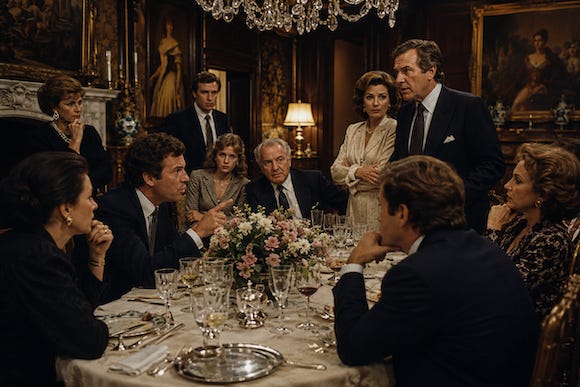
Eventually, a family member sold enough stake to an investment company based out of Bahrain. This was a little over 50% of the company.
By 1993, Gucci became a fully non-family-owned company.
Over time, all family members sold their portions off.
Investcorp owned 100% of Gucci.
Investcorp made Domenico De Sole the CEO. Tom Ford was made the creative head.
Together, they started righting what was wrong.
A large number of branding licenses were cut. The brand focussed on newly designed products.
The brand started clawing back lost glory.
To raise fresh money, the brand went for an IPO in 1995. The price was $22 per share.
In this IPO, Investcorp sold off about half of its stake. It was still the largest shareholder.
Investcorp was not in for the long run. They wanted to turn around a burning ship and exit. They had succeeded.
By March 1996, the company’s share price had risen to $48 per share.
They were sitting on very handsome profits.
They did a secondary offering and sold off all their shares.
From this point on, Gucci was owned by various investors, but there was no single controlling shareholder.
Domenico De Sole continued as the CEO since the board of the company felt confident in his abilities.
LVMH This Episode
LVMH was essentially a holding company.
Bernard Arnault had bought Christian Dior’s parent company at a distress sale in 1984.
Since then, he’d gone on to acquire one luxury company after another. It worked well. Today, the company is the world’s biggest luxury brand holding company.
By 1998, LVMH had acquired top luxury brands like Sephora, Givenchy, and Loewe.
Unlike other holding companies, LVMH was a holding company/investor that operated almost exclusively in the world of luxury.
It had developed a system for running such companies. It knew that luxury companies were not run using the same principles as any other consumer goods company.
LVMH understood luxury.
The Episode
So now, we get to the LVMH vs Gucci battle.
Gucci shares were almost entirely available on the share markets. There was no single large controlling shareholder.
To make Gucci even more tempting, it was no longer a fledgling luxury brand that was directionless or losing reputation.
It was a healthy, functional, and growing luxury brand.
These conditions made Gucci nearly perfect for a takeover bid by LVMH.
In 1999, LVMH announced that it had bought nearly 5% of Gucci’s shares. LVMH positioned this as a pure investment interest.
It is difficult to take over a company that has large controlling shareholders. They usually tend to stick and not sell easily.
But since Gucci was almost entirely held by smaller groups of investors, Gucci seemed like an easy takeover.
The CEO of Gucci had feared about a day like this.
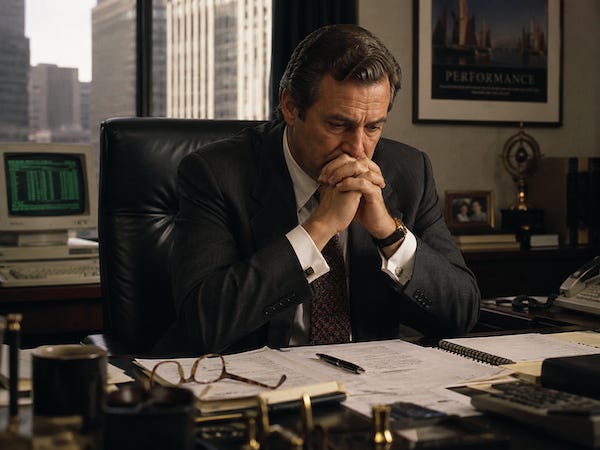
In the meantime, LVMH kept buying more shares of Gucci in the open markets. The CEO of Gucci had been correct to worry about it.
LVMH had built a business model out of this. They had lots of cash and could deploy the money fast. This helped them acquire companies rapidly.
Not long after that announcement, LVMH announced that it owned about 34.4% of the company.
34.4% does not give the company a majority. They were still far from 50%.
But they did become the largest shareholder, and that itself is powerful enough in a company where all other shareholders own smaller portions.
The CEO of Gucci did not like this.
Why?
CEOs are appointed by the boards of directors of companies.
The board of directors are elected by shareholders. So, the CEO and the board must act in the interest of the current shareholders.
De Sole, the CEO, was worried that LVMH might buy a little over 50% of the company and attain full control over it.
This, he felt, was unfair to the existing shareholders.
His pitch was that LVMH should take over the company and pay a fair price to all shareholders, not just 50%.
The Negotiation
With 34.4% stake, LVMH demanded board seats.
De Sole countered, saying LVMH should offer a price for all shares or reduce his stake to about 20% and accept a lower number of board seats.
Neither could meet in the middle. The tussle set off.
LVMH then tried to call for a shareholders’ meeting to let the shareholders decide who the members of the board should be.
In effect, he tried to get control over the company.
Poison Pill
De Sole decided to counter this with a shrewd move that is sort of a last resort for companies being taken over.
The move is called a poison pill.
What companies do is they create lots of new shares and give them to other shareholders (excluding the one trying to take over).
Gucci created new shares and gave them to employees via stock options (ESOP).
Since these were new shares entirely, the total number of shares increased.
Since LVMH was not given any new shares, the number of shares they owned remained the same. But the percentage they owned would drop from 34.4% to about 25%.
The move diluted the ownership percentage of LVMH.
This reduced their influence over the company.
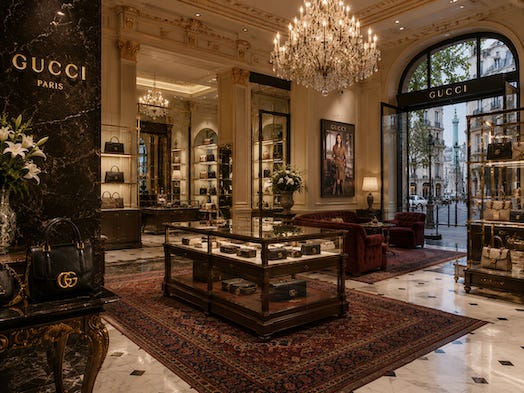
Why is it called a poison pill?
Because it is a bit self-damaging to prevent a larger damage. It is trying to make the company less attractive to the party trying to take over. It makes it tougher for them since now they’ll have to spend even more money to acquire the same percentage of stocks as before.
There are numerous examples of cases where the poison pill method worked as intended.
White Knight
The poison pill failed.
This gets a bit complicated.
Companies are allowed to use a poison pill to defend themselves. The idea is that a company can use poison pills to protect shareholders.
In this case, the poison pill got challenged in court because LVMH was also a large shareholder and was effectively being targeted by the board.
Poison pills are supposed to help buy shareholders time.
It cannot be used to retain voting power when another buyer is buying shares and therefore voting power.
The argument made by LVMH was that the board was using its powers to retain control over the company without respecting all shareholders.
Remember, these were ESOPs. So even other shareholders’ (the various small and individual investors) stakes were being diluted. Even their voting power was being effectively reduced.
Many poison pills use a strategy where free new shares are given to all shareholders except the one trying to take over the company.
This is more often allowed.
Gucci’s poison pill looked more like voting power manipulation and less like protecting shareholders’ best interests.
The poison pill did not pass the court’s test.
So now you’d imagine LVMH has a straight path towards acquiring a controlling stake in Gucci. They had 34.4% shares and could increase or demand board seats.
But De Sole had one more trick planned.
In March 1999, they signed an agreement with PPR, a French retail company.
The deal was to raise money from them by issuing fresh shares. Specifically, $3 billion cash.
A company is allowed to raise capital by issuing shares.
This move was legal.
So, Gucci created new shares and sold them to PPR for $3 billion.
With this, PPR now had a little over 42% stake in Gucci.
LVMH was no longer the biggest shareholder. PPR had more voting power and was friendly with the existing board.
PPR became the large, friendly shareholder — the white knight!
How was this a friendly move for the board and existing shareholders?
PPR had agreed to buy the shares for a 7% higher price than the market price. Since the company was also raising more cash while selling shares for a higher price, the company was benefitting from the move.
Why would PPR pay a higher price?
They wanted an entry into the luxury space. Unlike LVMH, they were not already a luxury holding company.
So they were willing to pay a higher price.
Gucci is still with PPR (PPR changed its name to Kering in 2013).
And yes, Kering is now what it wanted to be. It is a luxury holding company.
Its portfolio includes Balenciaga, Saint Laurent, and several others — around 12 core brands.
Kering’s market cap is about $35 billion today.
Between 1999 and 2004, PPR continued acquiring more stake in Gucci. Today, it is entirely owned by PPR (or Kering).
LVMH gave up on the idea of taking over Gucci. By the end of 2001, they had sold off their entire stake in Gucci. A big portion of that was sold to PPR.
But it did not give up on its strategy. It continued to acquire other luxury brands.
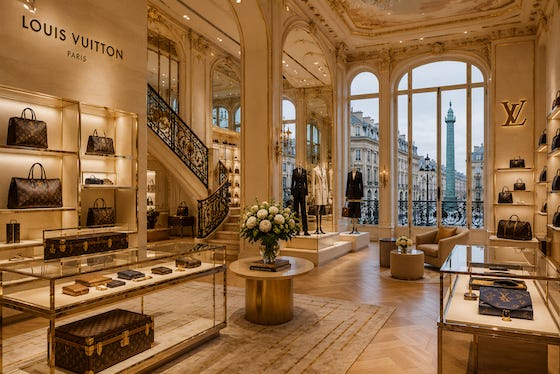
Today, LVMH is the largest luxury holding company in the world with over 75 brands.
Its market capitalization is about $280 billion today.
Quick Takes
+ India’s annual inflation rate rose to 4.38% year-on-year in June (vs 3.93% in May).
+ India’s merchandise exports rose 15.5% year-on-year to $40.41 billion in June while imports grew 31% to $70.84 billion. The merchandise trade deficit widened to $30.43 billion.
+ Zetwerk has received SEBI’s approval for its IPO.
+ India’s Wholesale Price Index inflation rose 9.87% year-on-year in June (vs 9.68% in May)
+ India’s net direct tax collections rose 16.4% year-on-year to over Rs 6.51 lakh crore as of 13 July, 2026.
+ MoSPI released the first Index of Services Production (ISP) for April 2026, covering 19 sub-sectors which cover 60% of the services sector. 17 out of 19 sub-sectors grew, with accommodation & food and retail trade growing the most. Air transport and railway transport were the only ones that fell.
+ The government has updated the Foreign Trade Policy to prohibit the import of goods made fully or partly using forced labour. The rule will come into effect 30 days after its publication in the Official Gazette.
+ US inflation fell 0.4% in June (vs a 0.5% rise in May). Core inflation, which excludes food and energy, stayed flat in June (vs a 0.2% rise in May).
+ The India-UK Comprehensive Economic and Trade Agreement (CETA) came into effect, aimed at increasing bilateral trade.
+ India’s unemployment rate remained unchanged at 5.5% compared to May. The rural unemployment rate fell to 5% (vs 5.1% in May). Urban unemployment rose to 6.6% (vs 6.4% in May)
+ The government approved two railway projects in Odisha and Jharkhand worth Rs 3,907 crore.
+ The government approved Semicon 2.0 with a budget of Rs 1.27 lakh crore to support the semiconductor design and manufacturing ecosystem in India.
+ The Ministry of Ports, Shipping and Waterways (MoPSW) has given in-principle approval for two maritime projects: a new shipbuilding cluster in Porbandar, Gujarat, and another project at Vadinar in the Gulf of Kutch.
+ The government increased windfall taxes on diesel and Aviation Turbine Fuel (ATF) exports effective today. Diesel export duties increased to Rs 15.5 per litre (vs Rs 8.5 per litre). ATF exports were raised to Rs 14.5 per litre (vs Rs 7.5 per litre). The export duty on petrol, however, was reduced to Rs 2.5 per litre (vs Rs 4 per litre).
+ India’s first hydrogen-powered train with a capacity of around 2,600 passengers, will begin operations tomorrow. The train will run on the Jind-Sonipat section of Haryana.
+ India’s forex reserves rose $964 million to $675.16 billion for the week ended on July 10.
+ The government will revise the series of the Index of Core Industries (ICI) with the base year 2022-23 on 20 July. The number of core industries has increased to 9 from 8 with the addition of iron ore.
+ MakeMyTrip’s Indian subsidiary confidentially filed for an IPO with SEBI. The company and its subsidiary, ibibo Holdings, will sell shares in the IPO, as per its filing to the U.S. SEC.
The information contained in this Groww Digest is purely for knowledge. This Groww Digest does not contain any recommendations or advice.
Team Groww Digest
Very Good