

About 2,250 years ago, Rome was expanding.
But it was already quite big to start.
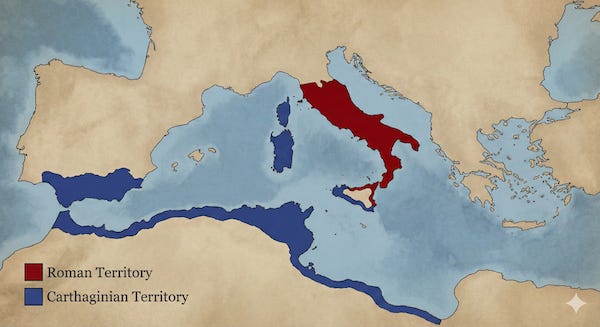
The Roman Republic was roughly centered around where modern day Italy is today.
Across the Mediterranean Sea was Rome’s enemy — Carthage.
In modern times, Carthage was in modern day Tunisia.
The rivalry between the two was fierce. The reason for that went back far.
What concerns us in the write up is how they dealt with each other in the Second Punic War.
Carthage was a mercantile and trading region that depended on sea-based trading routes. Their population was much lower.
Rome on the other hand was more land-based. It was more militaristic and more agricultural.
Hannibal
Hannibal became an absolute headache for Rome.
He was a Carthaginian general. The Carthaginians had some territory in Spain. Hannibal spent a lot of time there.
It is said that Roman parents used to scare their children saying ‘Hannibal is at the door’.
A proper villain in Roman culture.
Hannibal wanted to take over Rome despite having a much smaller army.
It started in 219 BC with Hannibal taking over Saguntum, in Spain. Saguntum was an ally of Rome.
This takeover was alarming to Rome. They began to notice.
From there, Hannibal took his army and started marching east, towards modern day Italy – Rome.
Rome declared war on Carthage.
Hannibal, on his way to Italy, crosses the Alps. On his way, he fights many battles and defeats many tribes, local chieftains, and smaller rulers.
As he defeats them, he dissolves the rival soldiers into his own army.
So as he fought more battles, he peculiarly gained soldiers from his enemies.
Hannibal continues his march into Italy and faces the Roman soldiers on many fronts.
Hannibal was a genius general. His military tactics are studied even today.
The first time the Carthaginian army and the Roman army clashed, the Roman army lost. They learnt just how well prepared and skilled the Carthaginian army really was.
This sent shock waves across the Roman Republic.
Some examples of Hannibal’s tactics can be seen in the various battles he fought.
For example, one of the earliest encounters of the two armies happened across the river Trebia. Here, Hannibal had hidden some of his soldiers in grasses and bushes that lay beside the river.
When the fighting advanced between the two armies, Carthaginian forces emerged from the grasslands, fresh and rested. They attacked the Romans from behind while they were fighting the Carthaginians in the front. Victory was Hannibal’s.
In another case, the Roman army was chasing the Carthaginians.
A road had a lake on one side and a hill on another side. Hannibal hid his troops on this hill. When the Roman soldiers marching behind him arrived on this road, they blocked it.
It was a foggy day and the Roman soldiers were confused about what was happening from all sides.
Hannibal then attacked the troops from the hills, and from the front and back of the Roman army’s path.
About 15,000 soldiers died.
This was deemed the biggest ambush exercise ever — even to this day.
The last example is from the Battle of Cannae.
A huge Roman army of 85,000 was up against the Carthaginians.
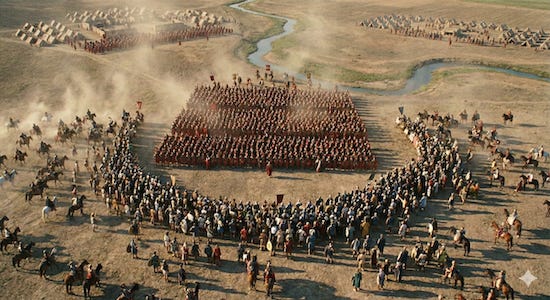
The Romans had put their best soldiers in the middle of the formation in order to be able to break the other side’s troops.
The Carthaginians intentionally kept their middle weak allowing the Romans to advance making them think they were winning.
Then, the Carthaginians surrounded the Romans from the sides and defeated them.
Victory
Hannibal spent about 15 years moving across Italy, defeating the Romans in their own backyard.
In that period, the Romans had panicked and appointed a dictator to take on the threat of Hannibal.
His name was Fabius.
Fabius was up against the master general called Hannibal.
Fabius soon understood that there was no way his Roman soldiers would be better than the Carthaginians.
His strategy involved marching the soldiers and following the Carthaginians. But they avoided contact as much as possible.
At first, all they did was shadow them. Then, they tried to cut off their supplies of food and other essentials.
This strategy started paying dividends.
But it was not enough.
Eventually, one strategy worked. Fresh supply of soldiers.
As the two armies confronted each other, Rome concentrated on getting new soldiers on the fields as their older soldiers died.
The Carthaginians were low in number. They fought bravely but they weren’t able to replace dead soldiers with freshly hired and trained soldiers.
The Romans had sheer size and numbers on their side. They just kept going on and on despite losing tons of battles.
Hannibal could not sustain.
Despite being a better general, having better tactics, having more able soldiers, he lost.
He retreated from Italy when he was called back to Carthage to fight another threat.
The Roman civilisation grew much bigger in the centuries that followed.
David vs Goliath
We all love the David vs Goliath stories.
The big powerful guy (Goliath) defeated by a small but skilled guy (David).
In reality, David rarely wins. Which is why David’s victory (whenever it happens) is celebrated so much.
Corporate history is filled with examples of large companies that were challenged by highly skilled and agile smaller companies.
Most of them fail. Some succeed — those are the stories we love talking about.
One famous example is that of Diapers(dot)com.
The company was a small start up selling diapers online. They were really good. And they had achieved a level of sales that was enviable.
Amazon offered to acquire the company which Diapers refused.
Their revenues, profits, and growth were on point — so they felt no reason to offer the company for sale.
Amazon decided to kill the company. They started selling diapers on Amazon at far lower prices. Lower than the wholesale price.
Amazon was suffering a loss to sell diapers that cheap.
Since Amazon was big, they could afford those losses. Diapers(dot)com on the other hand could not take that loss.
They buckled and eventually were acquired by Amazon in 2010. The website was shut in 2017.
Another example was that of Netscape.
It was a browser that was measurably better than anything out there. Microsoft managed to defeat it using its Internet Explorer browser.
How?
They simply bundled it in their Operating System (Windows).
So whoever used Windows would automatically have access to the Internet Explorer.
These big against small fights happen all the time in corporate rivalries.
More often than not, the Goiath wins.
A large size is often seen as a disadvantage in the corporate world. A fast nimble start up is by default expected to be better.
Both of those are true.
What gets ignored is the advantage size brings to big companies.
Deep pockets, large skilled workforce, redundancies, structure, and experience, all have many advantages.
A skilled investor must avoid falling into the trap of ‘size is inversely proportional to returns’.
Good money can be made investing in smaller companies. Those opportunities exist. Though they are not as common as many like to believe.
Good money can also be made in bigger stable companies.
Size does not automatically mean their returns will be lower.
Quick Takes
+ SEBI issued a circular stating that from 1 Jan 2026, investments by mutual funds and specialized investment funds (SIFs) in Real Estate Investment Trusts (REITs) will be treated as investment in equity-related instruments.
+ India’s industrial output grew 0.4% year-on-year in Oct (vs 4.6% in Sept). Manufacturing output rose 1.8%, mining fell 1.8%, and electricity fell 6.9%.
+ India’s manufacturing PMI fell to 56.6 in Nov (vs 59.2 in Oct). This means manufacturing activity grew less in Nov than in Oct.
+ The Indian government and the Asian Development Bank (ADB) have signed 3 loan agreements worth $846 million for development projects across Maharashtra, Gujarat and Madhya Pradesh.
+ The central government ordered all smartphone manufacturers to pre-install the Sanchar Saathi app on all mobile handsets sold or imported for use in India with compliance required within 120 days: Department of Telecommunications
+ India’s composite PMI (manufacturing + services) fell to 59.7 in Nov (vs 60.4 in Oct). Services PMI rose to 59.8 (vs 58.9 in Oct). This means overall economic activity rose less in Nov than in Oct.
+ The RBI has retained SBI, HDFC Bank, and ICICI Bank as domestic systematically important banks (D-SIBs). As part of the classification they must maintain additional capital buffers. SBI must hold an extra 0.80%, HDFC Bank 0.40%, and ICICI Bank 0.20%.
+ Russian President Putin will be visiting India for the first time since 2021 to discuss economic and defence ties.
+ The RBI reduced the repo rate from 5.5% to 5.25%.
+ India and Russia agreed on an Economic Cooperation Programme till 2030 to boost trade, investment, and strategic collaboration across different sectors.
+ India’s forex reserves fell $1.88 billion to $686.23 billion in the week that ended on 28 Nov.
The information contained in this Groww Digest is purely for knowledge. This Groww Digest does not contain any recommendations or advice.
Team Groww Digest