

1977, T.C. Rampuria.
That’s the year and the name of the government geologist who went to Bhilwara, Rajasthan, for a routine visit.
He was inspecting small pits where miners were digging for garnet.
But while walking around, he noticed something unusual.
Some of the rocks on the surface had turned rusty and reddish-brown.
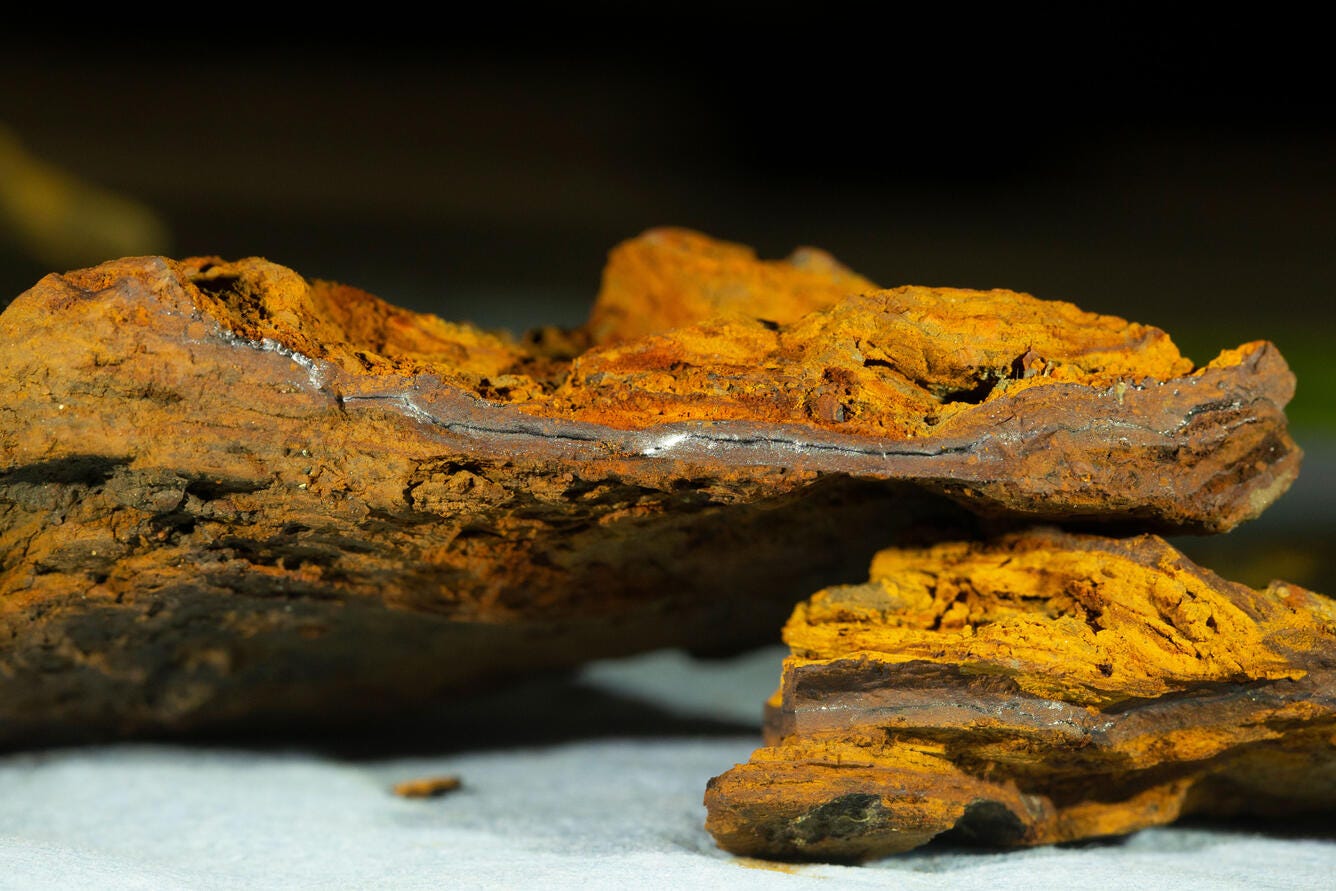
A gossan (representative image). Photo: Peter Pearsall / USGS.
These are called gossans.
They form when metal-rich minerals react with air and water over time. Sometimes, they are a sign that more metal could be present below the ground.
In this case, there was.
Rampuria and his team found a large deposit of zinc and lead in the area.
That discovery became the Rampura Agucha mine.
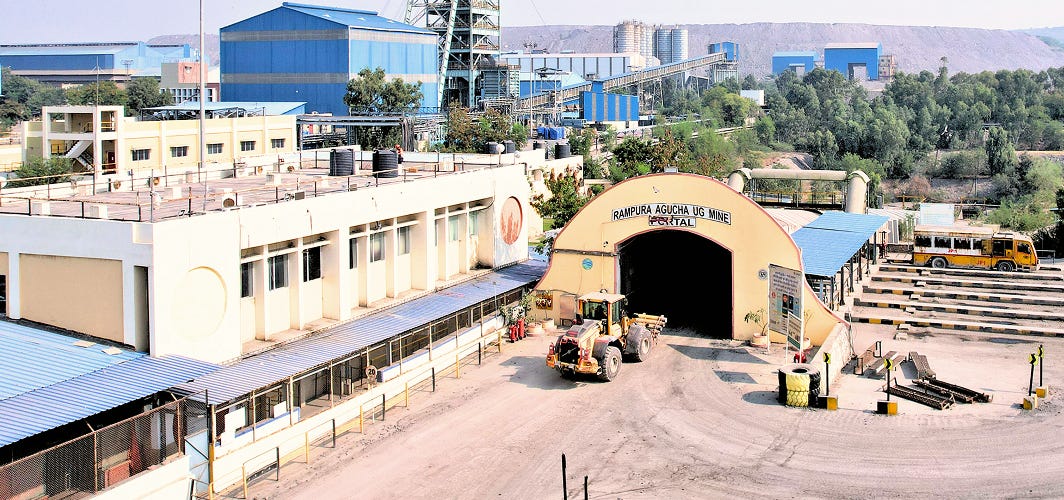
Rampura Agucha mine. Image: Hindustan Zinc
Today, Rampura Agucha is the world’s largest underground zinc-producing mine, according to the company.
In FY26, it produced around 5.08 million tonnes of ore and 576,000 tonnes of zinc and lead metal combined.
And there is still a lot left.
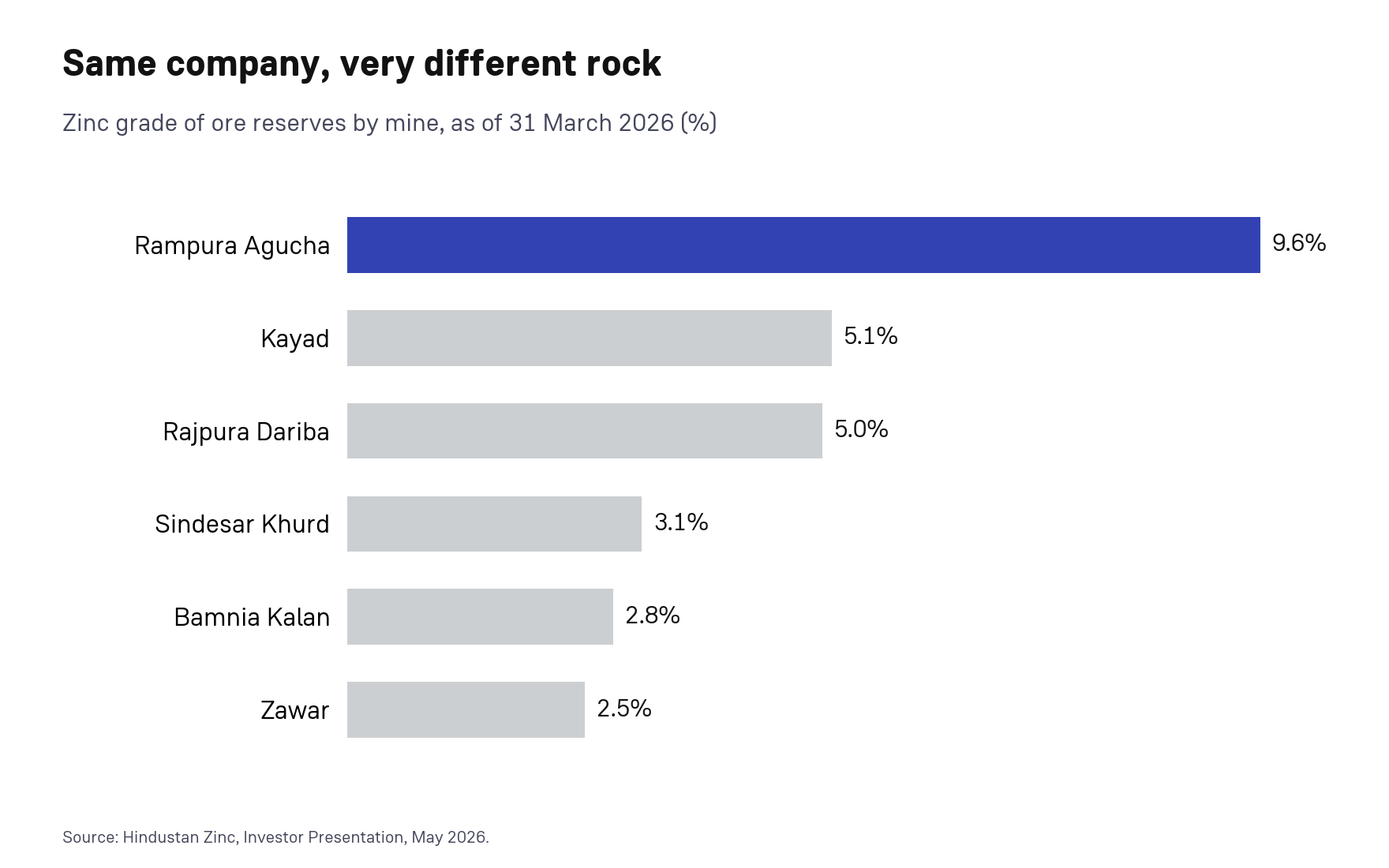
As of March 2026, the mine had around 45.1 million tonnes of ore reserves. Around 9.6% of that ore is zinc.
Now, 9.6% might sound small.
But for a zinc mine, that is a high amount. It means the miner gets more zinc from every tonne of rock it digs.
So the miner needs to dig and process less rock to produce the same amount of zinc.
Why is this mine so important?
Because it is the largest mine of the only company that mines zinc in India.
That company supplies about three-fourths of India’s primary zinc market. Most of the remaining zinc is imported.
A company built around zinc and lead. Surprisingly, silver too.
The company is Hindustan Zinc.
Today, it is one of the world’s largest integrated zinc producers.
In this report, we look at what makes Hindustan Zinc different, how it built its competitive advantage and why it would be difficult for another company to copy it.
So, to understand Hindustan Zinc’s moat, we first need to go back to a time before the company even existed.
How did the company get the deposit?
In 1944, a company called Metal Corporation of India, or MCI, was set up to develop the old Zawar mines in Rajasthan.
People had been mining metals around Zawar for centuries, but MCI wanted to turn it into a larger business.
By 1950, MCI had secured permission to mine and was extracting ore. It also built a plant at Tundoo to turn mined material into lead metal that could be sold and used.
The company then wanted to build a similar plant at Debari in Rajasthan to produce zinc. But building such a plant required expensive machinery, reliable electricity and a lot of money.
MCI did not have enough money to finish the project.
Meanwhile, the Indian government wanted to increase the production of zinc and lead within the country instead of depending heavily on imports.
So in 1965, the government took over MCI’s mining business, including its mines, factories and unfinished projects.
In January 1966, it established a new government-owned company called Hindustan Zinc and transferred MCI’s mining business to it.
Now, remember Rampuria’s discovery in 1977?
Finding minerals did not automatically give a company the right to mine them. It still needed government permission.
Today, companies generally compete in government auctions for newly allocated mineral deposits. But back then, there was no such auction system.
And since Hindustan Zinc was already a government-owned company involved in zinc production, it was given the right to mine the newly discovered deposit at Rampura Agucha.
But getting the deposit was only the first step.
Before spending hundreds of crores on a mine, a company must find out how much metal is present, how deep it goes and whether extracting it would be profitable.
So geologists drill holes and study rock samples from different depths.
At Rampura Agucha, drilling began in February 1980. By 1981, the company estimated that the deposit contained around 61.1 million tonnes of ore, with 13.48% zinc and 1.57% lead.
To understand how rich this was, Hindustan Zinc’s other mines had zinc concentrations ranging from 3.4% to 9.6% at the time.
So Rampura Agucha contained much more zinc in every tonne of rock, meaning the company generally needed to dig and process less material to produce the same amount of metal.
But the zinc was still underground.
The company had to dig out the ore, separate the zinc and lead from unwanted minerals and send the material to another factory, called a smelter, to turn it into usable metal.
This required expensive machinery, processing plants, electricity and transport facilities.
One major investment was the Chanderiya Lead-Zinc Smelter in Rajasthan, built to produce 70,000 tonnes of zinc and 35,000 tonnes of lead every year.
But building the mine and smelter was expensive. So in 1987, the British government agreed to provide £73.55 million to help fund the project.
Work began in 1989, but both the mine and smelter were ready for commercial production only in 1991.
So it took roughly 14 years from discovering the deposit to producing metal commercially.
And the investment did not stop there.
Initially, Rampura Agucha was an open-pit mine, where workers dug a large hole from the surface to reach the ore.
But as the mine became deeper, removing the surrounding rock became increasingly expensive.
Government inspection records from the open pit’s later years show the company removing about 12.6 tonnes of unwanted rock for every tonne of ore.
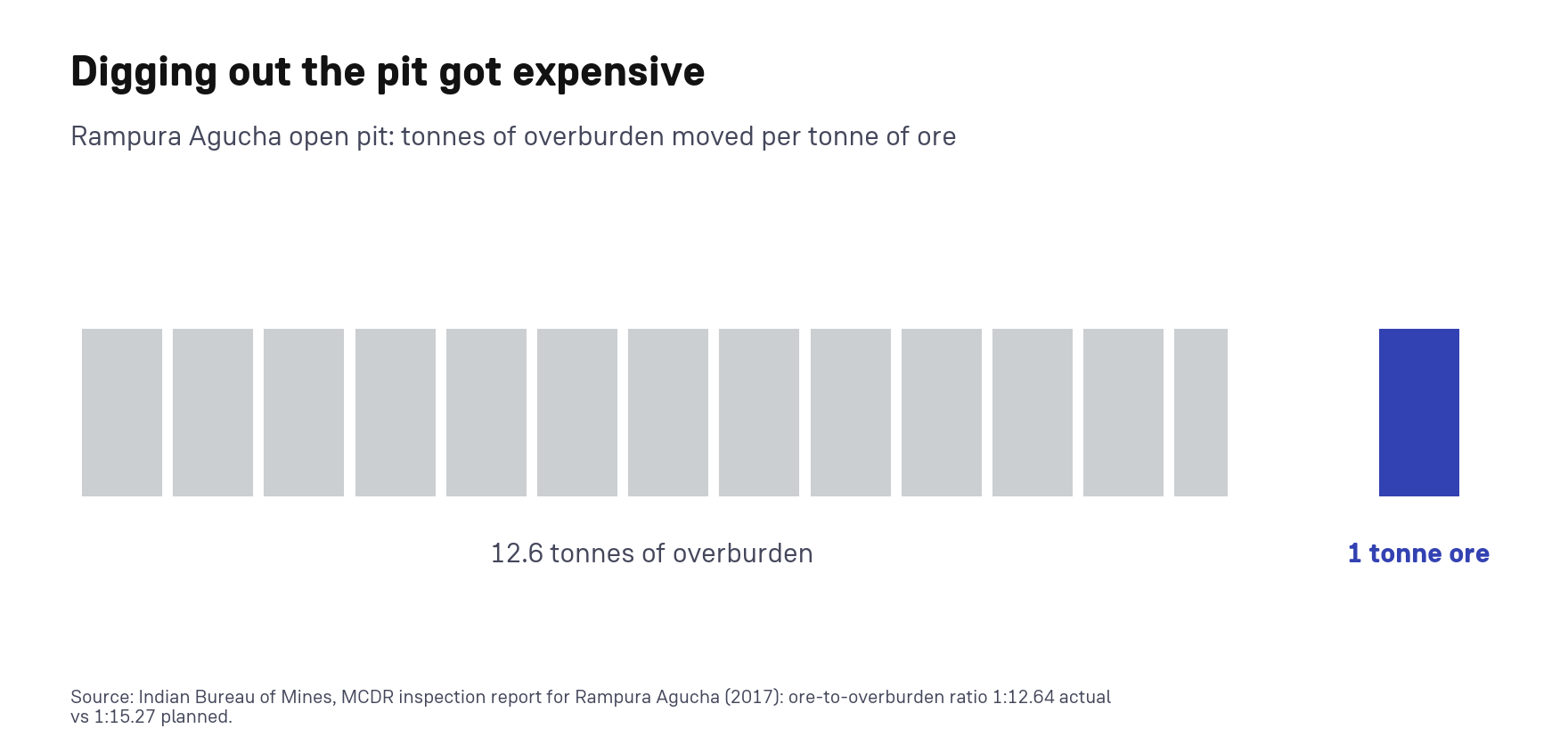
Eventually, mining from the surface became too expensive, and Hindustan Zinc had to move underground.
This meant building tunnels, systems to bring fresh air underground and machinery to lift the ore to the surface. One major addition was a 950-metre-deep shaft, essentially a giant lift system for mined rock.
The transition took years. Open-pit mining ended in 2018, while the main shaft began lifting ore in early 2020, about seven years after Hindustan Zinc announced its underground expansion plan in early 2013.
Now imagine a newcomer trying to do the same.
Even if another company discovered a rich zinc deposit, it would still need years of construction and enormous investments to turn that discovery into a working business.
Hindustan Zinc had already spent decades building its mines, factories and infrastructure. A new competitor would have to build much of that from scratch.
But having one of the richest zinc deposits in the world did not automatically mean Hindustan Zinc would make good profits.
The world changed around the great rock
For many years, Hindustan Zinc had relatively little competition in India.
There was another producer called Binani Zinc, but unlike Hindustan Zinc, it did not own zinc mines. It had to import material containing zinc from overseas, while Hindustan Zinc had its own mines in Rajasthan.
This gave Hindustan Zinc better control over its raw material supply and costs.
It was also much bigger. By the early 2000s, Hindustan Zinc was producing more than 80% of India’s primary zinc made domestically.
But its biggest competition was not Binani. It was imported zinc.
For years, imports were expensive because the government charged high taxes on them.
That started changing when India opened up its economy in 1991. Import duties gradually came down, making foreign metals cheaper for Indian customers.
For example, the basic import duty on finished zinc was reduced from 35% to 25% in the 2002–03 Budget.
And remember, zinc is a commodity.
Unlike branded consumer products, zinc from different companies is largely the same if it meets the required quality standards.
So customers have little reason to pay much more for one company’s zinc when similar metal is available elsewhere.
This means Hindustan Zinc cannot simply decide what price to charge. Zinc prices are closely linked to global markets, particularly the London Metal Exchange (LME).
In other words, Hindustan Zinc can control how efficiently it produces zinc, but it has limited control over the price at which it sells it.
And those prices can fall sharply.
The average global zinc price fell from around $1,128 per tonne in 2000 to $886 in 2001, and further to $778 in 2002.
Think about what this meant for Hindustan Zinc.
The company had spent years and enormous amounts of money building mines and factories. But the price at which it could sell zinc was still largely decided by global markets.
The problem became clear in FY2002.
Hindustan Zinc’s net profit fell nearly 60% to Rs 67.96 crore from around Rs 169 crore the previous year.
What makes this interesting is that the company actually produced more zinc.
India’s primary zinc production, most of it from Hindustan Zinc, rose about 15% that year, from 1.78 lakh tonnes to 2.05 lakh tonnes.
So Hindustan Zinc was producing more zinc, but its profit fell nearly 60%.
This showed the limitation of its competitive advantage. Owning a rich deposit helped reduce mining costs, but it could not completely protect the company when global zinc prices fell.
The government now had a company with valuable mines and factories, but one that needed more investment, better technology and more efficient operations to compete globally.
And that opened the door to one of the most important deals in the company’s history.
What changed after the Rs 445 crore deal?
In 2002, the government decided to sell a 26% stake in Hindustan Zinc along with management control.
Several companies initially showed interest, but the final bidders were Sterlite and Indo Gulf, an Aditya Birla Group company.
Sterlite won with a bid of Rs 445 crore.
Sterlite, which later became part of Vedanta, had not discovered Rampura Agucha or built the original mines. It was taking over a company that already controlled valuable deposits and had spent decades building its mining operations.
What it could change was how efficiently those minerals were extracted and turned into metal.
In 2003, Hindustan Zinc announced a Rs 1,500 crore expansion plan to increase production and build its own power capacity.
Turning zinc concentrate into metal requires a lot of electricity. So producing its own power helped Hindustan Zinc reduce its dependence on outside suppliers.
By 2005, Chanderiya’s annual metal production capacity had increased from 1.6 lakh tonnes to 4 lakh tonnes, supported by its own power plant. The company continued expanding its mines, factories and electricity production over the following years.
All these investments helped production grow.
In FY2002, Hindustan Zinc produced about 2 lakh tonnes of zinc and lead. By FY26, it produced about 10.5 lakh tonnes, more than five times as much
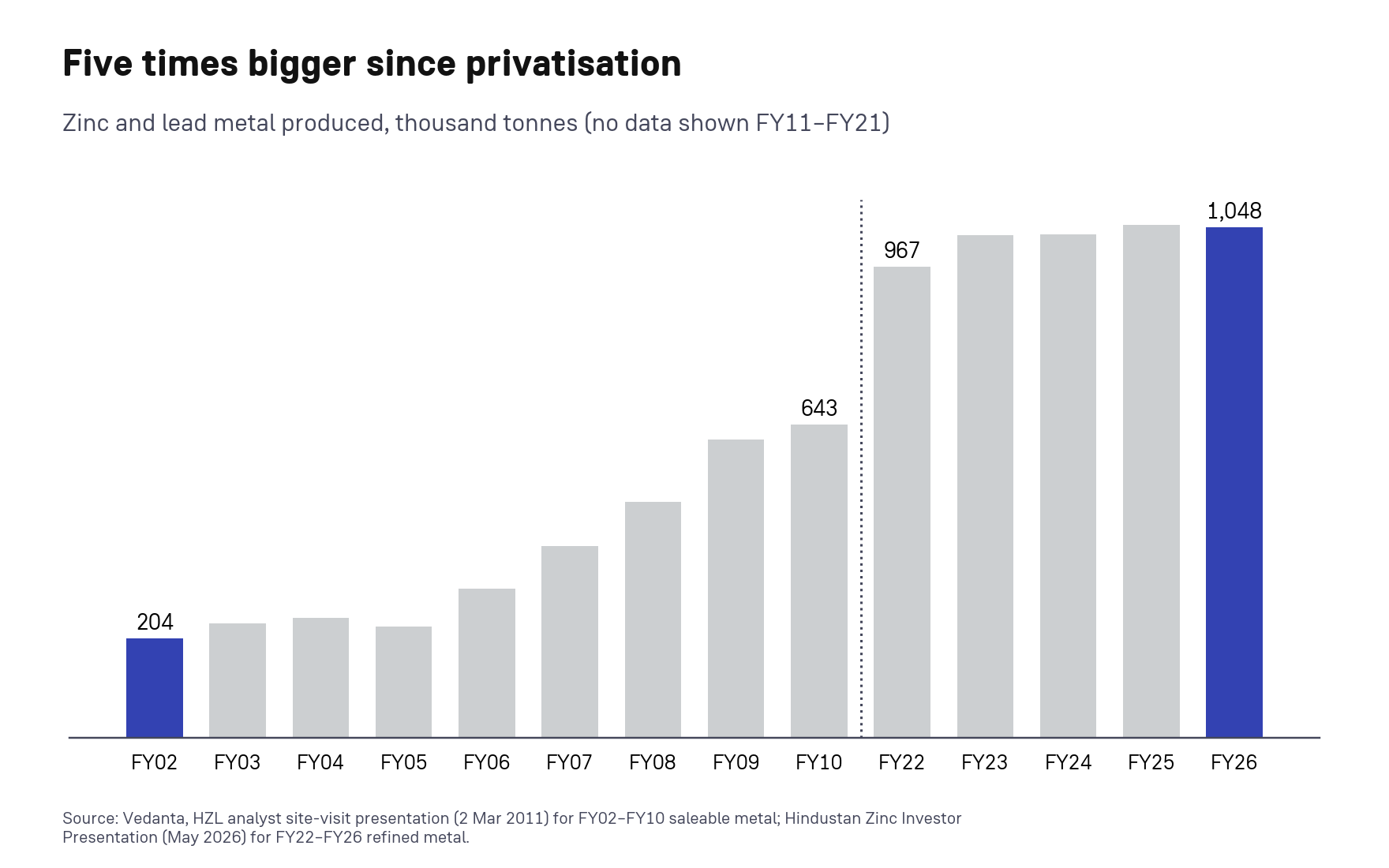
Its financial performance changed too.
Net profit increased from around Rs 68 crore in FY2002 to Rs 13,832 crore in FY26, while revenue reached Rs 40,844 crore.
Of course, higher metal prices and other changes over those 24 years also contributed to this growth.
But Sterlite’s takeover helped Hindustan Zinc expand production, build infrastructure and improve efficiency.
And there is an important difference between these improvements and the deposit itself.
Another company could also buy better machinery, build power plants and improve its mining processes.
What it could not easily copy was the rich zinc deposit Hindustan Zinc already controlled.
And as the company expanded, another metal found inside its deposits became increasingly important.
Silver.
How did a zinc company become a major silver producer?
When you think of a large silver producer, you might imagine a company operating mines specifically to extract silver.
But Hindustan Zinc gets its silver while mining rocks mainly for zinc and lead.
This happens because the same rocks contain several valuable metals. Silver is often found alongside lead minerals, allowing some of it to be recovered during zinc and lead processing.
Think about what this means for costs.
Hindustan Zinc has already spent money digging, transporting and crushing the rock to extract zinc and lead. Recovering silver from that same material gives it another product to sell without needing a completely separate mining operation.
Silver is not free, since refining it still costs money. But much of the expensive mining work is shared across several metals.
And this business has grown enormously.
In 2002, Hindustan Zinc produced just 47 tonnes of silver. Production increased as the company expanded its mines and invested in recovering more silver.
One important mine was Sindesar Khurd, which was commissioned at commercial scale in 2007.
Silver is not equally concentrated across Hindustan Zinc’s mines. As of March 2025, Sindesar Khurd’s ore reserves contained about 92 grams of silver per tonne, compared with 37 grams at Rampura Agucha.
So while Rampura Agucha is especially important for zinc, Sindesar Khurd plays a major role in silver production.
Silver production eventually reached a record 746 tonnes in FY2024. It then declined to 687 tonnes in FY2025 and 627 tonnes in FY2026.
But something interesting happened to its revenue.
In FY26, Hindustan Zinc earned Rs 9,841 crore from silver sales, up 61% from Rs 6,130 crore in FY25, even though production had fallen by 9%.
The reason was higher silver prices. The average price increased from around $30.4 per ounce in FY25 to $53.1 in FY26, a rise of about 75%.
As a result, silver accounted for around 24% of Hindustan Zinc’s total revenue but contributed roughly 45% of its overall profitability, according to the company.
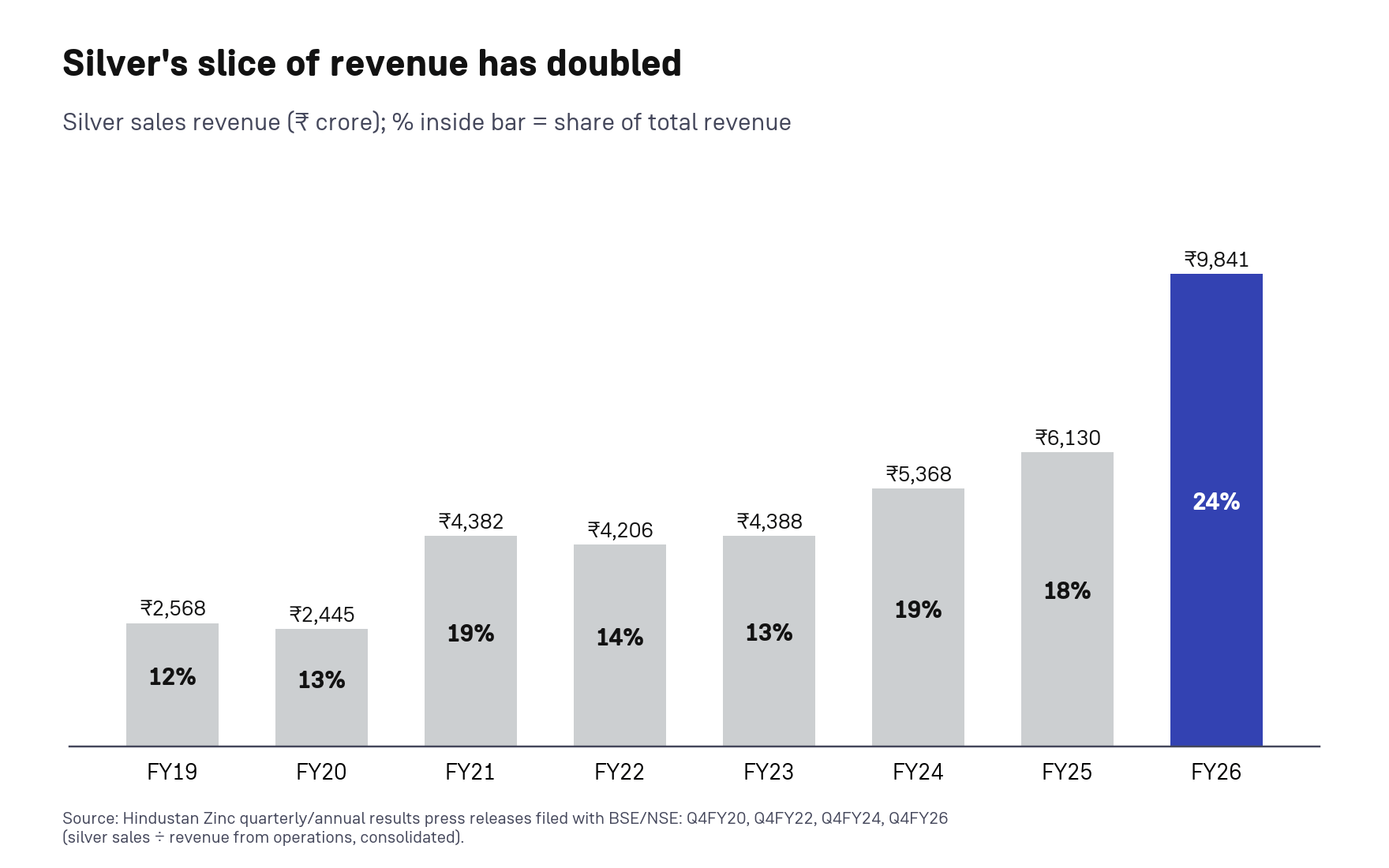
So while silver has become a valuable part of the business, higher prices have also played a big role in its recent growth.
That is a risk because Hindustan Zinc cannot control silver prices.
But the underlying advantage remains.
The same rock that produces zinc and lead can also produce silver, helping Hindustan Zinc earn more from the material it has already paid to mine.
But Hindustan Zinc is not the only company that recovers silver while mining other metals.
So what else makes its business difficult to compete with?
Why owning the mine and the smelter matters
Say there are two zinc companies.
One owns a mine but must send its extracted material to another company to turn it into metal. The other owns a zinc-processing factory but must buy raw material from miners.
Both businesses can work, but each depends on someone else for an important part of production.
Take Korea Zinc, one of the world’s major zinc processors. Much of the raw material for its factories comes from outside mining companies.
When miners sell material containing zinc to these factories, they negotiate a fee for turning it into metal. This is called a treatment charge.
When that raw material becomes scarce, factories compete to secure it, and the fees they can charge generally fall.
For example, the annual benchmark zinc treatment charge fell from $165 per tonne in 2024 to $80 in 2025, according to Reuters.
Hindustan Zinc avoids much of this problem because it owns both its mines and the factories that process their output.
Its mines, processing facilities and major zinc and lead factories at Chanderiya, Dariba and Debari are concentrated in Rajasthan.
So it can use material from its own mines without depending as heavily on outside suppliers. Having the facilities relatively close together also reduces transport requirements.
Being based in India helps too. Indian customers can buy Hindustan Zinc’s metal without the same international shipping costs and delays involved in importing zinc.
Of course, imported zinc still competes with its products. But Hindustan Zinc now supplies around 74% of India’s primary zinc market.
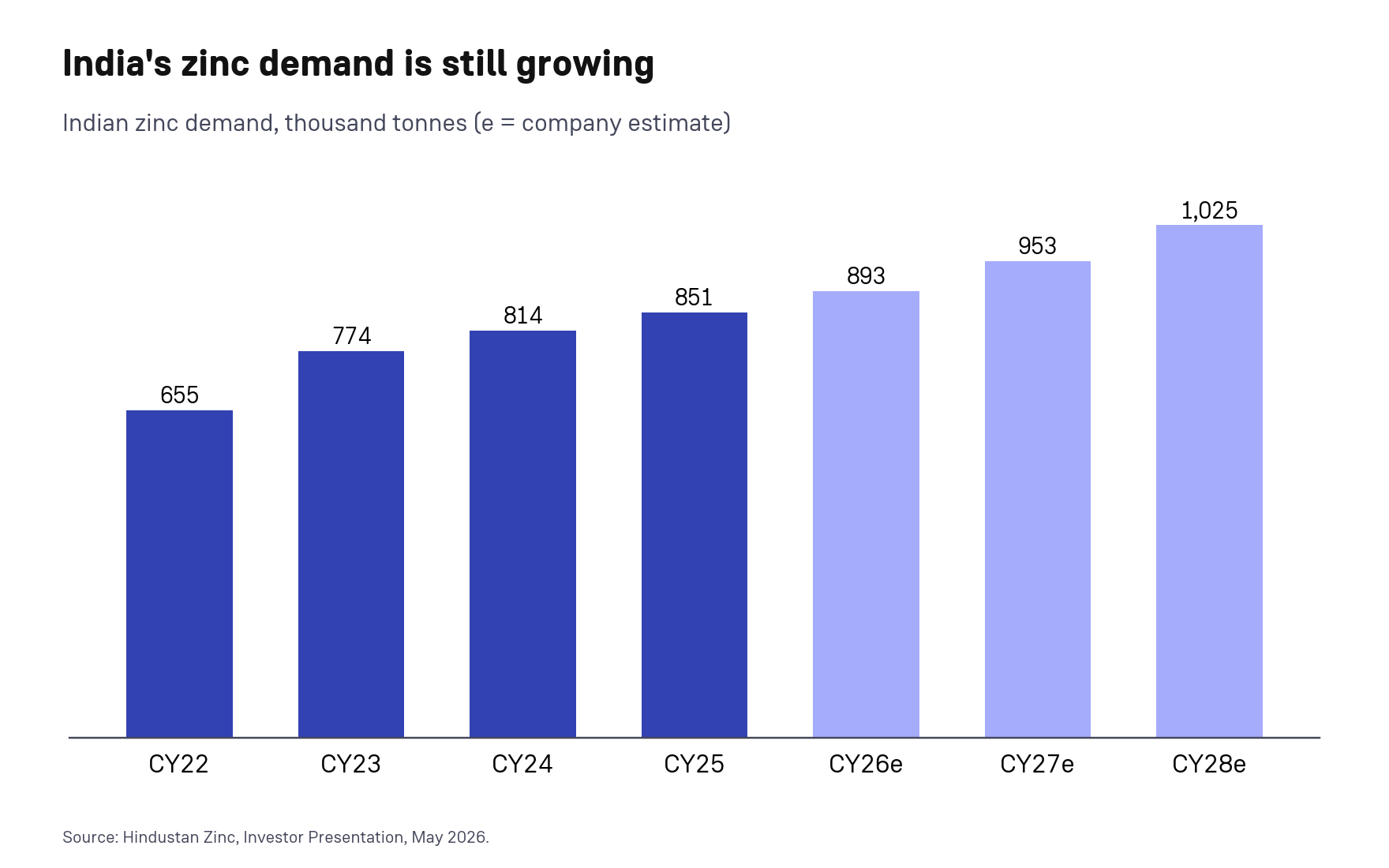
So its advantage is not simply that it owns a good mine.
It controls much of the journey from extracting zinc underground to selling finished metal to customers.
And all this becomes particularly important when global zinc prices fall.
Because the less a company spends producing each tonne of metal, the more money it can potentially keep.
What does it really cost Hindustan Zinc to produce zinc?
Remember what happened in FY2002? Zinc prices fell sharply, and Hindustan Zinc’s profit dropped nearly 60% even though it was producing more metal.
This is why production costs matter so much.
If two companies sell zinc at roughly the same global price, the one that spends less producing it generally earns a higher profit.
Hindustan Zinc says it is among the world’s lowest-cost zinc producers.
Its zinc production cost fell from $1,052 per tonne in FY25 to $959 in FY26, a reduction of around 9%.
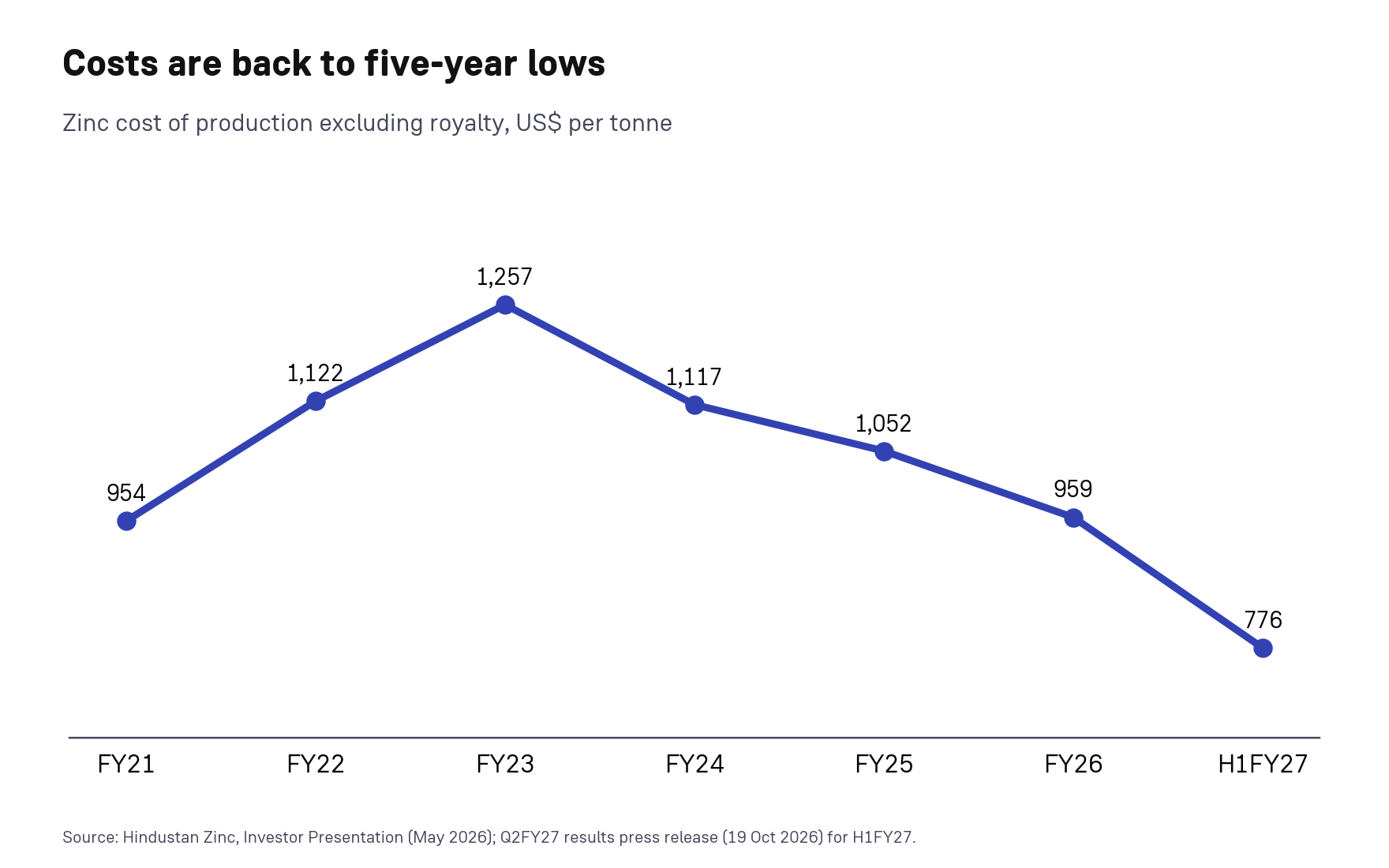
But this figure excludes royalty, which is money mining companies pay the government for extracting minerals.
Including royalty, Hindustan Zinc reported a production cost of $1,370 per tonne in FY26. The difference comes from the company’s cost-reporting definitions and should not be treated as the exact royalty payment alone.
Now compare this with the selling price.
The average global zinc price in FY26 was around $2,970 per tonne, substantially higher than Hindustan Zinc’s reported production cost.
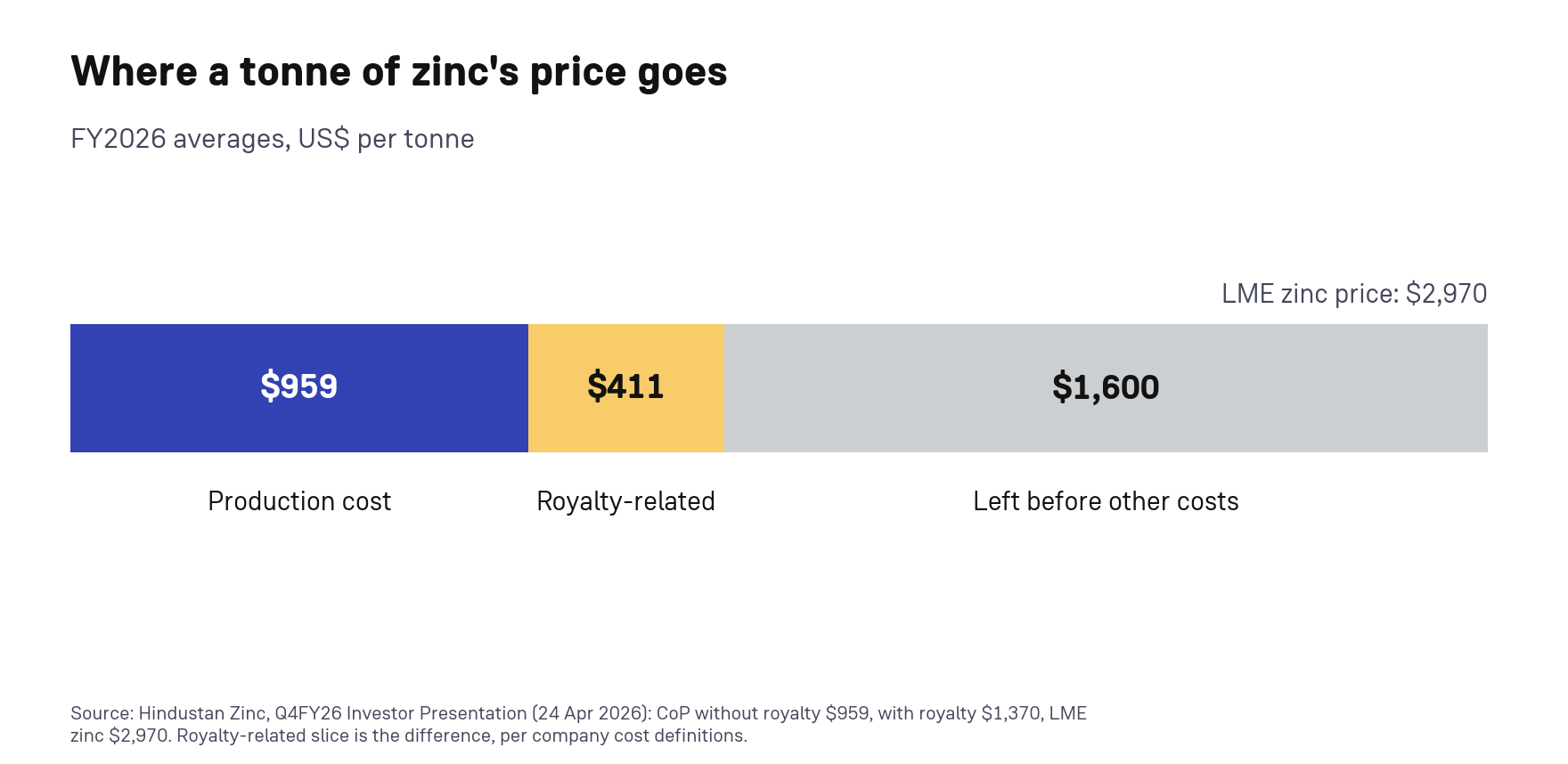
That difference was not pure profit, since the company still had other expenses. But it helps explain why producing zinc cheaply is valuable.
When zinc prices fall, every producer receives less money for its metal. But a company that produces zinc at a lower cost has more room before falling prices seriously hurt its profits.
Hindustan Zinc’s rich deposits, large mines, nearby factories and power infrastructure all contribute to this advantage.
But even a low-cost producer cannot control global prices. Its costs could also rise if mining becomes harder or government charges increase.
And that brings us to another important question.
Could another company build a Hindustan Zinc?
A competitor with enough money could buy mining machinery, hire experienced engineers, build zinc-processing factories and arrange electricity.
But finding another deposit like Rampura Agucha would be much harder.
Companies can spend years surveying land and drilling holes without finding a deposit large or rich enough to mine profitably. Even after finding zinc, they must secure government permission and spend years building the infrastructure.
Hindustan Zinc has already done much of this work over several decades.
That is why its competitive advantage is difficult to copy.
But there is another way a competitor could try to gain access to a rich deposit.
Instead of finding a new Rampura Agucha, it could compete for the right to mine the existing one.
And that is where 2030 becomes important.
2030
A mining company needs a lease, or government permission to extract minerals for a fixed period. And some of Hindustan Zinc’s most important leases are approaching expiry.
Rampura Agucha and Zawar have leases ending in March 2030, while Rajpura Dariba’s also ends around 2030.
Together, these three mines accounted for around 76% of Hindustan Zinc’s total mined metal production of 11.14 lakh tonnes in FY26.
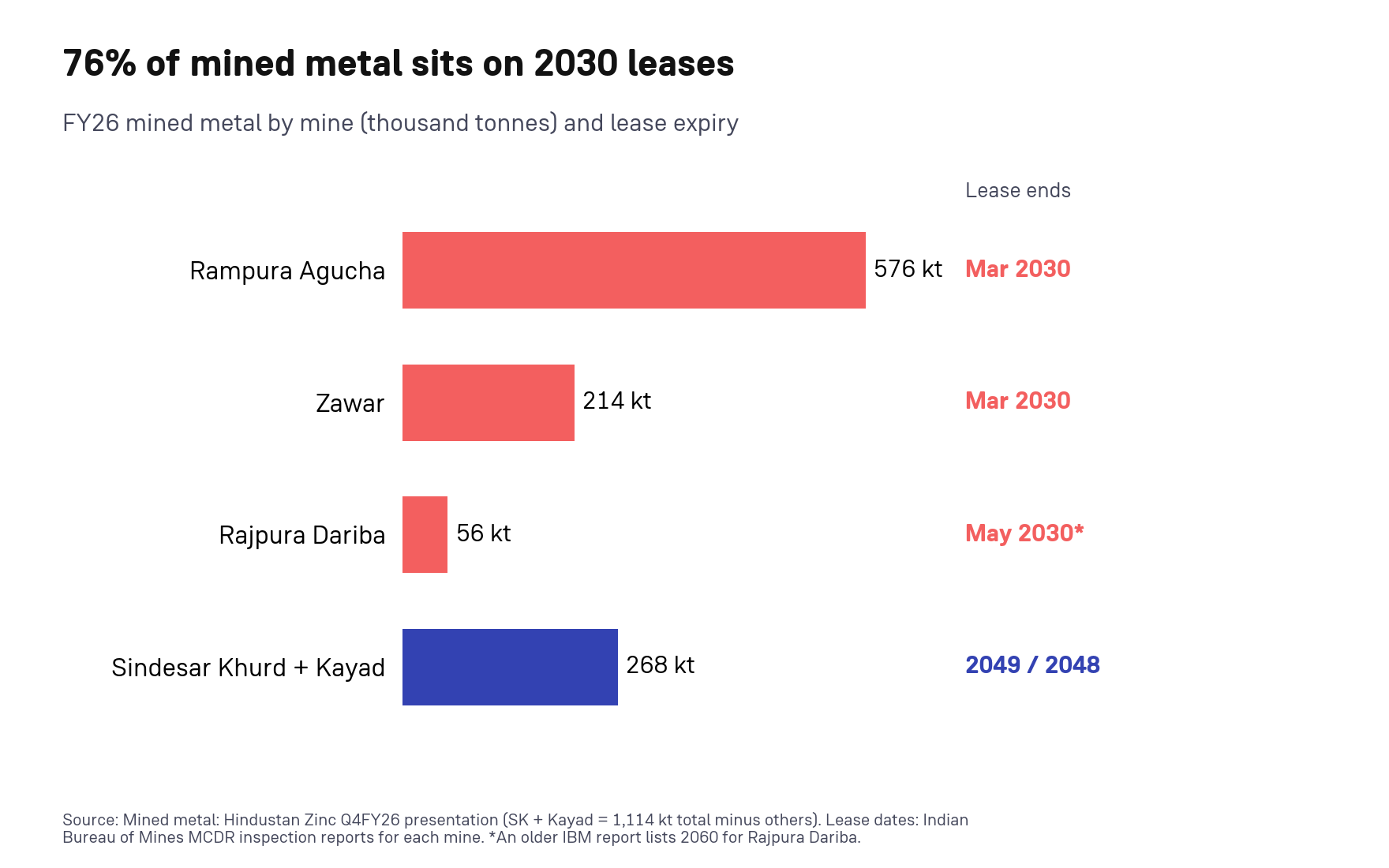
This is their share of production, not profits. Sindesar Khurd and Kayad have longer leases, running until 2049 and 2048, respectively.
So what happens when these leases expire?
Under India’s mining laws, qualifying leases are generally auctioned, allowing other companies to bid. But eligible existing operators can have a right of first refusal, meaning they can match the winning bid and keep the mine.
These three leases were extended until 2030 as captive leases, meaning the ore feeds the company’s own smelters.
This could allow the company to match the winning bid when the mines are auctioned, although the final legal position and auction rules will still matter.
Even if it retains the mines, it might have to pay the government more for every tonne mined, reducing its profits.
Hindustan Zinc has an advantage over new bidders because it already has the machinery, factories and decades of experience needed to operate these mines. But if retaining the leases becomes too expensive, some of that advantage could be lost.
Credit rating agency ICRA has also highlighted this risk.
And even if Hindustan Zinc keeps its mining rights, the zinc underground will not last forever.
What happens when the ore starts running out?
Unlike a factory, a mine gradually uses up what makes it valuable. Every tonne of ore extracted is gone.
At Rampura Agucha, the remaining ore reserves have stayed relatively stable, but their estimated zinc concentration has declined from 11% in March 2024 to 10.7% in March 2025 and 9.6% in March 2026.
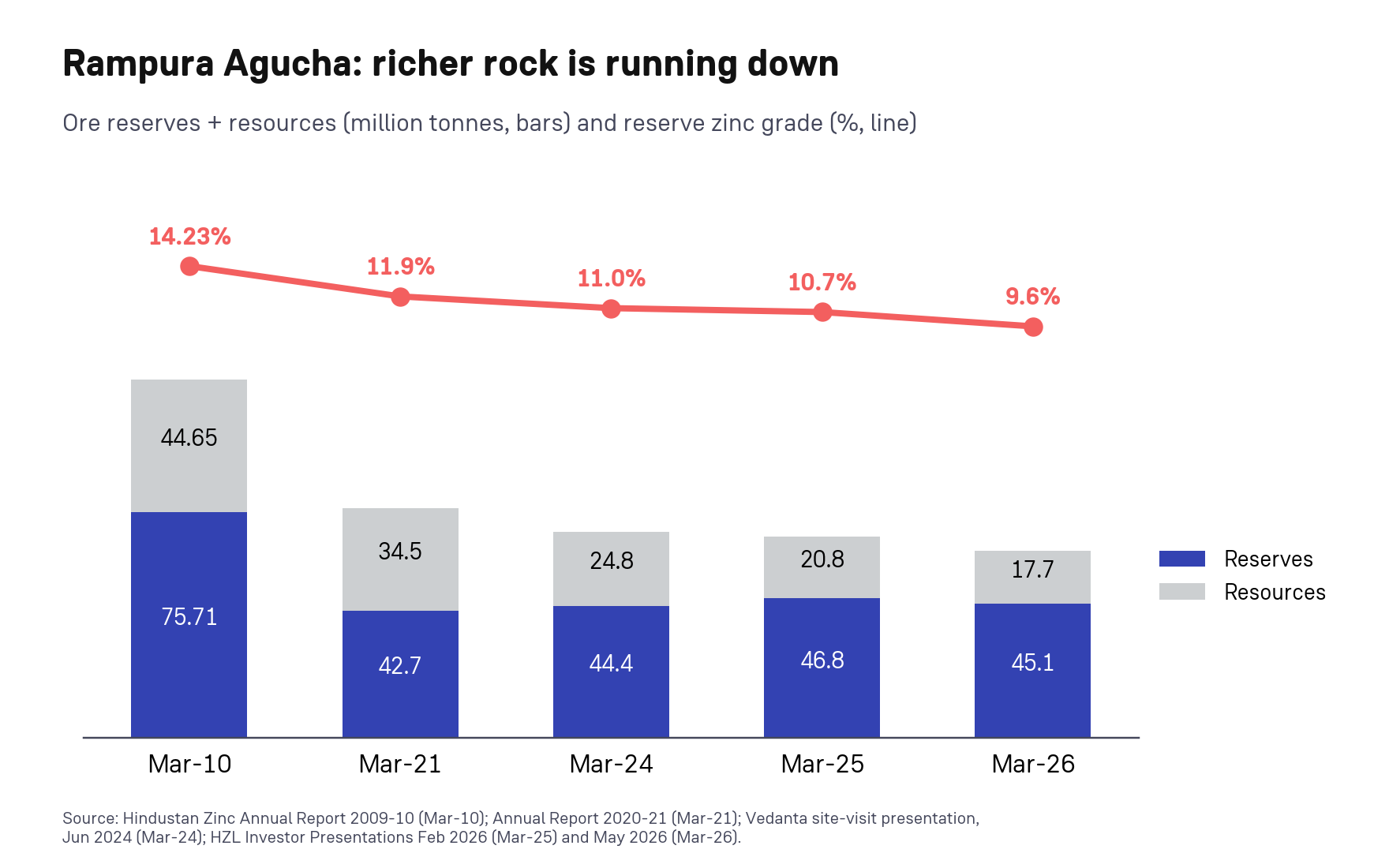
Lower zinc concentration means more rock generally needs to be processed to produce the same amount of metal, potentially increasing costs.
However, these figures refer to remaining reserves, not the ore currently being mined. In FY25, the ore actually extracted averaged about 11.7% zinc (13.4% zinc and lead combined).
Across all its mines, Hindustan Zinc had 219.1 million tonnes of ore reserves in March 2026, with an average zinc grade of just under 5%, much lower than Rampura Agucha.
So the company continues searching for more ore around its existing mines.
It reported 468.6 million tonnes of combined reserves and resources, which management estimates could support over 25 years of mining. Resources include identified deposits that may need further work before they can be mined profitably, so this is not a guarantee.
Hindustan Zinc is also investing up to Rs 3,823 crore in a plant to recover more metals from 10 million tonnes of leftover mining material annually.
This can help it earn more from ore already mined, but it cannot create new deposits.
What could make the advantage weaker?
Apart from the 2030 leases and declining ore quality, Hindustan Zinc faces other risks.
Global zinc, lead and silver prices can fall, affecting profits. Silver alone contributed around 45% of profitability in FY26, making its price particularly important.
Its concentration in Rajasthan reduces transport costs but creates exposure to local regulations and disruptions. Future expansion also requires large investments, and projects can face delays.
There is also the question of how much profit reaches shareholders after expenses and payments involving parent company Vedanta. Some related-party transactions have attracted scrutiny, although that does not automatically mean anything improper happened.
So an excellent business advantage does not automatically make an excellent investment.
It started with the rock, but it does not end there
Think back to the rusty-looking rocks Rampuria noticed in 1977. They led to one of the world’s most productive zinc mines.
Over the years, Hindustan Zinc built mines, factories and power plants around its rich deposits. Silver added another source of revenue, while owning the entire production process helped keep costs low.
That is what makes its business difficult to copy.
But with important leases approaching 2030, the question is how much Hindustan Zinc will have to pay to retain its mines, and how much of that advantage will continue to benefit its shareholders.