

When Japan’s first whisky was launched, it flopped.
In 1929, the “White Label” was not received well.
About 6 years earlier, Shinjiro Torii had set out to build Japan’s first whisky distillery.
He had hired Masataka Taketsuru.
Masataka had been to Scotland to learn the art.
White Label was perceived as too smoky, too heavy, and didn’t sit well with its target audience, the Japanese public.
It was at this time that Shinjiro Torii realized that directly copying the best whisky in the world was not going to work. At least not in Japan.
The Japanese wanted something else from their whisky. They wanted something lighter, more delicate, and Japanese-food compatible.
Introduced in 1937, Kakubin (“Square Bottle”) was that.
It caught on very well over the years.
Shinjiro’s idea worked.
Meanwhile, Masataka Taketsuru had different ideas.
He wanted his whisky to be more like the original Scottish whisky he had learned to make while in Scotland.
He had left in 1934 and started his own company.
Masataka insisted that his whisky should be perfectly made. The right air temperature, the right kind of water, the right wood barrels for aging, the right duration, and so on.
He was a meticulous man.
The industry evolved. While these two played a seminal role, a few others also joined the industry in Japan.
The Japanese whisky industry had players who believed in different philosophies. But their desire for perfection, nuance, and detail-oriented nature was common across the industry.
The quality was top-notch.
Then World War 2 hit. The ensuing economic crisis. All that.
Boom & Bust
Those who know Japan are well aware that the decades after World War 2 saw Japan climb by leaps and bounds.
The Japanese economy soared to new heights in the 1980s.
Japanese whisky consumption also followed a similar trajectory. It peaked a bit earlier, in 1983.
Japanese whiskies were mostly affordable and non-premium. They were for the salaryman.
In 1991, an economic slump hit Japan, and with that, corporate party budgets, individuals’ salaries, and disposable income shrank.
People were drinking less.
It did not help that the younger generation saw whisky as a drink of their parents’ generation. Sake, wine, shochu, and beer gained popularity.
Seeing dwindling demand, the Japanese whisky distillers struggled to generate strong revenues.
They scaled their operations down. They distilled less whisky.
Re-rating
Towards the start of the 2000s, Japanese whisky makers were struggling to sell their stock.
Whisky takes years to mature, and whatever they had left to age about a decade prior was not seeing enough customers.
Until this point, Japanese whisky was popular in Japan, but not outside. Japan itself was a huge whisky market, so these distillers had never felt the need to step outside much.
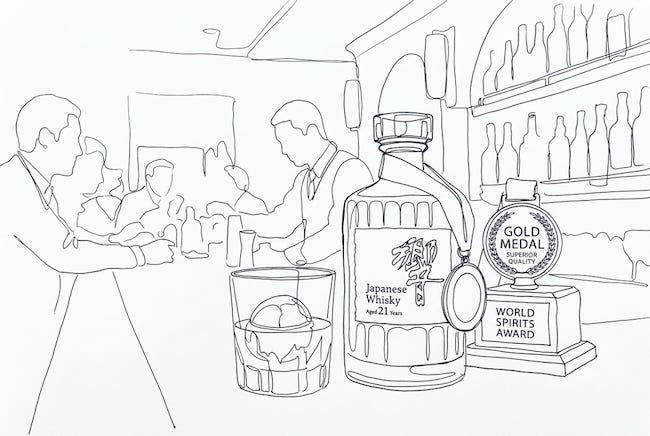
In blind tastings, the finely crafted Japanese whisky started to win awards sometime in the early 2000s — Western awards.
The Whisky Bible is an annual guide published by Jim Murray.
While it is not the only such guide, the Whisky Bible is one of the most popular.
It is subjective and not blind. It is opinionated. Jim Murray’s opinion.
Every year, Jim would sample over 1,000 new whiskies and rate them on various traits, scoring them on a scale of 100.
The highest-scoring whisky is titled the “World Whisky of the Year”.
In 2015, a Japanese whisky won this title for the first time: Yamazaki Single Malt Sherry Cask 2013.
Its price at launch in the UK was less than £100. After the “discovery”, its price rose to the £1,900 region.
The delicate and meticulously crafted Japanese whiskies had been quietly gaining global recognition. This award brought that into the open.
Whisky connoisseurs, collectors, enthusiasts, and regular whisky consumers all wanted Japanese whisky.
Whisky takes a while to age — 10 to 12 years, or even more.
And 10 to 12 years prior to the award and rise in popularity, Japanese whisky makers had been struggling and scaling down. This led to shortages in stock when demand was finally moving up.
The whisky had not changed. But the global recognition for it was new.
It had always been high quality; now, people outside Japan knew it as well.
The result, as you’d guess, was that the price shot up.
Japanese whisky had been re-rated.
Re-rated Stocks
This happens in the stock markets too.
Costco:
For years, Costco, the departmental superstore, was seen as a retail chain: high volume, low margin.
Consequently, it was priced like one.
Its revenues and profits kept climbing, but its multiple, or P/E ratio, remained in a fixed range.
(The P/E ratio or price-to-earnings ratio tells us how a stock is priced compared to its earnings per share.)
Some investors knew what Costco truly was. The wider market failed to realize this.
These investors realized that while Costco was selling high-volume, low-margin daily consumer goods, its earnings did not come from them entirely.
Instead, membership fees were the big driver. It was a gated club where members paid an annual charge to buy cheap goods.
About 50% of the company’s operating profits come from membership fees.
The renewal rate of this membership is extremely high, usually above 90%.
The company has been in a self-reinforcing loop.
Cheap goods attract more buyers. More buyers mean more volume. More volume means the company can negotiate even cheaper prices from suppliers, thereby making items even cheaper. This in turn attracts even more membership sales.
Until 2014, this company’s P/E ratio was mostly in the 20s. During the Great Recession, its P/E ratio even dipped as low as 15.
In the last 5 years or so, its P/E ratio has mostly been in the mid-40s.
Apple:
It is a little astonishing, but even years after the immensely successful launch of the iPhone, Apple’s P/E ratio was sometimes in the single digits. Mostly, it was in the 10-15 zone.
Everyone had made note of the iPhone’s stupendous success, but estimates suggested that the market for smartphones in the world was limited.
Android was offering much cheaper smartphones, and the fear was that they would saturate the market, thus eating into Apple’s share.
What they failed to realize was that Apple was able to create entirely new markets. It was able to expand the size of the markets.
Thanks to the iPhone, many new buyers who had not been smartphone users earlier also bought iPhones.
Investors recognized Apple’s ability to create markets where they didn’t previously exist.
Like Costco, Apple’s users were also extremely loyal and likely to switch/upgrade devices within the Apple ecosystem.
Further, Apple had done a fantastic job of increasing its income from services. It was not just a hardware company.
Over the last few years, Apple’s P/E ratio has often been in the 30s.
There are many other examples.
Microsoft got re-rated when it transitioned from being a PC operating system company to a cloud computing company somewhere around 2014–2020.
It went from having a P/E in single digits to being in the 30s.
If you look for more such examples, you will easily find them.
The phenomenon is not rare.
The lesson here is that many times, the wider market does not realize how good a company is.
And many other times, companies become better quality (compared to their earlier self).
In both cases, eventually, the wider market realizes and re-prices the stocks.
Their valuations are given a boost.
When companies get re-rated by the wider market, their P/E ratios often rise.
For really shrewd investors, the game is to spot a great company before it gets re-rated.
Quick Takes
+ India’s gross GST collections rose 22.9% year-on-year to Rs 2.31 lakh crore in October. Collections from imports rose 42.2%, while domestic collections increased 15.8%.
+ The price of a 19-kg commercial LPG cylinder rose by Rs 10 to Rs 2,820 in Delhi from 1 November. Prices also increased in other major cities.
+ The government introduced new aviation rules requiring airlines to clearly display cancellation charges and refund conditions when showing ticket prices. The rules will take effect on 1 January 2027.
+ TRAI tightened consumer grievance redressal rules where telecom operators can be penalised up to Rs 20 lakh per quarter per service area for improper handling of complaints.
+ SEBI recommended the government to remove long-term capital gains (LTCG) tax on foreign investors, as per media reports.
+ Coal production from captive and commercial mines rose 42% year-on-year to 22.03 MT from 15.49 MT a year ago.
+ SEBI allowed REITs and nvITs to issue Depository Receipts (DRs) backed by their units that permits them to access foreign investors.
+ IRDAI tightened Employee Stock Option Plan (ESOP) rules and reduced processing fees for share transfer among other measures in its revised framework.
+ Multi-asset international exchange, NSEIX, extended market operations for 23.5 hours from 03:15 am to 02:45 am to improve global accessibility.
+ The government approved two schemes: Rs 14,500 crore to develop 92 GWh of electricity storage capacity by FY31, and Rs 2,814 crore to support four lithium and nickel processing plants.
+ RBI received bids worth Rs 73,907 crore for its Rs 50,000 crore reverse repo auction, up from Rs 23,905 crore a day earlier. The auction helps RBI temporarily absorb excess money from banks.
+ The government shared tax devolution worth Rs 1.09 lakh crore with state governments to increase capital spending and welfare expenditure.
+ SEBI permitted mutual funds to settle cash market trades on a net basis to reduce funding requirements.
+ SEBI also revised the threshold limit for taking positions in currency derivatives involving the Rupee, without establishing underlying exposure.
+ India’s forex reserves fell $2.69 billion to $717.06 billion for the week ended 30 Oct.
+ Retail automobile sales fell 23.80% year-on-year to 31.72 lakh units in October compared to a year ago as per Federation of Automobile Dealers (FADA).
The information contained in this Groww Digest is purely for knowledge. This Groww Digest does not contain any recommendations or advice.
Team Groww Digest