

For an Indian farmer, every season is a high-stakes gamble.
The monsoon might arrive late, the soil might not be fertile enough, or a sudden pest attack might wipe out a month of labour overnight.
These are real costs that affect income and profits directly.
Nearly 45-50% of India’s workforce is still dependent on agriculture. That means millions of livelihoods swing with rainfall, crop prices, and yield cycles.
In such an environment, every decision matters, especially long-term decisions like farm equipment.
And one such investment farmers in India make is the tractor.
For most Indian farmers, a tractor means getting the crop sown on time, harvesting faster, and not having to depend too much on manual labour. It helps finish work quickly when the weather is right and ultimately helps protect yield and therefore income in a business where timing decides everything.
In many regions, tractors are central to how farming gets done. From land preparation and sowing to hauling produce and powering implements, the tractor has become the backbone of mechanised agriculture.
India has a massive farming population, and nearly 45–50% of the workforce is linked to agriculture in some way. That naturally makes tractors a big business.
In fact, India is the largest tractor market in the world by volume. In a normal year, around 9 lakh tractors are sold.
For many rural households, buying a tractor is second only to buying land or building a home in terms of financial commitment.
In a market this large, essential, and trust-driven, one company has emerged as the clear leader.
Mahindra & Mahindra.
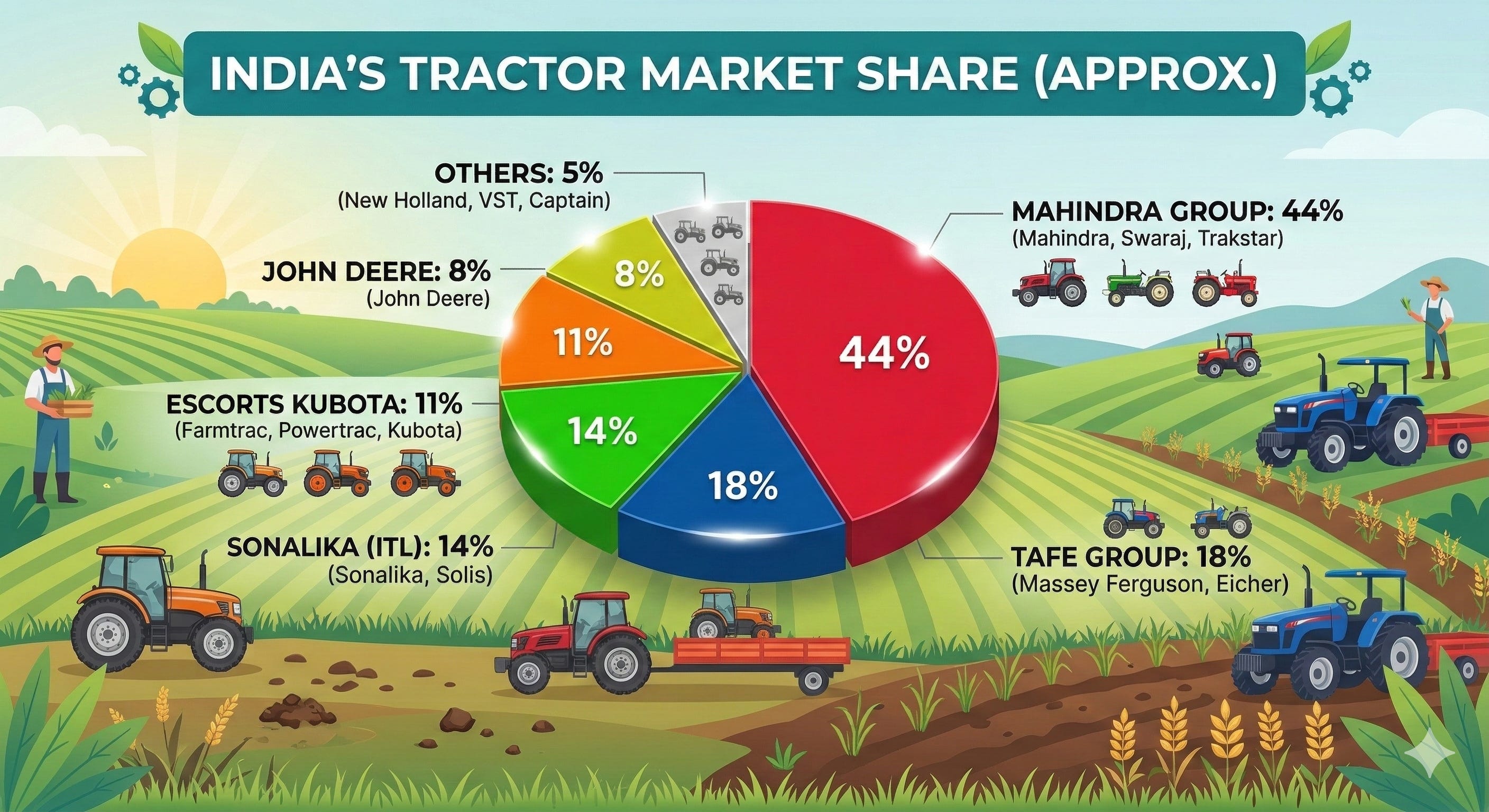
Today, roughly 40-44% of tractors sold in India carry the Mahindra badge, making it the largest player in the domestic market and the largest tractor manufacturer globally by volume.
But dominance in agriculture is not built through advertising alone. It is built through reliability, distribution reach, product suitability, and long-term trust earned in the field.
How did they earn this trust in the unpredictable climate of Indian agriculture?
Foray into the Tractor business
Mahindra & Mahindra (originally Mahindra and Muhammad) did not begin as an auto company. It started in 1945 as a steel trading business.
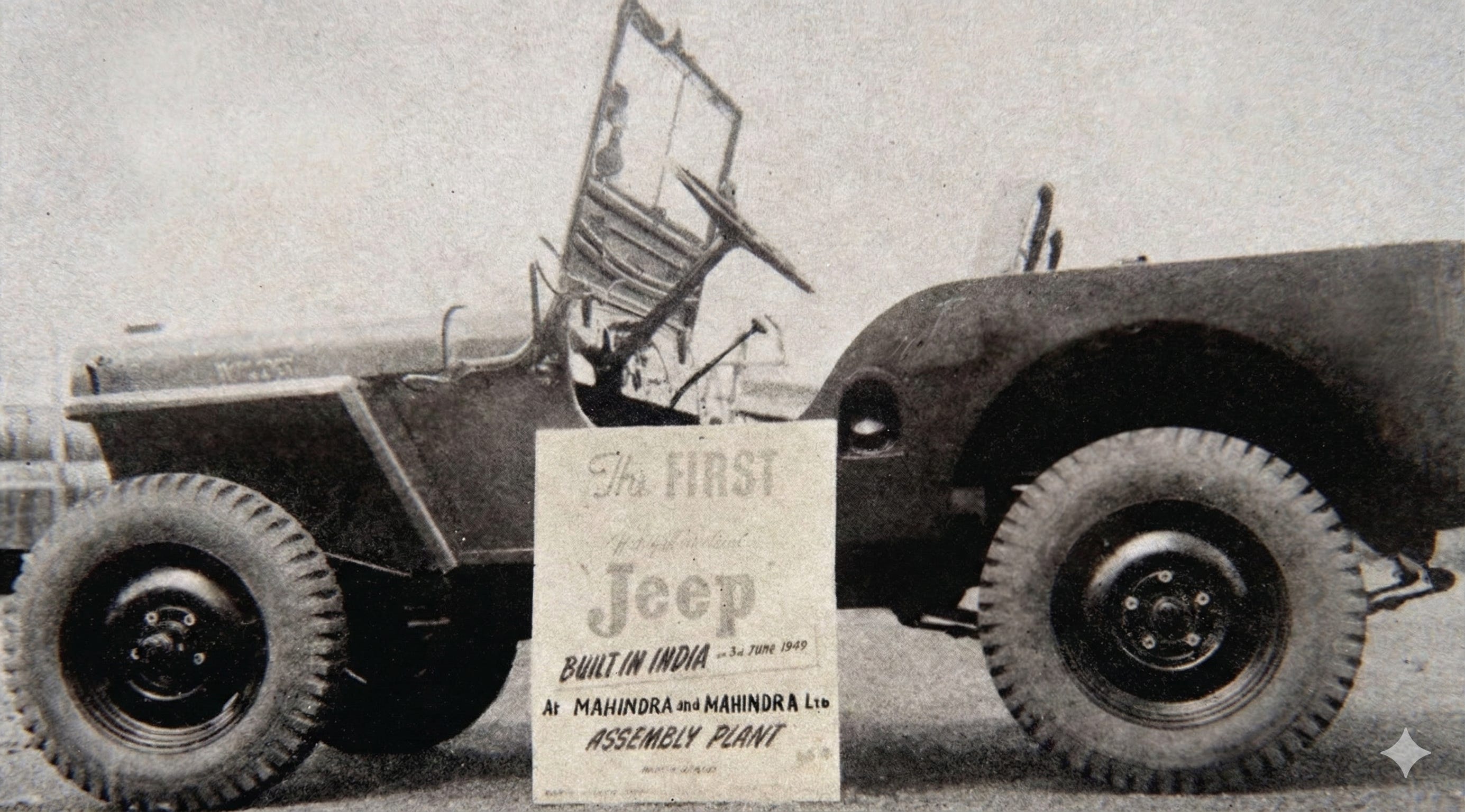
Soon after Independence, it secured a contract to assemble Willys Jeeps, designed to survive India’s ‘rugged’ terrain of rough roads and weak infrastructure.
Nearly two decades later, in 1963, it entered farm equipment through a joint venture with International Harvester, forming the International Tractor Company of India.
Their first tractor, the B-275, was based on International Harvester’s design. It was supposed to be practical, built for heat, dust, and uneven fields.
The timing worked out in their favour. The Green Revolution, India’s push in the late 1960s and 1970s toward higher-yield crops, better irrigation, and modern farming methods, was reshaping agriculture and driving demand for reliable mechanisation.
Farmers needed tractors they could trust, because a breakdown in the middle of the season was not just inconvenient; it was costly.
That trust was tested and strengthened in the 1970s. The global oil shock sent petrol prices soaring. Mahindra’s petrol-heavy Jeeps suddenly became expensive to run, and sales fell during that period.
To survive, the company adapted the diesel engine from its tractors and put it into its Jeeps.
The move acted as a signal for farmers: village mechanics who could fix a Mahindra tractor could also service a Jeep. It was a sign that Mahindra understood costs and could be trusted to build lasting machines season after season.
By 1977, Mahindra was confident enough to merge the joint venture into the parent company, formally creating its Farm Equipment Sector.
It began reducing dependence on foreign designs and innovating specifically for Indian soil and small landholdings.
In 1983, just twenty years after building its first tractor, Mahindra became the No 1 selling tractor brand in India — a position it has held for over four decades.
Trust and reliability laid the foundation of Mahindra’s dominance.
Over the years, Mahindra built multiple layers of protection around its tractor business; barriers that competitors cannot easily replicate.
Service Reach & Resale Advantage
A tractor is a crucial piece of equipment for farming. Whether it is sowing or harvesting, any malfunction means additional costs.
Over a period of time, Mahindra’s primary moat has become not the machine itself, but the accessibility of its repair.
As of early 2026, M&M operates over 1,200 main dealerships and thousands of auxiliary touchpoints, including specialized centers that provide parts, soil testing, and agronomy guidance.
This ensures that for most farmers, a service center is not too far away, something that might turn out to be a decisive factor while choosing a company.
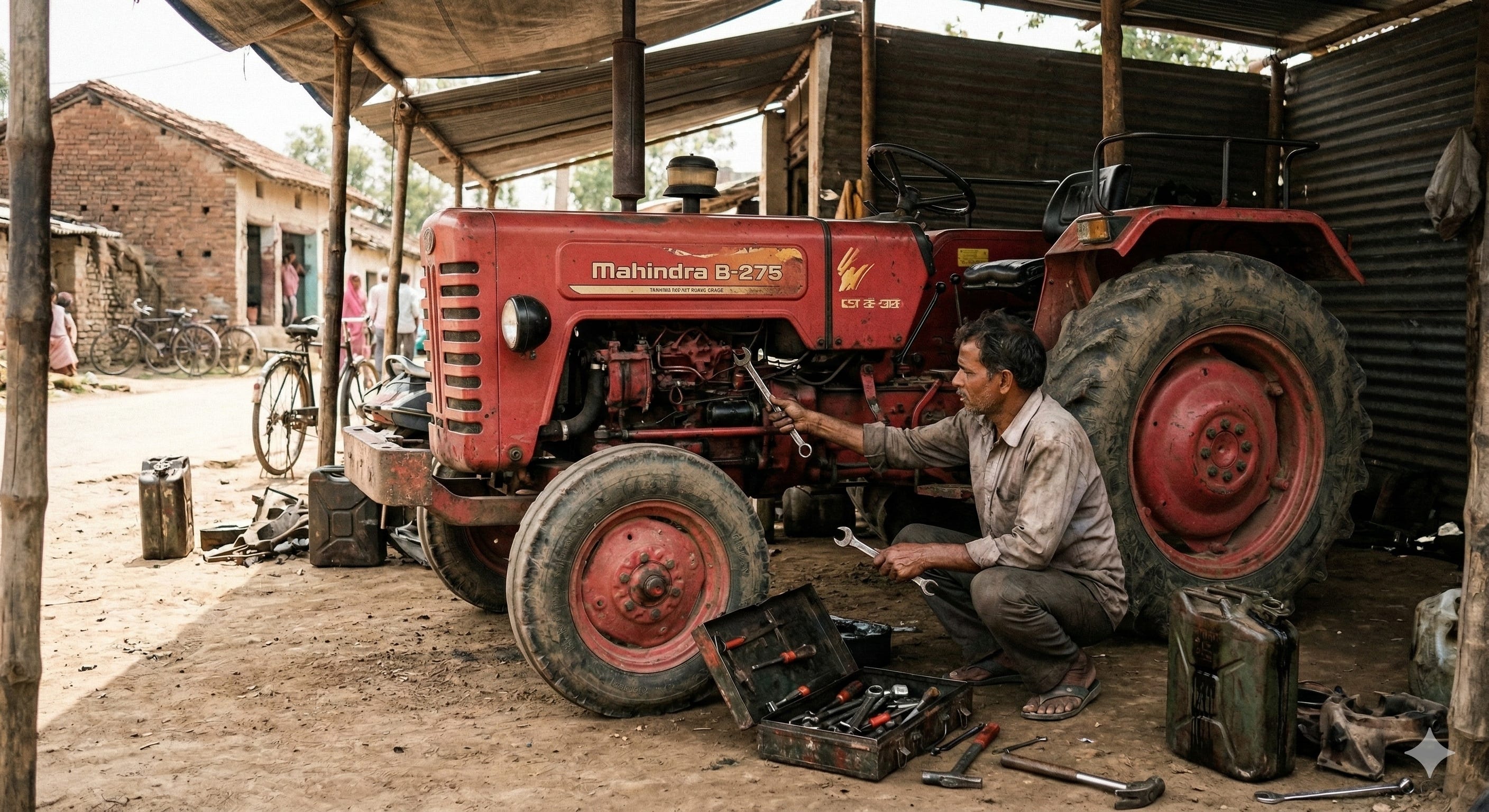
Also, Mahindra parts can be found in rural hardware stores. Unlike global competitors who require specialised parts and specific company tools, Mahindra parts are ubiquitous. They can be found in local stores.
This makes it easier for farmers to take care of their equipment if needed.
Mahindra is an old company. Decades of dominance have created a native workforce of roadside mechanics, fluent in Mahindra engines. This decentralized service network acts as a free, unofficial repair arm, ensuring a tractor can be fixed with a basic wrench and local ingenuity.
Reaching 500,000 villages requires years of network-building, dealer incentives, and mechanic training. Even with deep pockets, a new entrant would struggle to match M&M’s trust and reliability.
This strengthens another moat: resale value.
In the rural economy, liquidity matters. Farmers often need the ability to convert assets into cash quickly.
A Mahindra tractor frequently wins this race. Spare parts are affordable, mechanics are widely available, and which means that even a 10-year-old machine can retain strong value.
A niche foreign brand might offer marginally better fuel efficiency. But farmers know a Mahindra can be sold within a shorter time, often at a premium than what other brands would be at.
This high resale value lowers the cost of ownership, making it a safer financial choice for risk-averse households.
Mahindra Finance
A lot of the time, the barrier to rural mechanisation is Credit.
Traditional banks may often be hesitant to provide rural loans because many farmers lack formal payslips or standard credit scores.
Mahindra Finance tries to bridge this gap through a philosophy they call ‘Earn and Pay’.
Instead of relying purely on paperwork, the company’s aim is to assess a farmer’s income-generating potential through the tractor itself. Local officers, who live within the communities they serve, conduct field-level assessments. They evaluate crop health, land size, and seasonal cash flow to judge repayment capacity.
So, instead of waiting weeks for a bank to approve a loan, a farmer can get everything settled on the spot. With this, Mahindra ensures the sale happens instantly. This setup creates a win-win situation for the company.
They sell the machine: the company makes a profit on the tractor itself.
They provide the loan: the company earns again from the interest on the loan.
Mahindra Finance also offers quarterly repayment plans. A tractor is no longer a seasonal tool for farming. A lot of the time, it is also used for tasks like transporting bricks or sand, or local infrastructure projects during the months when the fields are quiet.
This aligning of payments with the harvest and commercial seasons ensures the farmer is never cash-poor when a payment is due.
The Multi Brand Strategy
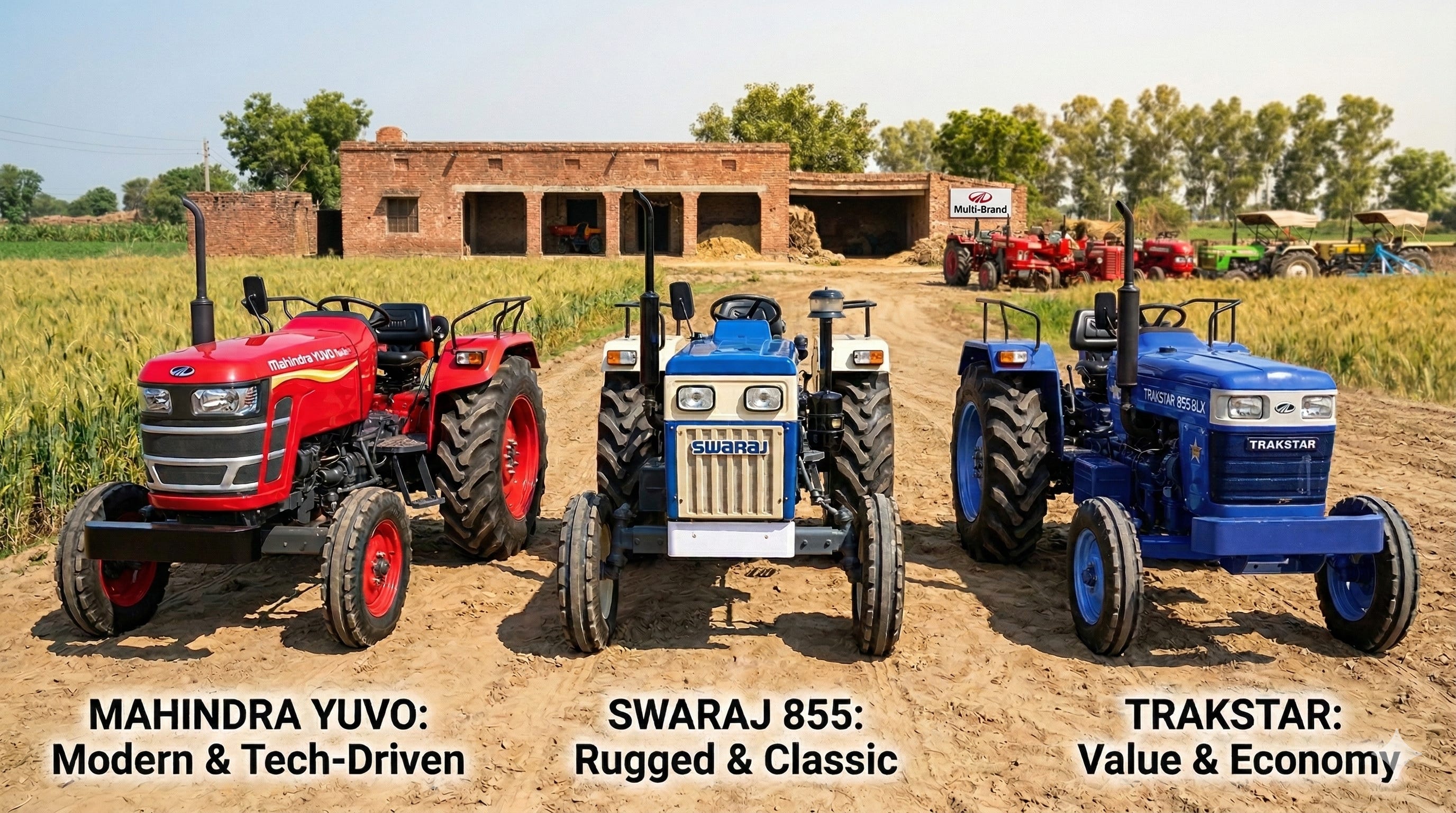
In 2007, Mahindra executed a strategic move by acquiring its largest rival, Swaraj Tractors. Instead of merging the two into a single brand, they kept them separate to appeal to different types of farmers.
Mahindra: Positioned as the modern, technology-driven brand for the aspirational farmer.
Swaraj: Positioned as the rugged brand, built with a ‘made by farmers, for farmers’ identity.
By running both brands, the company effectively competes with itself. If a farmer wants a change from a Mahindra, they can switch to a Swaraj, which follows just behind Mahindra in tractor popularity. This ensures that the majority of the market share stays within the same group.
To protect the entry-level market, they launched the Trakstar brand under Gromax Agri Equipment Ltd, a joint venture between Mahindra & Mahindra and the Gujarat government, targeting value-conscious, first-time buyers.
Future-Proofing: Tech and Strategy
M&M is also expanding into digital and technology-led services. While these changes are too new to be considered as moats, they show a strategic move, representing the company’s attempt to stay relevant as agriculture evolves.
There is the Krish-e app, which provides AI-driven crop calendars and advisory services.
On the hardware front, the Oja platform (developed in partnership with Mitsubishi) introduces automation and telematics into lightweight tractors. The platform is aimed at a new generation of farmers who are increasingly comfortable with digital tools like GPS tracking and automated hitch controls.
This digital shift is also backed by a massive structural advantage: a Rs 15,000 crore integrated facility in Nagpur. The facility will produce both traditional internal combustion (ICE) and electric (EV) tractors. By building a dedicated supplier park right next to the factory, Mahindra reduces logistics costs and supply chain risks in a way smaller players cannot match.
The company’s dominance is also the result of the compounding advantages that come with time.
After more than four decades at the top of the industry, the company has built economies of scale that new entrants would find difficult to replicate. This scale allows Mahindra to price its tractors competitively while still investing heavily in research, distribution networks, marketing and product development.
That does not mean competitors do not exist. Indian brands like Sonalika, Escorts Kubota and TAFE or international brands like John Deere are also occupying space in the market.
But being an established name in the Indian rural landscape also creates an intangible advantage. For many farmers, a Mahindra tractor is not just another brand; it is seen as a safe financial bet.
Over the years, the company has built an ecosystem that extends beyond the machine itself.
Hey Groww Team,
I enjoy the articles you publish. But it would be great to see more content around technology-business, and startups as well.
Many readers, including me, who follow finance and investing, are also interested in emerging tech companies and startup ecosystems, so I think this could add great value to the newsletter.