

In the 1600s, Spain and the Netherlands were at war.
There was no side with a clear upper hand.
The Netherlands was putting up a strong fight to defend itself.
The Spanish had colonies across the globe. One of their biggest colonies was New Spain (modern-day Mexico).
This new land had been a source of immense wealth for Spain.
Lots of gold and silver was being shipped from New Spain to Spain (Europe).
This consistent supply of money was one of the biggest reasons why Spain had sustained the war for so many decades.
Ships would sail from New Spain in groups. Sailing alone was risky since there was always the fear of pirates and bad weather.
For Spain, this practice had become routine. By that point, they had been importing gold and silver for about 100 years. They had grown to rely on this inflow of wealth.
In 1628, it had already been 60 years since the start of the war. The Dutch were desperate to find alternative ways to deal with Spain.
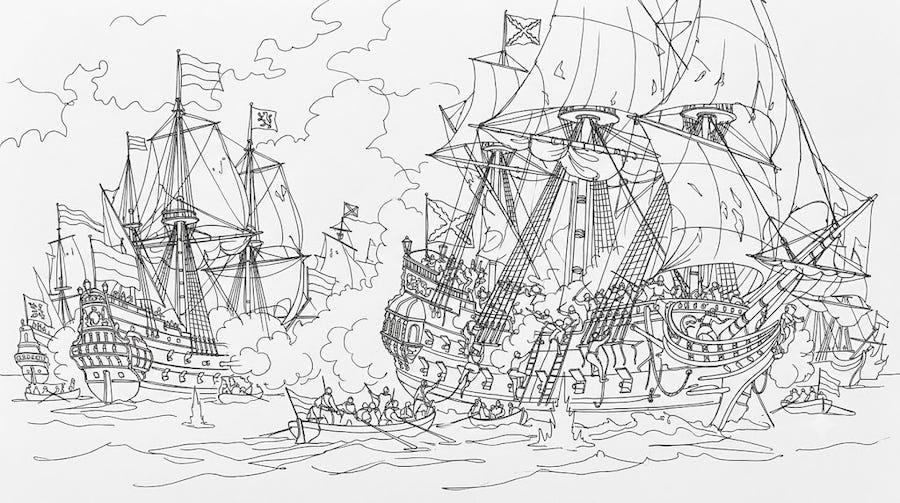
A fleet of 50 ships was sent to the Caribbean to intercept the Spanish ships’ fleet. The idea was a good one.
If the gold and silver never reached Spain, it would struggle to fund the war against the Netherlands.
Multiple Plans Fail
The Dutch ships, after a long journey across the Atlantic Ocean, were low on food supplies.
Scouting for food supplies, they went to different ports and docked. They managed to find enough goats and donkeys on a deserted island in the West Indies.
There they left a crewman behind.
This crewman ended up being captured by the Spanish. When interrogated, the crewman revealed the full plan to the Spanish.
The plan had failed.
The Dutch, however, were not aware that their plan had been discovered by their enemies.
A little way ahead, they waited for the Spanish ships to cross.
The Spanish, equipped with their newly acquired intelligence, came up with a simple strategy.
They knew the Dutch didn’t really have any support in this part of the world.
Eventually, their supplies would run out. Hunger and illness would set in, and the Dutch ships would leave.
The Spanish ships waited at two different ports.
The Dutch, unaware of the Spanish ships’ plans, continued patrolling the waters around Cuba.
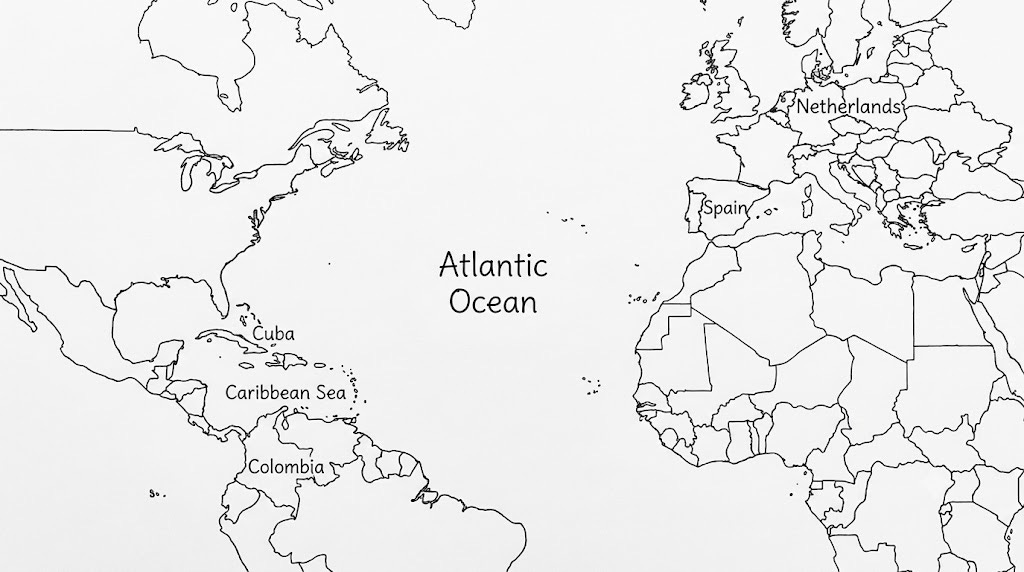
Weeks passed, and the Dutch found no Spanish ships crossing them.
Eventually, the Dutch ships’ food supplies started running low. The Spanish plan was working.
The captain spearheading the Dutch expedition noticed that sailors of his fleet were starting to fall ill.
He had come with about 50 ships and decided to send 19 back with the sick. He hoped that the reduced burden would allow them to sustain their patrolling effort for longer.
The Spanish had placed their messengers and informants to keep an eye on this fleet.
Seeing these Dutch ships turn around was exactly what they had strategically planned for.
But even their planning was not airtight.
When they noticed some of the Dutch ships leaving, they assumed they were all turning around. They failed to notice that fewer than half the ships had actually gone back.
After some gap, the Spanish ships, 16 of them, set off on their journey across the Atlantic.
And to their surprise, the Dutch were waiting.
When they entered the Cuban waters, they were spotted by the Dutch who started chasing.
The Spanish ships were commanded by someone who lacked sea-combat experience. The ships were also overloaded with treasure to the point that the sailors found it difficult to use their guns.
Heavily outnumbered by 31 Dutch warships, the 16 treasure ships were captured.
Overjoyed with the treasures they had bagged, the Dutch actually treated their Spanish prisoners well. They were given enough food and water and left on the shores, to walk back to civilization.
The captured gold and silver weighed over 90 tons. Most of it was silver.
These 16 captured ships made up a third of all Spanish ships in the region.
The wealth captured helped the Dutch sustain their war effort for about 8 months. It was a huge hit to the Spanish.
The war continued for nearly 20 years after this heist. But the heist did severely dent Spain’s ability to fight.
Indirectly, it can be said that the capture of these ships helped end the war between Spain and the Netherlands.
Moving Money
Moving money across vast distances is not easy. There are always extreme safety risks en route.
This is not an isolated event in history.
It might be easy to imagine merchants’ and traders’ wealth getting ransacked while travelling.
What’s more fascinating is that even governments were not immune — there are plenty of examples of that as well.
Thankfully, today, money moves a lot more easily and faster. And, safer too.
It is why the economy runs as smoothly as it does today.
So, how does it all happen?
One of the biggest reasons for the money’s safety is that the cash does not really move as such. A system called the SWIFT system is the most common global bank-network system.
And it works more like a secure messaging system.
SWIFT
Society for Worldwide Interbank Financial Telecommunication (SWIFT) is based in Belgium.
It was established by a group of 239 banks from across 15 countries in 1973. The idea was to standardize and automate the international money transfer mechanism.
Over the years, the system has grown to include more member banks from different countries. So much so that today, it is almost the default method of making international payments.
How does it work?
Imagine WhatsApp, but for banks.
Member banks are given access to the SWIFT portal. Using this portal, all they do is tell the bank on the other side that the money has moved from person X to person Y.
Example:
Say there is a company in Italy, Italiano Coffee, buying factory equipment from Tokyo Equipments, in Japan.
They agree to pay each other in the Japanese currency, Yen.
The Italian company asks its bank to pay Tokyo Equipments.
The Italian bank converts the money (which is in Euros) to Yen.
The two banks talk to each other.
The Italian bank tells the Japanese bank, “We have received money from Italiano Coffee. Please move the equivalent amount into Tokyo Equipments’ bank account from our account”.
Done — the money has moved out from Italiano’s account and at the same time, money has been deposited into Tokyo Equipments’ account.
The key point to note here is that banks that deal with each other maintain bank accounts with each other.
So, the Italian bank has a bank account with the Japanese bank. And the Japanese bank has a bank account with the Italian bank.
When Italiano Coffee pays, the Italian bank moves the equivalent amount from its Japanese account into the Japanese account of Tokyo Equipments.
The Italian bank has a Yen account, and the Japanese bank has a Euro account.
Notice that money never crossed borders during this exchange.
The money went from one account in Japan to another account in Japan.
It is actually a bit more complicated than that.
Many countries use US dollars to trade even though they might use their own currency within their country.
In such cases, both countries’ banks would maintain accounts in the US or in banks that deal with the US dollar.
Yes, confusing. But that is how it works.
SWIFT is not really a platform to send or receive money. It’s a platform that lets banks securely talk to each other in a fixed format.
Banks that offer services to send money across borders are members of the SWIFT system.
Membership of this backbone of international payments is almost a non-negotiable for international trade.
In 2022, when the Russia-Ukraine war started, Europe gradually barred many Russian banks from the SWIFT system.
This made it extremely difficult for the Russians to trade with the rest of the world. It was one way the Europeans levied sanctions on Russia.
SWIFT is not the only such system.
Many parallel systems exist that are based on other currencies.
But SWIFT is the biggest and most significant one.
So whenever you hear about India receiving FII inflow or FDI investment, you can assume that it was mostly routed via the SWIFT system.
And yes, it is many times safer than how the world used to send money across borders.
But that doesn’t mean it is 100% safe.
Hacks and exploits exist even today. It is a constant game of cat and mouse, in which online pirates are kept at bay most of the time. But failures do happen from time to time.
Quick Takes
+The government approved the rollout of flex fuel vehicles capable of running on E20 to E100 ethanol blends under the new Central Motor Vehicles Rules, 2026.
+A total of Rs 17.73 lakh crore was spent on 1,853 infrastructure projects from a total budget of Rs 37.56 lakh crore, as of September. Transport and Logistics accounts for the highest number of ongoing projects (1,320 projects) worth Rs 20.07 lakh crore.
+The government cleared acquisition proposals worth Rs 2.12 lakh crore for defence forces. About 82% of the procurements will be made from the Indian industry.
+The due date for companies to file financial statements for FY25-26 is extended up to 31 December without payment of additional fees. Annual returns can be filed up to 31 January.
+India’s outward FDI fell 13.96% to $4.34 billion in September compared to $5.05 billion in August according to RBI data. Outward FDI is the significant investment made by Indian companies in foreign companies.
+India’s total number of broadband subscribers rose 0.59% to 1,107.68 million in September compared to 1,101.21 million in August: TRAI.
+SEBI extended the deadline for compliance by Debenture Trustees for activities outside of SEBI’s purview to April 2027.
+India’s Industrial Production (IIP) slowed to 6.7% in September from 8% in August. Manufacturing and electricity & gas supply sectors were the top contributors this month.
+The government increased the Dearness Allowance (DA) and Dearness Relief (DR) by 3% with effect from 1st July, which will cost the treasury Rs 10,016.10 crore annually.
+A budget of Rs 10,000 crore up to FY 2039-40 was approved by the government for Container Manufacturing Promotion Scheme (CMPS).
+The government approved Pradhan Mantri Viksit Gram Swaraj Yojana for 5 years with a total budget of Rs 7,395.55 crore. The central government will fund Rs 4,869.48 crore and the remaining will be covered by the state government.
+Jio Platforms listed at Rs 1,358 on NSE, a premium of 21.36% over its issue price and closed 26.81% higher. It became the second most valued company on listing, in terms of market cap.
+India’s forex reserves fell $1.27 billion to $719.75 billion for the week ended 23 Oct.
+India’s fiscal deficit widened to 42.1% of the annual budget estimates between April and September, from 36.5% in the same period last year.
+The government defended the valuations and bidding process for IDBI Bank- Fairfax deal, saying that the procedure adopted helped increase the transaction value by Rs 3,917 crore.
The information contained in this Groww Digest is purely for knowledge. This Groww Digest does not contain any recommendations or advice.
Team Groww Digest