

In 1867, German-born pharmacist named Henri Nestle did something extraordinary in Switzerland. A premature infant who was unable to tolerate his mother’s milk was near death.
Nestle’s solution?
A scientifically designed food known as Farine Lactée, made up of cow’s milk, wheat flour, and sugar (literally ‘flour with milk’).
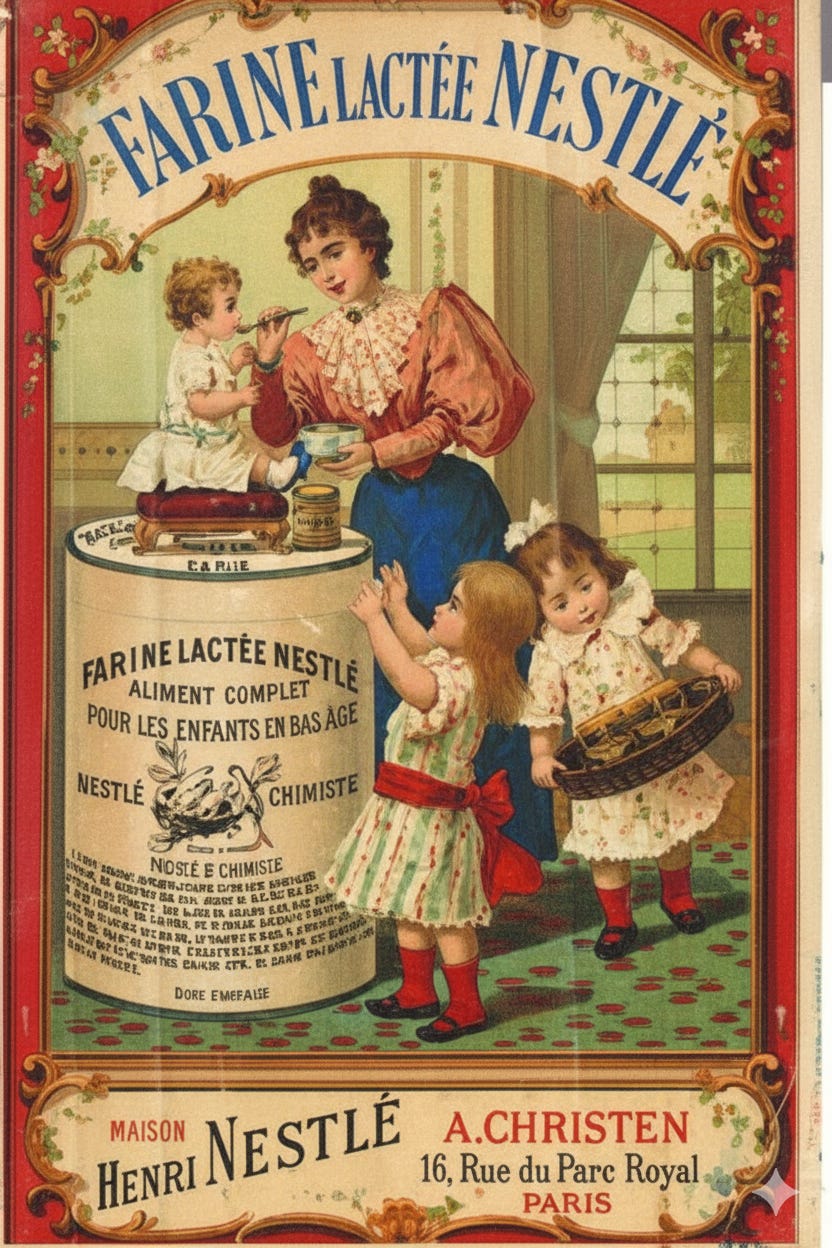
It wasn’t just milk powder. Farine Lactée was the world’s first infant cereal, designed to be digestible, nutritious, and with a shelf life. This was at a time when infant mortality was high and alternatives to breastfeeding were unreliable.
More than a century later, this product has produced one of the most unusual market outcomes in India.
Nestle India, now worth over Rs 2.5 lakh crore, is a household name with brands like Maggi, KitKat, and Nescafé.
Yet, the company’s most structurally powerful business is the least visible. The same one that started it: infant nutrition or to put simply, baby food. .
Here’s the strange part:
In this market, advertising is banned. Promotions are illegal. Every move is closely watched by regulators and public-health groups.
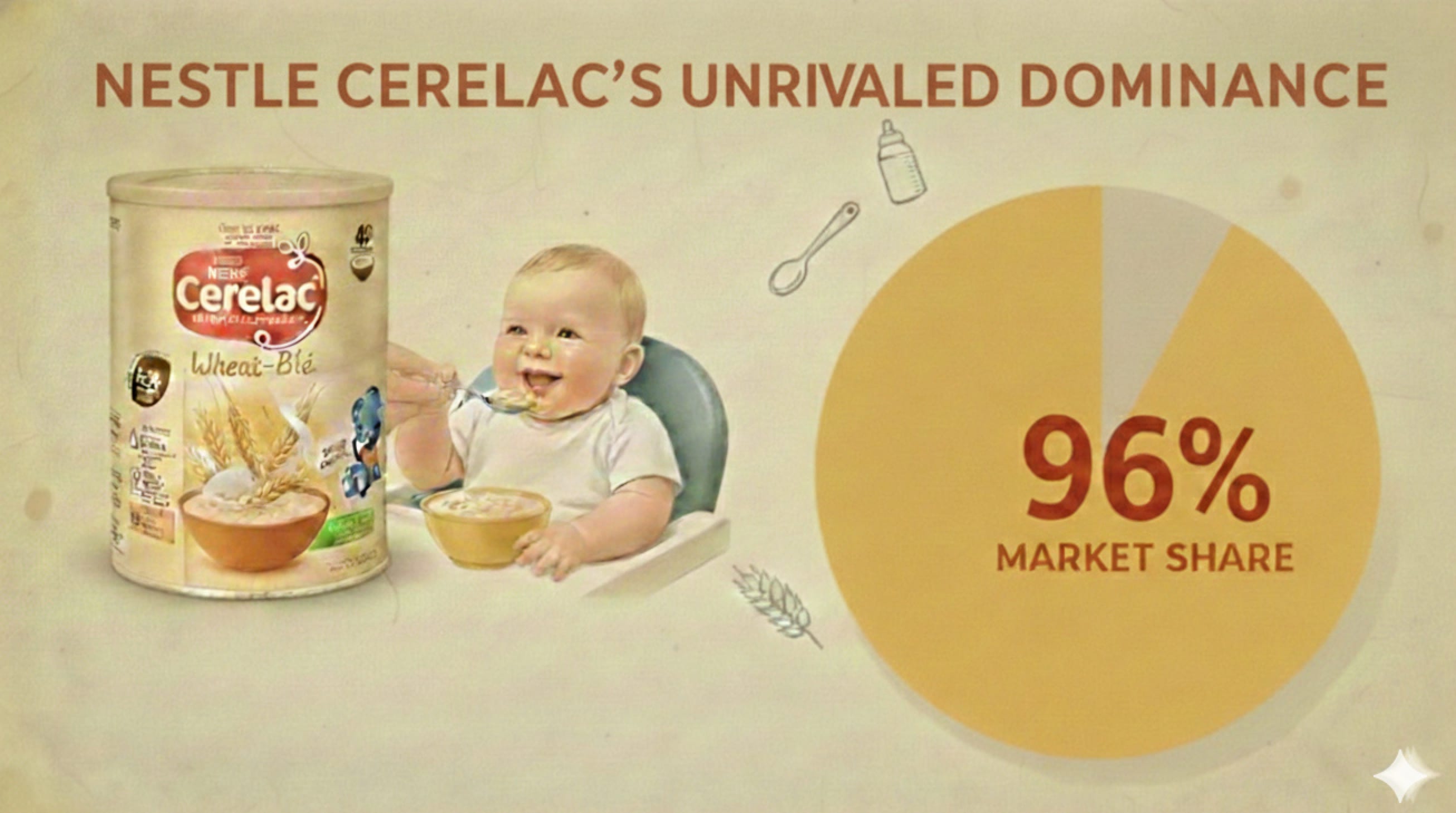
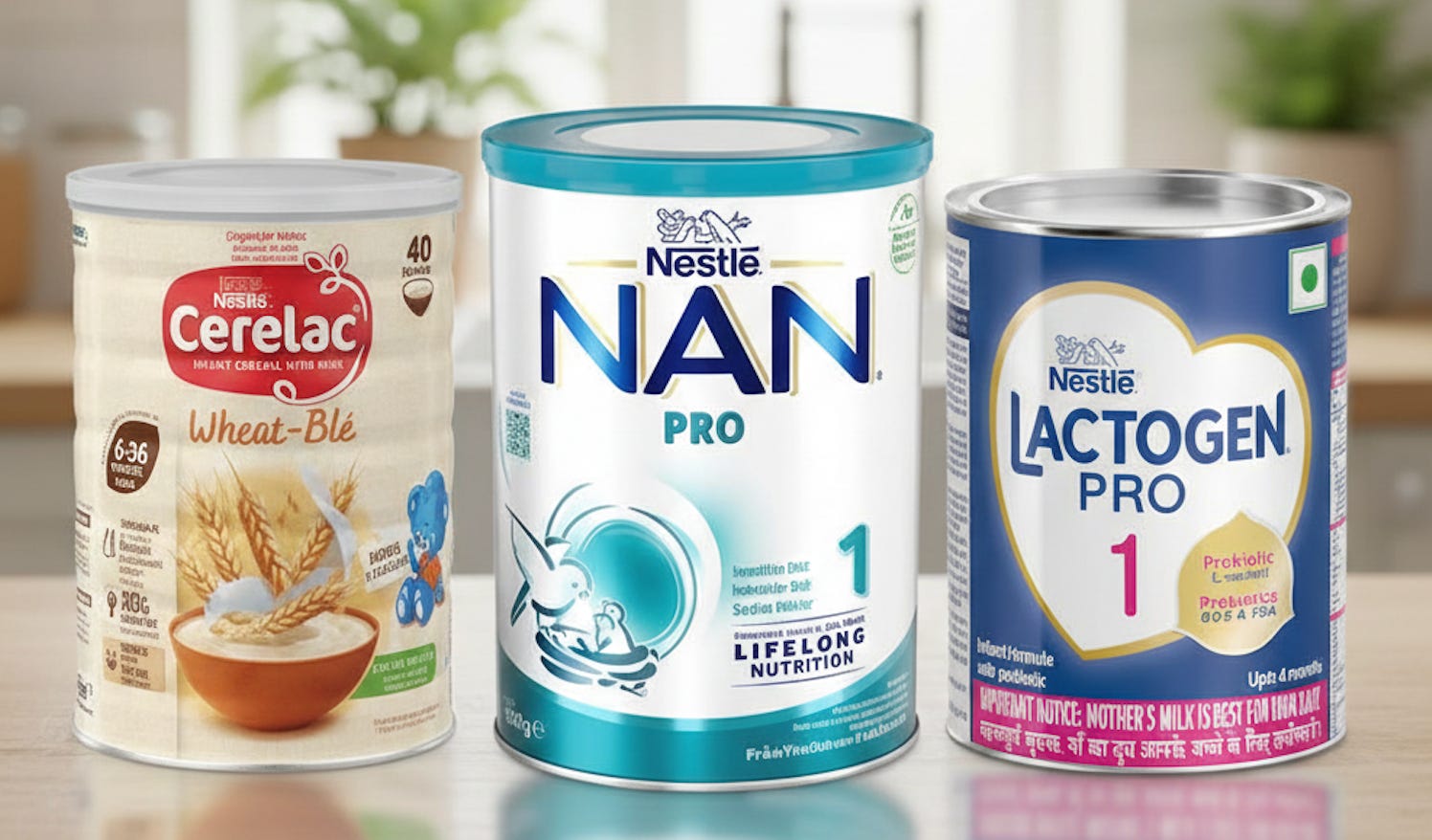
And yet, Nestle’s brands, like the infant cereal Cerelac and the formula NAN, continue to dominate. In India, Cerelac has a market monopoly of almost 96%.
How do you build a monopoly when you aren’t allowed to market what you sell?
Nestle’s arrival in India
Nestle’s story in India began long before independent India was born.
In 1912, the company arrived in India as the Nestle Anglo-Swiss Condensed Milk Company.
India then had no cold chains, unreliable milk quality, and only a small concept of branded dairy.
Nestle’s Milkmaid (condensed milk) was one of the players, along with other players like Glaxo (GSK) and Cow & Gate (now Danone), who filled this gap.
Soon, Nestle had established itself as a trusted name for science-backed dairy products.
So by the time India gained independence in 1947, Nestle was already a familiar presence.
In 1959, following the government’s push for domestic production, Nestle was invited to set up a factory in Moga, Punjab.
Nestle didn’t just set up a factory. It built a supply chain.
Their operations began with barely 500 kgs of milk collected from around 4,600 farmers. Today, the same ecosystem supplies over 1.3 million kgs daily from more than 1 lakh farmers.
Additionally, Nestle provided benefits at the farm level. It incentivised the farmers by providing veterinary care, improving cattle feed, and giving interest-free loans.
This provided a reliable stream of high-quality milk. For infant nutrition, where consistency and safety are non-negotiable, this mattered a lot.
The major domestic competitor Amul (founded in 1946), was structurally different. Unlike Nestle, it was new and had a cooperative model, which aimed to maximize farmer income and bring affordable butter and liquid milk into Indian kitchens. While it is a dominant player in dairy, it has not been a challenger to Nestle in the baby food market.
Nestle already had distribution, procurement, and manufacturing at its advantage, but for a segment like baby food, research builds trust.
The company had the capital and patience to invest early in R&D and position its products not as packaged food, but as ‘scientifically tested’ nutrition.
The Nestle Nutrition Institute, established in the 1980s, became central to this approach, providing a backbone, even as Nestle grappled with controversies over the years.
That early choice still shows up in the numbers.
Globally, nutrition and health science accounts for roughly 16% of the Nestle Group’s revenue, with market shares spread across geographies.
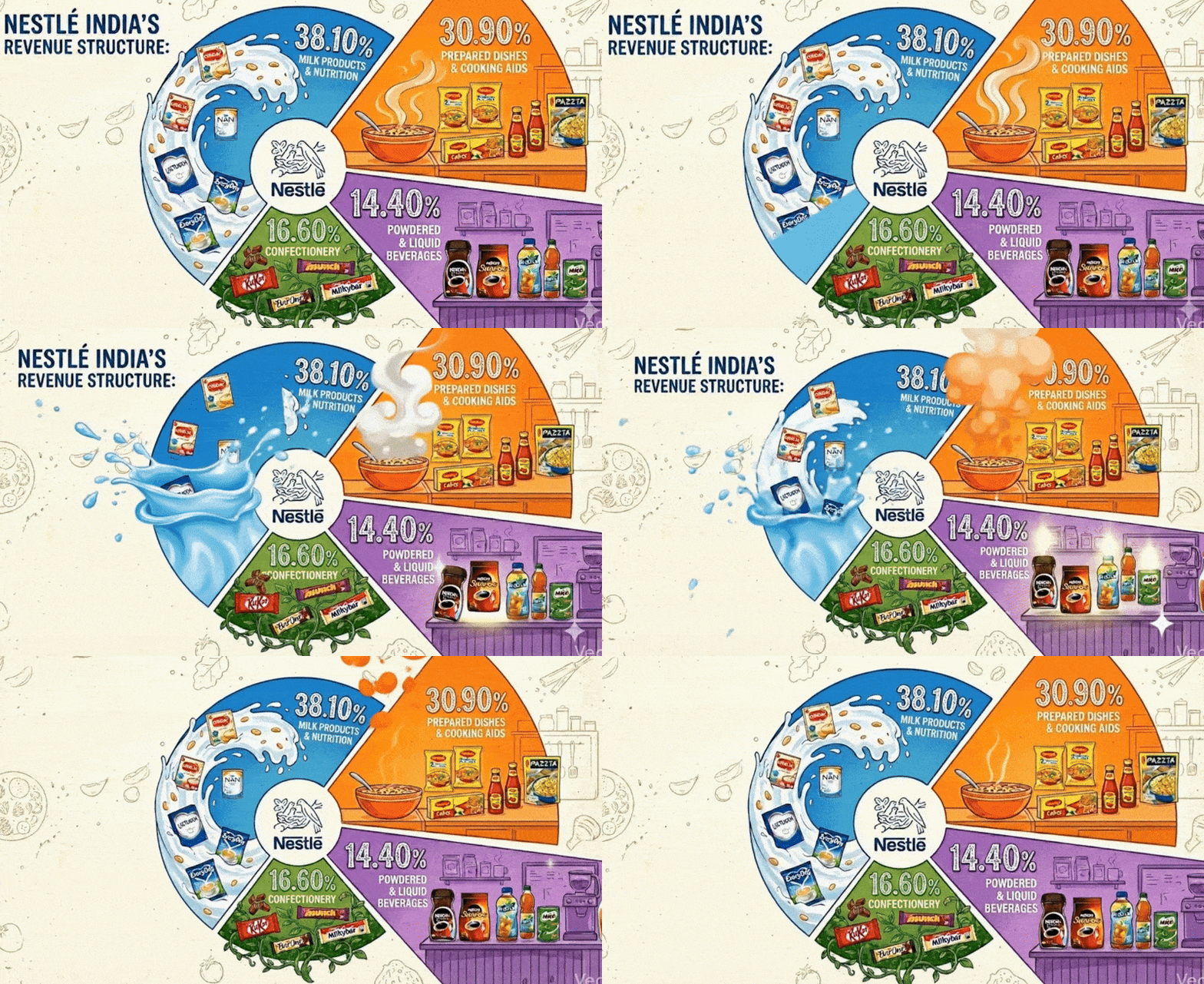
In India, concentration is far greater. The ‘Milk Products and Nutrition’ segment (which includes Cerelac, NAN, and Lactogen, along with other milk products), contributes close to Rs 8,000 crore annually, or nearly 38% of Nestle India’s revenue, with operating margins estimated between 21-23%.
In terms of market share, independent research suggests that even NAN and Lactogen, Nestle’s infant formula brands, hold more than 60% of the market in India.
The Moats that made the Brand
The Regulatory Shield (The IMS Act)
In 1992, India passed the Infant Milk Substitutes (IMS) Act, making the promotion of baby food for children under two illegal.
This wasn’t a random policy. By then, the global baby food industry (Nestle included), was under intense scrutiny. Since the 1970s, reports had accused companies of using scientific-sounding aggressive marketing to convince mothers that formula was superior to breast milk.
Something that could have serious health consequences.
In 1981, the World Health Organisation (WHO) issued the International Code of Marketing of Breast-milk Substitutes.
A strong social movement in India too, culminated in the IMS Act (and its 2003 amendment). This effectively banned:
TV and print advertising for infant food under 2 years.
Promotional campaigns in stores or pharmacies.
Free samples, discounts, or gifts to healthcare workers or hospitals.
The law’s intent was public health. Ironically, it became the biggest factor that cemented Nestle’s dominance in baby food in India.
Once advertising was banned, trust became an asset that was hard to challenge. Any brand that existed before the law retained visibility. Any brand that entered after it remained invisible.
Nestle had already spent nearly eight decades building recognition and credibility in India. After 1992, that became an unassailable advantage.
A new entrant could not outspend Nestle, out-market Nestle, or even introduce itself to new parents. The market stopped being competitive and became static.
The law designed to limit promotion became Nestle’s biggest advantage in the industry.
The Paediatrician Advantage
When advertising to parents was banned, influence shifted to the channel that was still open: medical professionals.
Under the IMS Act, companies are allowed to share ‘factual and scientific information’ with healthcare practitioners. They cannot give free samples, or sell subsidized baby food products to hospitals.
This turned the Nestle Nutrition Institute (NNI) into a powerful strategic asset. Rather than promoting products, the NNI positioned itself as a partner in pediatric science.
The NNI provides a channel for paediatricians with concise summaries of global research on infant nutrition. By sponsoring research and seminars, Nestle links its brand with trusted nutrition standards. Even doctors might have familiarity with the product since generations.
In India, this effect is powerful.
For a new parent, a paediatrician’s recommendation is rarely debated. It is followed.
Over time, this turned Nestle’s products into defaults rather than choices.
Once that happened, it became extremely difficult for a rival brand, especially one barred from advertising, to displace the current leader.
Competitors weren’t losing on quality. They were losing access to trust.
Regulatory Friction
But this approach hasn’t been without controversy. Groups like the Breastfeeding Promotion Network of India (BPNI) have monitored these interactions for decades.
Nestle has faced complaints alleging that ‘educational’ seminars or sponsored conferences were thinly veiled marketing.
Even so, the strategy works because it targets the real gatekeepers of trust, beyond parents.

The Sachet Strategy
All these moats considered, it is important to understand that India does not consume infant food like developed markets.
Over 60% of Indian households continue to rely on homemade baby food for infants. Around 25 million babies are born each year in India. This leaves the commercial market relatively small.
Nestle’s biggest competitor isn’t another brand. It is the traditional homemade recipes that dominate kitchens, tried and trusted by generations of mothers, especially in rural and semi-urban areas.
The company understood early that dominance wouldn’t come from large tins alone. It would come from small, daily decisions. Enter, the Rs 20 Rs 30 Cerelac sachet.
The sachets served two purposes at once. They made the product accessible without diluting brand perception. And they ensured physical presence in kirana stores across hundreds of thousands of towns and villages.
Even households that cannot afford a full pack could still buy the brand, one meal at a time, reinforcing habit, familiarity, and perceived safety.
Cracks in the Fortress
Even a 97% monopoly faces challenges.
In 2024, a report alleged that Nestle was adding sugar to Cerelac in developing markets like India while keeping it sugar-free in Europe.
Nestle responded by using its R&D muscle. By October 2024, they announced the launch of 14 ‘no refined sugar’ variants of Cerelac, a change they could implement within months because of their infrastructure.
Controversies have followed the company before: the Maggi episode, various product recalls, and in early 2026, a global recall of certain infant formula batches in over 60 countries due to a possible toxin contamination from a third-party supplier.
While Nestle India maintains its locally produced products are safe, such incidents are a reminder that even the most tightly controlled supply chains have vulnerabilities.
Still, scale and trust matter. Nestle is now too big to fail, with the resources, infrastructure, and regulatory know-how to navigate crises. For all its challenges, the fortress is remarkably resilient.
Nestle’s infant nutrition segment operates in a delicate regulatory and ethical environment.
For infants, exclusive breastfeeding is recommended for the first six months, and the IMS Act enforces marketing aspects of this strictly in India.
So the company must position its products as a reliable alternative without undermining breastfeeding.
At the same time, India is urbanizing. More mothers are entering the workforce, joint families are shrinking, and demand for convenient nutrition is rising.
This demographic shift might turn out to be a structural tailwind for Nestle.
The market may be concentrated now, but if and when the trend towards such products accelerates, Nestle is in a well-positioned spot.
Great case Study !!! SO much to learn about marketing and creating brand trust among the customers. Would like more studies like this.
Loved it 👏