

In 2020, a company from Nagpur did something no private business in India had ever done.
It won a contract to make hand grenades for the Indian Army.
This was the first time a private company in India had been entrusted with large-scale production of live battlefield ammunition.
For decades, weapons like these were made almost entirely by government-owned ordnance factories or imported from foreign suppliers, because strict rules and a tightly controlled defence system left very little space for private companies to make live ammunition.
Even when private companies were allowed into defence production, they were mostly restricted to safer, low-risk parts rather than live ammunition filled with explosives.
As a result, for a long time it was widely believed that a private company could not independently manufacture and supply large-scale ammunition to the Indian Army.
But that system was starting to change.
When the Ministry of Defence opened up ammunition manufacturing to private companies, only a handful of firms were actually in a position to take advantage of it. This was not like setting up a normal factory. Ammunition production needs deep experience with explosive materials, strict safety systems, large-scale chemical manufacturing, and the ability to meet very tight military quality standards every single time.
Solar Industries.
It won an order to manufacture ten lakh hand grenades worth Rs 409 crore.
This was the first time a private company in India had been given such a large contract for live ammunition.
After this, the business expanded quickly.
Within five years, the same company moved into advanced defence systems, entering a space where the Indian Army had largely relied on Israeli and other foreign loitering munitions. It built loitering munitions that were tested against old and established players from Israeli and Polish companies.
It also began exporting guided rockets to Armenia, marking one of the first times an Indian private explosives company entered the global precision-guided weapons market.
Here’s the strange part. The company we are talking about, Solar Industries, was not a defence company by origin. It had spent its first 25 years making something far less glamorous.
Explosives used to blast coal out of the ground.
Today, Solar Industries is India’s largest explosives manufacturer and holds around 24% of the industrial explosives market.
Its rise was not the result of one product or one large defence order.
Over several decades, the company built a strong foundation in the explosives space, which allowed it to move early and then quickly take up opportunities once the Indian government began opening up defence manufacturing to private players.
Today, Solar Industries is not only India’s largest explosives manufacturer. It has also become one of the country’s most important private defence companies.
So how did a mining-explosives maker from Nagpur build such a strong position across two difficult industries?
This article explores how Solar Industries built its competitive edge, why that advantage strengthened over time, and why competitors have struggled to recreate it.
The ‘ton-kilometre’ trap
An explosives company could not profitably survive more than 300 kilometres away from its centralised factory.
The problem began with the product itself.
Commercial explosives are dense and volatile chemicals. They are shipped in bulk to highly cost-conscious customers such as Coal India and other large mining contractors.
Coal India is the biggest buyer of commercial explosives in the country. It typically awards contracts through competitive tenders, where the lowest bidder has a strong chance of winning the order.
This gave Coal India considerable bargaining power.
Since suppliers were competing for the same large contracts, they could not simply increase prices whenever their costs went up. A higher price could mean losing the entire order to another manufacturer.
But the real problem was freight, which in India is priced on a tonne-kilometre basis.
This means the cost depends on two things: the weight of the material being transported and the distance the truck travels.
For an explosives manufacturer, the selling price per tonne may remain fixed once the contract is awarded. But the freight cost rises with every additional kilometre the delivery truck travels.
Take a simple example. Suppose a manufacturer sells one tonne of bulk explosives for Rs 50,000 and expects to earn a profit of Rs 5,000. If freight costs Rs 10 per tonne-kilometre, delivering the material to a mine 100 kilometres away costs Rs 1,000, leaving the supplier with Rs 4,000.
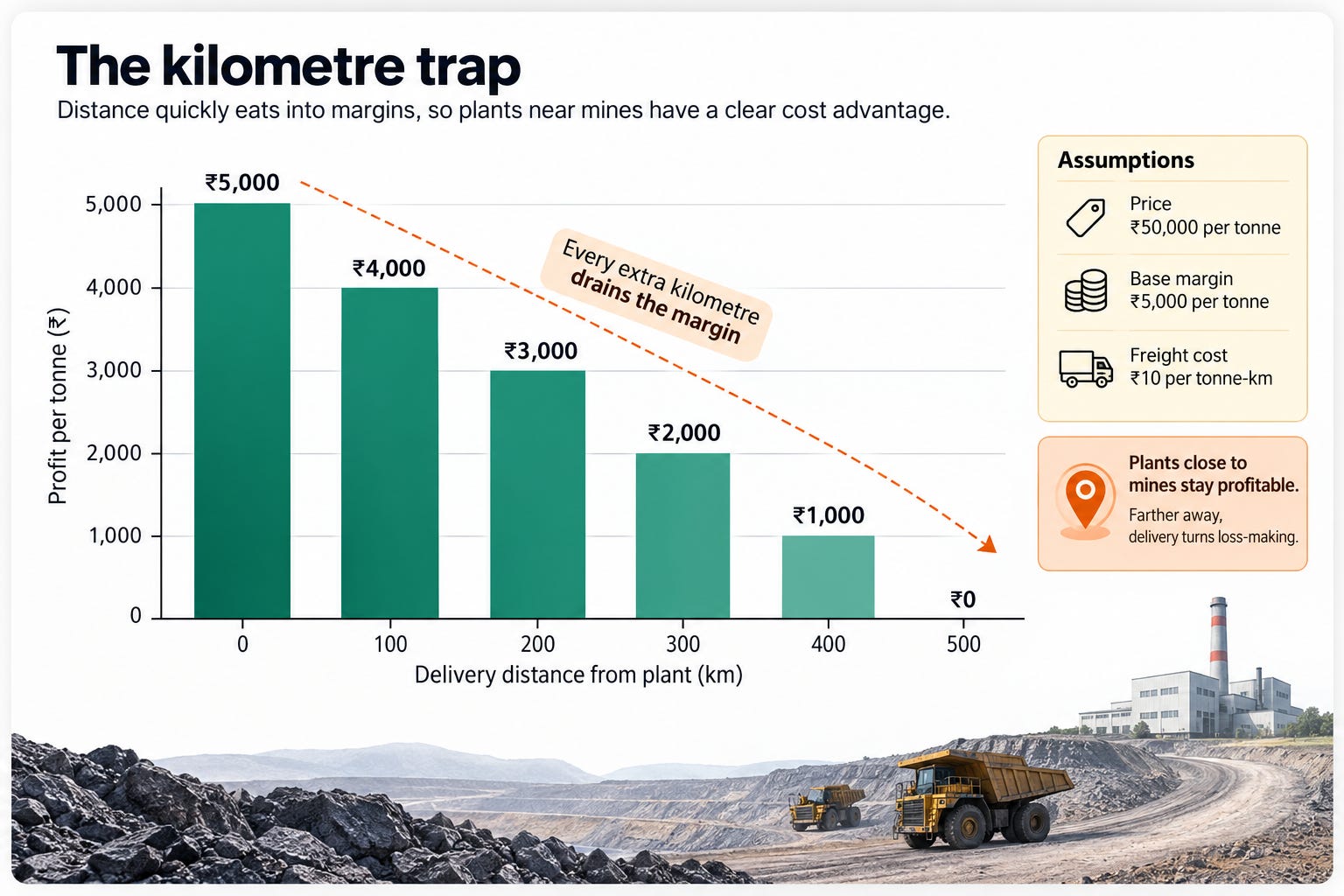
But if the same tonne had to be delivered to a mine 500 kilometres away, the freight bill would rise to Rs 5,000. The entire profit would disappear.
The product and selling price are the same. Only the distance changes.
Beyond a certain radius, the manufacturer does not merely earn a lower margin. It begins losing money on every delivery.
This kept India’s commercial explosives market fragmented and regional for decades. A company could serve mines located close to its factory, but supplying customers hundreds of kilometres away became increasingly uneconomical.
And freight was only one part of the problem.
Finished explosives are tightly regulated because they must be stored, handled and transported carefully.
Specially licensed vehicles may have to travel at controlled speeds, avoid densely populated areas and operate only during permitted hours. A journey that would normally take ten hours could stretch to two or three days.
The obvious solution was to build another factory closer to the customer.
But setting up an explosives plant was not like opening a normal manufacturing facility.
A new plant required an industrial licence, approval from the Petroleum and Explosives Safety Organisation, and no-objection certificates from police, district and local authorities.
Each new facility required capital, regulatory clearances, suitable land and a strong safety record.
So every manufacturer faced the same two barriers: distance damaged margins, while regulation made expansion slow and difficult.
Solar Industries found a way to turn both problems into an advantage.
First, the compliance layer
Satyanarayan Nuwal, the founder of Solar Industries, didn’t start out as a manufacturer. In the 1980s, he was a consignment trader and distributor, selling explosives made by established companies and running licensed storage facilities called explosive magazines.
These were tightly regulated storage facilities. The amount of explosives that could be kept was strictly limited, access was controlled, and every movement of material had to follow safety rules and government regulations.
Running these magazines gave Nuwal a clear understanding of how the industry worked. He saw how mining companies placed orders, how explosives were stored and transported, and how firms dealt with regulators.
Over time, this also built something important: a compliance record.
Solar Explosives was incorporated in 1995. A year later, it received its first manufacturing licence to produce 6,000 tonnes of slurry explosives in Nagpur. By then, Nuwal had already spent years operating within the system, so the company was not starting from zero in the eyes of regulators.
This mattered because every new explosives plant needed fresh approvals, and new companies had to prove again and again that they could safely make, store, and transport hazardous materials. Solar, however, already had a track record of running compliant operations that regulators could check.
Each safely run magazine added to its credibility, and every new manufacturing facility strengthened it further. Over time, this built a compounding advantage, where each successful operation made the next approval process a little easier.
Solar did not avoid regulations. It just got better at working within them than new companies entering the industry for the first time.
But knowing the rules was not enough to fix the freight problem. To solve that, Solar had to change where and how the business was set up.
Second, the proximity network
Knowing how to navigate regulation gave Solar Industries an advantage.
But it still had to solve the freight problem.
Solar did not try to solve this by building one enormous centralised factory. Instead, it restructured the entire system of production and delivery around the mines themselves.
The timing mattered because India’s coal industry was dominated by surface mining, which accounted for more than 90% of total output. To extract coal buried under layers of hard rock, mining companies needed both heavy excavators and large volumes of explosives.
And after India’s economic liberalisation in 1991, the economy began expanding rapidly. New factories were built, villages were electrified, and industrial activity accelerated across the country. All of this required one thing above everything else: electricity.
In India, that meant coal, which still accounts for about 70% of power generation.
As demand for electricity surged, coal production had to rise just as quickly. Coal India, which supplied most of the country’s coal, came under constant pressure to increase output to keep pace with the economy’s growth.
But higher output was not just a mining problem. It was also a logistics problem.
Traditional packaged explosives were poorly suited to this scale of demand.
They were transported as finished explosives, often in wooden crates. Moving them over long distances created serious logistical and safety bottlenecks. The material required careful handling, licensed vehicles, and strict regulatory compliance throughout the journey.
Solar Industries started using Bulk Delivery Vehicles, or BDVs.
A BDV carried the main ingredients separately, including the emulsion matrix and gassing agent. They were mixed only at the mining site.
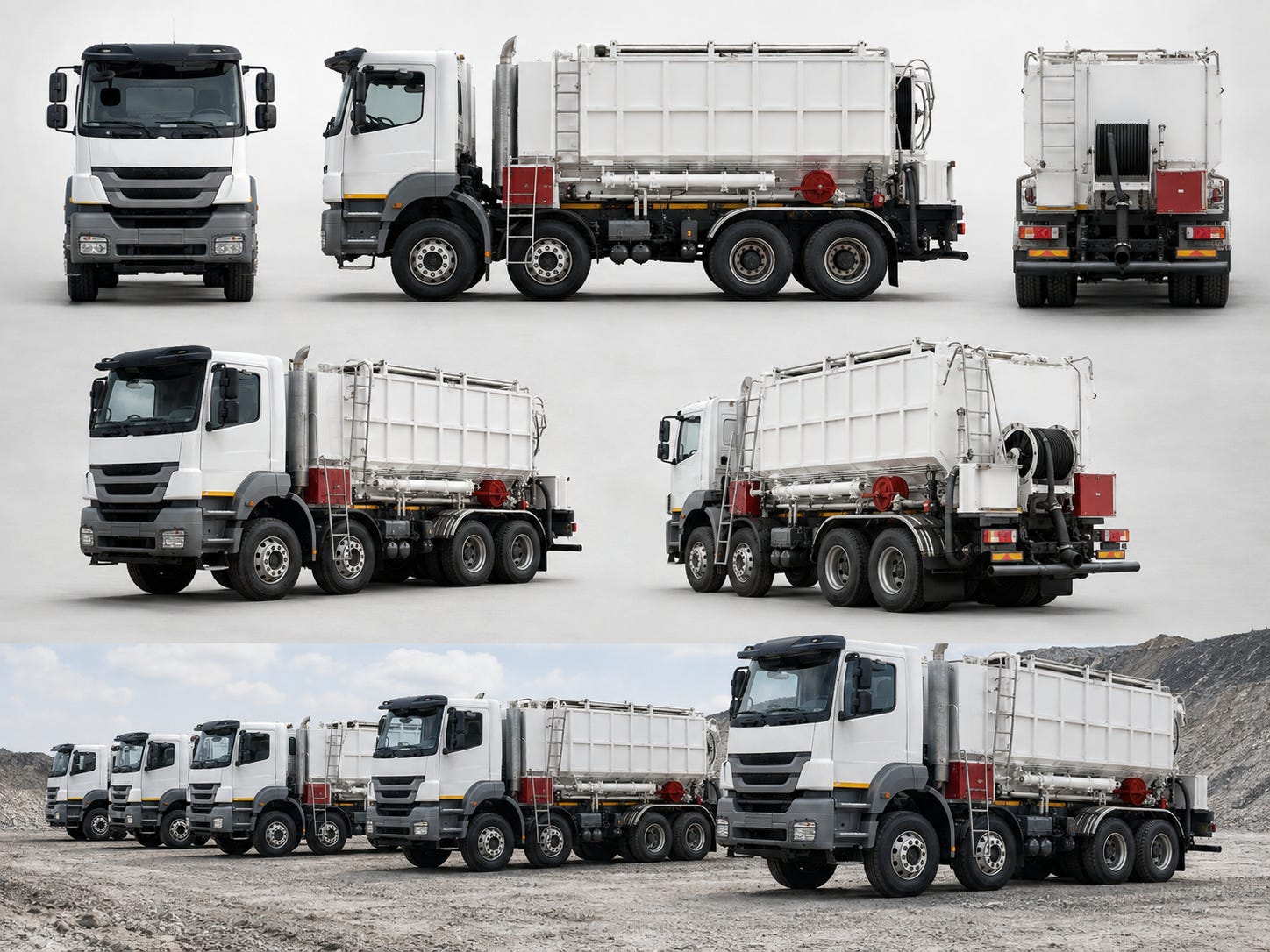
This made blasting simpler, faster, and cheaper to carry out.
The BDV also reduced the need to move, unload and manually place large quantities of finished explosives.
But the vehicles alone were not enough.
The real shift in Solar Industries’ strategy came when it stopped thinking of factories as fixed assets in one place.
It began treating factories as part of the mining ecosystem itself.
Instead of producing everything in Nagpur and transporting it across the country, Solar started building smaller plants close to major coal and mining belts.
Each plant was placed near a large customer with regular demand.
The Jharsuguda plant served Mahanadi Coalfields. Ramgarh supplied Central Coalfields, while Korba catered to South Eastern Coalfields. Waidhan served Northern Coalfields, and Chandrapur supported Western Coalfields.
Solar was not expanding randomly. It was placing production exactly where the explosives would be used.
This changed the economics of the business.
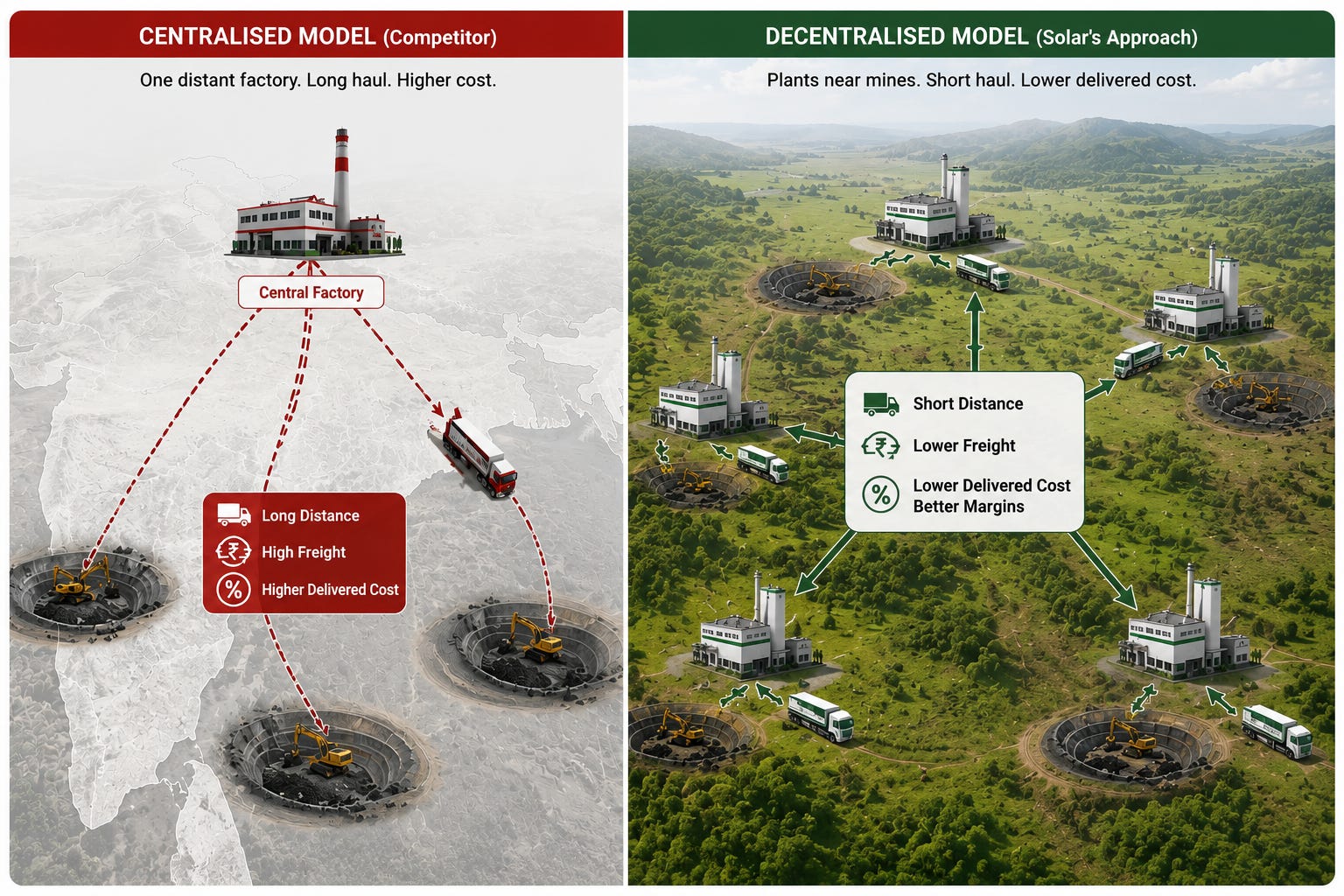
The logic was simple.
A competitor supplying from a distant centralised factory still had to pay high freight costs over long distances.
Solar removed most of that disadvantage even before the bidding started.
By making explosives closer to the customer and using BDVs for final delivery, it could offer a lower delivered price while keeping its own margins intact.
For Coal India, the benefits were practical. Explosives were available closer to the mine, deliveries were faster, handling was easier, and the mix could be adjusted based on local rock conditions. Overall costs went down.
For Solar, every new plant meant it could serve more mines profitably.
Large Coal India contracts also gave steady, predictable volumes. That stable demand helped keep plants running efficiently, supported more BDVs, and made it easier to expand further.
Over time, this model became hard for others to compete with.
A company making explosives from far away could not match Solar’s prices once transport costs were added.
But even setting up a new plant near the same mining area was not a good option, because the demand would then be shared, making both plants less efficient.
Solar had already reached the customer first and set up its capacity right next to the mines. This made it harder for new players to enter profitably.
As a result, companies that still depended on large, central factories were at a disadvantage. Whatever they saved in production efficiency was often lost in freight costs.
Solar was not just optimising production.
It was redesigning the entire delivery network.
Over time, the company built 34 decentralised manufacturing facilities across India, many positioned close to coalfields, mines and infrastructure projects.
It also reduced its dependence on outside suppliers.
In 1998, Nuwal set up Economic Explosives Ltd to make detonators and other ignition systems. This gave Solar control over another key part of the explosives process.
Now Solar could make the main explosive, produce the ignition components, and deliver the final mix directly into the mine. In simple terms, it controlled almost the entire chain from production to use.
A competitor could copy the chemical formula or buy similar machines. It could even use its own delivery vehicles. But copying Solar’s full system was much harder.
It needed many approved plants near mining areas, multiple licences, special BDV fleets, reliable access to ignition systems, strong customer relationships, and most importantly, years of experience to run everything safely and consistently at scale.
Each new plant increased Solar’s reach. Each big contract improved how well the network was used. Each safely run facility strengthened its record with regulators. And each step made the next expansion easier and cheaper.
Over time, this created a compounding effect. Solar built more than 400,000 tonnes of annual capacity across explosives, emulsions, and initiation systems, becoming India’s largest industrial explosives company with about 24% market share.
Its strong position in India also helped it expand globally. Today, it supplies customers in over 75 countries and has manufacturing units in places like South Africa, Turkey, and Zambia.
But the most important result of this network was not size or geography.
It was the steady, predictable cash the business generated.
The self-funding flywheel
Solar’s proximity to mines helped it win more than just market shareIt helped it make steady money.
Coal India usually gives contracts for about two years and then asks companies to bid again. Solar also had to compete every time, but it was already in a stronger position than others.
Its factories were already close to the mines. Its trucks were already working there. It had long relationships with customers because it supplied them regularly.
A company far away could offer a cheaper price at the factory, but after adding transport cost, it often became more expensive.
So Solar kept winning contracts.
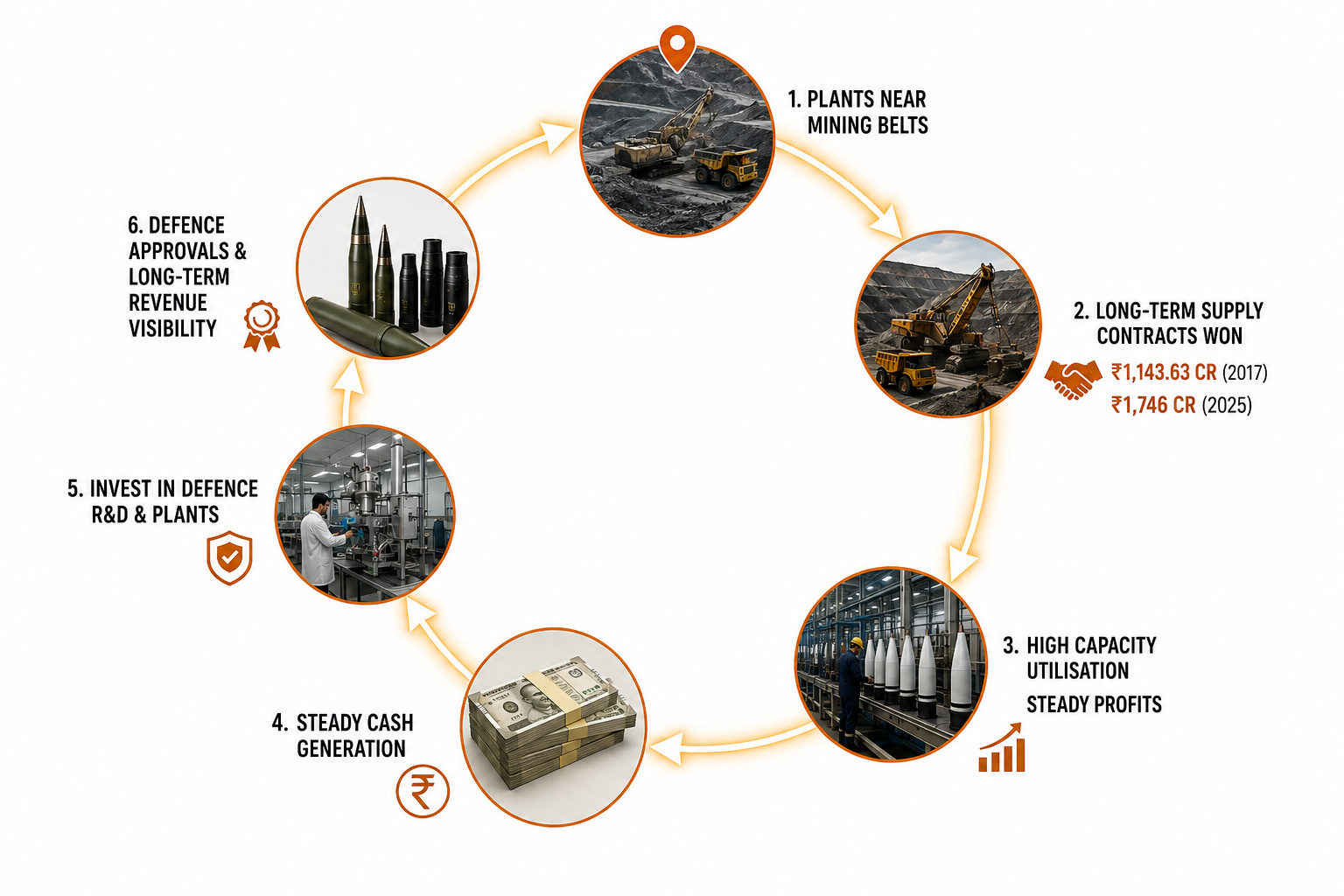
In 2017, it got a Coal India contract worth Rs 1,143.63 crore. In 2025, it again won a contract worth Rs 1,746 crore to supply bulk explosives to Coal India and its companies.
These contracts gave Solar a steady and reliable stream of business.
Explosives factories make good money only when they are running at full capacity. Because Coal India kept placing regular orders, Solar’s plants stayed busy and earned stable profits every year.
In 2010, Solar began using the steady cash generated by its commercial explosives business to enter defence.
At first, the move looked large. Mining explosives break rocks, while defence explosives go into ammunition, rocket motors and warheads.
But the underlying capabilities were similar.
Solar already had decades of experience handling volatile chemicals, operating high-risk plants, following strict safety rules and manufacturing explosives at scale. Defence was a more demanding extension of skills it had already built.
The company also had an important financial advantage.
Its mining business generated enough cash to fund specialised defence plants, technical teams and product development internally, without depending heavily on debt or external investors.
This mattered because defence products can take years to earn their first rupee.
Military explosives, propellants and ammunition must pass long rounds of testing under heat, cold, vibration, storage and battlefield-like conditions. During this period, the manufacturer keeps spending on facilities, technical teams and trial production, with no guarantee that the product will be approved.
Many smaller companies may have the technology but cannot survive years without revenue.
Solar could. Its commercial business supported the defence division through this waiting period.
Once a product is approved, however, the economics change. A qualified supplier can remain part of a weapon system for 20–30 years because replacing it requires fresh testing and may force the system to be qualified again.
This makes defence orders far more stable than mining contracts, which are rebid every few years.
Solar was also well placed when India began opening ammunition manufacturing to private companies. It already had explosives experience, factories, regulatory approvals, safety systems and the cash needed to survive long development cycles.
When the market opened, Solar did not have to build these capabilities from scratch.
It was already ready.
The orders that changed the business
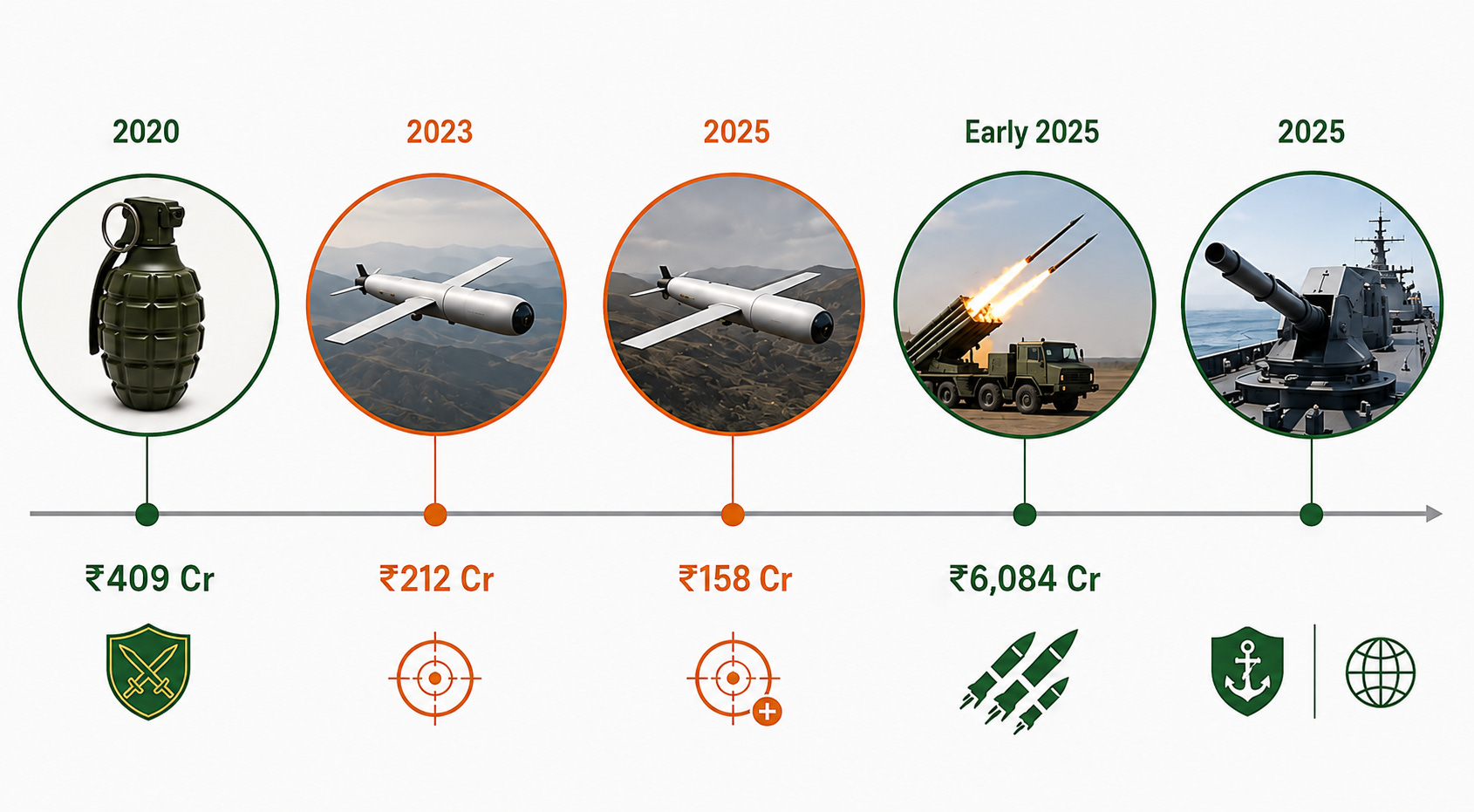
The first major breakthrough came in 2020, when Economic Explosives received a Rs 409 crore order to manufacture ten lakh multi-mode hand grenades for the Indian Army.
The order showed that a private company could manufacture live ammunition at scale while meeting military safety and quality standards.
It also changed how Solar was seen. It was no longer only a mining explosives company.
In 2023, Solar received a Rs 212 crore order for Nagastra-1, an indigenous loitering munition that competed against established Israeli and Polish systems.
In 2025, the Army placed another order worth around Rs 158 crore for upgraded Nagastra-1R units. This showed that the first order was not a one-time success.
Then came the largest order in Solar’s history.
In early 2025, it received a Rs 6,084 crore contract to manufacture rockets for the Pinaka multi-barrel rocket launcher, with deliveries spread over several years.
Solar also became the first private company to supply fully indigenous 30mm ammunition to the Indian Navy and began exporting guided Pinaka rockets to Armenia.
Economic Explosives was later renamed Solar Defence and Aerospace.
Between FY21 and FY25, defence revenue grew at around 68% annually. Its share of Solar’s total revenue increased from about 6% to around 17%, while the defence order book crossed Rs 13,000 crore.
Mining had provided the cash to enter defence. Defence was now providing long-term revenue visibility.
At the same time, Solar began strengthening its mining business.
Instead of only selling explosives, it started offering integrated blasting services through Solar Mining Services. It handled on-site mixing, blast design and execution, and expanded further by acquiring South African drilling-and-blasting company Problast in 2024.
It also promoted electronic and digital detonators, bringing more of the blasting operation onto its own system.
This changed the customer relationship.
When Solar only supplied explosives, a rival could replace it by offering a lower price. But when Solar managed the blasting process itself, switching suppliers could disrupt the mine’s operations.
Solar was turning a product sale into an embedded service.
Why the full system is difficult to copy
Other companies had parts of Solar’s capabilities.
IDL Explosives had early experience in detonators but did not expand at the same scale. It was sold to Apollo Defence in 2025 for Rs 107 crore—less than 2% of Solar’s Pinaka order.
Premier Explosives developed real capabilities in propellants and defence products but lacked a large commercial explosives business that could fund years of development without revenue.
Most competitors had one or two pieces.
Solar had the complete system: commercial cash flows, manufacturing plants, regulatory experience, safety approvals, customer proximity and qualified defence products.
These advantages strengthened one another.
Cash from mining funded defence development. Regulatory experience supported new approvals. Manufacturing scale improved execution. Defence qualifications created long-term contracts.
A competitor could copy a product, buy similar equipment or build a factory.
But it would still need years to create the cash flows, approvals, safety record, customer relationships and testing history that hold the system together.
The advantage is not risk-free.
Solar’s mining business remains dependent on coal demand. A long-term slowdown in coal production could reduce volumes and weaken the cash engine supporting its expansion.
The government is also encouraging other defence suppliers, including Munitions India, Adani Defence and Bharat Forge, to avoid depending on one company.
Solar also deals with powerful customers. Coal India can pressure commercial explosives prices, while the government has similar bargaining power in defence.
Safety and execution remain permanent risks. One serious accident could disrupt production and damage the company’s regulatory record. Large defence contracts also require years of timely delivery at consistent military quality.
Still, Solar’s position is not defined by a single product or contract.
It is defined by how different parts of the business interact.
Commercial explosives generate cash. That cash supports defence development. Defence approvals create long-term contracts. Manufacturing infrastructure supports both segments.
Each layer reinforces the others.
A competitor may be able to copy a product or set up a plant, but copying the full system is much harder. It requires building cash flows, regulatory approvals, a manufacturing network, and long-term customer relationships over many years.
The products have changed over time, but the system behind them has stayed the same.
And that system is the real moat.
Very detailed analysis . extremely informative . Thanks a ton . Keep them coming !!
Proud to be readers, Indian defence exporting