

The USA wasn’t always as big as it is today.
There was Louisiana, which bordered the USA on the west.
People familiar with the map of the USA would know that today, Louisiana is actually a small state in the US.
But that’s not what we’re talking about here. We’re talking of a much larger region called Louisiana.
This Louisiana was controlled by the Spanish people.
In 1800, Spain and France signed a treaty that allowed France to take Louisiana from Spain.
Thomas Jefferson became the President of the USA in 1801.
Jefferson was famous for his strict adherence to the constitution. His philosophy was that the USA was a federal republic.
This means that the individual states created the central government or the federal government. He believed in the absolute power of the constitution.
Jefferson was known for having been extremely vocal in trying to prevent the federal government from taking action in cases that were not defined by the constitution.
Before he became president, Jefferson was famous for vehemently defending free speech by rallying against a bill being brought in by the federal government.
His argument was that the federal government’s jurisdiction did not involve controlling free speech in any manner whatsoever. So it could not ban it in any manner.
Louisiana
The east side was the US. Then there was Louisiana. And then, there was the rest of the wild west — where America wanted to expand to. This area was controlled by the British, Spanish, and other native folk.
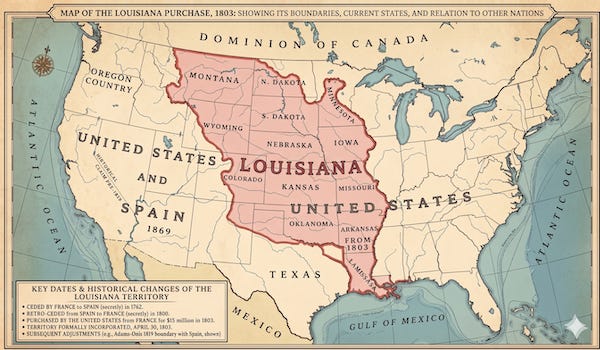
But that was not the only complexity. The river Mississippi formed the eastern border of Louisiana. And the USA depended on it heavily for trade and transportation.
The USA had signed a treaty with Spain for using the river.
For the USA, the Spanish were predictable. The treaty they had signed was enough for them to feel relaxed.
But with the territory going back to France, tensions rose.
Napoleon’s ambitions of territorial expansion had the Americans worried.
If the French were present in Louisiana, they could limit or prohibit them from accessing the Mississippi river.
Not just access to the river, Jefferson was worried about military threats from Europe.
Jefferson’s Idea
Jefferson had a simple idea.
He sent his trusted envoys to France to talk to Napoleon. They were authorised to spend a sum of $10 million (a lot lot more in today’s value).
And they were given a task that seemed monumentally difficult: try to buy parts of Louisiana to ensure access to the river.
They arrived in France and pitched the idea to the French.
Napoleon, the then ruler of France, had imperialist ambitions. He wanted to expand French territory in Europe and the Americas.
But the plans weren’t going as per his wishes. A revolution in Haiti spoiled his plans, and there were risks of wars starting on multiple fronts even in Europe.
He was running short on money and would need more to continue fighting.
When the Americans approached the French with an offer to buy parts of Louisiana, the French had a counteroffer that was hard to believe.
The French were offering to sell the entire Louisiana territory. All of it.
The two countries negotiated for a period, eventually agreeing to $15 million.
The deal was on.
The news was made public on the 4th of July, 1803.
The Challenge
Upon its announcement, the idea was more or less well received.
But for Jefferson, there was a small problem. A problem that he was more likely to be targeted for than others.
The constitution had no provision for the President of the USA to buy land.
The opposition was ready to target him for being a hypocrite.
Jefferson, being the strict follower of rules that he was, called for an amendment of the constitution to allow the president to buy land and incorporate it into the territory of the USA..
They wanted to finish with it before Napoleon changed his mind.
They were running out of time and would need to convince the opposition to allow for expanding the federal government’s powers.
This was peculiar because it was Jefferson’s side that was most famous for wanting to limit the federal government’s powers.
On Oct 20, 1803, the Senate voted and ratified the treaty.
And thus, Louisiana became a part of the USA — all 830,000 square miles of it!
The USA’s size doubled (that’s how much territory it bought).
Jefferson
This episode is a great example of how many times we first decide what we want to do, and then justify doing so later.
Jefferson knew the deal was too good to miss. He realised that the opportunity was massive and would solve many problems for the USA.
He decided to find ways to justify going beyond his constitutional power later. First, he wanted to ensure he got the territory.
And it worked.
After the treaty was signed, some senators still believed the move was unconstitutional. But it was never challenged in court.
Investing
If there’s one lesson for investors in this tale, it’s this: do not be so rigid with criteria that you miss good opportunities.
Warren Buffett was a strict believer in value investing. That is, buying stocks that were trading below their intrinsic value.
But over time, he changed his methods as the best of his investments happened to be great companies — even if not undervalued.
Charlie Munger bent the rules for Costco. Despite being considered overvalued by many, he never sold the shares.
Had he sold, the shares would have been sold at a much lower valuation.
Quick Takes
+ India’s manufacturing PMI rose to 55 in May (vs 54.3 in April). This means manufacturing activity grew more in May than in April.
+ India’s industrial output rose 4.9% year-on-year in April (vs 4.1% in March).
+ The government reduced export duties on petroleum products, effective 1 June to ensure domestic availability. The Special Additional Excise Duty is revised to Rs 1.5 per litre on petrol, Rs 13.5 per litre on diesel, and Rs 9.5 per litre on aviation turbine fuel (ATF). Domestic duties will remain the same.
+ India’s fiscal deficit for FY25-26 stood at 4.4% of the GDP, in line with government estimates.
+ Commercial LPG prices have been raised by around Rs 42 to Rs 53.50 per cylinder. This is the 4th hike in a month.
+ SEBI passed an interim order against Rajesh Exports, a gold refining and jewelry export company, over alleged misrepresentation of Rs 15.15 lakh crore in the revenue. This accounts for nearly 99.8% of the company’s consolidated revenue over 5 years. The company’s chairman has denied the findings.
+ India’s composite PMI rose to 59.3 in May (vs 58.2 in April). Services PMI rose to 59.8 (vs 58.8 in April). This means economic activity grew more in May than in April.
+ The government approved a one time Rs 10,000 crore Price Stabilization Fund to provide interest-free loans to Oil Marketing Companies. The aim is to stabilize jet fuel (ATF) prices to shield Indian airlines from West Asia crisis shocks and prevent extreme fare hikes.
+ The RBI dismissed rumors that it sold gold worth $12 billion to defend the Rupee, clarifying that its physical gold reserves remain entirely steady at 880.52 tonnes.
+ The US proposed tariffs up to 12.5% on goods from India and around 60 other countries, claiming these countries failed to block products made with forced labor from entering their markets. The India-US bilateral trade talks are currently underway.
+ Oyo’s parent company Prism received SEBI’s approval for a Rs 6,650 crore IPO.
The information contained in this Groww Digest is purely for knowledge. This Groww Digest does not contain any recommendations or advice.
Team Groww Digest
Very Good