

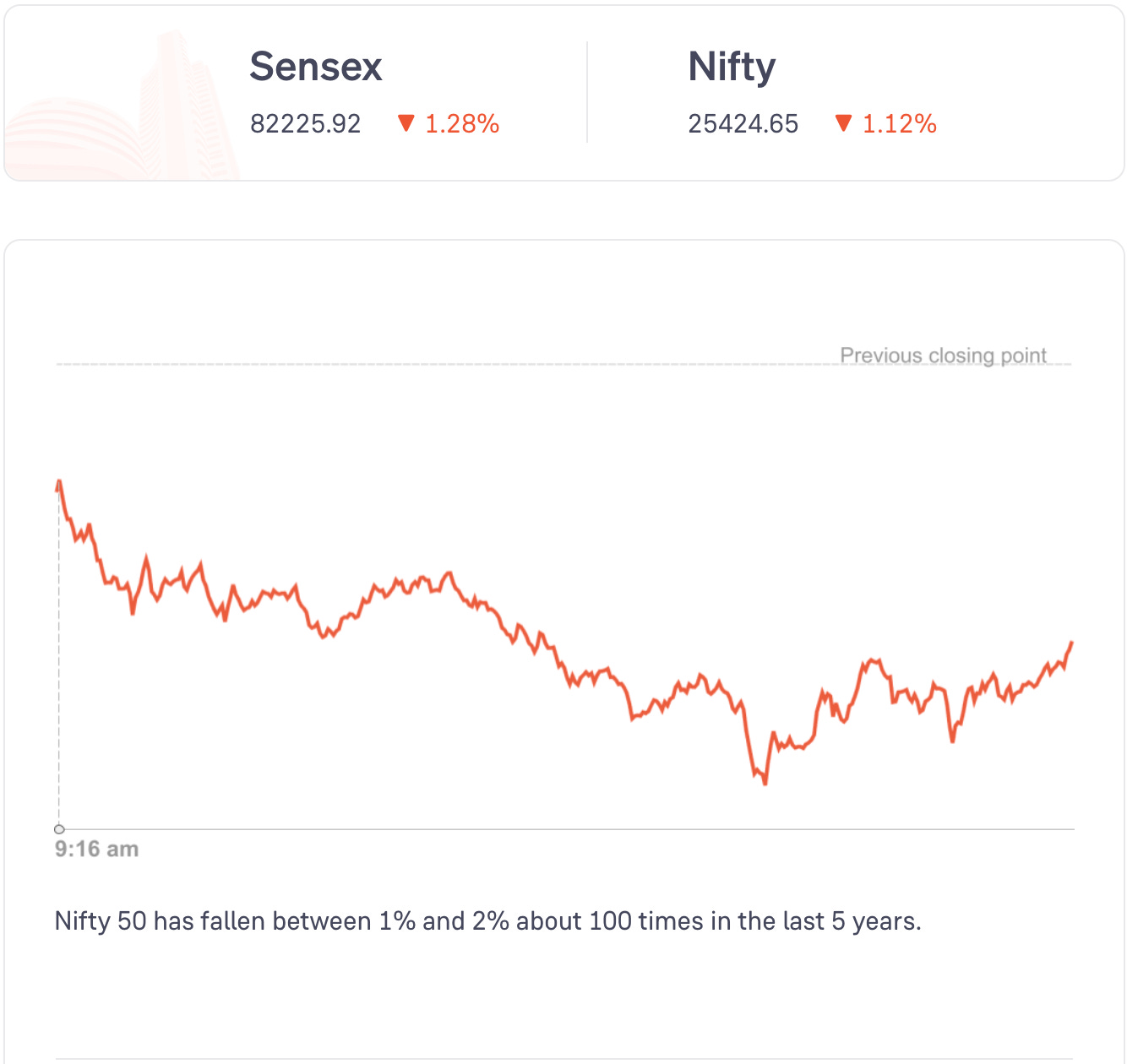
Markets opened below yesterday’s closing point.
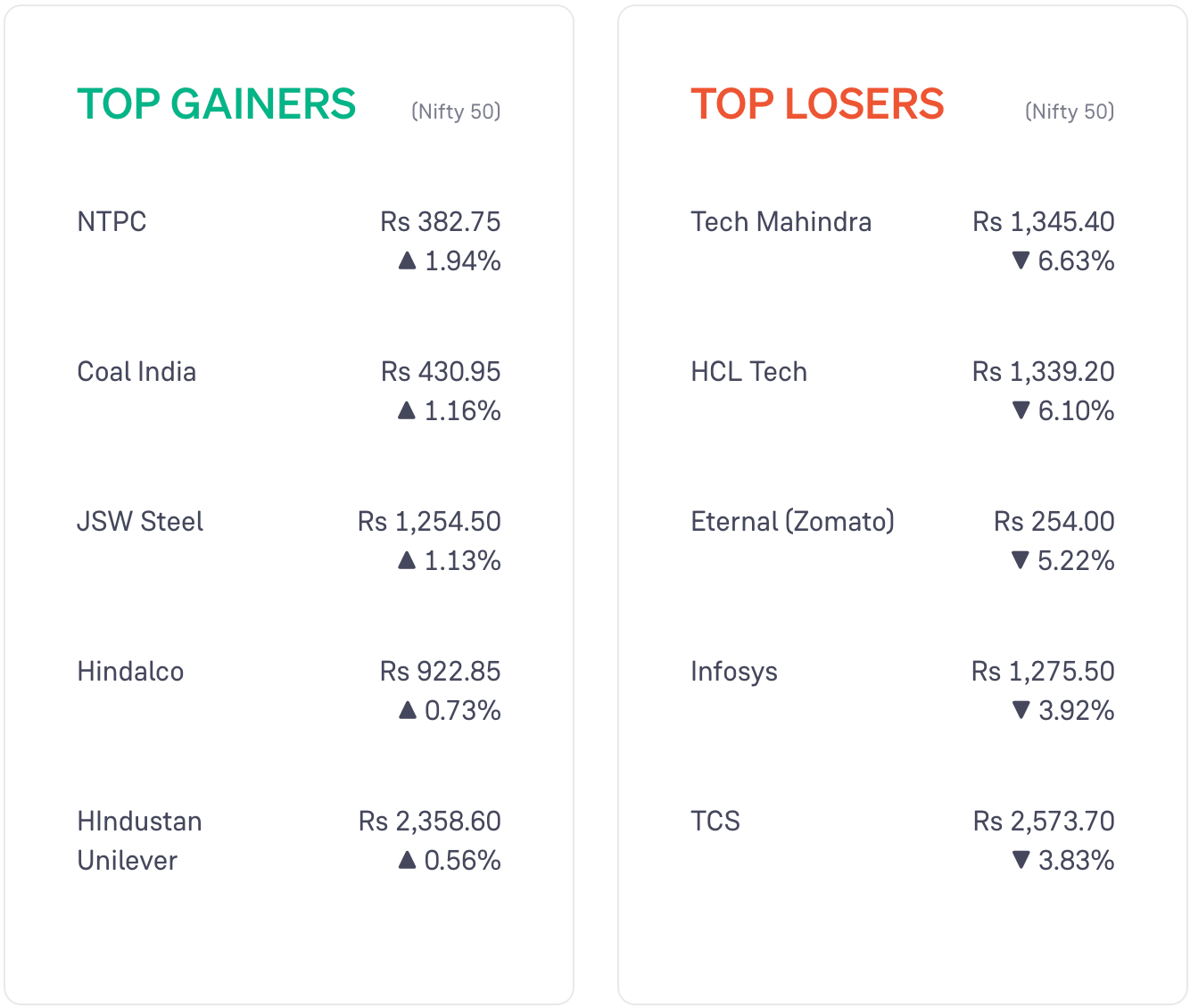
Metal stocks and oil and gas stocks rose the most today. IT stocks and realty stocks fell the most.
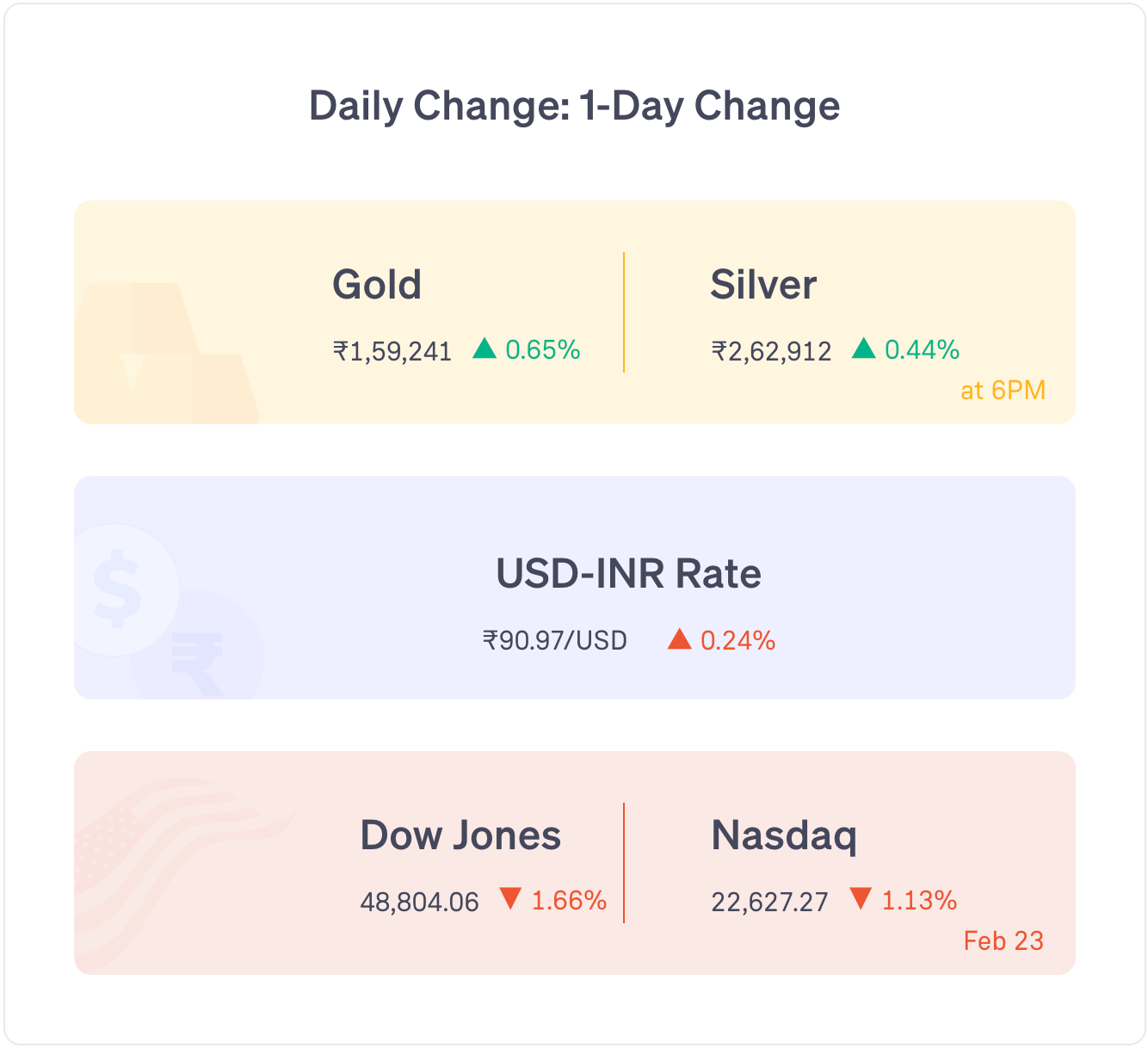
Global markets: US markets fell. Most Asian markets rose. Most European markets were flat (as of 6 pm IST).
News
The central government approved 3 railway projects across Maharashtra, Madhya Pradesh, Bihar, and Jharkhand at a total cost of Rs 9,072 crore.
India and the Gulf Cooperation Council (GCC) signed a Joint Statement to formally launch negotiations for a Free Trade Agreement (FTA).
The central government approved increasing the equity investment limit for Power Grid subsidiaries from Rs 5,000 crore to Rs 7,500 crore to allow it to take on larger projects.
Clean Max Enviro Energy IPO has been subscribed 0.45 times. Retail subscription: 0.04 times. IPO closes tomorrow (25 Feb).
Stocks Updates
Waaree Energies: received a domestic order to supply 500 MW of solar modules from an independent solar power developer.
L&T: won a significant order (Rs 1,000 crore to Rs 2,500 crore) from the Department of Atomic Energy to build the LIGO India Observatory at Aundha, Maharashtra. The observatory will be used for detection of gravitational waves.
Shree Cement: commissioned a 3.65 MTPA clinkerisation unit at its Kodla, Karnataka plant.
Adani Power: company subsidiary, Moxie Power Generation Ltd, received a power supply order of 558 MW of power for 5 years from Tamil Nadu Power Distribution Corp.
Cholamandalam Investment: allotted Rs 1,000 crore of non-convertible debentures on private placement at 8.66% interest rate for 7 years.
Word of the Day
Fractional Share
It means a part of a share of a company.
Instead of buying one full share, investors can buy a fraction of it, based on the amount they want to invest.
Example: if a stock costs Rs 5,000 and an investor invests Rs 1,000, they own 0.2 of a share.
Investors can also get fractional shares in situations like dividend reinvestments, or corporate actions such as stock splits and mergers.
Currently, fractional shares are not allowed in Indian markets, but investors can buy them in foreign markets (like the US).
So in situations like above, companies compensate investors with cash for these fractions.
6 Day Course
Theme: SIF
Day 2: Tuesday
The key difference lies in what SIFs can do with the investors’ money that mutual funds cannot.
One of the biggest differences between them is that of using derivative products.
Mutual funds can invest in shares. But they cannot short stocks or use derivative products like futures and options.
So let’s say there’s a stock that is believed to be overvalued. A mutual fund can only do a few things.
If they already have that stock in their portfolio, they may sell it or reduce their holdings in that stock.
But SIFs can actively short it. This way, they may be able to make money by betting against that stock.
Likewise, they can also make use of other derivative products like futures and options.
These can allow the fund manager to take advantage of shorter-term opportunities.
Featured Question
Q. “Can daily SIP can generate better long term (> 3 years) returns than monthly SIP for investment in stocks, ETF and MF?”
If you search online, you will find a few articles addressing this question.
Most of these articles find that a monthly SIP offers a good amount of reduction in risk.
But going from a monthly SIP to a daily SIP does not change the risk level or the returns much.
The difference is often negligible and goes unnoticed.
So practically speaking, a monthly SIP frequency is good enough. A daily SIP is overdoing it without much benefits.
Did you like this edition?
Leave a feedback here!